
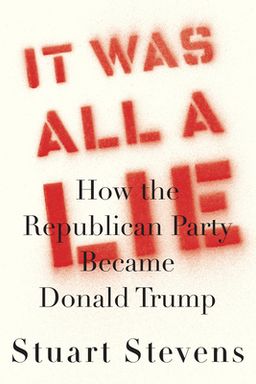
It Was All a Lie cover

It Was All a Lie

by Stuart Stevens

Stuart Stevens, a former Republican political consultant, delivers a scathing critique of the GOP''s transformation under Trump. Unveiling decades of deception and racism, Stevens argues that the party''s embrace of Trump marks a betrayal of its values, offering a stark warning about the future of American politics.

The Republican Party’s Moral Collapse

How does a political party lose its soul? In It Was All a Lie, veteran GOP strategist Stuart Stevens asks that haunting question of the Republican Party—and of himself. After decades building campaigns for figures like George W. Bush, Mitt Romney, and others, Stevens looks back and concludes a stark truth: the principles that Republicans once cherished—fiscal discipline, character, patriotism, small government, personal responsibility—were never truly believed. They were tools used for power, marketing slogans that dressed ambition and resentment in moral language. Everything he worked for, he admits, was built on deception.

Stevens argues that Donald Trump is not an aberration or a fluke; he is the logical culmination of the Republican Party’s long moral decay. From race-baiting appeals in the 1960s to hypocrisy on debt, corruption, religion, and truth, the party’s transformation has been gradual, deliberate, and enthusiastic. Trump merely stripped away the polite pretense. Through vivid personal stories and historical analysis, Stevens chronicles how the GOP traded integrity for victory and became a white grievance movement cloaked in patriotism.

From Principles to Power

The book’s central thesis is simple but devastating: Republicans claimed to stand for certain values, but in practice those values never guided their behavior. Stevens opens with a personal confession. As a lifelong operative, he sold ‘character counts’ even as the party elevated men who lacked it. He campaigned on fiscal sanity while exploding national debt, preached inclusion while plotting Southern strategies built on racial resentment, and celebrated law and order while embracing a president who undermined justice. Once, Stevens believed these were temporary deviations. Now, he sees them as the party’s DNA.

During the Cold War and into the Reagan years, Republicans marketed themselves as the moral stewards of the nation. But behind the slogans, Stevens shows, lay deep cynicism. Ideology didn’t drive the party; power did. The façade of morality—whether invoking religion, the Constitution, or patriotism—was a branding exercise that allowed Republicans to seize and hold power without ever reconciling their contradictions. The result: when Trump arrived, the base recognized him as an authentic expression of their underlying beliefs, not a betrayal of them.

The Perfect Storm of Hypocrisy

Stevens dissects various fronts of hypocrisy that defined the modern GOP: on race, family values, fiscal policy, religiosity, and truth. Each chapter reveals a system in which every supposed pillar of conservatism was hollow. Race, the author contends, was the “original sin” of the Republican Party. The Southern Strategy of the 1960s, embraced by Goldwater, Nixon, and Reagan, weaponized white grievance for electoral gain. Family values became a moral cudgel used to attack Democrats, even as Republican leaders—from Newt Gingrich to Donald Trump—violated every supposed virtue they claimed to defend. The evangelicals’ embrace of Trump, Stevens argues, is not a rupture but the end of their long descent from faith into idolatry of political power.

On economics, the party’s debt panic was always performative. Stevens, who helped craft national campaigns promising balanced budgets and smaller government, admits that deficits only mattered when Democrats were in charge. Reagan’s tax cuts exploded the deficit, Bush’s wars deepened it, and Trump’s corporate giveaways rendered obsolete any fantasy of fiscal responsibility. The GOP, Stevens writes, became a cartel that exists solely to elect Republicans—a self-perpetuating power structure without moral justification.

Truth Dismantled: Media and the Machinery of Lies

A large portion of the book examines how the Republican information ecosystem became an industrial-scale deception machine. Stevens traces the rise of conservative propaganda from the early newsletters of Human Events to the weaponized outrage of Fox News, talk radio, and social media. These platforms didn’t just report selectively; they created an alternate reality where facts were negotiable and conspiracies patriotic. What began as a critique of “liberal media bias” metastasized into a wholesale rejection of objective truth—a dynamic documented by academics like Yochai Benkler in Network Propaganda. This craving for grievance and victimhood allowed Trump’s lies to flourish unchallenged: Birtherism, fake news, and the “deep state” were not aberrations but the logical evolution of decades of intellectual rot.

The Reckoning and What Comes Next

By the final chapters, Stevens’s tone shifts from analysis to lamentation. Comparing the party’s cowardice to a friend drinking himself to death, he pleads for honesty. He believes redemption can only come through devastating defeat and accountability—a collapse so total that something morally serious might emerge from the ashes. Yet even this hope is faint. The author doubts that a center-right movement built on decency can survive in a party now defined by cowardice, white nationalism, and performative cruelty. The Republican Party, he concludes, needs America far more than America needs it—and until it accepts that truth, it will continue to destroy itself in pursuit of power.


Race: The Party’s Original Sin

Stevens begins with race because, in his view, every lie the Republican Party told stemmed from this one. He admits his own complicity: his first campaign in 1978 used an ad designed to split the Black vote in Mississippi so a Republican could win. That lesson never left him. The modern GOP, he argues, learned to speak in coded racial language to court white voters while claiming colorblind virtue. Barry Goldwater’s opposition to the 1964 Civil Rights Act, Nixon’s Southern Strategy, Reagan’s ‘welfare queens,’ and Trump’s wall are four chapters of the same book.

Republicans claimed theirs was the party of Lincoln, yet by the late 20th century they had become the party of white grievance. Every effort to broaden their coalition—like the 2012 RNC “autopsy report” urging inclusivity—was abandoned when Trump proved bigotry still won elections. Stevens points to a 1971 memo from Nixon aides Pat Buchanan and Kevin Phillips, openly recommending the use of racial resentment to divide Democrats. As historian Ian Haney López later termed it, this was ‘dog-whistle politics’—a strategy so successful that it reshaped American power for half a century.

The Delusion of Colorblind Conservatism

Stevens skewers the idea that Republicans were simply misunderstood champions of equality. ‘Colorblindness,’ he writes, was never neutrality—it was a weapon to deny systemic injustice. From Lee Atwater’s notorious comment about replacing the N-word with code words like “states’ rights” and “busing,” to modern claims that racism is over, the party whitewashed its motives. Stevens recalls how Reagan’s 1980 speech in Philadelphia, Mississippi, where civil rights workers were murdered, appealed to “states’ rights” before an all-white crowd. Context made the message clear. Trump’s “good people on both sides” in Charlottesville completed the arc.

A Party of Fear, Not Freedom

Underlying this history, Stevens argues, is fear—fear of demographic change, of cultural loss, of equality itself. The GOP’s love affair with voter suppression laws, from Mississippi’s 19th-century poll taxes to modern voter ID tactics, shows continuity rather than innovation. The party that once freed the enslaved has become, in Stevens’s words, ‘a white party fighting for the illusion of a disappearing America.’ Only by facing the truth about race and power, he insists, can political conservatism reclaim moral legitimacy. Until then, it remains built on the same lie he once helped sell.


The Corruption of ‘Family Values’

What does it mean when the ‘family values’ party crowns Donald Trump—twice-divorced, serial adulterer, porn-star payoffs—as its champion? For Stevens, it means the mask has finally slipped. He recounts how the GOP’s moral crusades of the 1980s and 1990s were never sincere. They wielded Christianity as a cudgel against Democrats, gay people, and feminists while ignoring the same sins in their own ranks. The rise of the Moral Majority under Jerry Falwell and the Christian Right under Pat Robertson fused politics with piety—producing a faith industry obsessed with power, not virtue.

When Evangelical Power Trumped Christian Faith

Evangelical loyalty to Trump, Stevens writes, is the ultimate test case of hypocrisy. Eighty-one percent supported him in 2016—more than any Republican before. Figures like Robert Jeffress and Franklin Graham reduced Christianity to tribal loyalty, blessing authoritarianism as God’s will. In a modern echo of medieval indulgences, Trump’s sins were excused because he promised conservative judges. Religion ceased to be a moral compass and became a political brand. Stevens quotes writer Michael Gerson’s despair that evangelicals now “wink at trashy behavior” and celebrate cruelty as authenticity.

The Grift Behind the Gospel

Stevens exposes the cynical business model behind Christian populism: televangelists, megachurch preachers, and PACs turned salvation into fundraising. Comparing Trump to a “white megachurch pastor,” he notes that both sell prosperity and resentment wrapped in divine language. Both revel in showmanship, border on idolatry, and treat followers as customers. For decades, this fusion of faith and commerce has habituated millions of voters to accept fraud as inspiration. To Stevens, the evangelical embrace of Trump didn’t betray Christian values—it revealed that political Christianity had long since abandoned them.


The Long Con of Fiscal Conservatism

If you ever believed Republicans were the party of balanced budgets and responsible spending, Stevens has bad news: it was all theater. He calls the GOP’s economic platform ‘a long con’—a set of slogans about debt and discipline that never survived contact with power. From Reagan’s tax cuts to Trump’s corporate giveaways, deficits ballooned every time Republicans won. Stevens cites Paul Ryan’s 2012 speech condemning Obama’s $16 trillion debt; within a few years, Ryan’s Congress and Trump had driven it past $22 trillion. ‘We screamed about socialism while maxing out the national credit card,’ he writes.

Debt, Hypocrisy, and the Art of Winning

The pattern wasn’t accidental. Fiscal restraint was useful rhetoric for attacking Democrats, never a governing philosophy. Stevens details case studies like Mississippi, his home state, where federal aid covers nearly half the state budget despite leaders deriding “big government.” The 2014 campaign of Senator Thad Cochran, which Stevens helped rescue, succeeded precisely because it promised to keep ‘bringing home the bacon.’ Republican voters, he realized, didn’t actually want small government—they wanted subsidies without guilt. The cult of limited government, he admits, was a moral cover for dependency funded by others.

Corporate Welfare and the Moral Void

Stevens highlights the breathtaking double standard of attacking ‘welfare queens’ while protecting corporate welfare kings. Subsidies for wealthy farmers, tech giants like Tesla and Apple, and defense contractors became untouchable. The same voters who cheered tax cuts mourned underfunded schools and bridges. By conflating patriotism with defense spending, Republicans made the Pentagon a sacred cow while calling food stamps socialism. In the end, Stevens concludes, fiscal conservatism died not of ideology but of cowardice. No one lost elections by profiting from hypocrisy—and no one dared to tell voters the truth.


The Machinery of Deception

How did a political movement that once prized intellectual rigor become addicted to conspiracy theories? Stevens answers: through decades of deliberate engineering. The conservative media ecosystem, from radio to Fox News to online extremism, became what he calls an ‘industrial-scale deception machine.’ It began innocently enough in 1940s newsletters like Human Events, grew under William F. Buckley’s National Review, and metastasized into the outrage industry of Glenn Beck, Sean Hannity, and Alex Jones. Their business model depended on keeping audiences angry and loyal, not informed.

The War on Truth

Stevens draws on academic studies such as Network Propaganda (Benkler, Faris, Roberts, 2018) to show how right-wing media abandoned shared reality. After decades of calling mainstream journalism biased, conservatives built parallel institutions that rewarded lies as identity markers. Trump’s infamous “What you’re seeing…is not what’s happening” captured this epistemic collapse. Stevens argues that Fox News resembles state television for an authoritarian regime more than a free press. Ironically, the party that once decried relativism became its chief practitioner, subordinating truth to tribal loyalty.

Cowardice, Complicity, and the Cult of Trump

By 2016, the machinery was so powerful that Republican officials could not escape it. Stevens recounts how colleagues privately admitted Trump was unfit but feared his voter base more than they feared dishonor. He likens them to addicts in a toxic relationship: ‘They wake up and defend a man they despise, because it’s easier than facing the truth.’ The result is a closed feedback loop of denial—politicians lie to voters who demand to be lied to. In this hall of mirrors, Trump thrived, and democracy dimmed.


Cowardice as a Political Creed

Stevens devotes an entire chapter to what he calls the GOP’s defining modern trait: cowardice. To him, Republican leaders aren’t fearful of policy consequences—they're terrified of their base and of losing power. The party of Lincoln has become, in his words, ‘a personality cult afraid of a tweet.’ Lawmakers who privately denounce Trump bend their knees in public. Cowardice, Stevens insists, is contagious: when principle costs votes, surrender becomes habit. Like an addiction, it corrodes the soul one moral compromise at a time.

Fear as Governance

He illustrates this through the evolution of the NRA and figures such as Wayne LaPierre, who turned gun rights into a fear-based cult vilifying law enforcement as ‘jack-booted thugs.’ In the 1990s, President George H. W. Bush had the decency to resign from the NRA in protest. That decency is now extinct. The party that once prized ‘law and order’ now attacks the FBI to shield Trump. From voter suppression to anti-immigrant panic, fear has replaced faith as the organizing principle of Republican politics.

The Cost of Moral Paralysis

For Stevens, this cowardice is also spiritual. Republicans once preached personal responsibility; now they rationalize corruption by calling opponents worse. In echoing Seneca’s warning that ‘we suffer more in imagination than in reality,’ he argues that the imagined dangers—socialism, multiculturalism, liberal elites—have become excuses for moral collapse. Courage, Stevens says, would have meant telling the truth even at the cost of defeat. Few did. The result is a party that defends power but has no idea why it wants it.


How Lies End—and What Comes After

In his closing chapter, Stevens asks: how do lies die? His answer is grim but clear—through defeat and exhaustion. ‘Watching the Republican Party,’ he writes, ‘is like watching a friend drink himself to death.’ Lies end when they stop working, when voters recognize the hangover of hypocrisy. Yet Stevens doubts the GOP will detox soon. After legitimizing bigotry and abandoning truth, it has lost the moral authority to lead a democratic nation. The center-right America needs, he warns, cannot be built on resentment and fear.

The Reckoning Ahead

Stevens likens the current GOP to a colonial power clinging to control in a changing nation. Demographics alone may force transformation: as the electorate grows less white and more urban, a “white party” cannot survive nationally. Honest conservatives, he urges, must build something new—one that values decency over dominance. Yet he ends on a note of sorrow more than hope: too many still prefer the comfort of lies to the labor of truth. The America he served, he fears, might no longer exist within his old tribe.

Ultimately, It Was All a Lie is not simply a political memoir—it is a moral autopsy of a party and a confession from one of its surgeons. Stevens’s message is less partisan than human: when winning matters more than truth, when fear replaces integrity, and when cynicism masquerades as realism, any group—political or personal—eventually becomes the thing it pretends to fight. Lies, he concludes, end only when those who built them finally choose to tell the truth.

Dig Deeper

Get personalized prompts to apply these lessons to your life and deepen your understanding.

Go Deeper

Get the Full Experience

Download Insight Books for AI-powered reflections, quizzes, and more.