
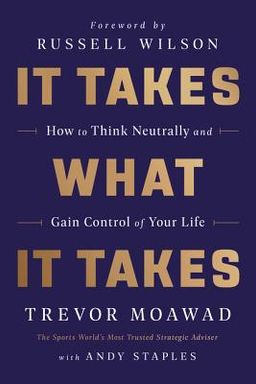
It Takes What It Takes cover

It Takes What It Takes

by Trevor Moawad with Andy Staples

It Takes What It Takes reveals how neutral thinking can transform your life. Through real-world examples and practical strategies, learn to control your mindset, make informed decisions, and overcome challenges with clarity, leading to personal and professional growth.

Neutral Thinking: The Discipline That Changes Everything

How do you respond when life blindsides you—a bad performance, a failed project, a collapsing relationship? Do you tell yourself to “stay positive” or do you spiral into negativity? In It Takes What It Takes, mental conditioning coach Trevor Moawad argues that neither extreme truly works. He insists that the key to consistency and success in any field—sports, business, or life—is neutral thinking: staying grounded in reality, free from judgment, emotion, or illusion.

Moawad contends that great performers—from NFL quarterbacks like Russell Wilson to Olympians like Michael Johnson—don’t rely on positive thinking when under pressure. Instead, they focus on the next right behavior. Positivity can be fragile when you're trailing 16–0 in a conference championship, as Wilson once was, but neutrality never fails. It’s not about denying difficulty—it’s about addressing what is true and what is possible, one step at a time.

Neutral Thinking vs. Positivity and Negativity

Moawad proposes that while negative thinking always works against us, positive thinking can sometimes feel out of touch. Neutral thinking, however, lives in the middle—focused on truth and immediate action. It frees us from the emotional entanglement of past failures or inflated confidence from success. That’s why Navy SEALs, elite athletes, and top CEOs all benefit from thinking neutrally in moments of adversity.

His central message is simple but transformative: what has happened is done, and what happens next depends entirely on what you do next. The past is not predictive; the next behavior is.

Building the Foundation of Mental Conditioning

The book is equal parts psychology, coaching, and autobiography. Moawad draws on two decades of work with NFL legends, college football powerhouses like Alabama and Florida State, and corporate leaders. He merges those experiences with lessons from his father, Bob Moawad, one of the early pioneers of self-esteem-based education, to build a practical playbook for mental discipline.

He highlights how words, language, and self-talk shape our internal environment—how everything we say or think becomes a “marketing campaign in your own brain.” By learning to speak and think neutrally, you can transform stress into strategy.

Stories That Ground the Philosophy

To bring the concept to life, Moawad shares powerful narratives. There’s Russell Wilson leading one of the greatest NFL comebacks after throwing four interceptions—by focusing only on the next play, not the past mistakes. There’s Fred Taylor, an NFL running back once branded “Fragile Fred,” who transformed his career by changing daily habits and reframing frustration into conscious behavior. And there’s Moawad himself, who used the same mental tools to navigate personal crises—a divorce, his father’s illness, and bouts of self-doubt.

Each story underscores his belief that mental toughness is not luck, talent, or optimism—it’s trained self-awareness, practiced neutrality, and relentless execution. Neutral thinking is “truth-based thinking.” It strips away excuses and forces clarity: where am I, what can I do, and what will I do next?

From Sports to Life: Why It Matters

Moawad transforms the language of competition into one anyone can adopt. Whether you’re navigating an argument at home or a presentation at work, negative thinking traps you in fear and self-pity, while blind positivity can leave you unprepared. Neutral thinking helps you focus on behavior—what you can control in the present.

His framework moves methodically: control your self-talk (the verbal governor), reduce negativity in your environment (the negativity diet), and create an inner marketing strategy (your personal ad campaign) to reinforce who you want to become. Through chapters like “It Takes a Plan,” “It Takes Hard Choices,” “It Takes a Verbal Governor,” and “It Takes Leadership,” Moawad shows how the same cognitive tools that helped Russell Wilson win a Super Bowl can help you win life’s smaller, tougher, everyday battles.

The Power of Neutral in Action

Ultimately, Moawad’s philosophy redefines resilience. He teaches that winners aren’t immune to failure or doubt—they’re simply fluent in the language of neutrality. Like astronauts calculating their oxygen supply on Apollo 13, they observe, adjust, and execute. Neutral thinking turns panic into progress. As Moawad writes, “It takes what it takes.” There’s no shortcut—only truth, action, and behavior, one play at a time.


It Takes Neutral Thinking

Neutral thinking is the bedrock principle of Trevor Moawad’s work and the first essential mental skill he teaches to athletes, executives, and anyone under performance pressure. It’s the discipline of removing bias—emotional or narrative—from your thinking so you can deal with truth, not noise. It’s not about feeling positive or avoiding negativity—it’s about what you actually do next.

From Russell Wilson to Apollo 13

When Seattle Seahawks quarterback Russell Wilson threw four interceptions against Green Bay in the 2015 NFC Championship, he refused to drown in negativity or force fake optimism. He stayed in what Moawad calls the “truth zone.” Wilson asked himself only, “Where are we? What’s real? What can I control?” He narrowed his world to execution, one throw at a time, and led the Seahawks to a shocking come-from-behind win. That’s neutrality in motion—it’s “next-play thinking.”

Moawad parallels this with stories from soldiers and astronauts. When the oxygen tank exploded on Apollo 13, Commander Jim Lovell and his crew didn’t freeze or dream their way home. They stayed neutral—gathering truth, managing pressure minute by minute, and surviving by stripping emotion from analysis. In his words, “You just keep going. You keep thinking up ways to get back.” That’s neutral thinking keeping humans alive under literal life-and-death conditions.

Neutral Thinking vs. the Biases of the Mind

Moawad shows how our brains are wired to distort reality through biases—negativity, recency, optimism, pessimism. Evolution made us hyper-alert to threats, but in modern life that bias distorts our judgment. Neutrality corrects that imbalance by focusing on present data. It’s an engineering mindset applied to human emotion—first acknowledge what happened, then identify what must happen next.

Shifting to Neutral

Moawad uses a car metaphor: when you’re in reverse, you can’t instantly slam into drive without burning the gears—you must pass through neutral. Emotionally, that means before redirecting failure toward success, you must pause, remove judgment, and find clarity. In teams from Alabama to Georgia, this “shift” was the differentiator between collapse and championship. At halftime in the 2018 Rose Bowl, Georgia had been outplayed by Oklahoma. Coach Kirby Smart used Moawad’s neutral language with his players: “The first half and the second half are two different events. Let’s get back to who we are.” They did—and they won.

Truth as Performance Fuel

Neutral thinking demands honesty: reality without exaggeration. It trains you to use the past only for information, not identification. As Moawad puts it, “The past isn’t predictive. The present determines the present.” For performers and leaders alike, this mindset builds resilience, judgment, and composure. In other words, it’s not about feeling good—it’s about functioning well.


It Takes a Plan

Planning, for Moawad, is the practical counterpart to neutral thinking. It transforms intention into execution. You can’t hope your way to a goal—you must chart a path based on behavior, not emotion. Through powerful stories of Russell Wilson’s mental preparation for Super Bowl XLIX, Moawad shows that planning is both an art and a discipline.

Mental Preparation Meets Physical Execution

The night before the Super Bowl, Wilson, his agent Mark Rodgers, and Moawad didn’t visualize trophies—they visualized behavior under chaos. They watched highlight reels of Wilson’s best moments, paired with music that anchored emotional states. They discussed what could go wrong—Belichick’s adjustments, crowd noise, interceptions—and predetermined Wilson’s response: calm, engaged, balanced. He replaced “if” with “I.” “If I do this” became “I do this.” In Moawad’s view, confidence requires commitment, not conditionality.

When the Plan Fails

We all remember the infamous Super Bowl interception at the one-yard line. For most players, that would define a career. Wilson handled it differently. In his post-game conference, he refused to deflect blame. He owned it, stayed neutral, and texted Moawad the next morning: “It’s time to hit the reset button.” They built a new off-season plan focused on growth rather than guilt. Moawad’s point: the best plans are built on adaptability. You re-plan after reality changes.

Behavior as the Core of Strategy

Whether in sports or life, elite planning isn’t about predicting every outcome—it’s about scripting controllable behaviors. Wilson’s motto—“Great fundamentals. Great balance. Be engaged.”—became his behavioral compass. In Moawad’s language, “It’s what you do, not how you feel, that gets things done.” This echoes behavioral psychology from B.F. Skinner to James Clear (Atomic Habits)—change beliefs through consistent action, not inspiration.

Moawad’s message for anyone reading: emotion is inevitable, chaos is certain, but if you act with prepared intention, your behavior will guide you through both. You don’t wait to feel motivated; you behave yourself into motivation. As he repeats throughout the book: plan it, own it, live it—then adjust. That’s how leaders and winners move forward after heartbreak.


It Takes Hard Choices

Moawad’s idea of discipline rests on what he calls “the illusion of choice.” Successful people, he insists, don’t actually have as many choices as they think. Once you commit to excellence, the formula is fixed. You either follow it—or you don’t. NFL legend Vince Carter taught him that longevity comes not from luck, but from repeatedly doing what’s required, not what’s convenient.

The Illusion of Choice

When Carter was still dominating at age 42, he told Moawad he stayed in the league because he did what it took—stretching longer, eating cleaner, skipping celebrations, hitting the gym when others slept. These aren’t glamorous choices—they’re necessities. Moawad translates this for leaders and teams: “It takes what it takes.” You can choose to be average or elite, but excellence itself leaves no room for negotiation.

Discipline and Consequence

Through his work with Nick Saban’s Alabama program, Moawad formalized the concept. Saban told his players, “If you want to be good, you really don’t have a lot of choices.” Greatness eliminates options; mediocrity multiplies them. Moawad likens this to diet: you don’t need a nutritionist to know an apple beats Doritos. The hard part isn’t knowing—it’s choosing consistency when the chips are right there.

Facing the Cost of Inconsistency

He contrasts this discipline with wasted potential—like NFL bust JaMarcus Russell, whose “choices” (skipping film, ignoring training) destroyed a multimillion-dollar career. Choice, Moawad argues, is the enemy of destiny when guided by comfort. Freedom without standards equals failure. In business terms (echoing Jocko Willink’s Discipline Equals Freedom), constraint is ultimate liberation because it focuses energy on what matters.

When you say, “I’ll try,” you’ve already given yourself an exit. Remove the illusion. Say, “I’ll do.” Whether you’re a CEO or a parent, the path to excellence is narrow. It doesn’t get easier—you just stop debating the necessary work.


It Takes a Verbal Governor

What you say controls how you think—and how you perform. Moawad calls your mouth’s output the verbal governor of your mind, much like the RPM limiter in a car engine. Negative words throttle your performance. Saying “I can’t,” “I suck,” or even joking self-deprecation is like loosening your own bolts—and the science supports it.

Words as Weapons

Moawad cites studies showing that the human brain absorbs negativity seven times more effectively than positivity. Speech magnifies the impact tenfold. Words externalize thought, turning temporary emotion into concrete programming. That’s why athletes at Alabama, Florida State, and Georgia were trained not just to think positively, but to stop saying stupid shit out loud. The mere act of verbal restraint, he discovered, dramatically improved morale, cohesion, and results.

The Evolutionary Bias Toward Negativity

Evolution programmed us to prioritize danger. Negativity once saved lives; today, it only sabotages performance. Whether it’s Bill Buckner verbalizing his nightmare of letting a World Series ball slip through his legs—or “Pistol” Pete Maravich predicting his own heart attack—words can prime outcomes. This doesn’t mean superstition; it’s about cognitive focus. What you say directs where your energy goes.

Moawad’s experiment across multiple teams was simple: go 24 hours without saying anything negative. Players reported feeling lighter, more focused, and oddly more optimistic. Less negativity didn’t make them delusional—it made them clear.

Silence as Strength

Neutral thinking begins with not feeding verbal poison to your brain. In place of despair or forced enthusiasm, Moawad advocates neutral phrasing: “This sucks” becomes “This is what it is.” That statement isn’t defeatist—it’s strategic acceptance. It lets you move faster to solutions. As he coaches teams: stop speaking problems; start acting them out of existence.


It Takes a Negativity Diet

If words can poison the mind, so can what you consume. Moawad’s “negativity diet” advises filtering toxic inputs from media, music, and conversation. His father banned bad news and sad country songs from their home to protect mental energy—a rule Moawad would later test scientifically on himself.

The Negativity Experiment

In 2018, amid personal upheaval, Moawad went on what he called a monthlong “Super Size Me” test of negativity. He consumed three to four hours of toxic media daily—cable news, heavy metal, heartbreak country songs—to see if his neutral principles could withstand overload. The result was devastating: anxiety, doubt, near breakdown. Within 26 days, he wrote, “I had broken.”

His takeaway was unequivocal: “I believed I could outthink toxicity. I was wrong.” What we feed our minds—through headlines, soundtracks, or social media—directly shapes our emotional weather. Even for a trained expert, constant negativity dissolved clarity and hope.

Hope as Mental Nutrition

The antidote to mental corrosion isn’t forced joy; it’s hope. As his Navy SEAL friend told him, “If you don’t become hopeless, you won’t become helpless.” Managing exposure to noise preserves hope as a habit. Just as an athlete cuts sugar before competition, your attention diet determines your resilience. Protect it fiercely.

Moawad’s conclusion was simple but revolutionary: you cannot thrive in a hostile information environment. If you want clarity, curate your inputs. Avoid content designed to enrage or depress. Choose media, music, and relationships that fuel behavior—not fear. Your mental fitness depends on what you consume.


It Takes an Ad Campaign in Your Brain

Moawad argues that your mind runs a full-time marketing department—and you are the creative director. The slogans, images, and scripts you run internally shape your behavior more than any external influence. To win mentally, you must design a conscious ad campaign in your own brain.

Inside-Out Marketing

Advertisers build billion-dollar empires on repetition and emotional anchors (“Just do it,” “Think different”). Moawad shows that you can use the same psychology to program yourself for neutral performance. His own inner slogans—like “What’s next?” or “Control the controllables”—act like emotional GPS, keeping focus on behavior instead of outcome. These mantras don’t promise success; they trigger action.

The Science of Self-Talk

Everyone runs internal dialogue, even those who claim not to. When Moawad asked Florida State players how many talk to themselves, only a quarter raised their hands. He pointed out that the rest just asked themselves if they did—that’s self-talk. The key is to manage that voice consciously. Internal speech is 10x more influential than external voices because it directly drives behavior. Words you say internally shape posture, confidence, and decision-making before a single action occurs.

Training the Internal Narrator

Borrowing from Nike’s famous campaign, Moawad notes that “Just do it” works because it’s neutral. It doesn’t promise joy or comfort—it commands action. You must craft your own version. Russell Wilson’s internal ad includes three slogans: “Great fundamentals. Great balance. Be engaged.” Those neutral statements reconnect him to execution under pressure.

Rewiring Focus Through Repetition

Like commercial jingles, mental commercials become automatic through repetition. If you tell yourself, “I am unfocused, I always screw up presentations,” your brain will oblige. Replace it with truthful, behavioral lines like “I prepare thoroughly” or “I deliver with energy.” These are your slogans. You are both the brand and the advertiser. Your life’s direction depends on the story your ads tell.


It Takes Self-Awareness

Self-awareness, to Moawad, is recognizing not only what you do but why you do it—and adjusting accordingly. It’s the psychological maturity that turns talent into mastery. He illustrates this through the rehabilitation of NFL star Fred Taylor, whose career changed when he learned to be consciously competent.

From Fragile Fred to Fortified Fred

Taylor, a supremely gifted running back, earned the cruel nickname “Fragile Fred” after repeated injuries. Moawad and performance coach Chad Bohling were brought in by the Jacksonville Jaguars not to strengthen Taylor’s body, but his mind. Together, they used the framework of competence levels—from unconscious incompetence to conscious competence—to map his awareness. Taylor realized he was operating on raw instinct, not intentional process. Once he studied the habits of veterans who lasted in the league—early training, recovery routines, ice baths—he replicated them. The result: 46 consecutive healthy games.

Owning Your Formula

Moawad teaches that great performers don’t rely on motivation; they understand their personal formula for excellence. They study their wins and losses and know which behaviors drive results. In relationships or careers, you can do the same: identify moments of success, trace their causes, and repeat the behaviors. Self-awareness converts randomness into reliability.

Continuous Self-Awareness

The final lesson from Taylor’s story: awareness isn’t finite. Life evolves, which means you must continually revisit your process. Conscious competence never gets locked in—it’s practiced daily. Whether in personal reinvention after divorce or business transformation, self-awareness is the cornerstone of sustained growth. As Moawad shows through his own vulnerable stories, it’s okay to be broken for a while—but you can’t stay unaware. Know yourself, adjust behaviors, and growth follows.


It Takes Pressure

Pressure, in Moawad’s world, isn’t the enemy—it’s the proving ground. As tennis legend Billie Jean King said, “Pressure is a privilege.” It means someone expects something of you. The difference between those who collapse and those who thrive lies in preparation and perspective.

Pressure Exposes, It Doesn’t Create

In 2013, Florida State faced Clemson under intense national spotlight. Moawad’s preseason mental conditioning had built habits: neutrality, truth-based evaluation, and behavioral repetition. Linebacker Telvin Smith embodied it—standing in team meetings declaring, “No more!” about undisciplined losses. When pressure hit, the team didn’t retreat—they executed what they’d practiced and routed Clemson 51–14. Pressure didn’t make them elite; it revealed the elite habits they had built.

Embracing the Squeeze

Moawad compares pressure to swimming in deep water—you can panic or you can rely on what you know. The remedy is preparation: honest self-assessment (“Who am I now?”) and strategic intention (“Who will I be next time?”). Pressure then becomes diagnostic, not destructive. It exposes weak systems before they fail catastrophically.

Owning Your Response

When the stakes rise, behavior outweighs feeling. Whether you’re pitching to investors or taking an exam, pressure can motivate precision if you welcome it. Moawad’s mantra is universal: “Run toward pressure.” It’s the only place growth lives. Preparing neutrally for it—studying the truth about your abilities—turns anxiety into readiness. You don’t get crushed by heavy weight when you’ve trained to lift it.


It Takes Leadership and Role Models

Leadership, Moawad argues, is learned behavior rooted in self-awareness and service—not charisma or position. Drawing lessons from Nick Saban, Bob Bowman, and his own father, he shows that true leadership is conscious competence: knowing why you’re effective and recreating it for others. Role models serve as mirrors for the leadership we want to embody.

Learning and Adapting Like Saban

Nick Saban isn’t great because he’s inflexible—he’s great because he never stops adapting. He studies other coaches like Tom Herman, integrates new playbooks, and constantly tests ideas. Despite being an introvert, Saban forced himself to become an exceptional communicator because effectiveness trumped comfort. Great leaders teach while learning, demand without demeaning, and adjust before failing.

The Four Levels of Leadership Competence

Moawad categorizes leaders the same way he classifies performers: unconsciously incompetent (dangerously unaware), consciously incompetent (self-aware but static), unconsciously competent (talented but unable to teach others), and consciously competent (predictably effective). The goal is the last stage—leaders who understand their process and can replicate it. This is why Olympic coach Bob Bowman could turn a young Michael Phelps into a legend—he studied which motivational levers worked and customized discipline accordingly.

The Power of Role Models

Role models make the abstract tangible. Russell Wilson modeled his mindset after Derek Jeter and his late father, just as Trevor’s own hero was his dad, Bob Moawad. From both men, Trevor learned that “attitudes are contagious.” The best mentors don’t tell you who to be—they show you how to live. As his father said, “Life cannot deny itself to the person who gives life his all.”

Leading yourself first—through truth, discipline, and consistency—creates the foundation to lead others. Leadership, at its highest form, is modeling neutral behavior in chaos so others can find calm. The best leaders are not heat deflectors—they are heat seekers.

Dig Deeper

Get personalized prompts to apply these lessons to your life and deepen your understanding.

Go Deeper

Get the Full Experience

Download Insight Books for AI-powered reflections, quizzes, and more.