
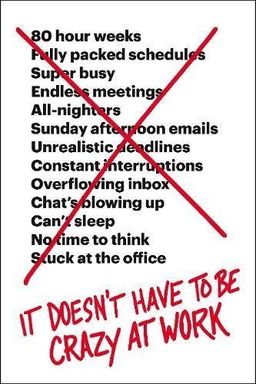
It Doesn’t Have to Be Crazy at Work cover

It Doesn’t Have to Be Crazy at Work

by Jason Fried and David Heinemeier Hansson

It Doesn’t Have to Be Crazy at Work offers a groundbreaking perspective on creating a calm, efficient workplace. Authors Jason Fried and David Heinemeier Hansson share insights from their company, Basecamp, to help eliminate stress, promote work-life balance, and increase productivity through practical strategies and a shift in mindset.

Calm Is the New Competitive Advantage

Have you ever finished a workday feeling like you’ve been busy nonstop—but without anything meaningful to show for it? Jason Fried and David Heinemeier Hansson, the cofounders of Basecamp, start It Doesn’t Have to Be Crazy at Work by challenging that exact feeling. They argue that the modern workplace has become addicted to chaos: back-to-back meetings, constant digital interruptions, and an unhealthy obsession with growth and productivity. But as they show, being relentlessly busy doesn’t mean being effective—it usually means being chronically distracted.

The authors contend that calm should be the standard of success. A profitable and sustainable business doesn’t need frantic energy—it needs focus, fairness, and balance. Fried and Hansson reveal how their own company, Basecamp, thrives in one of the most competitive industries in the world without venture capital, insane hours, or burnout. They work about 40 hours a week—and only 32 in the summer—and yet remain consistently profitable. Their entire message can be distilled to this: work shouldn’t hurt.

The Problem: Work Has Become a War Zone

The book opens with a diagnosis of modern work culture. Fried and Hansson describe workplaces that treat each day as a battlefield, adopting the aggressive vocabulary of war—“conquer,” “dominate,” “kill.” In that atmosphere, exhaustion becomes a badge of honor. Hustle culture glorifies endless effort, as if staying late every night and bragging about 4-hour sleep schedules were proof of excellence. Yet all this ‘hustle’ rarely produces better outcomes; it just creates stressed and tired teams. In their words, sustained exhaustion is not a mark of dedication, but of stupidity.

They note that this madness isn’t just prevalent in startups chasing investors—it’s everywhere, even among individuals freelancing solo. Everyone is pressured to perform heroics. But this obsession with being ‘always on’ is killing creativity and focus. Fried and Hansson’s antidote is deceptively simple: stop mistaking motion for progress. What matters isn’t how many hours you put in, but how much meaningful work you complete with calm concentration.

The Solution: Design for Calm

At the heart of the book lies the belief that a company isn’t just the sum of its products—it’s a product itself. Like any product, it can be redesigned, improved, and debugged. Fried and Hansson invite readers to stop accepting chaos as inevitable and to start intentionally building calmer work environments. At Basecamp, this philosophy translates into defending time and attention. Meetings are rare and short. Employees aren’t forced to broadcast that they’re working; their results speak for themselves. They forbid endless real-time communication—preferring asynchronous updates—to protect deep work.

They also highlight the value of working fewer hours well rather than squeezing more hours poorly. An uninterrupted eight-hour workday, they point out, is like an eight-hour flight from Chicago to London—long, substantial, and focused. It’s only when that time is chopped up by interruptions and status meetings that we feel work speeding by without substance. The cure is not to find more hours but to reclaim the ones we already have.

The Payoff: Calm Businesses Win

Embracing calm isn’t about abdicating ambition—it’s about creating sustainability. Fried and Hansson show that calm leads to better decision-making, clearer priorities, and longer-term profitability. They back this up with examples from Basecamp’s two-decade history: refusing venture capital, hiring slowly, paying everyone top-market salaries without negotiation, and offering benefits that encourage life outside work. For them, calm doesn’t mean complacency—it means clarity.

A Calm Company Is a Choice

The authors remind every leader that calm doesn’t happen by accident—it’s designed by choice. You decide how people communicate, how long projects last, how deadlines are set, and whether weekends stay sacred. You can be the company that asks for all-nighters or the company that says, “We’ll pick it up Monday.” Calm isn’t the absence of stress—it’s the presence of structure.

Ultimately, Fried and Hansson’s message is hopeful. Just because the modern workplace has normalized chaos doesn’t mean you have to join in. You can design systems where people rest, think, and deliver great work without panic. As they put it, calm is not the opposite of ambition—it’s the foundation for real success. This book isn’t just a critique of hustle culture—it’s a blueprint for reclaiming sanity at work and rediscovering the joy of doing things well.


Work Less, Do Better

One of Fried and Hansson’s most radical ideas is that you don’t need endless hours to do great work. At Basecamp, nobody works evenings or weekends, and 40 hours a week is “plenty.” Sometimes they even reduce that to 32 hours in summer. Their point is clear: productivity doesn’t come from time; it comes from quality attention.

Eight Hours Is Enough

Fried illustrates this with a striking comparison: an eight-hour flight from Chicago to London feels long because you’re uninterrupted. That same amount of time in the office feels short because your attention is constantly fragmented. To regain true productivity, you must protect those uninterrupted stretches as sacred. Most people don’t have eight hours of work—they have two hours of actual focus stolen by meetings, messages, and interruptions. The math works against deep work.

So they ban unnecessary meetings and encourage asynchronous updates instead. If you can’t finish meaningful work within 40 hours, Fried argues, the solution isn’t working longer—it’s working smarter. Cut what’s unnecessary, focus on what matters, and stop confusing busyness with accomplishment.

Healthy Boundaries Build Better Companies

Basecamp’s approach contradicts Silicon Valley’s love affair with the ‘crunch.’ No crunch weeks, no midnight deadlines, no heroics. When Friday comes, the work stops—even if things aren’t finished. They’ll pick it up Monday. This rhythm prevents burnout and creates long-term consistency. The authors frame this as an ethical stance: endless work hurts employees and doesn’t actually serve customers. If you’re constantly frantic, your decisions degrade, your products suffer, and your culture rots.

“If you can’t fit everything you want to do within 40 hours per week,” Fried writes, “you need to get better at picking what to do—not work longer hours.”

In the end, the authors don’t see shorter hours as indulgent; they see them as strategic. Working steadily, sustainably, and sanely lets people produce better work for longer. Instead of chasing a fleeting sprint, they build a marathon pace that lasts decades. That’s how Basecamp has thrived for twenty years in an industry obsessed with fast burnout.


Hire People, Not Profiles

When it comes to hiring, Fried and Hansson take a contrarian stance: they ignore résumés. Instead, they “hire the work,” not the story. You can’t tell whether someone will fit your company from their pedigree, their last employer, or their list of bullet points. You must see what they can do—and who they are.

Personality Over History

“It doesn’t matter how good you are at the job if you’re an ass,” Fried insists. Being kind, reliable, and collaborative matters more than brilliance with bad manners. Basecamp’s hiring motto is simple: good people over impressive résumés. They actively seek variety—not fifty clones in hoodies—but people who think differently, who can broaden the team’s perspectives. It’s not about cultural sameness; it’s about cultural richness.

At the same time, they never rely on past achievements alone. Big-name projects sound impressive—“led redesign for nike.com”—but what did the candidate actually do? You can’t know until you see their real work. That’s why at Basecamp, finalists do a paid one-week project for $1,500 that mirrors the job itself. That tiny test says more than any interview ever could.

Fair Pay Without Negotiation

Basecamp also reimagines how employees get paid. To eliminate the stress of haggling, they outlaw salary negotiation entirely. Everyone at the same role and level makes the same pay, benchmarked at the top 10% of market rates (based on San Francisco numbers, though no one works there). Raises happen automatically each year to match market trends, not because someone asked for one.

This system protects fairness, stability, and calm. There’s no dread about annual reviews or fear that being a poor negotiator will cost you thousands. It’s a radical vision of equity that matches the company’s broader philosophy: eliminate anxiety, build trust, and focus on doing the best possible work together.


Focus Beats Busyness

Today’s fixation with productivity has turned people into machines—but Fried and Hansson argue that real progress comes from effectiveness, not intensity. “Productivity is for machines,” they write. “Humans should focus on being effective.” In other words, stop trying to do more; start doing less that matters.

Effectiveness > Productivity

Rather than cramming the day with more hacks, Fried suggests removing unnecessary obligations altogether. You don’t need to manage your time better—you need to have less to do. The book’s mantra echoes Peter Drucker’s classic insight: “There is nothing so useless as doing efficiently that which should not be done at all.” Basecamp illustrates this with its decision to stop accepting check payments. It was manual, tedious work. Rather than “optimize” it, they just eliminated it. Revenue dipped slightly, but everyone gained time and sanity. That’s real productivity.

Meetings as Time Theft

To protect focus, they go after the biggest thief of the modern workplace: meetings. Fried calls shared calendars “Calendar Tetris”—an endless game of colored blocks that fill your day with 30-minute interruptions. Each meeting feels cheap to the organizer but costs hours to everyone attending. Basecamp’s solution is simple: make scheduling a meeting so hard that only essential ones happen. You can’t see someone else’s availability; you must ask directly and justify the interruption. It sounds cumbersome—but that’s the point.

Quality Hours Are Sacred

If your workday is a patchwork of fragments—15 minutes here, 10 minutes there—you’ll end up with a full schedule and an empty sense of progress. Fried urges teams to protect large, unbroken blocks of time. An hour of undisturbed focus is worth more than a dozen scattered minutes. Deep work requires continuity, not chatter.

By defending time, eliminating pointless obligations, and shifting the focus from “doing more” to “doing meaningfully,” Basecamp proves that calm can coexist with high performance. It’s not about squeezing every drop out of the day—it’s about making each hour count.


Build Culture with Trust, Not Fear

Fried and Hansson argue that most workplace stress originates from broken trust and ambiguous communication. To sustain calm, you must cultivate a culture where people feel safe, respected, and honest—not anxious or defensive. They call this psychological foundation the “trust battery.”

The Trust Battery

The idea comes from Shopify’s Tobias Lütke: when you start working with someone, the trust battery is charged to 50%. Each interaction either charges or drains it. Failing to deliver, snapping under pressure, or gossiping weakens it. Listening, fulfilling promises, and supporting others recharges it. Fried and Hansson use this metaphor to show that work relationships are cumulative—and must be maintained intentionally.

Low trust leads to overreactions and paranoia. A small misunderstanding feels huge. When teams recharge trust, conflicts shrink, collaboration expands, and calm returns. Fried insists that managers exist to build trust, not to monitor presence. You can’t demand honesty if people fear consequences. Instead, lead by example, communicate clearly, and own mistakes.

Honest Communication

At Basecamp, honesty extends even to how people leave. When someone resigns or is let go, the company doesn’t hide it behind euphemisms. They post a clear, company-wide farewell explaining what happened—authored by either the person leaving or their manager. Colleagues respond with photos, stories, and appreciation. Then the manager follows up to clarify any missing details. Transparency prevents rumors and builds stability.

“A dismissal opens a vacuum,” Fried writes. “Unless you fill it with facts, it’ll quickly fill with rumors.”

These rituals—charging trust, communicating openly, and treating departures kindly—make calm culture possible. Fear multiplies stress; trust diffuses it. It’s not fancy perks or slogans that define strong companies, but the daily honesty that keeps the battery charged.


Design Benefits That Benefit Life

Most companies use perks to trap employees at the office—free dinners, game rooms, laundry service. Fried and Hansson call these “insidious bribes.” They make it easier to stay late, not to live well. Basecamp flips the model entirely: benefits exist to help people get away from work.

Freedom Beyond the Office

Every Basecamp employee gets truly restorative benefits: paid annual vacations (up to $5,000 for airfare and lodging), 32-hour summer workweeks, one-month paid sabbaticals every three years, education stipends for non-work learning (like cooking or music), monthly massages, fresh produce CSA memberships, and fitness allowances. They even match up to $2,000 annually in charitable donations.

None of these benefits are designed to increase work intensity—they exist to improve life quality. They’re about well-being, curiosity, and real rest. The company naturally benefits when its people return healthier, inspired, and engaged. Calm isn’t just cultural—it’s physiological.

Vacations That Are Actually Vacations

Basecamp also bans “fakecations,” where employees still answer emails from the beach. When you take time off, you log out of everything—no Basecamp notifications, no quick calls. Vacations are meant to make you forget work entirely. This radical stance restores true mental space. After all, if you’re never fully off, you’re never fully on.

“Employers aren’t entitled to anyone’s nights, weekends, or vacations. That’s life time,” the authors write. It’s a declaration of respect for boundaries.

By rejecting manipulative perks and focusing on real-life benefits, Basecamp proves that generosity and calm coexist beautifully. These are benefits that truly benefit—the kind that remind people they’re working to live, not living to work.


Enough Is Plenty

For Fried and Hansson, calm isn’t possible until you’re comfortable with the idea of “enough.” Endless ambition—the constant chase for more—creates perpetual anxiety. Business becomes an arms race with competitors instead of a craft with customers. Learning to stop at enough is both radical and liberating.

The Trap of Too Much

They illustrate this through a customer-support story. At one point, Basecamp’s team reduced email response times from one hour to thirty minutes, then fifteen, then two minutes. Customers were amazed, but staff were crushed. The faster they went, the more pressure they felt—like failing if they took three minutes instead of two. It was absurd. Eventually, they slowed back down to fifteen minutes or an hour, and everyone breathed again. Customers were still thrilled; the team was calmer. “Fast enough,” it turned out, was plenty.

Choosing Sustainable Success

This story captures a central idea: perfectionism poisons good work. More speed, more features, more money—none of these automatically mean better outcomes. Fried and Hansson preach restraint: cut ambition to fit reality, not fantasy. Calm companies grow gradually, refusing to sacrifice sanity for acceleration. They remind readers that progress doesn’t have to mean expansion at all costs. It can mean refinement, simplicity, and peace.

“If it’s never enough,” they warn, “it’ll always be crazy at work.”

By reframing ambition as contentment, the authors show that calm isn’t laziness—it’s mastery. The companies that stay healthy aren’t the ones that sprint—they’re the ones that know when to stop running.


Calm Is a Choice—Make It Yours

The concluding message of It Doesn’t Have to Be Crazy at Work is empowering: chaos isn’t inevitable. Every moment at work is a choice—what you prioritize, what you approve, what you allow, and what you protect. Fried and Hansson urge every reader, manager, and founder to take responsibility for that choice.

Daily Decisions Build Culture

The authors list simple but profound tradeoffs: Will you demand instant replies or allow thoughtful responses? Will you push 10-hour days or respect 8-hour ones? Will you impose tight scopes or flexible ones? These micro-decisions shape a company more than grand mission statements ever do. Calm isn’t built by policy—it’s built by repetition. Every choice that protects focus and respect chips away at crazy.

They frame calm as a form of courage. Saying “no” to constant urgency can feel countercultural. But that discipline pays off in wiser decisions, healthier teams, and lasting success. Even if you can’t change your company immediately, you can change how you work: how you communicate, when you check messages, and how you defend your time.

Calm Starts with You

“No matter where you live in an organization,” Fried writes, “you can start making better choices. Choices that chip away at crazy and get closer to calm.”

Ultimately, Fried and Hansson’s philosophy reimagines leadership not as domination but stewardship. A calm company is a humane company—one that treats time, energy, and people as precious. You can choose that starting today, one decision, one “no,” at a time.

Dig Deeper

Get personalized prompts to apply these lessons to your life and deepen your understanding.

Go Deeper

Get the Full Experience

Download Insight Books for AI-powered reflections, quizzes, and more.