
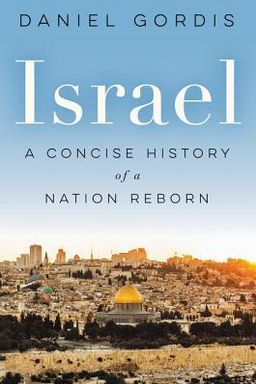
Israel cover

Israel

by Daniel Gordis

Israel: A Concise History of a Nation Reborn by Daniel Gordis delves into the captivating evolution of Israel. From its visionary beginnings and turbulent wars to its ongoing quest for peace and identity, this book provides a comprehensive overview of a nation that has defied odds and shaped global discourse.

The Making of a Nation: From Memory to Modern State

How does an ancient faith community turn itself into a modern nation? In his sweeping chronicle, Daniel Gordis argues that Israel is not simply a political creation but a civilizational rebirth—an effort to translate centuries of Jewish memory, ritual, and language into sovereign existence. The book traces that transformation from the cultural and ideological roots of Zionism through the struggle for statehood, the shaping of democratic life, and the moral challenges of sovereignty. You discover how ideas, literature, diplomacy, and defense all converge to produce one of history’s most improbable national renewals.

From Longing to Nationhood

Zionism began as both a political and cultural revolution. Gordis shows that Jewish identity, sustained for centuries through prayer and ritual (“Next year in Jerusalem”), became a practical project of return. Figures like Theodor Herzl and Ahad Ha’am offered competing models—Herzl’s political sovereignty versus Ahad Ha’am’s cultural renaissance—but their dialogue generated a synthesis that would animate the movement. Poets such as Chaim Nachman Bialik translated yearning into civic imagination, while Eliezer Ben‑Yehuda’s linguistic crusade revived Hebrew as a living national language. This conversion of spiritual nostalgia into modern tools—schools, poets, a shared language—was Israel’s first act of self-creation.

Building on the Ground

Ideas had to be matched by labor. The Yishuv, the pre‑state Jewish community in Palestine, became a laboratory for self-rule: pioneers drained swamps, farmed kibbutzim, founded Tel Aviv, and created institutions such as the Haganah, Hebrew University, and the Histadrut. Gordis interprets this as moral work—the re‑education of a people through manual labor and self-defense. External diplomacy, from the Balfour Declaration to U.N. partition debates, intertwined with this grassroots nation-building. Each immigration wave—the aliyot—brought ideological diversity and practical tension, forcing a balance between utopia and survival.

Catastrophe and Urgency

The Holocaust’s devastation gave Zionism unprecedented urgency. With the world’s doors closed, clandestine immigration became a moral defiance of British restrictions. The failed voyages of the Patria, Struma, and Exodus dramatized a planet unwilling to shelter Jewish refugees. Gordis insists that this tragedy transformed the argument for a Jewish homeland from idealism to necessity. As the Yishuv fought Britain diplomatically and militarily, it prepared to declare independence—knowing delay could mean doom.

War, Statehood, and Democracy

Statehood in 1948 arrived through peril: war against invading Arab states, internal rifts among militias, and population displacement. Gordis emphasizes how Ben‑Gurion fused authority through mamlachtiyut—a commitment to state-centered loyalty above party or sect. The new democracy drew on Jewish traditions of communal governance while integrating mass immigration. Yet its unity was fragile: the Altalena affair, religious‑secular divides, and demographic pressures would test this experiment in pluralism. Literature and poetry, from Alterman to Agnon, mirrored these paradoxes—celebrating victory while mourning its moral cost.

Enduring Moral Paradoxes

As Israel matured, it became a paradox of achievements and dilemmas. It absorbed refugees, cultivated democracy, and created a vibrant economy, yet carried the moral burden of occupation, the trauma of warfare, and the scrutiny of global institutions. Gordis interlaces military history (from Unit 101 to Suez and the Begin Doctrine) with moral inquiry. The result is a portrait of a state always negotiating between survival and conscience. By its centennial, Israel embodies both Herzl’s pragmatic statecraft and Ahad Ha’am’s spiritual renaissance—an ongoing conversation about power, morality, and meaning.

If you read Gordis carefully, you see that his central claim transcends politics: Israel is a continuing experiment in transforming memory into modern identity. Its vitality lies not in perfection but in argument—the argument over what it means to be a free, Jewish, and democratic people after nearly two millennia without sovereignty.


Ideological Roots and Cultural Resurrection

You begin by learning that Zionism was never a single ideology but a dialogue among rival visions. Theodor Herzl sought legal sovereignty; Ahad Ha’am wanted a spiritual center; Jabotinsky preached strength and defense; A. D. Gordon sanctified labor; Rav Kook bridged faith and modernity. Gordis treats their debates as nation-building in themselves: pluralism forged resilience. Each strand supplied an essential ingredient—political realism, moral idealism, cultural vitality, and spiritual depth. The resulting mosaic became Israel’s DNA.

The Language and Poetry Revolution

Behind every nation stands a shared language. Eliezer Ben‑Yehuda’s personal vow to speak only Hebrew transformed liturgical memory into daily life. His dictionary, journalism, and advocacy created a living linguistic spine for Jewish self-determination. Poetry then gave that language emotion: Bialik’s laments after the Kishinev pogrom turned tragedy into national awakening. You start to see how literature functioned as civic imagination. By the 1930s, Hebrew schools, theater, and the press sustained a common culture across immigrants who otherwise shared little.

Institutions as Cultural Infrastructure

Gordis shows the cultural project expanding through universities, journals, and youth movements. Zvi Hermann Shapira’s early vision inspired the Hebrew University; theater and public festivals secularized old religious rhythms. The “Next year in Jerusalem” of prayer subtly evolved into the practical blueprint for a nation. The revival of Hebrew and literature did more than express identity—it created a moral vocabulary to sustain politics.

(Note: Gordis’s argument parallels Benedict Anderson’s in Imagined Communities: nations are constructed through shared language and memory. Zionism’s success was precisely in making the imagined tangible.)


From Dream to Land: Nation-Building in the Yishuv

To watch an idea become a country, you follow the Yishuv’s daily labor. Gordis traces each immigration wave (aliyah) as both spiritual and logistical challenge. The First Aliyah built moshavot like Rishon LeZion with Rothschild’s aid. The Second Aliyah introduced socialist pioneers, establishing Degania and Tel Aviv. By the Third and Fourth Aliyot, institutions—defense, education, labor unions—emerged. Land purchases, the Jewish National Fund, and cooperative labor laid durable foundations for statehood.

Labor and Morality

For thinkers like A. D. Gordon, working the soil was not merely economic—it was moral therapy. “Labor has afflicted us and labor will heal us,” he said. Gordis frames this as a secular religion that transformed exiles into self-sustaining citizens. The kibbutz, although small in numbers, became the crucible of leadership and sacrifice, supplying many of the 1948 generation’s officers and ideals.

Urban Culture and Civic Modernity

Simultaneously, urban life flourished: Tel Aviv as a Hebrew-speaking city, Hebrew University as an intellectual hub, and the Technion as a symbol of modern competence. Gordis emphasizes the dual strategy—agricultural self-reliance and urban institutional growth. Together, they produced both moral cohesion and practical capacity. By the time Balfour and the Mandate recognized the concept of a “national home,” the Yishuv had already built one in substance.

Nation-building was exhausting and improvisational, yet it cultivated habits of democracy and self-governance long before independence. The achievements of the Yishuv explain Israel’s rapid emergence as a functioning state in 1948.


From Catastrophe to Independence

The Holocaust, global diplomacy, and armed struggle converged in the crucible of 1930–1948. Gordis recounts how the Holocaust transformed Zionism from vision to necessity. Refugees denied entry under the British White Paper exposed the moral bankruptcy of international politics. The Yishuv's clandestine operations to rescue and transport survivors—Mossad le-Aliyah Bet—became both humanitarian defiance and national preparation.

British Retreat and Jewish Revolt

During the Mandate’s final decade, British policy swung between promises and repression. After the Exodus and other tragedies, moral outrage tipped international sympathy toward Zionism. Meanwhile, internal Jewish forces—Haganah, Palmach, Irgun, and Lehi—debated methods. Ben-Gurion insisted on discipline; Begin’s Irgun demanded resistance. Terror, diplomacy, and debate coexisted in the march to statehood. The UN’s 1947 partition vote crystallized joy amid looming war.

War for Survival and the Democratic Birth

Independence came through battle. The 1948 war bloodied a nascent nation but forged a common identity. Gordis focuses on the moral struggles—the Altalena clash enforcing a single army, the refugee crises, and the young democracy’s ability to unite immigrants and ideologues under one flag. By 1949 Israel held elections and drafted a Declaration of Independence citing liberty, equality, and prophetic justice. Few new states were born democratic under fire; Israel managed that improbable feat.

Gordis calls this a “moral birth”: survival required force, but legitimacy required conscience. These twin imperatives would shape Israel’s politics and psyche forever.


Building the State and Its Moral Architecture

After 1948, Israel faced the challenge of absorbing masses while defining what the state should mean. Ben-Gurion’s doctrine of mamlachtiyut—state-ness—sought to instill loyalty to the state as moral center. He consolidated power, integrated militias, and emphasized civic service and education. Gordis presents Ben-Gurion as both visionary and pragmatist: he enforced unity through institutions like the Histadrut but preserved fragile religious “status quo” compromises that would later prove divisive.

Immigration and Social Strain

The Law of Return (1950) opened Israel’s gates to every Jew, leading to one of history’s fastest demographic inflations. Airlifts from Yemen, Iraq, and beyond—Operation Magic Carpet, Ezra and Nehemiah—embodied redemption. Yet absorption was painful: immigrants languished in ma’abarot camps and faced cultural condescension. Mizrachi resentment became a political undercurrent for decades. Israel had secured safety but now had to manufacture social equity.

Security and Moral Tests

Surrounded by hostility, Israel adopted deterrent strategies—Unit 101, Qibya, and retaliations under Ariel Sharon. Gordis examines the paradox: deterrence demanded severity, but conscience demanded reflection. Literature like S. Yizhar’s Khirbet Khizeh turned battlefield dilemmas into moral testimony. The Suez alliance with France and the Dimona nuclear initiative added strategic depth while raising ethical questions about secrecy and proportionality.

In the 1950s–60s, Israel became an assertive yet self-scrutinizing state: economically reliant on German reparations, culturally wrestling with Holocaust memory, and strategically balancing diplomacy and defense. The outcome was stability tinged with introspection—the essence of Jewish sovereignty confronting real power.


Wars, Peace, and the Dilemmas of Power

Gordis portrays Israel’s military history as a mirror of its moral evolution. Each war—1967, 1973, Lebanon, and the intifadas—reshaped politics and conscience. The Six-Day War supplied exhilaration and land; the Yom Kippur War delivered shock and humility; Lebanon sowed moral doubt; and Oslo reopened the dream of coexistence. Victories produced insecurity as much as safety.

Occupation and its Consequences

After 1967 Israel inherited not just territory but another people. Settlements in the West Bank and Gaza mixed religious zeal (Gush Emunim) with strategic argument. Gordis highlights internal dissent—Yeshayahu Leibowitz’s warning that ruling others would corrupt Israel’s soul. The hilltop youth and extremist offshoots later showed the danger of theology weaponized by politics. The dilemma remained acute: democracy versus dominion.

Between War and Peace

The Yom Kippur surprise shattered Labor’s dominance and paved the way for Begin’s 1977 “Mahapach.” Begin achieved peace with Egypt but embroiled Israel in Lebanon, where the 1982 Sabra and Shatila massacre forced collective soul-searching. The intifadas revealed the limits of control, Oslo exposed the costs of hope, and Rabin’s assassination revealed internal fracture. Each cycle forced Israelis to define moral red lines in the pursuit of security.

Israel’s modern security doctrine—from the 1981 Osirak strike to countering Iran’s nuclear ambition—illustrates a nation acting early to prevent annihilation while remaining haunted by ethical boundaries. Power, Gordis concludes, is both the expression and constant test of Israel’s moral identity.


Modern Challenges and Cultural Renewal

In the book’s final movement, Gordis broadens perspective from survival to meaning: how does a Jewish state renew spirit without succumbing to division? He traces three intertwined phenomena—international delegitimization, domestic religious tensions, and a surprising cultural renaissance.

Delegitimization and Global Scrutiny

Israel’s isolation within international institutions—hundreds of critical UN resolutions and campaigns like BDS—reveals how moral language can mask political bias. Gordis documents how Western activists and NGOs often conflate critique of policy with denial of legitimacy. The result is a second front: narrative warfare that shapes perception as profoundly as wars shape borders.

Haredim, Economics, and Democracy

Internally, the rise of the Haredi population poses social and fiscal stress. High fertility, limited workforce participation, and political leverage strain Israel’s liberal and economic fabric. Yet popular culture—like the TV drama Shtisel—suggests coexistence through curiosity. Gordis warns that demographic arithmetic could outpace civic adaptation unless new educational and service norms emerge.

Cultural Reawakening and Reconciliation of Visions

Against expectations, secular Israelis are rediscovering Jewish sources. Scholars and politicians like Ruth Calderon and Ruth Gavison champion pluralistic Talmud study and pragmatic covenants to make public life “palpably Jewish” yet democratic. Artists, musicians, and filmmakers transform religious motifs into national art. Gordis reads this as a reconciliation of Herzl’s state and Ahad Ha’am’s spirit: Jewish sovereignty infused with cultural soul. The renaissance redeems the original dream of a people both free and faithful to memory.

A century after Balfour, Gordis closes with paradox and pride: Israel stands as a democratic, innovative, spiritually restless nation—successful beyond measure yet still wrestling with the moral consequences of power. Its ongoing argument with itself is precisely what keeps it alive.

Dig Deeper

Get personalized prompts to apply these lessons to your life and deepen your understanding.

Go Deeper

Get the Full Experience

Download Insight Books for AI-powered reflections, quizzes, and more.