
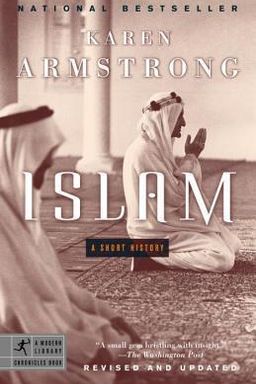
Islam cover

Islam

by Karen Armstrong

Karen Armstrong''s ''Islam: A Short History'' illuminates the remarkable rise of Islam from its origins in seventh-century Arabia to its status as a global faith. Armstrong explores Islam''s unique quest for justice, its historical impact, and its modern challenges, offering readers a profound understanding of a religion that has shaped, and been shaped by, the world.

Islam: The Sacred Drama of History

What if politics, empire, and divine purpose were all threads of the same fabric? Karen Armstrong’s Islam: A Short History opens with this challenging question. She argues that to understand Islam, you must stop separating religion from history. Where Christianity often retreated from politics to seek the divine, Islam made the world itself the stage of its spiritual quest. For Muslims, God is found in the struggle to create a just society, not apart from it. The story of Islam, Armstrong contends, is the story of a people striving again and again to align their communities with divine justice, only to see those efforts fracture, reform, and begin anew.

A Faith Rooted in History

Armstrong begins with a paradox: all religions claim to transcend history, but humans can only experience the sacred through time and culture. Buddhism, Christianity, and Islam all emerged amid political crisis. In Islam’s case, an illiterate merchant named Muhammad ibn Abdallah, worried by the social inequities of Meccan trade, retreated to a cave and emerged with verses that would reorder his world. The Quran was not a philosophical treatise—it was a call to action. It demanded justice, equity, and compassion, and declared that living by these principles was itself worship. To separate political life from religious life, Armstrong explains, would have made no sense in Muhammad’s Arabia. Islam’s mission was to redeem history, not escape it.

The Ummah: God’s Community in Action

When early Muslims migrated from Mecca to Medina in 622 CE, they weren’t simply changing addresses—they were creating a new kind of political organism. The ummah united tribes under ethical rather than blood ties. Membership was based on shared moral ideals, not lineage—a stunningly modern concept. Armstrong portrays this as both a mystical and pragmatic act: Muslims were learning that surrender to God (islam) required deep social commitment. The survival of the ummah became synonymous with spiritual life itself. In this way, the first mosque was both a church and a parliament—ritual and governance fused into one.

Why This History Still Matters

Armstrong’s book is not just a chronicle of empires. It’s an argument about modern misunderstanding. Western readers typically see Islam as a militant theocracy, but Armstrong insists that this view ignores its spiritual roots. Islam’s fusion of religion and society was not fanaticism—it was faith made practical. Every generation of Muslims, from the first caliphs to twentieth-century reformers, has wrestled with how to live out the Quran’s command for justice amid imperfect politics. The violence and extremism of modern movements, Armstrong warns, arise not from Islam itself but from its collision with colonialism, secularism, and the painful modernization forced upon it by the West.

A Journey Through Islamic Civilization

The book journeys through key epochs: the Prophet’s life and the first community; the great caliphates that turned devotion into empire; the creative flourishing of Islamic philosophy and mysticism; and the eventual onslaught of Western imperialism that shattered the political unity of the Muslim world. Along the way, we meet poets, philosophers, reformers, and warriors—from the ascetic Hasan al-Basri to the mystic Rumi and the revolutionary Khomeini—each trying to answer the same question: how can the sacred be lived in history?

Armstrong’s Central Message

Armstrong’s goal is to “resacralize history.” She invites readers to see the political upheavals of Islam not as distractions from spirituality, but as the very canvas on which Muslims seek God. The Quranic vision of a just community offered meaning where the modern West offers mere institutions. You cannot understand modern Muslim struggles, she argues, without grasping this sacred logic. Whether considering the aftermath of 9/11 or the rise of Islamic reform movements, Armstrong urges empathy: Muslims are not clinging to the past—they are still, as they always were, striving to redeem history.


Muhammad and the Birth of a Moral Revolution

Armstrong’s narrative of the Prophet Muhammad begins not with divine revelation but with social crisis. Mecca around 600 CE was a city in moral disarray—wealthy merchants had abandoned the tribal ethic that once ensured mutual care. Muhammad’s revelations—beginning on the night of 17 Ramadan in 610—were his answer to this disintegration. The Quran called people to compassion, equality, and justice. Faith was not belief alone but a new social ethic.

The Message of Equality and Action

At its essence, Islam was about surrendering one’s entire being to God’s will (islam) and building a community that embodied divine justice. Early converts often came from the poor and marginalized—women, slaves, and outcasts. Armstrong emphasizes that Islam rejected the idea of salvation through faith alone. The Quran’s doctrine was practical: feed the hungry, care for the orphan, defend the weak. Religion was measured not by dogma but by how you treated others, unlike in Christianity’s later focus on belief. The jihad of these early Muslims was not holy war—it was the daily struggle to align the ummah with God’s compassion.

From Persecution to the Ummah of Medina

When persecution drove Muhammad’s followers from Mecca, their migration (hijrah) to Medina in 622 marked a turning point. This exodus was more than survival—it was the first attempt to live out the Quran’s ideals politically. The


Muhammad and the Birth of a Moral Revolution

Armstrong’s narrative of the Prophet Muhammad begins not with divine revelation but with social crisis. Mecca around 600 CE was a city in moral disarray—wealthy merchants had abandoned the tribal ethic that once ensured mutual care. Muhammad’s revelations—beginning on the night of 17 Ramadan in 610—were his answer to this disintegration. The Quran called people to compassion, equality, and justice. Faith was not belief alone but a new social ethic.

The Message of Equality and Action

At its essence, Islam was about surrendering one’s entire being to God’s will (islam) and building a community that embodied divine justice. Early converts often came from the poor and marginalized—women, slaves, and outcasts. Armstrong emphasizes that Islam rejected the idea of salvation through faith alone. The Quran’s doctrine was practical: feed the hungry, care for the orphan, defend the weak. Religion was measured not by dogma but by how you treated others, unlike in Christianity’s later focus on belief. The jihad of these early Muslims was not holy war—it was the daily struggle to align the ummah with God’s compassion.

From Persecution to the Ummah of Medina

When persecution drove Muhammad’s followers from Mecca, their migration (hijrah) to Medina in 622 marked a turning point. This exodus was more than survival—it was the first attempt to live out the Quran’s ideals politically. The Medinan constitution united Muslims, Jews, and pagans in a single community bound by justice rather than kinship. For Armstrong, this was revolutionary: Muhammad replaced tribal vendetta with a rule of law and mutual responsibility. He transformed warlike clans into citizens of a moral polity.

A Prophet as Statesman and Reformer

In Medina, Islam became a civilization. The Prophet was not a distant mystic but a political leader—mediating disputes, organizing markets, and reforming family structures. Armstrong highlights his concern for women’s rights: the Quran granted women inheritance and divorce centuries before Europe would. Muhammad’s success, Armstrong argues, lay in his fusion of the sacred and civic. He embodied tawhid—unity—by making every aspect of life part of worship. His building of peace treaties, like the Treaty of Hudaybiyyah, shows his genius for diplomacy and restraint. Winning without war became his greatest victory.

Legacy and Lasting Vision

When Muhammad died in 632, he left no theological system—only a living model of justice. His mission had transformed tribal Arabia into a moral community. Armstrong suggests that Islam’s enduring tension—between spiritual integrity and political power—was born here. Muhammad’s followers, inspired by his example, would wrestle for centuries to preserve the unity he created. To this day, every Muslim effort at reform—from legal scholarship to modern revolution—echoes his original project: to make the divine real in history.


The Caliphate and the Fragile Ideal of Unity

After Muhammad’s death, the Muslim community faced its first great test: how to embody divine unity without a prophet. Armstrong calls this the moment when politics became theology. The first four caliphs—Abu Bakr, Umar, Uthman, and Ali—known as the rashidun or “rightly guided,” tried to sustain the Prophet’s vision of justice. But beneath their rule, old tribal loyalties and new ambitions stirred.

From Brotherhood to Empire

Under Umar, Arab armies left Arabia, conquering Persia, Egypt, and Syria. Yet Armstrong insists that these campaigns were not religious wars—they were extensions of the pre-Islamic ghazu raids turned outward to preserve unity at home. Converts were not forced to embrace Islam; in fact, conversion was discouraged because non-Muslims paid taxes that sustained the army. The early empire ran on pragmatic politics, not zealotry. Success was interpreted as divine blessing—the proof, Muslims believed, that justice and faith could coexist.

The Fitnah: Civil War and the Birth of Division

But harmony did not last. Uthman’s assassination in 656 ignited the fitnah—literally “trial”—a civil war that fractured the ummah. Ali, Muhammad’s cousin, faced rebellion from powerful families like the Umayyads. The resulting wars at the Camel and Siffin exposed a deeper anxiety: who could lead when revelation had ceased? Political conflict birthed theology. Groups like the Kharajites argued that only the most pious should rule; others, later called Shiis, insisted that leadership must stay in the Prophet’s bloodline through Ali. Sunni Islam, by contrast, upheld unity over hierarchy, accepting practical rule even by fallible caliphs.

The Loss of Innocence

When Ali was murdered in 661, his followers mourned not just a man but an ideal. For the first time, Armstrong writes, Muslims experienced history as tragedy. The unity that had mirrored God’s oneness was gone. From then on, every Islamic reform movement—from Sufi mysticism to modern fundamentalism—would attempt to heal this wound. The political drama of the early caliphate thus became Islam’s original spiritual crisis, turning history into a mirror of faith’s fragility.


Dynasty, Law, and the Making of an Islamic Civilization

When the Umayyads turned the caliphate into a hereditary monarchy in 661, many feared Islam’s ideals had been betrayed. Yet Armstrong argues that this imperial transformation made Islamic civilization possible. The Umayyads centralized administration and minted coins inscribed with Quranic verses—the first public assertion of a distinct Islamic identity. But it also sparked the birth of a critical religious counterculture: scholars, jurists, and mystics who tried to keep faith alive under autocracy.

The Piety Movements

From Basra to Kufa, reformers like Hasan al-Basri preached asceticism and accountability. Hasan’s claim that rulers must answer to God’s justice kindled a new science—fiqh, or Islamic jurisprudence. Jurists and theologians debated free will, divine justice, and leadership, creating schools of thought such as the rationalist Mutazilites and the conservative ahl al-hadith. Out of these circles came Abu Hanifa, Malik ibn Anas, al-Shafii, and Ahmed ibn Hanbal—the founders of the four enduring Sunni legal schools. Law became the means by which ordinary Muslims could live Islam even when rulers failed them.

The Abbasid Golden Age

In 750, the Abbasids replaced the Umayyads, fusing Persian imperium with Arab piety. Baghdad rose as a shining cosmopolitan capital of science, philosophy, and art. Caliph Harun al-Rashid’s court combined opulence with intellectual freedom—his reign would later inspire the tales of The Thousand and One Nights. Yet, as Armstrong notes, this splendor came at the price of disconnection: rulers lived in luxury while religious scholars sought purity elsewhere. This tension birthed movements of interior spirituality—from the rigorous legalism of al-Shafii to the mystical yearning of early Sufis such as Rabiah of Basra, who redefined devotion as love rather than fear.

The Birth of the Shariah

Armstrong shows how the Shariah, often misunderstood as medieval rigidity, was originally a radical project of freedom and equality. It placed all Muslims—ruler and peasant alike—under divine law, limiting tyranny and ensuring conscience over coercion. The Shariah equalized society and allowed spiritual autonomy even under despots. It was, she writes, “Islam’s quiet revolution.” By the tenth century, when the caliphs lost real power, it was the jurists, Sufis, and philosophers who held the empire’s moral center. They ensured that Islam outlived its politics.


Mysticism, Philosophy, and Political Decline

By the tenth century, the caliphate had fractured, but Islam’s spiritual and intellectual life flourished. Armstrong argues that decline in power often produced renewal in thought. With politics corrupt and uncertain, scholars sought God inwardly—through Sufism, theology, and philosophy. From Baghdad to Cordova, Islam became a world civilization of the mind.

The Esoteric Turn

Sufi mystics like al-Junayd and al-Hallaj taught that union with God was possible through self-annihilation (fanah). The Shiah evolved their own esoteric doctrine of divinely guided Imams, culminating in the legend of the Hidden Imam—a symbol, Armstrong notes, of God’s elusive presence in history. Meanwhile, philosophers such as al-Farabi, Ibn Sina (Avicenna), and later Ibn Rushd (Averroes) brought Greek rationalism into Islam, fusing reason with revelation. Their Falsafah celebrated intellect as a divine attribute. For a time, Baghdad, Cairo, and Cordova outshone Europe as centers of science and learning.

Al-Ghazzali’s Synthesis

The eleventh-century scholar Abu Hamid al-Ghazzali unified these currents. Stricken by a spiritual crisis, he abandoned his career in law to seek direct experience of God. His masterpiece, The Revival of the Religious Sciences, reconciled mysticism with legal orthodoxy, arguing that ritual law must lead to inner transformation. Armstrong credits him with creating the definitive Sunni worldview: pragmatic, ethical, and contemplative. His work made Islamic spirituality accessible to ordinary believers and preserved Sufism as Islam’s heart.

The Seeds of Stagnation

But political decay continued. Turkish and Mongol invasions shattered empires; the gates of ijtihad (independent reasoning) gradually closed as scholars prioritized preservation over innovation. Armstrong is careful not to call this a decline of Islam but a defense mechanism in a world of chaos. The madrasahs became guardians of heritage rather than engines of change. Yet even amid collapse, new creativity bloomed—from Rumi’s ecstatic poetry to Ibn Khaldun’s pioneering sociology. Islamic civilization withdrew inward but kept its soul alive.


Empires of Faith: Ottomans, Safavids, and Moghuls

Between 1500 and 1700, three great Muslim empires—the Ottoman, Safavid, and Moghul—rose on the strength of gunpowder and centralized rule. Armstrong calls this the period of “Imperial Islam,” when the old dream of unity returned in new political forms. Yet even at their peak, these empires faced the religious paradox at Islam’s core: how could absolute monarchy reflect the equality demanded by the Quran?

The Sunnis and Shiis Divide

The Safavid dynasty in Iran institutionalized Twelver Shiism as state religion, while their Ottoman rivals enforced Sunni orthodoxy. The result was centuries of sectarian conflict—the Muslim version, Armstrong notes, of Europe’s Reformation wars. Shah Ismail’s Iran persecuted Sunnis and elevated clerics (ulama) as interpreters of the Hidden Imam, planting the seeds of Iran’s later revolutionary Shiism. Meanwhile, the Ottoman Empire built an efficient bureaucracy that bound diverse peoples under Shariah law. Suleiman the Magnificent (al-Qanuni, the Lawgiver) fused religion and rational governance, turning Istanbul into a symbol of Islamic humanism and architectural grace.

The Moghul Experiment in India

In India, Emperor Akbar achieved what no ruler in Europe could: a truly pluralistic vision of faith. Abolishing religious taxes and inviting scholars of many creeds to dialogue, he embodied the Quranic principle of “no compulsion in religion.” His successors, however, reversed his tolerance—culminating in Aurangzeb’s puritanical rule, whose persecution of Hindus and Sikhs sowed lasting division. The Moghul story, Armstrong warns, illustrates how the Quranic call to justice may be betrayed when rulers mistake law for righteousness.

Cultural Brilliance, Structural Fragility

Under these empires, Islamic art, architecture, and scholarship flourished—Istanbul’s mosques, Isfahan’s domes, and the Taj Mahal all testified to spiritual grandeur expressed through earthly beauty. Yet the political systems behind them were agrarian autocracies. They could not match the industrial and intellectual revolutions stirring in the West. When modernization arrived, it would come by force, and this collision would spark Islam’s modern crisis.


Islam Agonistes: Confronting Modernity and the West

In the modern era, Armstrong shows Islam entering its most painful chapter—the encounter with a triumphant, industrialized West. From Napoleon’s invasion of Egypt in 1798 to European colonization of Muslim lands, modernization came as humiliation. Western powers dismantled Islamic governance, ridiculed religion as backwardness, and imposed foreign laws. For Muslims, this was not just political domination but spiritual trauma.

The Colonial Disruption

Colonial modernization was uneven: elites were Westernized, while the masses remained poor and religiously rooted. The gap created alienation. Intellectuals like al-Afghani and Muhammad Abdu tried to reconcile faith with reason, arguing that Islam was compatible with science and democracy. Others, such as the Iranian secularists Mulkum Khan and Aqa Khan Kirmani, urged wholesale Westernization. Armstrong underscores that these reformers were not anti-Western—they sought partnership, but their societies lacked time for gradual adaptation. The result was fracture: secular elites versus traditional majorities, each alienated from the other.

Secularism’s Dark Side

When Western-inspired rulers like Atatürk in Turkey or Reza Shah in Iran imposed modernization by decree—banning veils, closing religious schools, and persecuting clerics—they revived a familiar paradox. In trying to build modern states, they unwittingly repeated Europe’s own repressive secularism. For Armstrong, this coercion made religion more radical, not less. Islam, once a unifying force, became a banner of resistance. The political arena again became the sacred arena—as it had in Muhammad’s time, but now under siege.

The Search for an Islamic Modernity

From Egypt’s educator Abdu to Pakistan’s philosopher Iqbal, thinkers sought ways to harmonize Quranic values with democracy and pluralism. Iqbal, echoing Nietzsche and Bergson, saw Islam as rational yet spiritually alive—a needed corrective to Western materialism. But modernization under colonial control made this synthesis nearly impossible. Independence brought neither equality nor justice; it exposed Muslims to the double humiliation of being both free and powerless. The twentieth century, Armstrong concludes, left the Muslim world spiritually disoriented but still striving to find meaning in a world it did not make.


Fundamentalism and the Politics of Despair

Armstrong insists that Islamic fundamentalism is not a medieval survival but a modern creation. Wherever modernization arrives violently, she writes, a counter-movement arises that mirrors its intensity in reverse. Just as Christian fundamentalism arose in the United States after the trauma of industrialization, so Islamic fundamentalism emerged in Egypt, Iran, and Pakistan after the trauma of colonialism.

From Reform to Rejection

Thinkers like Abul Ala Mawdudi and Sayyid Qutb embodied this transition. Mawdudi imagined Islam as a revolutionary liberation theology: if God alone is sovereign, no government has absolute power. Qutb, radicalized in Nasser’s prisons, saw secular regimes as modern “jahiliyyah”—ignorant, pagan systems to be overthrown. His writings later inspired movements from the Muslim Brotherhood to Al-Qaeda. Yet Armstrong cautions that such extremism represents anguish, not essence: it is the cry of a faith betrayed by history.

Iran’s Revolution and Beyond

The 1979 Iranian Revolution demonstrated both the power and peril of political Islam. Ayatollah Khomeini’s theory of Velayat-e Faqih—rule by the jurist—turned Shiism from quietism to activism. Inspired by the martyrdom of Husain, millions rose against tyranny. Yet once in power, the clerics replicated authoritarian patterns, restricting dissent and freedom. Revolution, Armstrong argues, satisfied the longing for justice but not for peace. Elsewhere—from Zia ul-Haq’s “Islamization” of Pakistan to the Taliban’s puritanical regime—similar experiments showed how easy it was for the sacred ideal to harden into coercion.

Fear and Misunderstanding

In the West, these developments reinforced stereotypes of Islam as irrational and violent. But Armstrong asks readers to see fundamentalism as a mirror: it reflects society’s insecurity, not its fanaticism. “Wherever secularism is imposed by force,” she writes, “religion will return in fear and fury.” The Muslim world’s struggle is not backwardness—it is the modern human struggle for meaning amid chaos. The challenge for the West, she concludes, is not to crush this movement but to understand its pain and learn from its passion for justice.


Faith and Understanding After September 11

In her epilogue, written after the attacks of September 11, 2001, Armstrong confronts Islam’s deepest crisis and the world’s deepest misunderstanding. The hijackers’ violence, she states unequivocally, contradicted the Quran and the Shariah. Yet their worldview—shaped by Qutb’s despair and the legacy of oppression—was not born in isolation. It emerged from decades of humiliation, war, and a fractured global order. The West saw pure evil; Muslims saw their rage misused in God’s name.

Beyond Fear and Blame

Armstrong urges both Muslims and Westerners to resist easy narratives. Islamic tradition forbids aggression, demands protection of civilians, and prizes forgiveness. But violent actors, she notes, are often products of secular geopolitics more than religion. In the aftermath of 9/11, anti-Muslim hostility revealed how little the West understood Islam’s spiritual depth. “To view it as inherently the enemy,” she warns, “would be catastrophic.” Just as the Prophet’s early opponents misjudged his peace mission, we risk repeating history through ignorance.

The Call for Compassion and Knowledge

Instead of confrontation, Armstrong advocates empathy and education. Understanding Islam’s sacred history—the quest for unity through justice—can transform hostility into respect. Islam’s essence, she concludes, is not violence but the tireless effort to “make the divine effective in the world.” Knowledge is the new jihad. To engage with Islam truthfully is to engage with humanity’s shared longing for meaning amid the turbulence of history.

Dig Deeper

Get personalized prompts to apply these lessons to your life and deepen your understanding.

Go Deeper

Get the Full Experience

Download Insight Books for AI-powered reflections, quizzes, and more.