
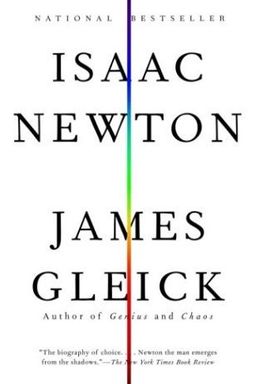
Isaac Newton cover

Isaac Newton

by James Gleick

Explore the life of Isaac Newton, the mastermind who transformed our understanding of the universe. Through his groundbreaking work in mathematics and physics, Newton challenged existing beliefs, faced fierce opposition, and left an indelible legacy that continues to shape scientific inquiry today.

Isaac Newton and the Invention of the Modern Mind

When you look at the world through your phone’s screen or ponder how a rocket travels to Mars, you’re seeing traces of one man’s logic. But how did someone born the posthumous son of an illiterate farmer, in a remote English village, become the architect of the modern world? In Isaac Newton, James Gleick invites you to rediscover not only the great scientist’s discoveries—calculus, laws of motion, gravity, optics—but also the inner landscape of solitude, secrecy, and relentless brilliance that defined him.

Gleick contends that Newton’s work reshaped how humanity understands knowledge itself—how to measure, model, and believe in the universe. His story is the story of how science became quantitative, predictive, and universal. Yet, beyond equations, Newton’s life was also shaped by human frailty: pride, isolation, obsession, and the deep intertwining of reason and mysticism. To understand Newton is to see where faith met physics, and where modernity itself was born.

From Darkness into Light

Newton’s world in the 17th century was one of “obscurity and magic.” When he was born in 1642, England was embroiled in civil war, still centuries away from the industrial mechanization his discoveries would help inspire. Against this backdrop, Gleick opens with the image of a funeral and a birth: the death of old superstition and the beginning of a new intellectual age. Newton’s state funeral in Westminster Abbey, carried out with regal pomp, marked the elevation of knowledge itself to a form of divinity. Philosopher Voltaire called him the man who showed the world “how the moon and sun tug at the seas.”

An Undiscovered Ocean of Truth

Newton’s own words, which Gleick resurrects with reverent awe, define his humility and ambition: “I seem to have been only like a boy playing on the seashore … whilst the great ocean of truth lay all undiscovered before me.” But as the author makes clear, that humility was deceptive—Newton’s genius derived from an unmatched confidence in the power of reason to find law in chaos. He believed that nature, however vast, could be parsed through definition, measurement, and number. What the Greeks imagined in ideal forms, he transformed into universal mathematics.

When you hold a smartphone’s accelerometer or watch planets orbit in simulation, you’re seeing Newton’s intellectual DNA at work. Gleick aligns Newton’s revelations with the birth of modern data culture: a belief that, through observation and quantification, all things could become knowable. Yet Newton didn’t just change the cosmos—he reinvented the thinker. For Newton, solitude and the act of thinking were sacred tools for decoding creation itself.

The Structure of the Book

Gleick moves through Newton’s life in stages: from an abandoned boy in Woolsthorpe scratching dials into stone, to a Cambridge recluse inventing calculus during plague quarantine, to the master of the Mint waging war against counterfeiters and rivals. Each chapter reveals a new paradox—Newton the mystic alchemist alongside Newton the scientific rationalist. You’ll encounter the fierce disputes with Robert Hooke, the friendship and feud with Leibniz over calculus, and his lifelong theological obsession with decoding God’s secrets. Gleick’s Newton doesn’t belong wholly to science or religion but oscillates between them, embodying both the faith of the magician and the discipline of the mathematician.

Why does this matter to you? Because Newton’s story is the story of how humans learned to trust evidence over dogma and pattern over myth—but also how intellect could become an island. Gleick suggests that the modern scientist’s detachment and precision come directly from Newton’s temperament: the solitary figure in a closed room, aligning prisms and chasing invisible forces through formulas.

Why Newton Still Shapes You

By the time you finish Gleick’s portrait, you’ll understand how Newton’s laws still guide everything from your car’s brakes to the orbits of satellites. But you’ll also see the cost of genius: the friendships torn by pride, the years lost to obsession, and the dangerous conviction that one mind could reach the mind of God. Newton’s universe—precise, mechanical, infinite—became ours. As Gleick writes, the child in the farmhouse became “chief architect of the modern world.”


The Solitary Genius at Woolsthorpe

Imagine being left behind by your mother at three years old, raised among sheep and stone walls, with war flashing across your countryside. This was Isaac Newton’s beginning. Gleick paints a vivid picture of a lonely, small boy in Woolsthorpe, England—an unlikely environment for the birth of modern physics. While his peers learned farming, young Newton carved sundials into the walls, building models of mills and kites that lit the sky. These weren’t games—they were the seeds of a new kind of mind: one that measured the invisible.

When Curiosity Replaces Companionship

In his solitude, Newton turned the natural world into his only teacher. His obsession with measurement began early: lines in dirt became scales of time, shadows became clock hands. He was surrounded by a world of superstition, yet he sought certainty in patterns. Gleick captures this beautifully: when the sun crept along his wall, Newton saw time itself as geometry—a concept that prefigured his eventual fusion of space, time, and motion.

What makes this moving is how clearly it parallels later innovators. Like Einstein puzzling over trains or Steve Jobs tinkering alone in a garage, Newton’s childhood isolation created a habit of deep, private experimentation. His inventions were pragmatic and magical at once—lanterns for kites, clocks fueled by dripping water. Each was an attempt to master nature’s hidden language.

A Mind Formed in Rebellion

When Newton’s mother tried to make him a farmer, “he spent more time gathering herbs and lying with a book among the asphodel.” He refused the life assigned to him. His rebellion was intellectual—a quiet refusal to accept the limits of class or tradition. Gleick frames this as the first great act of creative defiance in Newton’s life. To you, it’s a reminder that curiosity often looks like disobedience. It starts with wondering why the world must be as others say it is. From that disobedience grew the calculus of the planets and the laws of motion that govern every falling apple to this day.


Inventing a New Language of Nature

At Cambridge, Newton entered a world still ruled by Aristotle’s static cosmos. But instead of repeating ancient wisdom, he began to ask dangerous questions. What if motion and rest were the same? What if time was not human but absolute? What if the universe could be written as a language—one of numbers rather than words? This was his true rebellion: he reinvented the dictionary of nature.

Birth of the Calculus

During the plague years of 1665–1666, Newton retreated to Woolsthorpe and quietly changed the world. There, he created methods to calculate the infinitely small—what we now call calculus. Gleick calls it his moment of transfiguration: a twenty-four-year-old, living through pestilence, inventing the mathematics of motion and change. His Waste Book became the cradle of modern science. Later, this was the spark of bitter controversy with Gottfried Leibniz, but at the time, it was the birth of a tool that still runs your digital life, from algorithms to physics engines.

The Infinite and the Infinitesimal

Where others feared infinity, Newton embraced it. He sought to capture the infinitesimal—quantities “smaller than any finite amount but greater than zero.” Through this, he could describe not just things but processes: falling, curving, accelerating. Gleick contrasts Newton’s audacity with Descartes’s caution (Descartes had warned: “We should not enter into arguments about the infinite”). Newton did. And in doing so, he brought the invisible within reach.

For you, this reveals a timeless lesson: to see further, you must be comfortable with incompleteness. Newton’s equations didn’t close the world—they opened it, showing that behind every motion lies another pattern, waiting to be described. His patience with uncertainty became the foundation of all later science.


Gravity, Light, and the Architecture of the Cosmos

If Newton’s calculus gave science a voice, his synthesis of gravity and light gave it vision. Gleick calls this Newton’s architecture of knowledge—the structure that allowed humanity to see the heavens not as divine chaos but as predictable motion. What’s striking is how he did it: through thought experiments, not telescopes. He imagined cannonballs, falling apples, and orbiting moons, connecting them all through invisible forces.

The Fall of the Apple and the Rise of the Universe

Everyone knows the myth of the falling apple. Gleick restores the nuance: Newton didn’t discover gravity in one flash; he reasoned his way through scales of magnitude—from orchard to cosmos. His profound insight wasn’t that things fall, but that the same force that pulls the apple governs the moon’s motion. That single unifying principle turned the medieval heavens into a mathematical cosmos.

He calculated, roughly, how the moon would orbit if gravity weakened with distance squared—the same inverse-square law that lights obey in brightness. The numbers “answered pretty nearly.” It was enough to change everything. Gleick shows how this intellectual leap became the key to the 1687 Principia Mathematica, the book that gave the world its laws of motion and transformed faith in mystery into faith in law.

Light, Darkness, and Revelation

At the same time, Newton was splitting sunlight with prisms in his Cambridge rooms—an act that sent the last echoes of Aristotle scattering across the wall. He discovered that white light was not pure but composed of colors. Here Gleick connects science to metaphor: Newton found in light both the nature of color and the moral of knowledge—that illumination reveals complexity, not clarity. His optics experiments made him famous and drew envy that poisoned his relationship with Hooke. But they also embodied his deeper message: enlightenment is always refraction—truth seen through the angled glass of perception and mathematics.


The Philosopher of Secrecy and Solitude

For Newton, discovery and secrecy were inseparable twins. Gleick describes a man who feared exposure as much as he feared error. He published little, delayed for decades, and encoded results in cryptic notes. He invented calculus, then hid it; explored alchemy, then burned his traces; analyzed scripture, then concealed his heresies. Solitude wasn’t a choice—it was his method.

Alchemy and Heresy

Even as president of the Royal Society, Newton conducted secret experiments to transmute metals and pursued what he believed to be God’s hidden physics. Gleick reveals his thousands of pages on alchemy—mercury, cinnabar, “the two serpents ferment well.” Yet beyond the laboratory, he was performing a similar transmutation: forging spiritual insight into material law. His theology rejected the Trinity and sought to decode the Bible like nature—through numbers and symbols. He was, Gleick writes, “the last of the magicians.”

A Private Universe

You feel here the tragic beauty of his mind: a universe so vast and precise that it left no room for company. Newton distrusted others, quarreled bitterly with Hooke and Leibniz, and shunned fame. When he finally entered London society as Master of the Mint, he retained the habits of isolation. Yet his privacy gave his science its purity. In an age of eager communication, Newton reminds you that the deepest insights sometimes require silence—years of playing, unseen, with the pebbles on your own intellectual shore.


Rivals, Royalty, and the Making of a Legend

By the time he reached London, Newton was more than a thinker—he was an institution. Gleick turns his lens on this transformation: the recluse became the empire’s mind. As Master of the Mint, Newton applied the same scrutiny he brought to physics to England’s faltering currency, hunting counterfeiters with ferocity. His pursuit destroyed William Chaloner, the forger, as if proving that even criminal motion followed law. When Queen Anne knighted him, it wasn’t for his equations but his reliability—a symbol of order itself.

Clashing with Hooke and Leibniz

Gleick shows how Newton’s fierce pride corroded his relationships. His feud with Robert Hooke over optics turned acrid; his clash with Leibniz over calculus became one of science’s earliest priority wars. Both reflected Newton’s growing conviction that he alone could guard truth from corruption. In this, he anticipated the modern scientist’s paradox—demanding transparency yet guarding prestige. Gleick’s Newton is both creator and controller: the first to weaponize scientific authority as moral capital.

From Human to Monument

When Newton died in 1727, his funeral became the first state ceremony for a man of intellect. Gleick closes with the image of his marble effigy in Westminster Abbey—angels weighing planets, Newton recumbent beneath a celestial globe. It was the apotheosis of reason. Yet Gleick reminds you of the irony: the man himself “never played at the seashore,” likely never saw the ocean he described so perfectly. In life, he saw the cosmos through the mind, not the senses. In death, he became what he resisted most—a figure of myth, eternally still beneath marble waves of eternity.

Dig Deeper

Get personalized prompts to apply these lessons to your life and deepen your understanding.

Go Deeper

Get the Full Experience

Download Insight Books for AI-powered reflections, quizzes, and more.