
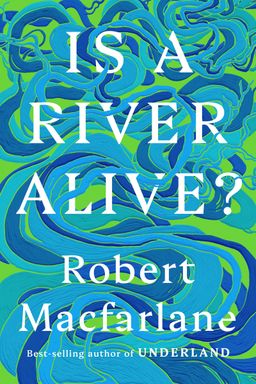
Is A River Alive? cover

Is A River Alive?

by Robert Macfarlane

The author of “Underland” explores flowing waters in Ecuador, India and Canada.

Rivers, Rights, and Living Waters

What if you treated a river not as infrastructure to be managed but as a living being with rights? This book argues that when you shift rivers from objects to subjects, your sense of duty, policy design and daily language all change. The narrative moves from Ecuador’s cloud-forests to Aotearoa New Zealand, India, the UK, and across to the Mutehekau Shipu (Magpie River) in Québec, so you can see how law, ritual, science, and grassroots bravery converge to defend water as life—often against powerful forces of extraction and erasure.

Two worlds, one turning

You inhabit two overlapping legal-political worlds. In one, rivers are resources—drainage basins, kilowatt potential, channels to be straightened, tapped and dammed. In the other, rivers are relatives and ancestors, capable of holding rights and of being represented in courts by guardians who speak for their life and flow. This second world is no longer hypothetical. It appears in Ecuador’s 2008 Constitution (Articles 71–74), in Aotearoa New Zealand’s Te Awa Tupua Act for the Whanganui River (2017), in Colombia’s Atrato decision, and in Québec’s mirror resolutions for the Mutehekau Shipu (2021). Each case shows a river made legally audible.

Law as new grammar

Rights-of-nature law acts like a “grammar of animacy” for governance. When a statute names a river a legal person, it reorders who can speak and what counts as harm. Whanganui’s proverb—“Ko au te Awa; ko te Awa ko au” (I am the river; the river is me)—enters law as premise, not poetry. Ecuador’s judges at Los Cedros used constitutional articles to halt mining, writing that the forest and its rivers hold rights to maintain cycles and functions. In Québec, the Innu Council of Ekuanitshit and the Minganie regional municipality used twin resolutions to recognize the Magpie’s rights to flow and evolve naturally, pairing Indigenous cosmovision with municipal authority (a "Two‑Eyed Seeing" strategy that braids knowledge systems).

Hydrology and ecology, made visible

The book makes hydrology intimate. Cloud‑forests like Los Cedros literally make rivers by catching mist on epiphytes and dripping it into streams as fog‑drop. Mycelial networks act as subterranean micro‑rivers, holding and redistributing moisture. In cities, daylighting brings buried streams back to sight—Cheonggyecheon in Seoul and the Isar in Munich prove that urban life revives when waterways are freed. You learn to read a river’s tongues, eddy‑lines and spirals, so advocacy rests on embodied knowledge, not abstraction.

Front lines: dams, mines, and murdered rivers

Hydro‑Québec’s plan to multi‑dam the Mutehekau Shipu shows how “development” drowns rapids, spreads mercury, and fragments boreal forests with roads and transmission corridors. The Romaine River—now the Magpie’s ghost sister—is what multi‑damming does: chained reservoirs, lost salmon beds, and social harms rippling through nearby towns. In Chennai, colonial and modern planning erased wetlands and eris (traditional tanks), so floods and water scarcity now alternate like fevers. The Cooum and Adyar rivers, once living channels, are treated as open sewers. Wherever you look, the harm is hydrological and cultural at once.

Key claim

“Words make worlds.” Change the legal and everyday language for rivers, and you change what becomes politically possible.

Ritual, poetry and grief as practice

Legal personhood without cultural practice risks hollowness. In Québec, the Innu poet‑healer Rita Mestokosho ties red threads, burns sage, gives tobacco for offerings, and asks travelers to fast and “think like the river.” Ritual makes responsibility felt. The journey down the Magpie becomes a rite not of cure but of passage: griefs are carried differently after you ask the river your question. This echoes Indigenous water ceremonies elsewhere and aligns with Robin Wall Kimmerer’s call for a grammar of animacy (Braiding Sweetgrass) that teaches gratitude and kinship.

Defenders, evidence and movement

Nothing here moves without people. Josef DeCoux, living for decades at Los Cedros, hosted judges and scientists; lawyers like Agustín Grijalva and Ramiro Ávila built robust constitutional cases; mycologist Giuliana Furci documented rare fungi that helped win in court. In Chennai, educator‑activist Yuvan Aves trains children, maps lost wetlands, and walks turtle‑guard nights. Mirrored resolutions, guardianship councils, citizen science and counter‑mapping travel quickly—youth organizing for Lake Erie shows the idea’s portability. The book’s hard truth: water defenders face threats and, sometimes, murder (as with Alba Bermeo Puin). The work requires courage, coalition and care.

What this asks of you

Recalibrate your baseline. Learn your river’s language—its eddy‑lines and drought scars—and your place’s memory—where wetlands once held monsoon or snowmelt. Support legal personhood and guardianship where it fits, but pair law with ritual, story, and science. Resist extractive projects that pretend costs are local and benefits are universal. Above all, speak differently: say “the river who,” not “the river that,” and let that shift guide your next act—whether it is a petition, a court brief, a daylighting plan, a turtle patrol, or a quiet morning offering on a cold bank.


Law That Hears Rivers

Rights of Nature gives you a practical way to defend rivers: make them legal persons with standing. That move transforms who can sue, how harm is defined, and what remedies look like. The book tracks this shift from Christopher Stone’s 1971 provocation (“Should trees have standing?”) to present‑day statutes, court decisions and municipal resolutions that treat rivers as indivisible, living beings—respected not just in story but in law.

Signatures and statutes

Start with the Whanganui River in Aotearoa New Zealand. The Te Awa Tupua Act (2017) declares the river a single, living whole and appoints Te Pou Tupua—human guardians—charged with speaking for its mana and mauri. Ecuador goes further: its 2008 Constitution embeds Rights of Nature so judges can act without new statutes. In the Los Cedros case (2021), the Constitutional Court halted mining concessions by Cornerstone/ENAMI, holding that extraction would violate the forest‑river system’s rights to maintain life cycles and evolutionary processes (Agustín Grijalva and Ramiro Ávila’s opinions are philosophically rich and ecologically precise).

Municipal mirrors and guardians

In Québec, the Innu Council of Ekuanitshit and the Minganie MRC passed “mirror resolutions” declaring the Mutehekau Shipu a rights‑bearing entity with the right to exist, flow and evolve naturally. This twin‑document strategy carries both Innu‑aimun and French framings—what elders call "Two‑Eyed Seeing"—and proposes a mixed guardianship team of Innu and settler members. Guardians become the river’s legal mouth: they monitor, speak, and, if needed, litigate. Similar moves appear in Colombia’s Atrato ruling (T‑622/16) and in rising North American campaigns around the St Lawrence, Lake Erie and Great Salt Lake.

How personhood rewires remedies

When a river is a person, harm is not only a breach of permit conditions; it becomes a violation of a being’s right to life cycles, health and flow. Restoration then focuses on re‑establishing ecological function, not just offsetting damage. The Los Cedros judgment orders companies to leave and requires protection and regeneration; the Te Awa Tupua framework channels funds and authority to a guardianship that asserts the river’s voice in planning decisions.

Tensions and tests

Personhood is not a magic shield. In India’s Uttarakhand, judges briefly granted the Ganges and Yamuna legal personhood in 2017, then reversals and jurisdictional snags followed. Québec has not categorically ruled out future dams on the Magpie despite its rights status. Skeptics like Wayne Chambliss worry about ventriloquism: can human guardians truly “speak the river”? The book’s answer is pragmatic: guardianship is a tool among many—its legitimacy grows with community trust, ecological data, and lived practice (ceremony, monitoring, storytelling). Without these, personhood risks becoming a paper shield.

Working principle

Pair law with culture: personhood plus guardianship plus ritual and science gives rivers the best chance to be heard and heeded.

Language as legal technology

Legal personhood travels on language. The Te Awa Tupua Act embeds Māori terms; Ecuadorian judgments adopt sumak kawsay; Québec’s mirror resolutions echo Innu kinship. This mirrors Robin Wall Kimmerer’s “grammar of animacy”: call a river “who,” and law can follow. The Declaration of the Rights of the River Cam in the UK shows how such words build momentum even without immediate statutory backing (Note: municipal declarations can prefigure later national moves, as civil rights and climate policies often did).

How you can adapt it

If you aim to protect your river, study the Mutehekau model: craft dual‑language resolutions, name concrete rights (to flow, to be pollution‑free, to regenerate), constitute a guardianship council, and anchor it in both Indigenous law and municipal authority. Link personhood claims to scientific baselines and community rituals so they are monitorable and meaningful. Then prepare for hard cases: utilities, mining and large‑scale agriculture will test the boundaries—exactly where guardianship and standing become most valuable.


Dams, Power, and River Death

Big dams promise clean power, but the book shows how they often deliver ecological erasure and social harm. Hydro‑Québec’s designs for the Mutehekau Shipu (Magpie River) illustrate the playbook: start with one dam (2008), then propose more by leveraging existing lines, work camps and regional control—the Romaine complex next door becomes the template, a “ghost sister” showing what chained impoundments do to a once‑wild river.

How dams alter rivers

Think in four transformations. First, free‑flowing water turns into a procession of reservoirs that drown rapids, portages and salmon beds—river becomes lake. Second, banks and floodplains die, leaving submerged forests that rot and mobilize mercury, a long‑term toxin for fish and people. Third, construction brings access roads and transmission corridors that fragment boreal forest and invite extractive incursions. Fourth, large camps induce rapid social shifts: jobs, yes, but also spikes in crime, STIs, divorce and homelessness (Romaine’s public‑health monitoring documents this).

The calculus and its blind spots

Companies count megawatts, not memory. Hydro‑Québec’s “social acceptability” rhetoric, the book argues, masks a decision pathway built far from the river’s life. Chief Jean‑Charles Piétacho’s lament at the Romaine‑4 opening—loss of campsites, canoe routes, and fisheries—shows how impoundment is cultural dispossession. (Comparative note: Three Gorges on the Yangtze made this globally visible; the costs scale down to regional projects, too.)

Rights of Nature as brake and beacon

Personhood for the Mutehekau Shipu becomes both legal brake and narrative beacon. The Innu Council and Minganie MRC assert the river’s rights “to exist and to flow,” and propose guardianship. Even if Québec refuses to renounce future dams outright, developers now face a river with standing, community resolve and national attention (witness Canada’s Bill C‑271 proposals to give the St Lawrence legal capacity). The combination of rights, ritual (Rita Mestokosho’s ceremonies), and skilled river guides (Danny and Raph) shifts the terrain from kilowatt spreadsheets to lived kinship.

Alternatives and transitions

The book doesn’t romanticize scarcity; it asks you to count full costs. Methane emissions from reservoirs, mercury bioaccumulation, and the loss of salmon economies challenge the “green” label on certain hydro projects. Where energy is necessary, prioritize efficiency, grid upgrades, run‑of‑river designs with strong ecological safeguards, and distributed renewables sited away from critical watersheds (Note: the Elwha Dam removal in Washington shows how fast rivers revive when obstructions fall—salmon returning, beaches rebuilding, forests reborn within a decade).

Moral of the river

A river is not an energy corridor with scenery attached; it is a living archive whose erasure cannot be cleanly offset or “mitigated.”

How you can act

If dams loom in your region, demand cumulative‑impact analysis, mercury and methane accounting, and serious consideration of non‑dam alternatives. Press for Indigenous consent as prerequisite, not afterthought. Where projects exist, monitor flows and fish populations, and build alliances like the Mutehekau Shipu partnership—Indigenous councils, municipal leaders, whitewater groups, conservation NGOs. Bring story and science together: portage names, spawning records, and health data form a case that speaks to courts and neighbors alike.


Cloud‑Forests Make Rivers

If you picture a river only as surface water, Los Cedros rewrites the image. In Andean cloud‑forests, mist condenses onto epiphytes—orchids, bromeliads, mosses—and drips steadily into headwaters. The forest is a water‑making machine; cut it, and you cut the river. The book walks you up ridges and down ravines to show how this airborne hydrology becomes the Río Los Cedros, whose pools and riffles sustain otters, quetzals, spectacled bears and a hidden multitude of fungi.

Hydrology as life support

Cloud‑forests sit where moist air cools, often between 3,000–8,000 feet. Epiphytes amplify surface area, catching fog and turning air to water—“fog‑drop.” This slow drip keeps streams alive through dry spells, buffering drought and stabilizing flow (compare England’s drying chalk streams when abstraction and drought remove that buffer). You learn to see trees as condensers and fallen logs as sponges, with mycelium as capillary plumbing beneath your feet.

Mining as hydraulic assault

Open‑pit gold and copper extraction unravels this system. Road building, pit blasting, cyanide leaching and tailings ponds don’t just scar a hillside; they disable the fog‑capture network and fracture aquifers. Cornerstone/ENAMI’s concessions crept into Los Cedros’ lower third, reaching three headwaters. The likely outcome—deforestation, cyanide run‑off, dammed rivers—would be not mere pollution but the stoppage of the living processes that create flow.

Court as watershed

On 10 November 2021, Ecuador’s Constitutional Court ruled for the forest and river, invoking Articles 71–74 of the Constitution. The decision did not treat Los Cedros as a resource parcel; it framed a life system with rights to maintain its cycles and evolutionary processes. The judges visited annually, listened to local testimony and—crucially—integrated scientific findings as legal evidence (Note: this is what strong environmental courts can do when constitutional language is clear and judges are willing).

Fungi as witnesses

Giuliana Furci’s mycology was pivotal. Discoveries of rare species (Amanita galactica; later Protostropharia with psilocybin) testified to the forest’s uniqueness. Bioluminescent “mycelial light” from rotting stumps revealed active nutrient cycles. These were not curiosities; they were legal allies. The court recognized that destroying this fungal‑tree‑river mesh would cause irreversible loss. Giuliana’s line—“No one is without another”—captures the hydrologic‑ecologic intimacy at stake.

Lesson from the ridge

Protecting headwaters and cloud‑forests is the baseline for river survival—not a luxury add‑on.

Guardians and risks

People held the line. Josef DeCoux ran the Scientific Station, hosted judges and scientists, and faced threats. Organizers like José Cueva and Monse Vásquez did the public work that courts later ratified. The costs were real: the book names murders and intimidation of water defenders (Alba Bermeo Puin’s killing as a stark warning). The victory at Los Cedros emerges from years of grassroots defense—science, ritual, law and grit braided in hard terrain.

How you can use the template

In your watershed, map fog‑capture zones, springs and mycelial hotspots; gather baseline biodiversity data; document community reliance downstream. Pair that science with cultural narratives (Indigenous cosmology, local stories) and push for constitutional or municipal recognition of the ecosystem’s rights. When extraction looms, make the hydrological case plain: to cut the forest is to cut the river who feeds us.


Language, Ritual, and Animacy

How you speak shapes what you can love and defend. The book shows how a “grammar of animacy” turns rivers from “it” into “who,” easing the leap from empathy to law. This isn’t semantic play—it’s political technology. When Māori terms like mauri enter the Te Awa Tupua Act, when Innu kinship infuses the Magpie resolutions, when Ecuadorian judges write that a forest speaks, language reorganizes obligation.

Why words matter in water work

English tends to objectify: “the river that flows.” Robin Wall Kimmerer’s work invites you to speak as if rivers live because they do—animacy is an empirical and ethical insight. The book models this by consistently writing of rivers and forests as “who.” That choice normalizes guardianship. It also clarifies harm: if a river is a relative, sewage outfalls and over‑abstraction become trespass, not “externalities.”

Rituals that teach attention

Rita Mestokosho’s practice—burning sage, singing in Innu‑aimun, tying red threads, orienting tents to sunrise—reorients travelers from control to listening. She asks each person to fast and bring one question to the river. The journey down the Mutehekau Shipu becomes a school of attention where grief finds a place to stand. The rituals are not private piety; they’re public pedagogy, making collective care possible (compare with water ceremonies around the Great Lakes that have energized Rights‑of‑Nature talk there).

Poetry as legal force

“My people wrote while walking / they had the library of the land with them,” Rita writes. Poetry does diagnostic work courts struggle to do: it expresses value beyond markets. In practice, poems, declarations (like the River Cam’s), and community charters move opinion and create the preconditions for law. Judges read stories; councilors vote with images in mind; children learn to guard beaches through songs as much as through statutes (the Turtle Patrol on Chennai’s shore is living curriculum).

Daylighting speech

Daylighting is physical and linguistic. In Seoul, restoring Cheonggyecheon unburied a stream and a civic mood; in Munich, the Isar’s rewilding reopened urban imagination. The book asks you to daylight dormant words too: revive names for streams, tanks and wetlands (Chennai’s eris, kammai) so policy can see what bulldozers once erased. When citizens say the names out loud, maps change, and so does municipal will.

Practice prompt

Start small: say “the river who,” learn one local water word each week, and make one tiny ritual of reciprocity. Small speech acts compound into political possibility.

Facing the limits

Language without institutions can become sentiment; institutions without language can become technocratic and cold. The book’s answer is braidwork: pair animacy‑language with legal personhood, pair ritual with guardianship, pair poetry with baseline data. That is how words make worlds you can live in—and defend in court.


Cities, Daylighting, and Chennai

Urban rivers are often ghosts. The book’s Chennai chapters show how erasing wetlands and burying streams turns a water‑literate landscape into a city of floods and thirst. You also see how daylighting and community practices can undo some of this harm, if policy and people move together.

A water‑wise city forgotten

Historically, Chennai lived with monsoon rhythms through eris—tanks and channels that stored and slowly released water. Colonial and modern planning paved and built over these “blue hoof‑prints,” erasing capacity to absorb rain and recharge groundwater. The result is a boom‑bust cycle: catastrophic floods (2015) and then desperate scarcity (2019). The rivers—the Kosasthalaiyar, the Cooum, the Adyar—carry the memory of their courses and return in floods when squeezed (the book calls them spectral, vengeful presences).

Murdered rivers and living costs

The Cooum has become a byword for filth; the Adyar estuary hosts turtle carcasses; the Buckingham Canal and Pallikaranai Marsh choke on development and toxic discharge. This is not just ecological data; it is social hardship for the poor who live closest to water’s edge, inhale the fumes, and suffer displacement. (Context: similar patterns recur from Nairobi’s Mathare to São Paulo’s Tietê.)

Practices that restore

The book documents counter‑currents. Vedanthangal bird sanctuary thrives under local stewardship anchored in tank hydrology. The Turtle Patrol gathers volunteers—parents, grandmothers, teenagers—to guard Olive Ridley nests by night. Activist‑educator Yuvan Aves teaches hydro‑literacy, organizes counter‑mapping of “Lost Wetlands,” and helps press legal action (including against polluters like Sun Pharma). Citizen science—water quality tests, species counts—meets rituals of care in a practical civic weave.

Daylighting and rights together

Physical daylighting projects matter. Seoul’s Cheonggyecheon shows that pulling a highway off a buried stream cools a city, lowers pollution, and gives people back a commons. Munich’s Isar rewilding shows floodplains can return in dense places. But the book insists: pair engineering with rights. Give rivers and wetlands legal standing, appoint guardians, and protect eris networks in law so gains stick and the poor are not displaced by “green gentrification.”

Urban water ethic

An ecological, juridical, and reparative agenda can let cities live with water rather than die by it.

What you can do where you live

Map buried streams; learn your city’s “pre‑asphalt” hydrology; push for green‑blue corridors and wetland protections with legal teeth. Combine school programs with night‑watch volunteerism (your local “turtle patrol”). Demand pollution transparency and prosecute chronic offenders. Most of all, refuse the amnesia of shifting baselines by recovering stories of abundance—when fish ran thick, when tanks held monsoon—so the future you seek is not a guess but a remembered possibility.


Hydro‑literacy and Embodied Knowing

To protect a river, you have to learn its language. On the Mutehekau Shipu, guides Danny and Raph teach the author and Wayne a practical hydro‑literacy—how to read tongues, eddy‑lines and spirals; how to ferry across current; how to survive a capsize. This is more than sport. It’s embodied epistemology: the river becomes intelligible through your body, and that knowledge fuels credible advocacy.

The river’s glossary

You learn Strahler stream order to grasp branching complexity (the Romaine scores a 7, signaling massive connectivity—and massive impact when dammed). “Tongues” are fast, narrow flow lanes you can catch; “eddy‑lines” are boundaries between main flow and counterflow, places of oxygenation and fish passage; “holes, strainers, sieves” are killers—re‑circulations, logjams and pinning rock slots. These terms become survival tools and policy metaphors (e.g., a dam can turn oxygen‑rich tongues into stagnant backwaters).

Training for humility

Capsize drills and ferry runs teach three rules: don’t panic, get clear of the craft, and float flat with feet up, head upstream. RM flips and gets pinned briefly under his boat—a small panic turns the lesson true. Ghost‑boating and hand‑lining appear when rapids like Saxophone or Marmite become too dangerous to crew. The ethic is pragmatic: read risk, respect limits, proceed by feel and evidence. River work and policy work share this humility.

From reading to ethics

When you can “read” a rapid, you also see where salmon stage and rest, where invertebrates thrive, and how sediment writes the memory of floods (oxbow scars). This attention defeats shifting baselines. It also strengthens testimony: you can point to the exact eddy-line an intake would disturb, or to the riffles that would drown under a reservoir. Hydro‑literacy turns abstract claims into felt specifics that judges and neighbors can picture.

Linking skill to change

Elwha Dam removal proves what skilled attention can win: salmon returned within seasons; beaches rebuilt; cottonwoods surged—rivers heal fast when you get the obstructions out of their way. Combine that precedent with your river’s hydro‑literacy to argue for daylighting, dam removal, or flow restoration. Add personhood where fitting, so your knowledge has a legal carrier.

Takeaway

Know the names and the moves—then your voice carries the river’s shape into rooms where decisions are made.

Your next steps

Learn basic ferrying and safety; walk your river at different levels and seasons; map tongues and eddies; note where fish rise. Teach children this vocabulary so memory carries forward. Pair these practices with citizen science—temperature, dissolved oxygen, insect counts—and with stories that hold place. You are building not just skill but stewardship.


Fungi and Forest Intelligence

Beneath the moss and leaf litter runs a second river system: mycelium. The book centers fungi as agents—holding moisture, moving nutrients, lighting up the forest floor with bioluminescent “mycelial light.” Giuliana Furci’s fieldwork at Los Cedros makes fungi both ecological actors and legal witnesses, showing how underland life stabilizes rivers and strengthens court cases for protection.

Mycelial hydraulics

Hyphae weave capillary networks that wick and release water, extend tree roots’ reach, and create micro‑reservoirs beneath your boots. Ectomycorrhizal partnerships boost nutrient uptake; decay cycles turn deadwood into sponges. The glow from stumps is not a trick; it’s a sign of conversion: wood to water‑holding substrate, carbon to soil life. Think of mycelium as subterranean riffles and pools that keep headwaters from snapping under stress.

Evidence that saves forests

Giuliana’s collections—Amanita galactica; a psilocybin‑bearing Protostropharia on wood—demonstrate biological singularity in Los Cedros. Add fungal agriculture by leaf‑cutter ants, and you see a co‑operative economy underground. In court, these details matter: they show irreversibility if mining proceeds. Judges can then rule not on sentiment but on specificity: living processes, in named species and quantified networks, would be cut beyond repair.

Kawsak Sacha and legal form

The Kichwa concept Kawsak Sacha—Living Forest—presses law to see territory as a conscious, interdependent being, not a set of parcels. A mycelial worldview supports this: if life is networked, governance that atomizes (tree here, stream there) misses the point. Rights‑of‑nature language that protects “structure, functions and evolutionary processes” is a better legal fit for what fungi actually do.

Ethic of interbeing

“No one is without another,” Giuliana says in a clearing. The line doubles as river ethic: your well‑being is braided with hyphae, moss, cedar buttresses, otter trails, and the human guardians who hold ground. When extractive projects move in, they don’t just take ore; they break relationships. The remedy must be relational too—guardianship, ritual, data, and care in long companionship.

Practical move

Map fungi and mycorrhizal indicator species as part of watershed planning; treat them as hydrological infrastructure, not ornament.

What you can carry forward

Adopt an “underland lens” in environmental impact assessments. Include fungal richness, wood‑decay stages, and mycorrhizal types alongside flow metrics. In education, teach children to look down as much as out—night walks to see “mycelial light” can kindle a lifetime of allied care. In policy, use Los Cedros as precedent: fungi can be the hinge that swings a judgment toward protection.


Defenders, Memory, and Movement

Rivers rarely save themselves in human forums; people do the carrying. The book’s cast—Josef DeCoux at Los Cedros; lawyers Agustín Grijalva and Ramiro Ávila; mycologist Giuliana Furci; Innu poet‑healer Rita Mestokosho; guides Danny and Raph; Chennai educator‑organizer Yuvan Aves; volunteers on turtle beaches—shows what multi‑species justice looks like in practice: lawyering, teaching, ritual, science, mapping, and night watches woven together.

Everyday courage, real costs

Standing for water is dangerous in many places. The narrative names threats, intimidation and murder—Alba Bermeo Puin’s killing among them. It also names resilience: judges who hike to headwaters; shamans who purify courtrooms; grandmothers who tie thread and guard nests. Women often lead, as global environmental movements confirm, holding communities together when extractive forces arrive.

Shifting baselines and memory work

You inherit a thinning memory: each generation accepts a poorer river as normal. The book calls you to “lift the baseline” by recollecting abundance—chalk streams running clear, insects spattering windscreens, salmon thick in riffles. The Elwha’s quick recovery after dam removal proves that repair is not fantasy. Memory, paired with precedent, creates political urgency.

From local to global

The Mutehekau Alliance’s mirror resolutions inspire bill proposals for the St Lawrence and youth campaigns for Lake Erie. The River Cam declaration ripples through UK waterways. Networks like GARN and MOTH help share templates: declarations, litigation, and guardianship models. The pattern mirrors other justice movements: start local, articulate doctrine, build institutions, and move up the legal food chain without losing community voice.

A toolkit you can use

Gather a coalition that mixes Indigenous leadership, municipal allies, scientists, artists and guides. Draft rights‑of‑nature language with specific rights (to flow, to be pollution‑free, to regenerate). Constitute guardians with clear duties and community trust. Document baselines (hydro‑literacy plus biodiversity surveys). Tell stories—poems, short films (like Shipu), maps of “Lost Wetlands.” Practice rituals of reciprocity. Prepare for court with both data and cultural testimony.

Movement ethic

Make protection both felt and enforceable—law with heartbeat, ritual with bite.

What changes when you act

Policies shift; companies hesitate; children learn to love what they name; judges see places instead of projects. Most vitally, your own sense of kinship recalibrates. You begin to live as if “I am the river, and the river is me” were not metaphor but practice, and then the river’s future starts to look like a timeline you can help extend.

Dig Deeper

Get personalized prompts to apply these lessons to your life and deepen your understanding.

Go Deeper

Get the Full Experience

Download Insight Books for AI-powered reflections, quizzes, and more.