
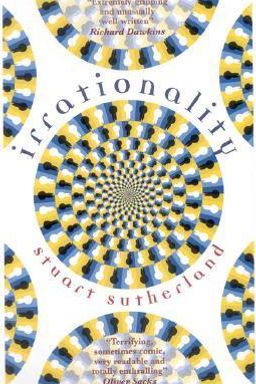
Irrationality cover

Irrationality

by Stuart Sutherland

Irrationality by Stuart Sutherland delves into the surprising prevalence of illogical thinking and decision-making in our lives. By examining common errors and their causes, Sutherland offers insightful solutions to cultivate more rational thought processes, ultimately helping readers make better decisions in personal and professional arenas.

The Mechanized Soul: Searching for Meaning in a Dehumanized World

What happens when the rhythm of machinery becomes the pulse of your life? In Smallcreep’s Day, Peter Currell Brown explores the inner disintegration of a man whose search for meaning collides with the mechanical and moral absurdity of modern industrial civilization. Brown’s novel, first published in 1965, is a surreal and philosophical journey through the claustrophobic depths of a factory turned metaphor for human existence. The protagonist, Pinquean Smallcreep—a slotting machinist who has spent decades performing a single, monotonous task—sets out one morning to find what happens to the pulleys he makes. His quest unfolds as an extraordinary allegory for humanity’s attempt to rediscover purpose in a world that has surrendered to the logic of machines, bureaucracy, and blind obedience.

A Modern Allegory of Mechanization

Brown constructs the factory as both a literal and symbolic labyrinth—a universe of endless corridors, pipes, and machines that defy logic and orientation. Each department Smallcreep visits exposes a new absurdity in the human condition. Workers are reduced to mechanical extensions of their tools, blindly serving systems they can neither see nor comprehend. The factory becomes a stand-in for society itself: a machine whose purpose long ago forgot its human origin. Like Kafka’s Josef K. in The Trial, Smallcreep moves through layers of an incomprehensible structure governed by contradictory rules and senseless rituals, recognizing too late that the machinery is only an external reflection of his own inner alienation.

A Journey from Ignorance to Revelation

What makes Smallcreep’s Day so resonant is the tension between curiosity and futility. Smallcreep’s seemingly simple question—“What happens to the pulley?”—opens into metaphysical inquiry. His pilgrimage across the departments reveals not the rational progression of a production line but the moral disintegration of individuals who serve it. From the painter’s section where colours lose meaning, to men working in endless circles or duelling in obscene contest, each vignette transforms industrial realism into allegory. These encounters resemble Dante’s descent in The Inferno, each stage illustrating a deeper circle of moral corruption or philosophical despair. By the time Smallcreep stands before the monstrous final machine—a grotesque, godlike construction that consumes him in noise, light, and fury—he recognizes it as the embodiment of humanity’s creation turned creator: a deity of progress that demands worship through submission.

The Collapse of Personal and Social Identity

Smallcreep’s quest is also a psychological unravelling. As he journeys deeper into the factory, his sense of self dissolves. He encounters versions of authority—the foreman, the union man, the manager, and finally the managing director—that echo external control and self-betrayal. Each figure offers a distorted mirror of Smallcreep’s own moral compromise as an obedient worker. The novel’s surreal episodes—men copulating in cubicles, battling obscene competitions, or worshipping their machines—externalize the suppressed instincts and repressions of industrial man. When Smallcreep at last confronts the managing director, he finds not a tyrant but a broken oracle who admits his power is illusionary and condemns the very structure he oversees. The revelation is devastating: there is no higher purpose to justify the suffering; authority itself is a collective fiction sustained by fear and habit.

Why It Matters Today

More than half a century after its publication, Smallcreep’s Day still feels disturbingly relevant. Its vision of alienation presaged the automation and bureaucratic homogenization that define twenty-first-century life. Brown writes not simply about factories but about the condition of individuals trapped in systems—corporate, political, or digital—that reward obedience and punish reflection. Through Pinquean Smallcreep’s odyssey, Brown confronts the reader with haunting questions: How much of your work, your morality, even your sense of self, has been shaped to fit the demands of a machine? Is meaning still possible in a world run by systems that neither see nor care? The novel’s answer is both shattering and liberating: meaning exists only in the act of questioning itself, even if the question leads you into madness. Smallcreep’s pilgrimage ends where it began—back at his slotting machine—but his mind has glimpsed the divine horror of truth. For readers today, his story is a warning and a mirror: when we mistake noise for progress and efficiency for purpose, we too become parts in someone else’s engine.


The Factory as a Living Hell

From the opening pages, Brown turns the factory into a vision of industrial hell—a place where the boundaries between machine, flesh, and soul dissolve. Pinquean Smallcreep begins the day stepping out of his normal, repetitive slotting section and quickly descends into an environment filled with grotesque caricatures of human labor. Each department he visits becomes more surreal and more infernal, echoing the structure of Dante’s circles but infused with modern absurdity: the mechanical clang of machinery replaces the devil’s tortures.

Men as Machines

The workers seem half-alive, repeating motions until their entire bodies become synchronized with the machines they operate. One man continues a conversation without missing a beat in his movements; another cannot stop his habitual gestures even on the bus home. Brown’s imagery blurs body and mechanism—spanners become extensions of hands, clocks replace heartbeat, and the noise of presses replaces thought. It’s a chilling vision of what Karl Marx called “alienated labor”: the moment when workers become estranged from the product of their work, from each other, and from themselves. The factory no longer produces goods—it manufactures obedience and numbness.

The Soundscape of Damnation

Brown’s prose uses sound to create a sensory prison. The factory noise is at first deafening, then becomes an environment Smallcreep literally moves through, “a jelly of sound difficult to breathe.” When the machines fall silent, the silence is “minus sound,” a void so absolute it becomes terrifying. This manipulation of auditory imagery invites you, the reader, to feel how industrial life invades not just the body but the psyche. The factory’s endless roar symbolizes the impossibility of inner peace in a world where everything vibrates with mechanical rhythm.

A Modern Version of Dante’s Inferno

Each episode mirrors a moral condition: in one workshop, workers act like corpses, moving automatically; in another, two men endlessly carry the same casting back and forth, convinced they are fulfilling their duty. Such surreal absurdities expose a spiritual sickness beneath the industrial order. Like Dante’s sinners, these workers are trapped in eternally looping punishments of their own making. Yet Brown’s genius lies in his refusal to offer an external devil; his hell is man-made, sustained by habit and fear. For you as a reader, these scenes ask a haunting question: what part of your daily routine is a mechanical ritual disguising its own futility?


Work, Time, and the Illusion of Purpose

Smallcreep’s journey is not just through the geography of the factory but through the psychology of time itself. Brown transforms time into another instrument of oppression, showing how the regimented minute breaks the spirit as effectively as any whip. Clocks dominate the factory’s architecture; every action, meal, and conversation is synchronized to their jumpy movements. The mechanization of time mirrors the mechanization of the human spirit.

The Jumping Clock and the Death of Continuity

In a haunting early scene, Smallcreep observes that factory clocks “jump” instead of flowing naturally. They reflect the managerial obsession with precision and measurement at the expense of lived experience. This ‘jumping’ time denies continuity—it’s a reminder that human life itself has been cut into measurable units of productivity. For Smallcreep, this becomes an existential wound; life no longer unfolds but stutters forward, minute by minute, until decades vanish unseen.

The Ritual of the Workday

The novel captures how routine annihilates self-awareness. Brown writes that one can “go to the factory in the morning thirty-one years of age and come back the same night thirty-eight.” Time collapses when every day repeats itself. The workers’ obsession with overtime and “making treble time” is not greed but addiction—a desperate attempt to give meaning to meaninglessness. This is what modern psychologists might call the “workaholic paradox”: working harder not for happiness, but to avoid confronting emptiness.

Faith in Chance: A Factory Religion

Late in his journey, Smallcreep realizes that what keeps workers going isn’t faith in God or justice but in chance—the dream of winning the football pools. This fleeting hope functions as a secular religion, offering the illusion of escape. Yet, as Brown reveals, even that hope is mechanized—a lottery of statistical odds replacing genuine belief. You see how systems of routine create their own myths to keep the human spirit compliant. The tragedy is not that people believe in something false, but that they need to believe at all to endure the monotony.


The Search for Meaning and the Lost Whole

At the heart of Smallcreep’s Day lies a deceptively simple question: what happens to the pulley once it leaves the slotting section? Brown uses this literal curiosity as a metaphor for humanity’s need to see the whole—to know that our fragmentary efforts connect to some coherent purpose. Smallcreep’s years at a single repetitive task have robbed him of that vision, and his quest to find it becomes an act of rebellion against the logic of specialization itself.

From Craftsmanship to Compartmentalization

In an earlier age, the craftsman could trace his work from raw material to finished object, embedding meaning into creation. Industrialization shattered this unity. Smallcreep’s longing for understanding recalls the Romantic ideal of the maker—akin to William Morris’s call for the marriage of art and labor. When he asks others what happens to the pulleys, he encounters confusion, denial, or hostility. Each worker guards his compartment like a priest of some forgotten ritual, performing without comprehension. The division of labor, meant to improve efficiency, becomes moral fragmentation. Everyone can say, “I only made my part.”

The Assembly Line as Metaphysical Symbol

When Smallcreep finally reaches the assembly line, it stretches to infinity—both directions disappearing into perspective. It is a vision of infinity disguised as machinery, representing the modern cosmos: everything connected yet no one understanding the whole. In Brown’s prose, the line becomes a theological revelation. Each man works on a tiny component of something vast and terrible. When the final machine awakens, its voice is that of humanity’s own monstrous creation. Its roar is divine wrath transcribed into mechanical form. The revelation is unbearable—knowledge without meaning is madness.

The Return to the Beginning

Having touched the infinite and survived, Smallcreep returns to his slotting machine. The novel ends with him resuming the same motions as before—but transformed. In that cyclical return lies Brown’s final message: awareness does not guarantee freedom. Like Sisyphus in Camus’s existential parable, Smallcreep’s consciousness may be his only victory. Yet Brown leaves you questioning whether enlightenment in such a world is salvation or curse. Perhaps the only way to remain sane in a mechanized universe is to forget that you’ve seen its heart.


Authority, Obedience, and the Machinery of Power

One of the most unsettling chapters finds Smallcreep meeting successive figures of authority—the foremen, the sales managers, the union officials, and finally the managing director—each representing another mask of power. Through these encounters Brown exposes how authority perpetuates itself not by strength but by complicity. Every level of the hierarchy mirrors the same fear: to question the system is to risk annihilation.

The Paradox of the Manager

When Smallcreep reaches the managing director, expecting wisdom or at least purpose, he finds a man crippled by melancholy. The director confesses that he too is trapped—that authority is only an illusion built from collective obedience. His speech, one of the novel’s most powerful passages, dismantles every justification for industrial hierarchy. “The whole idea of authority,” he tells Smallcreep, “is humbug. I might be leading you all to Hell for all you know.” In this moment, Brown fuses philosophical pessimism with political satire: leaders and followers sustain each other’s imprisonment, mistaking control for moral order.

Freedom as an Unbearable Idea

The managing director’s final insight is devastating: people don’t truly want freedom. Left alone, they would rather return to their routines than face the terror of choice. As in Stanley Milgram’s experiments on obedience (published around the same era), Brown suggests that submission provides psychological comfort. Freedom demands self-confrontation, and in a mechanized society most prefer the safety of servitude. This revelation reframes the entire novel: Smallcreep’s exploration of the factory is not a search for liberation but for a master whose existence can justify his suffering.

The Political Satire Beneath the Surface

Brown’s depiction of union meetings, bureaucratic negotiations, and managerial hierarchies satirizes both capitalist and socialist ideologies. In one scene, a labor representative literally flies off the ground on a flood of rhetoric—Brown’s surreal embodiment of empty political speech. Both sides claim moral supremacy but speak the same hollow language. The system, whether democratic or dictatorial, survives because every participant—from manager to machinist—plays his role. The machinery of authority, Brown warns, runs best when no one believes they are driving it.


The Collapse of Morality and Humanity

As Smallcreep ventures deeper, Brown’s world grows more grotesque. Factories become theaters of moral inversion, where decency is punished and corruption parades as logic. Acts of absurd cruelty—workers cutting off their hands, women giving birth unnoticed amid laughter—serve as parables of dehumanization. The novel’s shock lies not only in its surreal imagery but in the recognition that these horrors are ordinary—they could only happen in workplaces that have normalized moral blindness.

Degradation as Entertainment

The unnerving canteen scene, where a woman gives birth while the crowd cheers a comic act, epitomizes Brown’s critique of distraction. The workers, trained to obey and amuse themselves, have lost all capacity for empathy. Their laughter drowns the cry of life itself. Brown transforms the absurdity into judgment: this is society’s punishment for having turned labor into routine and art into noise. For you as a reader, it asks whether constant consumption of distraction—from television to social media—has rendered compassion as obsolete as factory craftsmanship once was.

Violence as Ritual

Throughout the novel, confrontation replaces communication. Workers strike each other with wrenches, foremen roar like apes, and even intellectual debates descend into physical brawls. The violence feels both comic and tragic—a mirror of how industrial systems channel suppressed emotion into aggression. Brown anticipates what later thinkers like Erich Fromm described as the “escape from freedom”: when people cannot express meaning, they express dominance.

Faith Without Redemption

Even the novel’s glimpses of faith become twisted. Workers turn gambling or company slogans into new forms of worship. When Smallcreep witnesses men chanting “Morning” at the start of shift like a sacred liturgy, he realizes the factory has replaced religion. Brown offers no divine salvation—only the possibility of awakening through recognition. The tragedy is that enlightenment arrives too late: by the time Smallcreep glimpses what he has built, the gods of industry are already alive and roaring.

Dig Deeper

Get personalized prompts to apply these lessons to your life and deepen your understanding.

Go Deeper

Get the Full Experience

Download Insight Books for AI-powered reflections, quizzes, and more.