
Idea 1
Why Everyone Owes Everyone and No One Can Pay
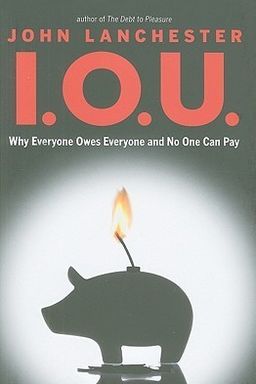
When you swipe your card or take cash from an ATM, do you ever wonder what money actually is—and who truly owes what to whom? John Lanchester’s I.O.U.: Why Everyone Owes Everyone and No One Can Pay takes this ordinary question and unfolds it into a gripping explanation of how global finance became a web so complex that no one—not banks, not governments, not even economists—really understands it anymore. Lanchester argues that the 2008 financial crash revealed not only systemic greed and flawed mathematics but something deeper: the way capitalism itself turned risk into a mirage and morality into an accounting trick.
At its core, the book explores how humanity's age-old fascination with money escalated into a global addiction to credit. The subtitle captures Lanchester’s warning perfectly: everyone owes everyone—not metaphorically but literally through loans, bonds, and derivatives—and yet, when the system freezes, nobody can pay. The result is both a story of systemic failure and a reflection on human nature’s desire for certainty in a world that runs on promises.
The Moral and Psychological Foundation
Lanchester begins not with numbers but with people. His vivid anecdote of the Icelandic student who can’t withdraw cash from an ATM during the nation’s banking collapse makes an abstract idea painfully real. Iceland becomes the book’s microcosm for the world—a nation of only 300,000 that inflated its banking sector to twelve times its own GDP, collapsing under the weight of unreliable promises. The story reveals how free-market triumph after the Cold War fostered a climate of deregulation and reckless faith in self-correcting markets.
Beneath the jargon of leverage ratios and toxic assets lies a moral narrative. The financial boom, Lanchester insists, was driven by a cultural shift: capitalism, unchallenged since the fall of communism, stopped being one philosophical model and became a secular religion. Bankers replaced priests. Risk became faith. And regulation—the earthly restraint—was cast aside.
How the System Engineered Itself Into Crisis
To explain the crash, Lanchester masterfully combines storytelling with economic demystification. He traces how credit creation—the simple lending cycle of banks multiplying deposits—was turbocharged by the rise of exotic financial instruments. These tools, from derivatives to collateralized debt obligations (CDOs) and credit default swaps (CDSs), were sold as ways to manage risk but in fact concealed and spread it. Following the line from J.P. Morgan’s invention of credit swaps in Florida to David Li’s mathematical model of default correlation, Lanchester reveals how “rocket science” finance blinded investors with complexity, turning human judgment into algorithmic faith.
The math behind these products wasn’t just misunderstood—it was wrong. Lanchester uses the concept of Value at Risk (VAR) to show how banks systematically underestimated improbable events, treating crises that occurred once every few decades as if they were one-in-a-billion anomalies. When housing prices fell just 20 percent—something that happens regularly in history—the models treated it as an event rarer than the age of the universe. This is how an entire system “crashed with the certainty of serious injury and the high probability of death,” as he puts it in his metaphor about putting a speeding car into reverse.
From Boom to Moral Reckoning
Lanchester doesn’t stop at the technical aspects; he examines the human behaviors driving them—greed, overconfidence, and fantasy. The moral rot begins with incentives. Bankers rewarded themselves when bets paid off but faced no punishment when they failed, creating a culture of one-way risk, reinforced by the doctrine that some institutions were “too big to fail.” That arrogance, Lanchester warns, was not mere incompetence but a philosophical corruption: the belief that profit absolved responsibility. When the bill came due—massive taxpayer bailouts, pain for ordinary people, and political upheaval—the world discovered that finance had privatized gains and socialized losses.
Ultimately, I.O.U. is not just a postmortem of the crash but a meditation on what we do next. Lanchester’s final chapters turn from outrage to challenge: if capitalism won the ideological war, perhaps it now needs an opponent—not an external one like socialism, but an internal conscience. The word he leaves you with is deceptively simple: “enough.” In a world of limitless leverage and insatiable consumption, rediscovering the idea of enough—in money, power, and growth—is not just economic wisdom but human survival.