
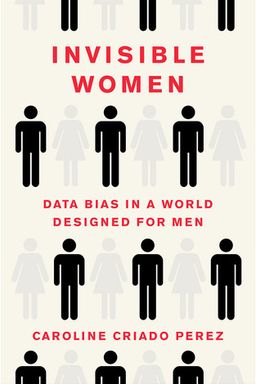
Invisible Women cover

Invisible Women

by Caroline Criado Perez

Invisible Women by Caroline Criado Perez exposes the pervasive gender data gap that disadvantages women worldwide. From healthcare to technology, Perez reveals how data centered on men impacts women''s lives and offers solutions to bridge this gap, advocating for an inclusive world where women''s needs are equally represented and valued.

Counting Women, Designing the World

Why do so many policies, products, and systems feel misaligned with women’s real lives? Caroline Criado Perez’s Invisible Women answers with one unifying argument: society is built on data that exclude women. Across medicine, design, transport, economics, and technology, Perez exposes how the assumption that the male experience equals the human experience creates distortions, inefficiencies, and sometimes deadly consequences. The book’s core claim is clear—you can’t design fairly if you don’t measure fairly.

The Missing Half of Data

Perez calls this structural erasure the gender data gap—the absence, poor quality, or underrepresentation of female data in the evidence used to make decisions. From clinical trials that test drugs on male bodies to city designs optimized for linear commutes, the lack of sex-disaggregated data isn’t deliberate malice; it’s the result of social blind spots that assume men as default humans. The problem runs deep—from ancient agrarian tools favoring male strength (Boserup’s plough hypothesis) to modern AI models trained on male-dominant text corpora.

You see the consequences everywhere: medical dosing errors, cities unsafe for caregivers, smartphones that don’t fit half the population, and car safety tests that ignore women’s anatomy. Perez’s tone is analytical but urgent: incomplete data create incomplete understanding, and incomplete understanding produces unequal societies.

A Cascade of Invisible Costs

Perez shows how the gender data gap accumulates harm in three main ways. First, it turns physical design dangerous—protective equipment, crash tests, and drugs calibrated for male bodies compromise women’s safety. Second, it hides economic and policy realities—unpaid care, household inequality, and poverty measured at household level obscure what women actually experience. Third, it distorts technological and institutional systems—algorithmic hiring, voice recognition, and even public policy tools replicate biases embedded in their training data.

These distortions are costly not only to women but to society at large. When women’s needs are ignored, productivity falls, health systems misdiagnose, and infrastructures fail to serve those who use them most. Perez reframes equality not as sentiment but as evidence-based design: measure what matters, and value the unpaid, unseen patterns that sustain households, communities, and economies.

From Blind Spots to Design Revolution

Perez insists the solution lies in changing how we collect and analyze data. When Karlskoga reorganized snow-clearing by gendered mobility patterns, pedestrian injuries dropped; when the New York Philharmonic introduced blind auditions, female musicians flourished. These are simple but radical shifts—acknowledge bias and redesign around inclusion. Whether you’re building a city grid, running clinical trials, or coding algorithms, the question is the same: who isn’t being counted?

The book’s intellectual lineage runs through Simone de Beauvoir’s insight that “man is the default human” and modern feminist economics from Nancy Folbre to Diane Coyle. Its practical methods align with design thinking: iterate, test, and include real users. Perez makes clear that representation isn’t symbolic—it’s empirical. When you include women in data collection and decision-making, outcomes improve for everyone, because human diversity stops being treated as a bug and starts being seen as a design feature.

Changing the Narrative

Across chapters, Perez connects missing female data to broader myths: meritocracy, neutrality, and equal opportunity. She demonstrates how algorithms inherit bias, how GDP measures erase unpaid care, and how political representation affects the evidentiary base of policy itself. Her message is both moral and pragmatic. Fair data aren’t just an ethical imperative—they’re a technology for better decision-making.

Perez’s Principle

“Once you start measuring women, you change what you design.” Data inclusion alters priorities, shifts budgets, and reveals that the invisible half of the world is not a minority problem—it is a majority reality.

In sum, Invisible Women exposes the structural biases embedded in data, urging you to become a better designer of systems—whether those systems are mechanical, social, or digital. The book’s optimism lies in its practicality: gender-aware data aren’t utopian, they’re simply accurate. If you want a world that works for everyone, start by counting everyone.


Designing for Real Bodies

From crash-test dummies to piano keyboards, Perez illustrates how physical design defaults to male norms. You experience this when gloves don’t fit, tools strain your shoulders, or protective gear fails to protect. Design bias is not aesthetic—it affects safety, comfort, and participation.

The Anatomy of Design Bias

The historical root traces to the plough: Boserup’s theory that plough agriculture separated men’s and women’s roles because upper-body strength became economically decisive. This legacy persists—industrial and consumer tools often replicate male ergonomics. Christopher Donison’s campaign for smaller piano keys exemplifies how minor adjustments can remove barriers and injuries for countless female musicians.

In contemporary contexts, car safety exemplifies deadly bias. For decades, dummies modeled the 50th-percentile male; scaled-down versions “for women” ignored real anthropometry. As a result, women were nearly 50% more likely to be injured in crashes. Medicine follows similar paths: “standard” devices often lack female calibration, from pacemaker thresholds to drug dosages.

Digital Design and Invisible Errors

Software design repeats the same omission. AI image sets associate “nurse” with women and “CEO” with men because source data reflect historical stereotypes. Speech recognition struggles with female voices; virtual reality environments cause more motion sickness in women because baseline parameters were tuned to male physiology.

Design Is a Policy Decision

Perez urges a mindset shift: male-default design is not neutral—it is political. Inclusive design tests for all users, treating representation as engineering precision.

Building Systems That Fit Everyone

Practical steps are within reach. Test products on diverse bodies, collect sex-disaggregated trial data, and adjust standards accordingly. Vienna’s redesigned pavements and Barcelona’s pedestrian superblocks prove that small physical refinements yield major safety and mobility gains. Design should begin with diversity—not adjust for it later.

Perez’s broader design philosophy mirrors inclusive innovation studies: when you design for extremes (small hands, pregnancy, caregiving schedules), you achieve better performance for everyone. Equal design is good design—it replaces assumptions with evidence.


Medicine that Ignores Women

Medicine, the field most reliant on evidence, often misuses it. Perez chronicles how male bodies dominate textbooks, training, and experiments, turning the female patient into an irregular case. The consequences ripple through diagnoses, drug trials, and symptom interpretation.

From Thalidomide to Today

After the thalidomide disaster, regulators excluded women from clinical trials to avoid reproductive risk. This protective instinct became a data blackout. For decades, dosing and side-effect profiles were set for male physiology. Women remain underrepresented in early-phase trials—just 22% in phase I studies—meaning that initial drug reactions are observed mainly in men. The fallout is predictable: drugs fail women, side effects multiply, and therapies are delayed.

The Yentl Syndrome

Perez describes the “Yentl Syndrome”: women receive proper treatment only when they present as men do. Heart attacks exemplify it. Women’s symptoms—nausea, fatigue, breathlessness—are misread as anxiety. Diagnostic tools like ECG thresholds and angiograms are tuned to male norms, masking female-specific cardiac patterns. Troponin benchmarks, set too high, miss women’s cardiac events entirely.

Preclinical Blind Spots

Even before human trials, the bias begins with male-only animal and cell studies. When sex is specified, up to 80% use male specimens. These gaps distort fundamental science. Dr Tami Martino’s experiments showed how immune responses differ drastically between sexes—evidence that would have been lost in male-only setups. Ignoring such variation isn’t just sloppy; neuroscientist Jeffrey Mogil calls it “scientifically idiotic and ethically wrong.”

Measure or Misdiagnose

Sex-specific research is not optional—without it, you design drugs for half the population and hope they fit the rest. Perez’s demand is simple: mandate sex-balanced trials and sex-disaggregated results.

Medicine, Perez concludes, mirrors society’s presumptions: women’s bodies are deviations to be explained rather than core templates for health. Fair medicine starts with fair data—and education that teaches clinicians to listen. Listening, she emphasizes, is not courtesy; it is survival science.


Care Work and the Invisible Economy

Economic theory holds that GDP measures value creation, but Perez and feminist economists show it measures only what’s monetized. Unpaid care—predominantly done by women—sustains societies yet disappears from economic statistics. This omission forces flawed policies and deepens inequality.

The Second Shift

Globally, women perform about 75% of unpaid care. Perez recounts Iceland’s 1975 “Long Friday,” when 90% of women struck from both paid and unpaid work, halting the nation. The lesson: unpaid labor underwrites economies but is uncounted. Women’s overrepresentation in part-time work and caregiving diminishes earnings and pensions, creating lifetime wealth gaps and health risks from overwork.

GDP’s Blind Spot

National accounts by design exclude home production. Diane Coyle and Nancy Folbre estimate that including unpaid work could lift measured GDP by 50–80%. Without these metrics, governments misjudge policy impacts. Austerity in the UK shifted billions in care costs back onto households, worsening women’s unpaid burden. Policymakers measure “efficiency” while erasing human labor sustaining those cuts.

Tax and Poverty Bias

Economists often treat households as equal units, but intrahousehold inequality matters. When child benefit payments shifted from fathers’ tax credits to mothers’ accounts, family spending changed—money controlled by women prioritized children. Experiments like Karnataka’s asset survey revealed that household-level poverty stats miss the majority of poor women, who live inside “non-poor” households. Tax rules compound it: joint filing in the U.S. penalizes second earners (usually women); Japan’s spousal deduction discourages women from exceeding income limits.

Counting Care Is Smart Economics

Investing in childcare and eldercare isn’t welfare—it’s growth policy. The Women’s Budget Group found a 2% of GDP investment in care creates more jobs than the same spend in construction and boosts female employment, tax revenue, and long-term GDP. Perez’s economics are empirical: you fix inequality by first measuring it.

When societies count care, they design budgets that match reality. When they ignore it, they exploit a silent subsidy from women’s time. Perez reframes equality as fiscal precision—the real economy includes the home.


Safety, Space and Mobility

Safety and mobility define freedom, and Perez reveals how cities and public infrastructure often restrict female movement. Urban planners, assuming male commuting patterns, design transport, toilets, and lighting that disadvantage women. The result: hidden health costs, lost income, and fear that limits participation.

Cities Built for Commutes, Not Care

Urban data assume a twice-daily journey to a fixed workplace. Women’s “trip-chaining”—moving between childcare, errands, and work—is ignored. Road-centric planning prioritizes male commuters, while short pedestrian trips and off-peak travel (heavy for women) vanish from official surveys. Vienna’s Eva Kail proved redesign works: wider pavements, ramps, better lighting improved safety and convenience for caregivers. Barcelona’s “superblocks” slowed cars, restored walkability, and supported community care networks.

Sanitation and Fear

Missing toilets and poor lighting transform routine trips into hazards. Mumbai’s slums, with six bathrooms per 8,000 women, expose sanitation as both health and safety crisis. Yale models show doubling toilets can cut assaults by 30%. Women’s fear—reported in surveys at twice men’s levels—curtails public participation and work options. Projects like Safecity crowd-map harassment because police data fail to capture its scale.

Infrastructure as Equity

When Karlskoga prioritized snow removal on sidewalks before roads, hospital costs fell. London’s “hopper fare” saved trip-chaining commuters money. These examples aren’t luxury; they’re evidence that gender-aware infrastructure improves efficiency and safety. Perez reframes urban planning through equity metrics: count who moves, where, when, and why.

Fear Has a Price

Ignoring safety design doesn’t just inconvenience—it lowers female labor participation and public-health outcomes. Safe design is economic design.

Perez’s urban chapters remind you that mobility isn’t neutral. A bus route, a light, a toilet policy—each either expands or limits women’s range of action. Design the city for everyone, and you reduce fear’s hidden tax.


Power, Merit and Representation

Perez closes by examining politics, workplaces, and technology—the institutions that decide whose data count. She dismantles myths of meritocracy and neutrality, showing how representation changes outcomes. Whether in parliament or in algorithms, male-majority systems perpetuate male-default assumptions.

The Meritocracy Myth

People who believe they’re objective tend to act with more bias. Blind audition experiments at the New York Philharmonic proved that anonymity increased female hiring by nearly half. In corporate settings, language and performance-review gaps favor men even when results are equal. Algorithmic systems then codify these biases—hiring tools scoring “social capital” on male-heavy platforms filter women out systematically.

Women's Representation in Power

Policy changes when women hold seats. Studies across OECD nations and Indian local councils show female legislators prioritize education, care, and family policy. Yet parliament remains hostile territory: two-thirds of female MPs report misogynistic abuse, one in five sexual violence (IPU survey). Quotas and electoral systems matter—Labour’s all-women shortlists and Sweden’s zipper lists significantly raised representation, proving that equality can be structurally engineered.

Algorithms and Accountability

In technology, transparency is the new quota. Disaggregated data and algorithm auditing are the governance tools of the digital age. Blind hiring platforms like GapJumpers replicate the Philharmonic’s success; diversity metrics force accountability. Perez calls for the same principle across fields—measure representation to change outcomes.

Representation Is Data

Democracy, workplaces, and algorithms each need to reflect real populations. When women sit at the table, unseen evidence becomes visible, and the policies built on that evidence improve for everyone.

Perez’s concluding message is systemic and hopeful: eliminating bias demands counting voices and designing structures where those voices can act. Power equality isn’t charity—it’s calibration.

Dig Deeper

Get personalized prompts to apply these lessons to your life and deepen your understanding.

Go Deeper

Get the Full Experience

Download Insight Books for AI-powered reflections, quizzes, and more.