
Idea 1
Finance as a Force for Good
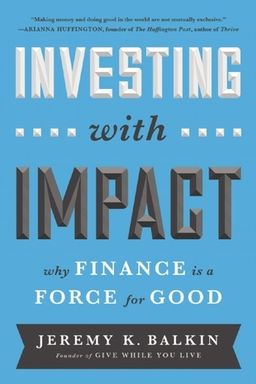
What if money itself could help heal the world instead of harming it? In Investing with Impact, Jeremy K. Balkin challenges one of the most deep-seated assumptions in modern economics: that profit and purpose are incompatible. Drawing on the events of the 2008 global financial crisis and his own experience in finance, Balkin argues that the financial system did not fail because capitalism itself was immoral — it failed because people within it lost their ethical compass. His central claim is simple but profound: finance is a force for good when guided by moral courage and enlightened self-interest.
Balkin’s mission is to restore capitalism’s moral foundation by redefining how people, institutions, and governments think about money. He builds a case for impact investing — investments that intentionally pursue both financial returns and measurable social outcomes — as the way to realign the financial system with its higher purpose of human progress. Through this lens, money becomes not a vice, but a vehicle for justice, innovation, and shared prosperity.
A Moral Crisis, Not a Market Failure
Balkin begins by reframing the 2008 financial meltdown. He notes that while Wall Street institutions like Lehman Brothers and AIG collapsed under reckless risk-taking, the deeper issue was a collapse of human values — what he calls a “morality crisis.” Banks are built on trust, yet trust itself eroded as greed replaced stewardship. Citing figures like Ben Bernanke and Timothy Geithner, he shows how the crisis endangered not only the economy but the moral legitimacy of capitalism itself. The problem wasn’t free markets, he writes, but “unenlightened self-interest” — selfishness disguised as rational ambition.
Unlike many critics who blame abstract systems or political ideologies, Balkin turns the mirror toward individuals. Every citizen who enjoyed inflated housing values or booming stocks without questioning unsustainable debt, he argues, shares responsibility. This sense of shared moral accountability is central to his philosophy of enlightened self-interest: doing what’s right for others ultimately serves oneself and the whole system.
From Blame to Responsibility
The author sees the post-crisis culture as mired in the “blame game”— scapegoating Wall Street or Congress while ignoring collective complicity. Quoting former Swiss National Bank chairman Philipp Hildebrand, he underscores that the crisis was “a collective failure of society at large.” Instead of vilifying capitalism, Balkin calls for a moral realignment — a reawakening of finance’s original role: to match ideas with capital and enable prosperity. Financialization had once been the engine of growth, he explains, but by 2008 it had become self-referential — enriching the few while creating systemic risk for all.
To stop history from repeating, Balkin urges readers to reject moral apathy. Whether you’re an investor, policymaker, or consumer, your choices can either perpetuate greed or generate impact. As he reminds us, “Time is the most precious non-renewable resource there is.” Allocating that time — and your capital — with purpose is the essence of impact investing.
Millennials and the Rebirth of Capitalism
Balkin’s optimism rests with the millennial generation — now inheriting both the debts and dreams of their forebears. In his analysis, millennials are not disillusioned idealists but pragmatic reformers. Rather than rejecting capitalism, they are reinventing it. Drawing on Pew Research and Deloitte studies, he shows that millennials prize businesses that “improve society” over those that merely generate profit. These digital natives, raised amid transparency and disruption, are demanding authenticity and ethics in the marketplace — and soon, their preferences will reshape Wall Street.
For Balkin, millennials represent capitalism’s moral recovery. They are skeptical of politics but not of enterprise; they volunteer more than any generation before them and crave meaning in work. As they inherit an estimated $41 trillion in wealth from baby boomers, they will channel these funds toward what he calls “finance as a noble cause.”
Impact Investing: The New Ethic of Capital
If the first half of the book diagnoses the moral collapse, the latter half offers a solution: impact investing. This approach fuses economic logic with moral purpose. Impact investors intentionally seek both financial return and measurable social benefit, proving that profit need not come at the expense of people or the planet. Balkin traces the philosophy’s lineage to a 2007 Rockefeller Foundation meeting that coined the term and presents it not as a niche movement but the logical evolution of capitalism itself. “Every investment has impact,” he insists — the only question is whether that impact is positive or negative.
He expands this idea through his “6E Paradigm” — a six-dimensional model (Economics, Employment, Empowerment, Education, Ethics, and Environment) for evaluating both profit and social outcomes. Using Starbucks Corporation as a case study, he illustrates how companies can thrive financially while fostering ethical supply chains, reducing environmental impact, and empowering diverse employees.
Finance Reimagined
The book culminates in an inspiring vision: a financial system rebuilt on moral courage and measurable purpose. Balkin envisions banks and investors not as villains, but as stewards of prosperity. By positively influencing the allocation of capital, finance can fund clean energy, inclusive infrastructure, microfinance for the poor, and innovation that uplifts humanity. This is not utopian thinking — it’s pragmatic idealism backed by trillions of dollars in pent-up capital and a generation demanding change.
Ultimately, Investing with Impact is both a manifesto and a blueprint. It argues that you don’t need to choose between doing well and doing good — in fact, doing both is the only sustainable path forward. Balkin’s challenge is moral as much as financial: rebuild trust, restore human dignity in markets, and prove that capitalism, when guided by enlightened self-interest, remains humanity’s greatest engine of progress.