
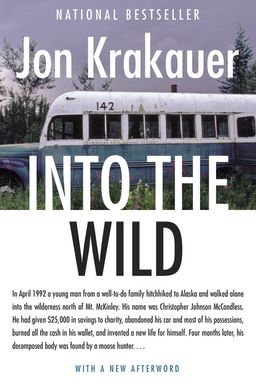
Into the Wild cover

Into the Wild

by Jon Krakauer

Into the Wild chronicles the riveting life and tragic death of Christopher McCandless, a young man who abandoned his privileged background to seek adventure and authenticity in the American wilderness. Through his encounters and experiences, McCandless''s story offers a compelling meditation on self-discovery, risk, and the quest for meaning.

The Search for Authentic Freedom in an Artificial World

Have you ever wondered what it would mean to strip away everything—your possessions, your comforts, even your identity—and test yourself against the raw elements of life? Jon Krakauer’s Into the Wild invites you to explore that question through the gripping, tragic odyssey of Chris McCandless, a privileged young man who abandoned civilization to seek truth and freedom in the Alaskan wilderness. His journey was a rebellion against the suffocating forces of wealth, conformity, and expectation—and a quest to see whether spiritual purity and authenticity could truly survive outside society’s walls.

Krakauer argues that McCandless’s story is not just one of reckless adventure but a deeply human search for meaning. The author contends that McCandless, who rechristened himself “Alexander Supertramp,” embodied the ancient impulse toward pilgrimage—the same hunger that drove Thoreau to Walden Pond, Everett Ruess into the Utah desert, and the monks of old into lonely caves and wild coasts. Yet Krakauer complicates the myth of pure freedom: he shows how McCandless’s romantic pursuit collided with human vulnerability, self-doubt, and fatal ignorance.

A Modern Pilgrim’s Journey

At the heart of the book lies Krakauer’s belief that McCandless was not suicidal or crazy, as some have suggested, but a pilgrim testing the boundaries between idealism and reality. Through letters, journal entries, and interviews with those who met him—from Wayne Westerberg in South Dakota to Jan Burres in California—Krakauer reconstructs a vivid portrait of a young man driven by moral conviction and ecstatic idealism. McCandless’s journey unfolds like a modern American folk tale: he gives away his money, burns the rest, and wanders across deserts, mountains, and rivers in search of “ultimate freedom.”

In doing so, McCandless becomes a mirror for readers’ own struggles with meaning and authenticity. His rejection of materialism—paralleling Tolstoy’s asceticism and Thoreau’s solitude—poses uncomfortable questions: What do you actually need to live? What happens when your ideals demand sacrifice? And can pure freedom exist without responsibility?

Krakauer’s Personal Connection

Krakauer blends biography with memoir, threading McCandless’s story with reflections from his own youth. Like Chris, Krakauer once sought transcendence through peril—scaling Alaska’s Devil’s Thumb in a desperate test of self-reliance. His near-fatal climb becomes a parallel adventure illustrating how young men often turn danger into a language of transformation. Krakauer’s empathy gives the narrative depth: he understands the lure of wild places not as a death wish but as a longing to touch something absolute, a truth uncluttered by civilization’s noise. This connection transforms Into the Wild from tragedy into meditation.

Beyond the Myth of Wilderness

The book also challenges the American myth of wilderness as salvation. While writers such as John Muir celebrated nature as a spiritual cure, Krakauer exposes how the wilderness can also strip away illusion, forcing a person to face their own frailty. Alaska in McCandless’s story isn’t merely majestic—it is indifferent. It stands as “not his Mother Earth,” as Thoreau wrote, but matter vast and terrifying. McCandless believed that nature would purify him; instead, it tested his ignorance. His death, Krakauer suggests, was less a moral failure and more a collision between lofty idealism and biological reality.

Why This Story Matters

In exploring McCandless’s life, Krakauer raises larger cultural questions about freedom, risk, and the American obsession with self-invention. Like Hemingway’s wounded heroes or Thoreau’s solitary seekers, McCandless represents the yearning to live “deliberately,” beyond comfort and conformity. His story resonates precisely because it asks what many dare not confront: Are you willing to pursue truth even if it costs you everything?

Through his meticulous investigation, Krakauer reveals both the glory and peril of that pursuit. Into the Wild becomes not just a biography but a philosophical inquiry—a haunting meditation on how far you can go to find yourself when surrounded by a society that has forgotten what selfhood means.


Rebellion Against the Ordinary

One of the driving forces of McCandless’s journey was his passionate rebellion against the ordinary world—a revolt against comfort, conformity, and inherited expectations. Raised in an affluent Virginia suburb, Chris grew up surrounded by success and structure. His father, Walt McCandless, was a NASA engineer, and his parents embodied the quintessential American dream. Yet that very security became suffocating. Chris saw the life of wealth and achievement as spiritually empty, built on hypocrisy and control. He sought escape not just from his family, but from the entire value system they represented.

Rejecting Material Success

After graduating from Emory University, McCandless did something extraordinary: he donated his entire $24,000 savings account to charity and vanished. For him, money symbolized spiritual corruption. In his letters, he ridiculed the “secure future” most people chased, arguing that “nothing is more damaging to the adventurous spirit within a man than a secure future.” To live fully meant to abandon possessions, obligations, and identity itself. His decision to burn the remaining cash and leave his car in a desert wash was not madness—it was ritual cleansing, a symbolic rebirth into freedom.

A Pattern of Flight

From that act onward, McCandless’s life became a pattern of escape. He fled the material trappings of Bullhead City and the human intimacy offered by people like Ronald Franz or Jan Burres. His pilgrimage echoed Thoreau’s ideal of retreating from society to find truth. Yet every encounter with friendship or affection frightened him: intimacy threatened independence. He fled not only his family but anyone who might tether him emotionally. This perpetual movement became both his freedom and his prison.

The Ideals Behind the Rebellion

Krakauer compares McCandless to other seekers—Everett Ruess, the desert wanderer who disappeared near Davis Gulch, and the Irish monks who sailed west of Iceland searching for solitude. These figures reflect the timeless impulse to abandon social order and pursue divine truth. McCandless’s rebellion thus fits into a lineage of spiritual dissidents who reject the artificial for the authentic. His ideals—self-discipline, purity, truth—were noble, even heroic. But they also carried arrogance. He believed that sheer willpower could conquer nature’s indifference. In the end, this faith turned fatal.

(Note: Krakauer contrasts this with Thoreau’s disciplined humility at Walden—Thoreau prepared carefully and acknowledged nature’s danger, while McCandless, enthralled by pure vision, dismissed caution altogether.)


The People He Changed Along the Way

Although Chris McCandless sought solitude, his travels were punctuated by deep human connections. His journey rippled through the lives of ordinary people—from elderly leatherworker Ronald Franz to South Dakota farmer Wayne Westerberg—each of whom found themselves profoundly transformed by their brief encounters with this fiery young wanderer.

Ronald Franz and the Power of Affection

One of the most heartbreaking episodes in the book involves Ronald Franz, an eighty-year-old widower who met McCandless in the California desert. Franz took the young man in, taught him leatherworking, and came to see him as a surrogate grandson. McCandless briefly filled the emotional void that had haunted Franz since the loss of his own son decades earlier. When Chris urged Franz to embrace a nomadic life, the advice stuck—after McCandless’s death, Franz actually sold his possessions and lived in a van, awaiting the boy’s return. His grief later curdled into despair so deep that he renounced his faith in God. Through Franz, Krakauer exposes the paradox of McCandless’s compassion: his words inspired transformation but his absence inflicted devastation.

Wayne Westerberg and the Gift of Work

In Carthage, South Dakota, Westerberg gave McCandless work and shelter. Chris thrived under the rhythms of manual labor, performing difficult tasks with moral intensity. He spoke little of his past but impressed everyone with his intellect and ethics. When Westerberg discovered Chris’s real name through a tax form, he respected the secret. Later, after Chris’s death, Westerberg mourned him deeply, realizing that the boy’s fiery idealism masked profound loneliness. The grain elevator he worked at became one of the few places where McCandless found belonging without compromise.

Transiency and Connection

Across the highway towns and desert encampments—Niland, Bullhead City, Carthage—McCandless left trails of influence. Jan Burres described him as a “good kid” who brought laughter and spiritual warmth to a community of nomads. Yet even there, he resisted closeness, disappearing abruptly to resume his solitary quest. Each relationship reveals Krakauer’s nuanced view of freedom: wherever McCandless went, he gave people hope, yet fled before intimacy could take root. His search for purity always required severing human ties.

The irony is inescapable—McCandless, who believed joy did not come from human relationships, ultimately discovered in his final journal entry that “happiness only real when shared.”

Through the people he met, Krakauer shows us that idealism is not only a solitary pursuit but a contagion. It awakens longing in others. Yet the cost of such purity, as McCandless’s story proves, is loneliness—an isolation as endless as the Alaskan tundra itself.


The Alaskan Dream—and Its Cost

“The climactic battle to kill the false being within,” McCandless wrote when he entered Alaska—the final stage of his spiritual experiment. He saw the frontier as sacred ground, America’s ultimate testing site for purity and courage. Yet Krakauer reveals how the mythic “Great White North” both exalted and destroyed him, exposing the gap between romantic imagination and biological reality.

The Myth of the Frontier

From Jack London to Thoreau, Alaska symbolized a place where civilization’s moral decay could be washed away. McCandless entered this myth willingly, armed only with a ten-pound bag of rice and spiritual conviction. His aim was not simply survival but purification—living off the land, free from mediocrity and human corruption. He recorded his triumphs in terse journal entries: “Gourmet duck,” “Climb mountain!” His ecstatic vision made the wilderness not a landscape but a cathedral. Yet Krakauer reminds us that London himself romanticized Alaska from afar and died obese and despairing—showing how dreams of wild salvation often collapse under human fragility.

Nature’s Indifference

Krakauer dismantles the myth by showing nature’s utter indifference. McCandless’s confidence—that intellect and will could substitute for experience—proved fatal. Alone in the derelict Fairbanks bus along the Stampede Trail, he battled rain, hunger, and the merciless isolation of Alaska. He misidentified seeds that poisoned him, ignored the rising flood of the Teklanika River, and found himself trapped. His journal descended into exhaustion: “Day 100... Death looms as serious threat.” The wilderness he sought as teacher instead became executioner.

The Final Revelation

Yet as he neared death, McCandless experienced an awakening. While reading Tolstoy’s Family Happiness, he underlined: “Happiness only real when shared.” In his last note, he thanked God for a happy life, showing acceptance, not despair. He died, Krakauer writes, smiling—“serene as a monk gone to God.” In this moment, Alaska fulfilled its mythic role: it stripped away illusion and revealed truth, not in triumph, but in surrender.

Like the monks and mystics Krakauer evokes, McCandless found divinity not in conquering nature but in being humbled before it. His death becomes not a cautionary tale about recklessness, but an elegy for the impossible dream of pure freedom in a world that demands compromise.


Nature and the Inner Landscape

For McCandless, wilderness was less a physical destination than an inner state—a mirror reflecting the soul’s contradictions. Krakauer suggests that the landscapes Chris traversed—the deserts of the Mojave, the glaciers of Alaska, the fields of South Dakota—were metaphors for his own inner terrain: vast, radiant, perilous.

The Desert as Revelation

Krakauer opens with Chris in Detrital Wash, where he abandons his car and money. The desert’s emptiness operates as revelation: stripped of structure, the human spirit faces its raw truth. As naturalist Paul Shepard wrote (whom Krakauer quotes), prophets and pilgrims go to the desert “not to escape but to find reality.” McCandless’s desert becomes his baptism, his rebirth through deprivation. Its silence magnifies his voice—the start of transformation through solitude.

The Wilderness as Mirror

Throughout the book, nature reflects McCandless’s temperament. The serene beauty of Alaska parallels his idealism; its cruelty mirrors his hubris. Just as the desert’s austerity exposes truth, the Alaskan wild confronts him with mortality. Krakauer writes that man encounters “a force not bound to be kind to him.” Nature’s power doesn’t moralize—it reveals. Chris’s starvation thus symbolizes inner famine: a hunger for meaning no philosophy could fully feed.

Learning from Solitude

In this landscape of matter and mystery, McCandless achieves fleeting wisdom. His meticulous notes on plants and animals show respect rather than conquest. He learns that joy doesn’t depend on human company but exists “in everything and anything we might experience.” Yet solitude, like wilderness, comes with limits. The wilderness exposes the lie that purity is sustainable—humans are social beings, bound to interdependence. McCandless’s death unites these truths: the wilderness took him in, but also reminded him that no soul remains untouched by others.

Krakauer’s portrayal of nature transcends geography. It becomes spiritual terrain—a reminder that “wildness” lives not only in forests, but in your own resistance to complacency. The lesson is universal: every person carries both wilderness and civilization within; the challenge is learning how to survive the tension between them.


Fathers, Sons, and the Inheritance of Restlessness

Behind McCandless’s quest lies a haunting human story—a broken bond between father and son. Krakauer presents it not as rebellion alone but as inheritance: a lineage of restless men whose ambitions and silences reverberate across generations. In exploring the McCandless family history, Krakauer also reveals parallels to his own strained relationship with his father, suggesting that emotional exile often drives physical escape.

The Wound of Betrayal

Chris discovered during his college years that his father had led a double life—still seeing his first wife and fathering another child after Chris’s birth. This revelation shattered his faith in family and morality. To him, the hypocrisy invalidated everything his father had taught. The betrayal became a scar he carried into the wild. His letters to his sister Carine reveal bitterness so intense that he planned to “divorce” his parents once and for all. This emotional implosion, Krakauer shows, explains his harsh moral absolutism: to flee corruption, he had to erase its source.

Inherited Fire

Walt McCandless’s brilliance and intensity lived on in his son. Both were driven men unable to yield. Krakauer portrays this as tragic symmetry: “The old man built a bridge of privilege,” he writes, “and Chris repaid him by chopping it down.” In this light, McCandless’s wanderlust reads as a distorted echo of paternal ambition—an attempt to redefine greatness outside social achievement. Krakauer draws explicit comparison to his own father’s perfectionism, suggesting that this generational restlessness is a human pattern: we rebel not just against parents, but against the parts of ourselves they planted within us.

Reconciliation Beyond Death

In the book’s epilogue, Walt and Billie McCandless visit the bus where their son died. They don’t curse fate—they decorate it with flowers and install a brass plaque. Walt admits, “I didn’t know how I was going to react, but now I’m glad we came.” In that act of pilgrimage, Krakauer locates quiet redemption: love outlasts ideology. McCandless’s severance led to reconciliation only through tragedy. The Alaskan wilderness becomes a grave, but also a bridge—the symbolic place where father and son finally meet, beyond judgment.

By weaving his own father’s story, Krakauer transforms Into the Wild into a generational parable: the search for freedom, whether external or emotional, is rarely a rebellion against the world—it is a yearning to heal the unspoken wounds handed down by family.


The Meaning of McCandless’s Legacy

Why does Chris McCandless’s story continue to haunt readers decades later? Krakauer’s closing reflections reveal that McCandless’s death was not senseless, nor was his dream naïve—it was the logical extension of a deeply human longing for significance. His journey confronts you with uncomfortable truths about risk, authenticity, and the boundaries of freedom.

Beyond Recklessness

Many condemned McCandless as foolhardy, but Krakauer dismantles that judgment. Chris was inexperienced, yes—yet he survived for 113 days alone, fending for himself with resourcefulness. His death stemmed from a small but catastrophic error, not incompetence. Krakauer contrasts him with other Alaskan wanderers—Gene Rosellini, John Waterman, Carl McCunn—who pursued isolation to self-destruction. McCandless, unlike them, sought clarity, not oblivion. He wanted life “in conformity to higher principles,” echoing Thoreau’s belief that moral awakening often demands suffering.

The Lesson of Risk

Krakauer proposes that the urge for danger and solitude—so often condemned—is part of human evolution. It’s how we test boundaries. He recounts his own climb on the Stikine Ice Cap, nearly dying in pursuit of transcendence, admitting that he wasn’t suicidal but “consumed by a longing to look over the brink.” McCandless’s risk-taking reveals a similar paradox: through danger, one seeks life intensified. His failure reminds you that meaning and safety rarely coexist.

A Mirror for Modern Restlessness

When Krakauer examines letters from readers, he finds that McCandless’s journey evokes both admiration and outrage. The polarization reflects something unsettling about modern society: deep down, many yearn for escape but fear what freedom costs. McCandless becomes a mirror for that buried hunger—to be pure, to be alone, to matter. His mistake was not dreaming too boldly but failing to reconcile idealism with survival. His legacy, Krakauer argues, lies in the reminder that “the joy of life comes from our encounters with new experiences.”

In the end, Into the Wild is not about adventure or death. It’s about the perpetual human pilgrimage toward truth—the belief that somewhere, beyond comfort and control, your real self waits, ready to meet you in the wild silence.

Dig Deeper

Get personalized prompts to apply these lessons to your life and deepen your understanding.

Go Deeper

Get the Full Experience

Download Insight Books for AI-powered reflections, quizzes, and more.