
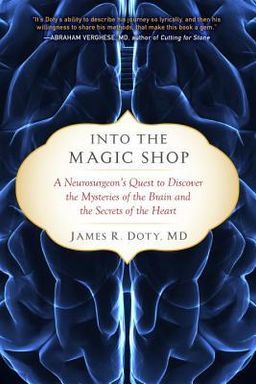
Into the Magic Shop cover

Into the Magic Shop

by James R Doty, MD

Into the Magic Shop explores the profound connection between the heart and brain, revealing how meditation fosters compassion, clarity, and purposeful living. Neurosurgeon James R. Doty, MD, blends scientific insight with personal experience to guide readers towards a more fulfilling life.

The Magic of the Mind and Heart

Have you ever wondered if changing your thoughts could truly change your life? In Into the Magic Shop, neurosurgeon James R. Doty invites you into an extraordinary story that blends neuroscience and compassion, childhood trauma and spiritual awakening. He argues that real magic—the kind that transforms our lives from within—is not a trick of illusion but the interplay between the brain and the heart. According to Doty, mastering the mind allows you to shape your external world, but opening the heart allows you to live meaningfully within it.

Doty contends that the greatest human transformation comes from aligning these two centers of intelligence: the rational and the emotional. In his words, when the brain and heart work together, “we can make the most extraordinary magic there is.” But this realization didn’t come easily. Through his own journey—from a poor boy in Lancaster, California, to a millionaire neurosurgeon facing emotional bankruptcy—Doty shows that intellect and ambition alone can’t bring peace, purpose, or love. You must, as he learned from a woman named Ruth in a dusty magic shop, learn four magic tricks: to relax your body, calm your mind, open your heart, and clarify your intent.

A Childhood Transformed by ‘Magic’

At twelve, Jim Doty was a boy weighed down by hunger, poverty, and a chaotic home. His father drank heavily, his mother attempted suicide. But a chance encounter with Ruth—a shopkeeper’s mother who introduced him to what she called “real magic”—would change everything. Ruth taught him practices we now associate with mindfulness and compassion meditation: to control his body’s stress response, observe his thoughts without judgment, and nurture empathy for himself and others. Long before neuroscience revealed how such exercises create new neural circuits (neuroplasticity), Ruth intuitively knew that focused attention rewires the brain.

Her four tricks formed the template of Doty’s life: each would teach him control, compassion, and clarity. But Ruth also warned that power of the mind alone could lead astray unless guided by the heart. This tension—between intellect and empathy—would define Doty’s life as he rose from hardship to success, lost everything, and ultimately found meaning through giving and research on altruism.

The Rise and Fall That Led to Compassion

As Doty grew up, Ruth’s lessons guided him through college, medical school, and an Army neurosurgery career. He visualized success, focused his mind, and surpassed odds. Yet he neglected her deeper lesson—opening the heart. When he achieved immense wealth during the dot-com boom, becoming worth seventy-five million dollars, he felt hollow. His relationships were shallow; his emotions numb. When the market crashed, his fortune vanished, but what remained was Ruth’s earlier wisdom about the “compass of the heart.” Returning to Lancaster and rediscovering his notes, Doty realized that the magic wasn’t about wealth or control—it was about kindness, forgiveness, and presence.

This realization catalyzed a new chapter. Doty dedicated himself to medical service, research on compassion, and the creation of Stanford’s Center for Compassion and Altruism Research and Education (CCARE), supported by His Holiness the Dalai Lama. Through neuroscience, he confirmed that compassion isn’t just philosophical—it’s biological. Acts of care light up the brain’s reward centers and promote physical and emotional health. Ruth’s intuition had found scientific proof.

Why This Matters for You

At its core, Doty’s story reminds us that success without emotional growth leads to emptiness. You can calm your body and master your mind, but if you don’t open your heart, you lose connection to others—and yourself. The book teaches us that compassion, kindness, and love aren’t sentimental extras but essential neurological functions for human survival. They improve health, reduce stress, and deepen happiness. In a world driven by productivity and accumulation, Doty’s message is countercultural yet vital: our greatest strength lies in vulnerability, empathy, and service. The true magician isn't the one who makes wealth appear but the one who can turn suffering into compassion.

In the chapters ahead, you’ll explore how Doty mastered Ruth’s four tricks, applied them to his life’s highs and lows, and ultimately became the rare scientist who bridges hard neuroscience with soft-hearted wisdom. You’ll learn how relaxing the body and mind transforms the brain, why thought alone can’t heal what the heart must face, how loss can reveal the compass of compassion, and how giving—materially and emotionally—creates the most powerful magic of all.


Relaxing the Body: Controlling Stress and Fear

Doty’s first lesson from Ruth was deceptively simple: to relax the body. This wasn’t just a calming exercise—it was a way to master the physiology of fear. As a twelve-year-old living in constant tension, Doty’s nervous system was on overdrive. Ruth taught him to breathe slowly, unclench muscles, and pay attention to his heartbeat. Decades later, neuroscience confirmed what she intuitively understood: breathing slowly and focusing on muscle relaxation stimulates the parasympathetic nervous system, lowering stress hormones like cortisol and calming the heart.

The Power of Breathing

Ruth instructed him to breathe in deeply through the nose and out through the mouth, guiding attention to each part of his body—from toes to scalp. This conscious relaxation reduced the constant fight-or-flight state caused by his chaotic home life. Doty describes how, within minutes, his heartbeat slowed and his thoughts cleared. Years later, in the operating room, he used these same techniques to remain steady during surgeries that demanded absolute precision.

Neuroplasticity and Emotional Healing

What Ruth accomplished intuitively was the creation of new neural pathways—what scientists now call neuroplasticity. She helped Doty’s brain learn calmness as a reflex, reshaping his emotional responses. This rewiring allowed him to handle trauma and fear not with rage but with composure. Research from scholars like Richard Davidson and Jon Kabat-Zinn later affirmed that mindfulness can reshape the brain’s emotional centers, increasing resilience and empathy.

Key Lesson

Physical calmness isn’t just relaxation—it’s the foundation for emotional stability and mental focus. You can’t control external chaos, but you can control how your body responds to it.


Taming the Mind: Turning Down the Inner Noise

After Ruth helped Doty calm his body, she taught him the second trick—to tame the mind. She described a hidden radio deejay continuously narrating our lives, criticizing and comparing. “You are not the voice in your head,” she said. “You are the one listening.” This insight, now a cornerstone of meditation research and cognitive therapy, taught Doty how to observe thoughts without being consumed by them.

The Deejay in Your Head

Ruth’s analogy transformed how Doty saw his thoughts. When his mind wandered to worries about grades, guilt, or his father’s drinking, she reminded him to refocus on breathing or a candle flame. This practice mirrors what psychological researcher Daniel Goleman calls “meta-awareness”—the ability to notice mental chatter and redirect attention. Over time, Doty learned that every time he quieted his thoughts, he diminished the power of fear.

Mantras and Focus

Ruth encouraged him to choose a mantra—a simple phrase repeated silently to shift attention away from anxiety. Doty’s childish phrase, “Chris knob,” seemed meaningless but trained his focus. By repeating it rhythmically with breath, he learned presence. Studies later proved that repetition activates parts of the brain associated with attention control and emotional regulation.

Key Lesson

You tame the mind not by stopping thoughts but by returning attention—again and again—to the present. Over time, awareness itself becomes your superpower.


Opening the Heart: The Science of Compassion

Ruth’s third lesson—opening the heart—was the most transformative. She asked Doty to feel unconditional love, first for himself, then for others, even those who had hurt him. At twelve, this was revolutionary. Ruth explained that hurt people hurt others, and sending love heals both sides. Neuroscience would later reveal that compassion activates the brain’s reward centers and improves heart health by increasing vagal tone.

Learning Empathy Through Pain

Doty’s own pain—his mother’s addiction, his father’s rage—became the training ground for empathy. Ruth helped him see these wounds as openings rather than scars. By visualizing love toward his abusers, he began to transform anger into understanding. This practice mirrors Tibetan loving-kindness meditation (compassion training endorsed by the Dalai Lama). Doty discovered firsthand that compassion produces physical calm and emotional strength.

Heart Intelligence

Research from the HeartMath Institute shows that the heart sends more signals to the brain than the brain sends to the heart. Ruth’s “compass of the heart” anticipated this science. Doty learned the heart isn’t just a pump—it’s an intelligent organ shaping perception, reasoning, and happiness. Opening it meant connecting with others authentically, including himself.

Key Lesson

An open heart transforms pain into compassion. Emotional vulnerability isn’t weakness—it’s the gateway to wisdom and connection.


Clarifying Intent: Manifestation with Responsibility

The final trick Ruth taught Doty was the power of intention—the process of visualizing what you want until it becomes real. She warned that what you think you want isn’t always what’s best. Without heart, intent can become greed. Doty learned to visualize vividly—seeing every detail of success as if it already existed. This cognitive rehearsal mirrored what athletes and neuroscientists describe as mental conditioning.

Visualizing Success

Doty practiced imagining himself as a doctor, seeing the white coat, hearing his name called over hospital loudspeakers. This internal movie created neural familiarity with success. Years later, when he faced rejection letters and obstacles, his mind remained anchored to the vision. Visualization changed perception, and opportunities appeared. Ruth had taught him to see through what she called “the window in your mind”—a metaphor for clarity and faith.

The Temptation of Selfish Intent

Yet ambition without compassion led him astray. As a millionaire, Doty realized he’d manifested everything on his childhood wish list—money, cars, success—but at the cost of relationships and peace. Ruth’s warning echoed: “What you think you want isn’t always what’s best.” When the dot-com crash erased his fortune, Doty recognized that loss as liberation. Through surrender, he found his true intent: to help others.

Key Lesson

Clarity of intent means aligning ambition with compassion. Manifestation without love creates emptiness; intention guided by heart creates meaning.


The Fall and the Compass of the Heart

Doty’s fall from wealth—losing seventy-five million dollars in the crash—became the crucible for rediscovery. Alone and ashamed, he found his childhood notebook and Ruth’s underlined phrase: “Compass of the heart.” It was a reminder that direction matters more than speed. When an attorney informed him his charitable trust hadn’t been finalized and he could reclaim millions, that compass guided his response. He chose to donate everything anyway. In doing so, he found freedom.

From Greed to Giving

The act of turning down regained wealth was Doty’s turning point. He realized that giving was the only antidote to the illusion of control. Neuroscience later affirmed that altruism triggers the same pleasure centers as receiving rewards. Giving, paradoxically, restores power because it reconnects you to others. Doty built his life anew on this principle and began researching compassion at Stanford, blending Ruth’s teachings with science.

The Neuroscience of Connection

Doty found that isolation diminishes health more than smoking, while empathy extends life and resilience. His own healing came through service, proving Ruth right: when you use the compass of the heart, it steers you toward connection and contribution. His emotional bankruptcy became spiritual wealth—the kind measured in lives touched, not dollars earned.

Key Lesson

When you lose everything, what remains is the direction of your heart. Compassion is the truest north any of us can follow.


The Alphabet of the Heart: A Guide to Living Kindly

After his transformation, Doty created a daily ritual he called the Alphabet of the Heart: ten principles embodied by letters C through L—Compassion, Dignity, Equanimity, Forgiveness, Gratitude, Humility, Integrity, Justice, Kindness, and Love. This was Ruth’s magic system made scientific, a mnemonic for living ethically and emotionally balanced. When practiced daily, these traits cultivate an integrated brain-heart connection.

A Neuroscientific Mnemonic

Each letter represents a virtue tied to measurable physiological effects. Gratitude, for instance, reduces stress and increases serotonin (as shown in studies by Robert Emmons). Forgiveness releases hostility that poisons wellbeing. Kindness generates hormonal ripples through oxytocin, inspiring reciprocal kindness. Love encompasses all—it’s the emotion that holds our humanity intact. Doty’s Alphabet is both meditation and moral compass—reminding that these values harmonize the brain and heart for health and happiness.

Medicine and Humanity

In his later years, Doty taught medical students that empathy and time heal more than technology. Patients, he learned, seek not just competence but connection. By listening with his heart, he found fulfillment beyond the scalpel. The stethoscope, he reminds us, was invented to create distance between doctor and patient—but compassion closes that gap.

Key Lesson

Living with compassion is both science and art. When you carry integrity, gratitude, and love in your heart, you practice the real medicine of humanity.


Manifesting Compassion: From Science to Spirit

Doty’s final evolution came as he merged science and spirituality through compassion research. He recounts his collaboration with the Dalai Lama and the founding of Stanford’s Center for Compassion and Altruism Research and Education (CCARE). What started as Ruth’s intuitive wisdom became a proven scientific paradigm: compassion is instinctual, neurologically wired, and vital for survival. Acts of kindness light up pleasure centers more than personal gain, and witnessing kindness inspires further kindness—a contagion of empathy.

From Patient Care to Global Healing

Doty’s encounter with an opera singer named June reveals compassion’s power. During her risky brain surgery, he momentarily lost focus, imagining her voice lost forever. He regained control through deep breathing and love—a microcosm of his lifelong tension between empathy and precision. Afterward, June’s recovery affirmed his belief that caring doesn’t hinder skill; it enhances it. Loving with intention, he discovered, is the bridge between science and spirit.

Survival of the Kindest

Doty challenges the misinterpretation of Darwin’s “survival of the fittest,” showing that cooperation and compassion—not ruthlessness—secure species survival. His research demonstrates that kindness improves longevity and collective success. Ultimately, his life’s work, from Ruth’s lessons to Stanford’s labs, proves humanity thrives not by competing but by connecting.

Key Lesson

Compassion isn’t sentimental—it’s biological. The most evolved human act isn’t domination or defense; it’s care.


The Face of God: The Ultimate Magic

In the closing chapter, Doty’s journey comes full circle. Thirty years after being dismissed by medical gatekeepers, he returns to Tulane Medical School to deliver the White Coat Ceremony address for new students. He stands on stage, reflecting on his failures and triumphs. Everything Ruth taught him—relaxing the body, taming the mind, opening the heart, and clarifying intent—culminates here in one truth: we find the divine not in perfection but in compassion.

The Religion of Kindness

Doty quotes the Dalai Lama: “My religion is kindness.” He calls on future doctors to practice not only the oath of healing but the act of love. As he shares his “Alphabet of the Heart,” tears fill the auditorium. The audience isn’t moved by his success but by the collective recognition that compassion unites all human stories. His speech, titled “The Face of God,” symbolizes that when we act with empathy, we reveal divinity within ourselves and others.

Making Your Own Magic

Doty closes where he began: “We don’t need to walk into a magic shop to discover magic. We need only to look into our own minds and hearts.” Magic isn’t about illusion but transformation. When heart and mind align, compassion becomes creative power—the ability to see every human being as worthy of love and healing. That, he writes, is the greatest trick of all.

Key Lesson

Real magic isn’t pulling rabbits from hats—it’s pulling empathy from suffering and love from pain. That’s the face of God Doty discovered within himself.

Dig Deeper

Get personalized prompts to apply these lessons to your life and deepen your understanding.

Go Deeper

Get the Full Experience

Download Insight Books for AI-powered reflections, quizzes, and more.