
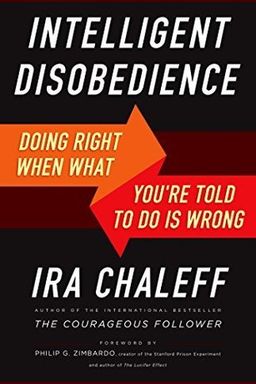
Intelligent Disobedience cover

Intelligent Disobedience

by Ira Chaleff

Intelligent Disobedience by Ira Chaleff challenges us to question authority and resist harmful orders. The book provides practical strategies for assessing when to obey and when to dissent, promoting moral courage and a culture of thoughtful disobedience. It’s essential reading for anyone looking to foster critical thinking and ethical decision-making.

Doing Right When Told to Do Wrong

How can you find the courage to say “no” when someone in authority—your boss, a teacher, or even a government—tells you to do something you know is wrong? In Intelligent Disobedience, Ira Chaleff argues that humanity’s tendency to obey must be balanced by a conscious, trained habit of resisting inappropriate or harmful authority. Through vivid stories, from guide dogs saving their blind partners to corporate scandals and military disasters, Chaleff makes a compelling case that learning to do right when told to do wrong is not just an act of rebellion—it’s an essential moral and civic skill.

Chaleff draws inspiration from an unusual source: the training of guide dogs. These companions are taught not only to obey commands, but also to disobey when following a command would put their human in danger. A dog that refuses to cross the street because of an oncoming car is not being stubborn—it’s saving lives. What if humans trained themselves the same way? What if organizations, schools, and governments valued individuals who could intelligently disobey orders when ethics and safety demanded it?

The Cost of Blind Obedience

Blind obedience, Chaleff reminds us, has fueled some of history’s darkest chapters—from Nazi soldiers claiming they were “just following orders” to corporate employees hiding financial fraud. Decades of psychological research, most notably Stanley Milgram’s experiments at Yale and Philip Zimbardo’s Stanford Prison Experiment, have shown that ordinary people will harm others simply because an authority figure told them to. These studies expose the agentic state—a psychological condition where we stop seeing ourselves as autonomous agents and become instruments of authority.

Chaleff contends that waiting until adulthood to confront blind obedience is too late. By then, habits of compliance are deeply ingrained. Society conditions us from childhood to respect authority, follow rules, and avoid conflict—yet rarely teaches us when or how to respectfully resist. The result? Ethical catastrophes in every sphere: government cover-ups, healthcare negligence, engineering disasters, and everyday workplace misconduct.

The Moral Logic of “Intelligent” Disobedience

At the heart of the book is Chaleff’s distinction between obedience that serves the greater good and disobedience that prevents harm. Intelligent disobedience is not defiance for its own sake—it’s obedience to a higher principle than the immediate order. A nurse refusing a doctor’s unsafe instruction, a co-pilot questioning a captain’s decision, or an employee exposing financial fraud are all examples of this moral clarity. True accountability means recognizing that following orders does not absolve you of responsibility; you are always accountable for your own actions.

This form of disobedience, the author explains, is deeply social. In environments where questioning authority is supported and modeled, more people act ethically. In contrast, cultures of rigid hierarchy suppress dissenting voices until disaster strikes. Intelligent disobedience, therefore, must become a learned cultural reflex, not an accident of character.

From the Lab to the Living Room

Chaleff extends this notion from professional settings to child-rearing and education. He argues that children should be taught not only how to obey, but also when not to. Parents can cultivate this by explaining rules, welcoming respectful questioning, and praising discernment instead of mere compliance. Schools, he warns, often do the opposite—overemphasizing obedience to teachers or standardized systems at the expense of critical thinking. The story of Louise Ogborn, a fast-food worker manipulated into obeying a fake police order to strip-search herself, underscores what happens when obedience is taught too well.

The same principles apply within organizations. Leaders who encourage honest feedback—what Chaleff called “courageous followership” in his previous book—create safety and accountability. Those who punish dissent cultivate risk, silence, and scandals. Building a culture of intelligent disobedience means rewarding those who question harmful orders, not punishing them for insubordination.

A Vision for Accountable Cultures

Ultimately, Chaleff’s vision is as civic as it is personal. If societies embedded intelligent disobedience in upbringing, education, and professional training, authoritarian abuses could be stopped before they grow. In a self-correcting culture, individuals would instinctively balance loyalty with conscience. The challenge, he concludes, is not just to understand this principle but to embody it. Each of us must learn, like a well-trained guide dog, to stop when told to move forward—if that step endangers what’s right.


Why We Obey Even When It Hurts

Chaleff grounds his argument in a sobering reality: most people obey harmful orders, even when fully aware that doing so causes suffering. Psychologist Stanley Milgram proved this in the 1960s when participants, believing they were part of a learning experiment, continued delivering supposedly lethal electric shocks to strangers simply because an authority in a lab coat insisted.

Milgram found that nearly two-thirds of participants obeyed, a statistic that mirrors real-world obedience—whether in corporate scandals, military atrocities, or everyday groupthink. Only 35 percent of subjects resisted. Chaleff reinterprets these findings not as evidence of human cruelty, but as an urgent call to train people in recognizing when obedience becomes dangerous.

The Agentic State and Loss of Self

Milgram coined the term “agentic state” to describe how people transform from autonomous moral actors into obedient agents. Once someone accepts another’s authority as legitimate, their responsibility shifts outward—they see themselves as fulfilling duty rather than making choices. Chaleff warns that this subtle psychological switch happens daily in workplaces and institutions. It’s how a nurse follows a terrible order or a bureaucrat enforces an unjust rule, believing they’re merely doing their job.

The Power of Context

Disobedience doesn’t depend on personality as much as on situation. When authority feels official—through uniforms, credentials, or proximity—people comply. When authority is questioned by peers or distant in space, obedience declines. In Milgram’s variations, if two confederates refused to continue the shocks, 90 percent of others also stopped. Chaleff draws on this to argue that social support for dissent is critical. A lone resistor is a rebel; two resistors create a movement.

Overriding the Reflex to Obey

Why do we keep obeying? Because society has rewarded compliance since childhood—first with praise, then with promotions. Obedience, Chaleff says, is our default setting. We obey to belong, to avoid conflict, or because disobedience feels rude or risky. Yet the true danger lies in automatic compliance. “We are accountable whether or not we were following orders.”

To override this reflex, Chaleff suggests conscious retraining: recognizing discomfort as a moral signal, pausing instead of reacting, and questioning authority respectfully but firmly. Only by doing so can we reclaim moral agency and prevent the “servile will” that philosopher Paul Ricoeur warned diminishes our humanity.


Breaking the Habit of Blind Obedience

In one of the most memorable stories in the book, Chaleff recounts the experience of a young U.S. Army lieutenant who learned to question authority under pressure. His new captain deliberately gave him nonsensical orders and commanded him to reply, “That’s BS, sir!” until he could say it with confidence. The goal was not disrespect—it was to retrain his reflexive obedience so he could think critically under stress.

This scene illustrates Chaleff’s central tactic for rewiring obedience: deliberate practice. People can’t unlearn submission through slogans like “think for yourself.” They need coaching, rehearsal, and support—just as athletes or pilots do—so they can override years of conditioning that reward compliance.

Training Courage Under Command

The lieutenant’s training worked because his captain understood a deeper truth: fear of authority is learned, so it can be unlearned. By ordering the lieutenant to speak up, he allowed him to rebel within safe parameters, turning defiance into disciplined responsibility. Later, when a colonel pressured the captain to cover up misconduct, the lieutenant again said, “That’s BS, sir”—and this time saved both men’s careers. The lesson: courage grows through structured opportunities to practice dissent.

How Leaders Can Reinforce or Destroy Accountability

Leaders often say they value candid feedback, but their reactions prove otherwise. If dissenting employees are punished, they learn silence; if praised, they strengthen a norm of accountability. Chaleff urges leaders to reward loyal resistance—to make it clear that honest critique serves the mission, not defies it. Wise leaders understand that intelligent disobedience protects authority from its own blind spots.

When subordinates challenge orders for good reasons, they safeguard both integrity and effectiveness. As the captain demonstrated, authority is strongest when it invites correction rather than commands submission.


The Power of Voice: Speaking Up to Authority

One of Chaleff’s most practical chapters explores what he calls the “right level of voice.” Just as a guide dog communicates danger through firm body language, you must learn to use a voice strong enough to be heard, but not so aggressive that it triggers defensiveness. The author analyzes famous air disasters—like the 1982 Air Florida Flight 90 crash—where copilots noticed danger but used deferential, tentative language instead of decisive warnings.

Mitigating vs. Assertive Language

Linguists call it “mitigating language”: a polite softening of speech that signals deference to authority. “I’m not sure this is right” instead of “Abort now.” In emergencies, mitigation kills. Crew Resource Management (CRM) training, later developed by NASA and United Airlines, specifically taught flight crews to voice concerns assertively and persist until acknowledged. After CRM was introduced, fatal airline crashes dropped sharply.

Chaleff argues this same training should extend beyond cockpits—to hospitals, classrooms, and corporations—so everyone knows how to escalate a warning: from “I wonder if...” to “Stop—this is dangerous!”

Voice as a Moral Tool

Learning to speak assertively isn’t just communication—it’s moral action. When a nurse questions a doctor’s risky order or an employee refuses fraudulent paperwork, they’re protecting others through voice. The key is practice: role-playing risk scenarios and rehearsing how to escalate from polite inquiry to firm insistence.

The human version of the guide dog’s counter-pull begins with your voice. Intelligent disobedience often starts not with defiance, but with a well-placed “Wait a second—this doesn’t seem right.”


Why We Say Yes to Harmful Orders

Even when we sense danger, we often comply. Chaleff explores this paradox through cognitive dissonance—the brain’s mechanism for reducing discomfort between what we believe and what we do. When orders clash with values, instead of confronting anxiety, most people rationalize the behavior by saying, “It’s probably fine.” That’s how ethical disasters like the WorldCom accounting scandal unfold.

The Betty Vinson Case

WorldCom accountant Betty Vinson was asked to falsify financial reports to protect executives. Torn between loyalty and ethics, she justified her actions as “just once.” When the deception continued quarter after quarter, she felt trapped by her own compliance. Like Milgram’s subjects, the longer she obeyed, the harder it became to stop. Eventually, she served prison time for conspiracy. Her story demonstrates how small compromises turn into moral collapse.

Long-Term vs. Short-Term Risks

Chaleff highlights a dangerous bias: we overreact to immediate threats (like losing a job) and underreact to distant ones (like ethical ruin). Intelligent disobedience requires flipping that instinct—valuing integrity over convenience. When in doubt, pause. Question. Reassess whose interests the order serves. As Chaleff puts it, “Saying no may cost your position; saying yes may cost your soul.”

The guide dog’s strength lies in trained hesitation. Humans need the same reflex—learning to stop, breathe, and check alignment between actions, values, and consequences before stepping forward.


Teaching Children to Resist Wrong Authority

Perhaps the most radical idea in the book is that resistance must be taught from childhood. Chaleff unpacks how schools and families often teach obedience too well—conditioning students to accept rules without question. Using the tragic story of 18-year-old Louise Ogborn, humiliated by a prank caller posing as a police officer, he shows how compliance learned at home and reinforced at school can turn deadly.

Obedience as a Default Mode

Ogborn obeyed the caller because she had been taught that “when an adult tells you to do something, you don’t argue.” The same unconditional obedience saturates many classrooms, where educators managing difficult students rely on rigid control systems that prize silence over thought. Chaleff analyzes popular classroom management methods—like Lee Canter’s and Fred Jones’s—to show how they train compliance through posture, tone, and rewards. The unintended result: a citizenry expert at pleasing authority, not questioning it.

Balancing Respect with Autonomy

To reverse this, Chaleff urges educators and parents to treat obedience as a skill to be balanced, not maximized. By explaining reasons for rules, inviting critical dialogue, and modeling respectful dissent, adults can teach children that authority exists to serve safety and truth—not to silence them. Programs teaching “refusal skills” and body autonomy already prepare kids to resist abusive adults; the same principles can apply to moral and civic education.

“Obedience without awareness breeds danger,” Chaleff warns. Teaching intelligent disobedience from an early age creates citizens capable of both cooperation and conscience—an antidote to totalitarian drift in any society.


Creating Cultures that Do the Right Thing

At the system level, Chaleff calls for whole cultures—families, schools, organizations, and governments—that honor accountability as much as cohesion. Obedience alone cannot produce ethical stability; it must be balanced by moral courage. A culture that values Intelligent Disobedience, he argues, protects both individuals and institutions from self-destruction.

Fractals of Moral Behavior

Chaleff uses a metaphor from nature: just as patterns repeat fractally, habits of conscience learned in small decisions reproduce at larger scales. A child taught to say “no” when wronged becomes an adult who resists unethical policies. A worker who questions a flawed order prevents catastrophe. When such learning becomes cultural DNA, societies evolve toward justice and freedom.

Technology and the New Challenge

Modern technology, Chaleff warns, amplifies authority’s power to surveil and manipulate citizens. The safeguard must be twofold: moral maturity and transparent systems that empower speech. In an age when every action is tracked, the courage to dissent—supported by peers and ethics curricula—becomes civilization’s firewall.

Chaleff ends with a simple challenge: “What action will you take?” Whether you’re a parent, teacher, manager, or citizen, your role is to model personal accountability—to show that true loyalty sometimes means disobedience. Cultures worthy of freedom depend not on those who follow orders blindly, but on those who pause, question, and protect what is right.

Dig Deeper

Get personalized prompts to apply these lessons to your life and deepen your understanding.

Go Deeper

Get the Full Experience

Download Insight Books for AI-powered reflections, quizzes, and more.