
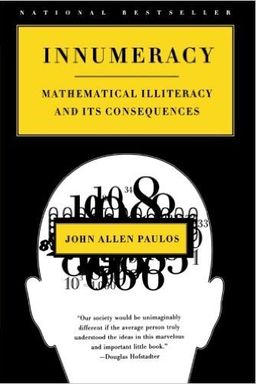
Innumeracy cover

Innumeracy

by John Allen Paulos

Innumeracy unveils how mathematical illiteracy affects our lives, from poor decision-making to susceptibility to pseudoscience. Through real-life examples, John Allen Paulos provides solutions to conquer math fears, empowering readers to think critically and make informed choices.

The Costs and Consequences of Innumeracy

What happens when a society that lives by numbers can’t understand them? In Innumeracy: Mathematical Illiteracy and Its Consequences, mathematician John Allen Paulos asks this unsettling question and proceeds to show how our collective inability to reason with numbers, probability, and logic has warped everything from politics and media to medicine and everyday decision-making. If you’ve ever heard someone say “I’m not a numbers person,” Paulos argues that this brand of self-professed ignorance isn’t harmless — it’s a civic and cultural liability.

Innumeracy — the inability to comfortably deal with basic quantitative ideas like scale, probability, and estimation — is not about bad calculation skills. It’s about poor thinking. People proudly announce their mathematical incompetence but would never brag about their illiteracy. That gap, Paulos contends, allows misinformation and pseudoscience to flourish unchecked. From superstitions about astrology to political polls misinterpreted by journalists, misusing numbers shapes our fears, beliefs, and public policies.

Why Numbers Matter Everywhere

Paulos warns that in a world driven by data, innumeracy distorts our understanding of everything from risk to randomness. For example, millions of adults overestimate their chance of dying by terrorism and underestimate their risk behind the wheel. Others confuse correlation with causation — assuming that if two things happen together, one must cause the other. These failures of perception feed conspiracy theories, political rhetoric, and public panic. Understanding probability, he suggests, is not about memorizing formulas but about seeing the world more clearly and responding rationally to uncertainty.

Mathematics as Thinking, Not Computation

One of Paulos’s core arguments is that mathematics is not about rote computation. It is a way of reasoning and interpreting. He compares calculation to typing — necessary, but far from the whole of writing. Most of our mistakes with numbers come from failing to think conceptually. When someone multiplies probabilities incorrectly or interprets a statistic without context, the result isn’t just a numerical error but a flawed worldview.

He laments an education system obsessed with algorithmic drill rather than curiosity, pattern, and logic. To combat this, Paulos recommends teaching estimation, inductive reasoning, and probability judgement in everyday contexts — from evaluating risks in medical procedures to questioning claims in the news. His humorous examples, from gamblers and meteorologists to doctors and election analysts, illustrate that a little quantitative literacy can quickly separate sense from nonsense.

The Broader Cultural Problem

Innumeracy, Paulos argues, also has cultural roots. Romantic misconceptions make people think that concern with numbers somehow diminishes emotional depth or appreciation of beauty. He dismisses this as “balderdash,” contending that mathematics enhances rather than restricts wonder — just as understanding the physics of a waterfall doesn’t make it less magnificent. When we fear numbers, we allow sentimentality to overrule reality.

Throughout the book, he also notes how innumeracy leads to belief in pseudoscience. Astrology, psychic predictions, and miracle diets all depend on misunderstanding probability and coincidence. Without statistical thinking, people confuse anecdote for evidence and accept logical fallacies as truth. This makes society vulnerable to manipulation, political spin, and false hopes, from miracle cures to market scams.

Moving from Ignorance to Insight

Paulos invites readers to see mathematics as a language of insight into both the practical and philosophical dimensions of life. He uses vivid examples — like calculating the chance you’ve inhaled a molecule from Julius Caesar’s last breath — to spark curiosity and humility. Numbers, he insists, are tools of perspective. Understanding scale and probability helps you interpret social issues, notice bias, and make smarter personal decisions.

In brief, Innumeracy is both warning and wake-up call. Paulos claims that learning to think more numerically is not just a matter of technical education but of cultural maturity. To be numerate is to be equipped to navigate a world of risks, trade-offs, and uncertain truths. His stories — whether about pseudoscience, probability errors, or mathematical beauty — remind you that developing numerical literacy is an act of intellectual responsibility, not calculation.


Mastering Scale and Probability

Paulos opens his first major section with astonishing examples of how most people fail to comprehend big numbers and small probabilities. You probably know that a million is one thousand thousand — but can you feel the difference between a million, a billion, and a trillion? He points out that many educated individuals cannot, and this ignorance leaves them vulnerable to exaggerated fears or grandiose misconceptions.

Learning to Feel Magnitude

To appreciate scale, Paulos asks you to imagine time: a million seconds is just 11.5 days, but a billion seconds equals almost 32 years. With vivid analogies — blood volumes filling Central Park, or Mount Fuji dismantled truck by truck — he teaches how estimation builds intuition. Knowing approximate quantities, he says, is crucial to thinking rationally about everything from budgets to population statistics.

For example, he notes that while millions fear being the victim of terrorism abroad, only seventeen Americans were killed overseas by terrorists in 1985 — out of 28 million travelers. By contrast, 45,000 died in car crashes that year. When someone objects “but what if you’re that one?”, it reveals a personalizing habit that defies numeracy: we overidentify with rare risks and ignore pervasive, mundane ones.

From Snails to Supercomputers

To cultivate tangible understanding, Paulos compares the Concorde jet's velocity (2,000 miles per hour) to a snail’s crawl (0.005 miles per hour) — a ratio of 400,000:1. He describes that a supercomputer adds ten-digit numbers one billion times faster than you can. These comparisons make “big” and “small” meaningful, transforming abstract figures into relatable perspective.

Scientific notation, he adds, should be as natural in journalism as spelling. Instead of “seventy-three billion nine hundred eighty-four million,” write 7.39842×10¹⁰. Such clarity simplifies comprehension and reduces the emotional impact of intimidating numbers. (This echoes Hans Rosling’s approach in Factfulness, where understanding scale makes global trends less frightening.)

Seeing Patterns Through Magnitude

Numbers also reveal hidden structure in the world. Paulos shows how Archimedes’ insight that any number, no matter how small, can sum to exceed any number, no matter how large, explains how trivial behaviors — like aerosol spraying or driving — accumulate into environmental impact. Similarly, probability and combinatorics, such as counting possible dice rolls or lottery sequences, help grasp how rare events arise naturally from huge sample spaces.

Underlying his teaching is a call to play with numbers. Estimate how many pizzas are eaten in a year or how many words you’ve spoken in your lifetime. By practicing creative estimation, you train not just numerical skill but curiosity and proportion. Innumeracy, he suggests, is cured through imagination as much as through arithmetic.

Ultimately, learning scale and probability leads to what Paulos calls “numerical humility” — realizing both the vastness and subtlety of the world’s quantities. It’s a perspective that turns superstition and panic into understanding, and it begins simply by asking: What’s reasonable here? How big or small is that, really?


Understanding Chance and Coincidence

Paulos devotes an entire chapter to probability and the human tendency to misread randomness as meaning. Whether you see coincidences in dreams, resemblances in history, or streaks in sports, your brain tends to impose pattern on chance. He argues that innumeracy and superstition thrive on this cognitive bias.

The Birthday Paradox

His famous example is the “birthday problem.” You need only 23 people in a room for the odds to exceed 50% that two share a birthday. Most people guess near 180—five times too high—because they confuse a specific match (someone with your birthday) with any match (any two sharing one). This small demonstration reveals how our intuition fails with probability and how misunderstandings like this feed pseudoscientific coincidence-hunting.

Coincidences and Filtering

We remember the hits and forget the misses. A psychic makes one correct prediction and everyone forgets the ninety-nine wrong ones. Paulos terms this psychological bias the “Jeane Dixon effect.” Filtering gives anecdotes more importance than data and makes superstition feel empirically justified. Chance ensures that “amazing” events occur regularly — it would be improbable for improbable events not to happen in a large population.

Social Connections and Random Links

He also uses the “small world phenomenon” to show how even unlikely encounters are predictable by statistics. With 200 million adults in the U.S. each knowing roughly 1,500 people, two random people are nearly guaranteed to be connected by a chain of two intermediates. Psychologist Stanley Milgram’s experiment confirmed this mathematically — giving rise to the concept of “six degrees of separation.”

Filtering and Fallacy

Paulos insists that coincidence is not causation. He demonstrates through playful examples — comparing astrological “synchronicities” and urban myths — that seeing meaning everywhere can lead to pseudoscience, from astrology to stock-market scams. The antidote is awareness: before trusting coincidence, calculate its probability. Usually, it’s higher than you think.

By the end of the chapter, coincidences no longer feel mystical but inevitable. As Plutarch said and Paulos reaffirms, “Numerous coincidences should spontaneously occur.” Understanding chance helps you live more calmly in a world that seems random but isn’t personal.


How Pseudoscience Exploits Innumeracy

Astrology, psychic readings, miracle cures — all depend on mathematical mistakes. Paulos devotes a chapter to exposing how pseudoscience preys on ignorance of probability and logic. He shows that untested theories gain power because they borrow the language of mathematics and science without its discipline.

The Trap of False Certainty

Many pseudoscientific ideas use numbers to fake precision. Biorhythms predict emotional cycles by assigning mystical significance to mathematical periods; psychic research manipulates odds to inflate apparent success. Freud’s friend Wilhelm Fliess even convinced him to believe in 23- and 28-day metaphysical rhythms by showing they could produce any number with simple arithmetic — a trivial property of prime numbers mistaken for revelation.

Unfalsifiable Claims

Innumeracy also blurs the distinction between scientific and metaphysical statements. Paulos invokes Karl Popper’s criterion: a claim must be falsifiable to be scientific. If an astrologer can explain any outcome by equivalently vague conditions — “Mercury in retrograde means miscommunication or success depending on your aura” — the claim is meaningless. A similar logical fuzziness infects psychoanalysis and Marxism when adherents interpret contradictory evidence as proof. Everything becomes “confirmation.”

Probability and Prediction

Because people misunderstand randomness, ESP testing and psychic predictions exploit wishful thinking. Paulos explains why even a one-in-a-million coincidence will reliably happen thousands of times among millions of people. Predictive dreams and paranormal coincidences, he suggests, are statistical certainties, not supernatural messages.

He compares astrology claims with scientific studies showing no correlation between zodiac signs and personality tests. Even when astrologers were tested objectively — picking profiles of anonymous subjects — they performed no better than chance. What keeps belief alive, Paulos argues, is human vanity and confirmation bias. People prefer stories that flatter them or give control over uncertainty.

Science vs. Seduction

Real science is humble and self-correcting; pseudoscience is bold and unaccountable. Yet without numeracy, they look the same. Medical quackery, for instance, thrives because most diseases improve or fluctuate naturally. A fraudulent cure coinciding with a remission seems miraculous. The believer ignores the countless failures and remembers the one success — filtering all data through wishful eyes.

Paulos’s humor keeps the exposure spirited, but his warning is serious: innumeracy makes intelligent people credulous. Without comfort with uncertainty and proportion, you risk embracing confident nonsense simply because it feels orderly.


Roots of Mathematical Illiteracy

After diagnosing the disease, Paulos turns to its origins. Why do so many educated people fear mathematics? His answer combines poor education, psychological aversion, and cultural romanticism. Mathematics, he says, has been misrepresented as mechanical rather than creative, hierarchical rather than flexible, lifeless rather than playful.

Failed Education

Most schools teach arithmetic but not reasoning. Students learn to multiply but not why or when to multiply. They practice algorithms but forget estimation, word problems, and induction — all essential to real-world numeracy. Paulos’s childhood memory of being rightfully proud of calculating a baseball player’s earned-run average, only to be dismissed by his teacher, encapsulates this failure of imagination. Schools too often punish curiosity rather than reward it.

Anxiety and Personalization

Math anxiety, explained here with warmth and humor, paralyzes adults who see numbers as threats to their identity. They believe there are “mathematical minds” and “non-mathematical minds.” Paulos insists that this is nonsense — everyone can think quantitatively. Anxiety grows from intimidation, poor teaching, and personalization of problems: people resist abstraction because it feels impersonal. Innumeracy thrives when emotions displace logic, as when risks are assessed not by probability but by vividness.

Romantic Misconceptions

Important cultural myths also undermine numeracy. Paulos dismantles five major misconceptions about mathematics: that it is mere computation, strictly hierarchical, unrelated to story, suitable only for geniuses, and somehow alien to feeling or freedom. Against these beliefs, he portrays math as playful, narrative, aesthetic, and deeply human. He quips, “Mathematics has as much to do with computation as writing has to do with typing.”

Mathematical reasoning, he argues, expands rather than constrains creativity. Understanding relationships and patterns helps you see the world more richly, not more mechanically. (This echoes Bertrand Russell’s description of mathematics as possessing a “cold and austere beauty” intertwined with imaginative freedom.)

Cultural Ramifications

Paulos connects innumeracy to filtered emotions and poor decision-making. Without proportional thinking, society exaggerates risks, inflates fears, and neglects deeper realities like heart disease or poverty. He even proposes a “logarithmic safety index” to show comparative dangers — ranking car crashes, smoking, lightning strikes — because narrative emotion distorts perception. The media, he says, love spectacular anomalies over statistical truth.

Understanding why innumeracy persists helps you spot it in yourself. Fear of abstraction, pride in ignorance, and resistance to uncertainty are cultural, not personal flaws. By recognizing them, you gain the first tool of numeracy: awareness that numbers aren’t cold facts but lenses of honest attention.


Statistics, Trade-offs, and Rational Society

In the book’s final major section, Paulos explores how innumeracy corrupts public logic on social trade-offs and statistics. Politics, economics, and ethics all involve probabilistic thinking; yet society insists on certainties. From polls to public policy, misunderstanding numbers leads to distorted priorities and irrational choices.

Probability Paradoxes and Public Decisions

Paulos illustrates voting and policy paradoxes with humor. Counterintuitive probability shows that rational individuals can produce irrational collective outcomes — the same logic behind Arrow’s impossibility theorem. The Wisconsin legislator who feared daylight saving time because it might fade curtains exemplifies how ill-defined “trade-offs” mislead people who lack quantitative perspective. The mathematician’s lesson: your intuition about fairness, risk, and decision often fails without statistics.

Risk, Policy, and the Prisoner’s Dilemma

He adapts the famous “prisoner’s dilemma” to everyday ethics. Acting selfishly often harms everyone; cooperating rationally benefits all. Whether you’re deciding environmental policy, nuclear arms strategy, or corporate competition, mathematical models reveal moral insights: reasoned self-interest should include collective outcomes.

Confidence Intervals and Media Misuse

Paulos skewers journalistic misuse of polls. When polls report “X favored by 51%,” without stating margins of error, viewers imagine certainty where none exists. Understanding confidence intervals (plus or minus 4% at 95%) would prevent false interpretations of trivial shifts. Without this awareness, public discourse jumps to conclusions over statistically meaningless differences.

Correlating Without Cause

He dismantles common correlation fallacies: believing that divorce rates or cancer clusters imply direct causes rather than hidden factors or randomness. He humorously shows, for instance, how body lice once signified good health merely because sickness drove them away — correlation misread as causation. Such thinking infects public debate and pseudoscience alike.

The Logic of Trade-offs

Numbers clarify moral choices. Every policy has costs and risks. Rejecting a potentially bad drug early prevents harm but denying a good one costs lives — Type I and Type II errors, redefined for society. Paulos pushes for honest quantification of values rather than sanctimonious slogans. The idea that every life is “priceless” may be inspiring but makes rational policy impossible. Instead, he argues for open, ethical arithmetic: finite values honestly acknowledged to reach better collective outcomes.

By the book’s close, Paulos extends numeracy from individual reasoning to democratic maturity. Understanding statistics, probability, and trade-offs is not cold intellect but civic empathy — the ability to weigh consequences fairly. Rational society, he concludes, begins when citizens learn to think statistically rather than sentimentally, with humility about what numbers do and don’t say.

Dig Deeper

Get personalized prompts to apply these lessons to your life and deepen your understanding.

Go Deeper

Get the Full Experience

Download Insight Books for AI-powered reflections, quizzes, and more.