
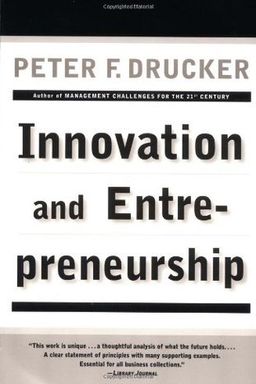
Innovation and Entrepreneurship cover

Innovation and Entrepreneurship

by Peter Drucker

Innovation and Entrepreneurship by Peter Drucker provides essential strategies for leveraging innovation to succeed in both new ventures and established corporations. Discover how to identify opportunities, harness market changes, and create customer demand, empowering everyone to achieve entrepreneurial success.

Innovation as a Deliberate Practice

How can you turn creativity into a reliable process instead of waiting for luck? Peter Drucker, in Innovation and Entrepreneurship, argues that innovation is a purposeful discipline — a form of work and management, not a matter of genius or chance. He insists that entrepreneurship is behavior you can learn rather than a trait you’re born with. The entrepreneur’s job is to shift resources from low- to high-yield uses, and the manager’s job is to make that shift systematic.

Innovation as organized work

For Drucker, innovation resembles engineering or medicine: it depends on observation, experimentation, and professional discipline. You can, and must, manage it deliberately. This means embedding innovation into your organization’s daily routines — from measuring unexpected results to learning from external shifts. The real breakthrough isn’t in creativity itself but in organizing creativity through systems and metrics. When companies like McDonald’s, IBM, and General Electric professionalized their managerial processes, they proved that structured innovation delivers repeatable results.

(Note: This view contrasts with ideas of spontaneous innovation common in Silicon Valley culture — Drucker’s framework stresses methodical opportunity search more than intuition.)

Entrepreneurship as behavior

According to Drucker, entrepreneurship is not limited to startups. It’s a pattern of action — seeing and acting on change to create new economic results. The McDonald brothers didn’t invent food; they reinvented a process and system that multiplied value through consistency. Similarly, DuPont and GE innovated by designing managerial structures that fostered long-term discovery. You don’t need a 'founder personality' to be entrepreneurial; you need disciplined curiosity and the willingness to convert insight into organization.

Management as the enabling technology

Drucker calls twentieth-century management the most powerful new technology of all. It transforms ideas — even mundane ones — into productive realities. The real challenge lies in harnessing management to support change, not merely to maintain stability. This approach allows even hospitals, universities, and nonprofits to become entrepreneurial by redesigning their missions and delivery systems. The modern university, for example, evolved as a social innovation that combined research, teaching, and self-governance. Management, Drucker insists, is itself the bridge between innovation and execution.

Making innovation habitual

To embed innovation into your organization, Drucker suggests scheduling systematic searches for opportunities, assigning team responsibility for identifying anomalies, and measuring progress based on customer results — not internal pride. Treat change as normal and measurable. When you build feedback channels that reward exploration and institutionalize learning from surprises, innovation stops being heroic and becomes routine. Drucker calls this the shift from 'momentary genius' to 'organized improvement.'

Core Insight

Innovation is not invention. It is the systematic application of knowledge—scientific, technical, social, and managerial—to find and exploit change as an opportunity for a different business or service.

Through this lens, Drucker reframes entrepreneurship as the professional practice of change. It begins not with ideas but with disciplined curiosity about what surprises reveal. By learning to search systematically, test quickly, and manage through feedback, you can make innovation a normal function — the lifeblood of your work, not an occasional burst of inspiration.


The Seven Windows of Opportunity

Drucker gives you a practical diagnostic framework: seven distinct sources of innovative ideas. These sources act as windows into change — some from within your organization, others from the world at large. The first four are internal and therefore more predictable; the last three are external and riskier but crucial for long-term adaptation.

The four internal sources

1. The Unexpected: A surprise success, failure, or event reveals what customers value differently than you thought. Macy’s accidentally discovered a huge appliance market; IBM realized that personal computers could become mainstream after watching hobbyists. Treat anomalies as opportunities, not nuisances.

2. Incongruities: When reality diverges from industry assumptions — as in steel, where mini-mills undercut integrated giants — the mismatch signals opportunity.

3. Process Need: Fix the weak link in an existing process. When Mergenthaler’s linotype mechanized printing or O. M. Scott’s 'Spreader' solved uneven fertilizer application, entire businesses were born.

4. Industry or Market Structure Changes: Rapid growth, segmentation shifts, or technology convergence (like computers and telephony joining in PBX systems) expose new strategic openings. Newcomers like ROLM or MCI exploited exactly these discomfort zones.

The three external sources

5. Demographics: Population changes are the most reliable external signals. When baby boomers hit college or retirement, entire industries expand or collapse. Drucker highlights universities like Pace that built adult education early.

6. Changes in Perception: Society’s self-view often shifts faster than physical conditions. Americans began to see themselves as middle class rather than working class, fueling demand for education, Encyclopaedia Britannica, and health goods.

7. New Knowledge: Scientific, technical, and social discoveries—such as Nylon or computing—have the longest lead times and highest gamble. They require converging fields and readiness among users.

Practical Rule

Start your systematic search with internal sources — especially the unexpected success or incongruity — for faster, lower-risk wins. Use external trends for long-term positioning.

Treat these seven as a continuous search routine: scan them quarterly, assign responsibility, and verify signals through direct contact with users, suppliers, and staff. Innovation rarely comes from abstract brainstorming; it emerges from the disciplined habit of looking where change has already begun to happen.


Turning Change into Opportunity

Drucker teaches you to see change itself as diagnostic data. Each deviation, failure, or surprise points to shifts in customer value or system design. The question isn’t "Why did this fail?"—it’s "What is this telling me about change?"

Learning from the unexpected

Unexpected success may be the richest data source. IBM moved from mainframes to PCs only because it studied unexpected hobbyist demand. Macy’s could have lost its lead had it ignored appliance sales. Conversely, failures signal outdated assumptions: a padlock firm learned customers bought symbolic locks, not stronger ones. Drucker’s rule: investigate every major success or failure with the same rigor you give quarterly results.

Fixing incongruities and process gaps

Every system hides mismatches between what it promises and what users need. The steel mini-mill corrected investment-cost distortions; the ocean container solved ship-port incongruity. Similarly, process-need innovations — like Connor’s enzyme for cataract surgery — pinpointed a bottleneck and eliminated it. Drucker’s criterion: find a self-contained process, identify the missing link, and deliver a solution that users instantly adopt.

Reading industry structure shifts

When industries restructure — through growth, segmentation, or convergence — you must decide quickly whether to specialize, scale, or dominate a function. Ford’s mass-production, Rolls-Royce’s luxury niche, and GM’s multi-brand management show contrasting, deliberate responses. The same pattern repeats: small outsiders (like MCI or DLJ) often see changes first because incumbents stay locked in old definitions.

Key Principle

Every change—internal or external—is an invitation to reallocate resources from what was once productive to what’s about to become productive.

By cultivating disciplined awareness of surprises, mismatches, and shifts, you make change itself the raw material of opportunity. Innovation becomes less about intuition and more about listening systematically to what the environment is trying to tell you.


Demographics, Perception, and Knowledge

External trends shape opportunity slowly but powerfully. Drucker highlights three key forces: population change, perceptional shifts, and knowledge convergence. Master these, and you can anticipate whole industries rather than react to them.

Demographics: the predictable future

Population movements—birth rates, aging, education—are measurable years ahead. When analysts ignored adult education demand, Pace and Golden Gate Universities capitalized by serving working adults. When baby boomers aged, health and leisure industries expanded accordingly. Drucker’s warning remains timely: demographic indicators are certain, but most leaders ignore them until too late.

From numbers to meaning

Demographic data only matters when interpreted through social psychology. Americans’ redefinition as middle class fueled new consumption habits; women’s mass entry into the workforce reshaped financial services. Entrepreneurs who listen to how people see themselves can design markets before they officially exist. (Note: This insight parallels Theodore Levitt’s idea that customers buy 'value meanings,' not just products.)

Knowledge-based innovation

Scientific and technical advances promise immense payoffs but come with extreme risk and timing challenges. Drucker notes that it took decades for computing and synthetic polymers to converge into usable industries. To manage such innovation, you must define the required knowledge set, build missing pieces, and time market entry precisely. Focus narrow: own the system (Edison), the market (DuPont), or the function (Pfizer in fermentation). Trying to do all three drains resources and kills ventures.

Managing the gamble

When the knowledge window opens, the market floods with entrants—and then shakes out brutally. Those who survive combine technical mastery with entrepreneurial management: finance discipline, distribution channels, and rapid field testing of receptivity. Drucker’s pragmatic checklist—map inputs, focus narrowly, and test small—transforms high-uncertainty breakthroughs into managed bets.

Think of these external forces as the longest levers in your portfolio: demographic predictability for sure growth; perception shifts for sudden inflection; and knowledge convergence for transformative leaps. The disciplined entrepreneur uses all three—each according to its horizon and risk appetite.


Building Entrepreneurial Organizations

Once you see where opportunities lie, the challenge becomes organizational: how do you make innovation habitual? Drucker’s answer is to redesign management systems so that innovation protects, not threatens, managers’ careers. That requires policies, measurement, and culture change.

Abandonment and the Business X‑Ray

Every few years, Drucker advises you to put each product, service, and policy “on trial.” Ask: would we start this again today? If not, either stop or transform it. This policy of planned abandonment frees both capital and attention. The Business X‑Ray complements it by mapping each product’s life expectancy and showing how much new innovation you need to maintain growth. IBM and Xerox used such tools to identify aging technologies and redesign portfolios in time.

Resourcing the innovation gap

After diagnosing decline, calculate your "innovation gap": the new revenue needed to replace what’s dying. Fund at least triple that amount in projects — Drucker’s conservative rule — and staff those projects with proven performers, not whoever is available. Give unambiguous deadlines and decision checkpoints to ensure weak ideas are replaced early.

Culture that rewards change

Procter & Gamble, Johnson & Johnson, and 3M show how to institutionalize innovation by designing meetings, reviews, and promotion criteria that celebrate opportunity-finding. Drucker cautions leaders: if you don’t make innovation profitable for managers, they’ll defend the past. Culture grows from policies—when executives expect every unit to innovate as part of normal work, entrepreneurship stops relying on charisma and becomes process.

Core Rule

You must make the organization greedy for new things—so that people want innovation because survival and reward depend on it.

By normalizing abandonment, measurement, and celebration of new work, you convert good management from a defense of yesterday to a platform for tomorrow.


Designing Systems for New Ventures

Even with culture in place, new ventures die without structural support. Drucker explains how to design the organizational, financial, and human mechanisms that give innovations a fighting chance.

Separate and protect the new

Emerging projects must live apart from existing businesses. Daily crises and ROI metrics in core divisions will suffocate early-stage ideas. Successful firms like 3M and P&G create distinct venture units, each with its own project manager empowered to pull in resources without fighting corporate inertia. The robotics firm that buried innovation several levels deep lost its lead precisely because its infant project lacked a champion.

Align responsibility and rewards

Drucker insists on locating senior accountability for all new ventures—ideally at the CEO or an appointed executive level—to prevent delays caused by line managers defending the status quo. Compensation systems must also evolve: suspend ROI calculations for early stages; reward success through advancement or equity; and let innovators return to safe roles if projects fail. Removing punishment for intelligent risk-taking is essential.

Metrics that nurture, not choke

Infant ventures can’t meet mature-unit controls. Adjust expectations—focus on milestone progress and market learning, not short-term profits. Create feedback loops akin to R&D reviews: assess results regularly, learn what deviated, and adapt. Drucker cites banks and pharma firms that treat experimentation as continuous education rather than pass-fail auditing.

New businesses mature only if you protect their infancy with lighter procedures, honest metrics, and leadership continuity. The right structure and incentives turn what might have been a spark into a sustainable enterprise.


Managing Ventures from Idea to Maturity

Entrepreneurship doesn’t end with launch. Drucker details how to manage a fledgling enterprise through its early growth while balancing market learning, cash flow, and team development.

Stay market-obsessed

Products always find unexpected uses. 3M’s success with Scotch Tape or Apple’s discovery of hobbyist markets show how crucial it is to treat early surprises as guides. Avoid relying solely on traditional research; instead, experiment directly with users and gather real feedback through pilots. The venture that listens more survives longer.

Manage cash and capital realistically

Growth consumes cash fast—profits on paper often mask liquidity crunches. Drucker recommends planning twelve months ahead in cash terms, securing financing before you need it, and anticipating a re-capitalization after every 40–50% growth surge. Cash foresight is survival knowledge.

Build a team before crisis

No founder scales alone. Map your core activities—product, manufacturing, marketing, finance—and identify leaders before emergencies arise. Drucker warns that founders who cling to all roles either fragment or stagnate. You must define your own best role honestly and prepare successors years in advance.

Lead with realism

Ask what the venture truly needs now—your ego or its next phase of leadership. Founders like Ray Kroc and Soichiro Honda succeeded because they knew when to delegate or step back. Maturity depends as much on managerial humility as on originality.

Managing new ventures means balancing vision with guardrails—staying close enough to adapt, distant enough to let others build competence. Drucker’s management-centric entrepreneurship ensures that great ideas grow into institutions rather than one‑hit stories.


Entrepreneurship Beyond Business

In Drucker’s broader view, entrepreneurship is not just for profit-making enterprises. Public-service institutions, governments, and societies themselves must adopt entrepreneurial habits to stay relevant in an era of constant change.

Making public institutions innovative

Nonprofits and public entities often reward activity rather than results. Drucker identifies three main barriers: expansionary budgets that resist program cuts, multiple veto-holding constituencies, and moral absolutism (“eliminate hunger” instead of “reduce famine”). To overcome them, leaders must define missions clearly, set reachable goals, and treat failure as feedback to rethink objectives. When the Girl Scouts revamped programs for working mothers and minorities, or when hospitals offered management contracts to smaller facilities, they proved that mission-driven institutions can innovate through pragmatic self-redefinition.

From welfare state to entrepreneurial society

Drucker’s final message is social: modern economies must become entrepreneurial systems. Central planning or high-tech fetishism cannot substitute for distributed innovation. Policies should promote capital formation, retraining, and adaptive institutions. 'Sunset laws' should retire obsolete programs, while tax and regulatory incentives should encourage new ventures. Lifelong learning and flexible education systems are keys to keeping labor mobile and opportunity open.

Drucker’s Social Lesson

The only humane alternative to stagnation or revolution is a society built for continual self-renewal — one that treats every change as an invitation to innovate.

By applying entrepreneurial thinking to public systems—via mission clarity, measured outcomes, and adaptive policy—you transform innovation from a luxury into a civic necessity. Drucker ends by urging both managers and policymakers to see entrepreneurship as the engine of renewal for organizations and nations alike.

Dig Deeper

Get personalized prompts to apply these lessons to your life and deepen your understanding.

Go Deeper

Get the Full Experience

Download Insight Books for AI-powered reflections, quizzes, and more.