
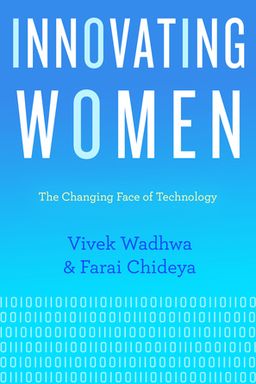
Innovating Women cover

Innovating Women

by Vivek Wadhwa and Farai Chideya

Explore the untold stories of female innovators in ''Innovating Women,'' where gender bias meets remarkable achievements. This book reveals the challenges and triumphs of women in technology, inspiring social change and redefining success against all odds.

Innovating Women: Redefining Power, Technology, and Equality

What will it take for women to fully shape the future of technology, business, and innovation? In Innovating Women, Vivek Wadhwa and Farai Chideya argue that unlocking women’s potential in science, technology, engineering, and business is not just a moral imperative—it’s an economic necessity and a catalyst for global transformation. Through hundreds of stories from women around the world, the book reveals how gender bias has slowed progress but how a powerful wave of innovators is redefining what success, leadership, and creativity look like.

The authors contend that women have always driven innovation, yet history and existing networks have systematically excluded them—from Ada Lovelace, the first computer programmer, to modern tech pioneers who still face invisible barriers. Innovating Women blends rigorous research with personal narrative to show how women are reshaping education, entrepreneurship, culture, and technological industries. The central argument is that modern innovation requires diversity of thought, empathy, and collaboration—all strengths that women have historically been denied the space to exercise.

Breaking Open the Hidden History

The opening chapters uncover a forgotten lineage of female innovators—Ada Lovelace, Marie Curie, Sophie Vandebroek, and Kay Koplovitz—women whose brilliance illuminated the path toward digital and scientific revolutions but who were often erased from public memory. Wadhwa explains that these women were visionaries who not only solved problems but also imagined new systems for thinking. This historical grounding demonstrates that women in technology are not anomalies, but inheritors of a legacy of creativity suppressed by cultural norms.

(Note: This approach mirrors Howard Gardner’s concept in Frames of Mind that innovation arises when diverse modes of intelligence—logical, interpersonal, aesthetic—intersect. Here, women embody that intersection.)

The Core Argument: Innovation Needs Inclusion

The authors show, through extensive research and stories from women entrepreneurs, scientists, and engineers, that companies with higher female representation in leadership outperform their male-dominated counterparts by significant margins. Yet persistent stereotypes—such as the idea of the 'male nerd' as a default innovator—continue to restrict women’s access to funding and advancement. Innovation, Wadhwa argues, is not about coding faster or raising more venture capital; it’s about solving problems through empathy, collaboration, and resilience, qualities often nurtured by women’s life experiences.

These recurring themes—education, mentorship, cultural bias, entrepreneurship, and policy reform—tie together the book’s chapters. From classrooms in Guatemala to boardrooms in Norway, from Kenya’s tech hubs to Silicon Valley’s venture capital networks, women fight different battles but share the same goal: to participate fully and reshape the system from within. The book’s mosaic-like narrative argues that empowering women in technology will make industries more ethical, innovative, and globally responsive.

Why It Matters for You

As a reader, you’re invited to see innovation not as a solitary pursuit but as a collective responsibility. You’re asked: What biases have you internalized? How do the systems you work within reinforce exclusion? The stories—from Lynn Tilton creating employment through corporate turnarounds, to Deborah Mills-Scofield mentoring young disruptors—reveal that every act of invention is also an act of empathy. Women innovate not only for profit but for purpose—to solve social problems, build communities, and design technologies that serve humanity.

Through this lens, Innovating Women becomes a manifesto for change. It argues that the next wave of progress will not be defined by faster processors or higher returns, but by the inclusion of every brilliant mind—especially those long excluded. It asks you to imagine what could happen if innovation was not coded as male, if creativity was not limited by culture, and if gender equity were treated as a technological revolution itself.

Ultimately, Wadhwa and Chideya’s work isn’t just about women in STEM—it’s about humanity’s evolution toward collaboration, empathy, and equality. The book urges readers to reimagine leadership as a shared endeavor and innovation as a collective art form. When women rise, innovation rises with them.


Educate to Innovate: Breaking the STEM Divide

Education is the seed of innovation—but for millions of girls, the soil is hostile. In the chapter “Educate to Innovate,” Wadhwa and Chideya reveal how cultural expectations, stereotypes, and resource gaps silently derail women’s progress in science, technology, engineering, and mathematics (STEM). To innovate, women must first survive an educational system that too often tells them they don’t belong.

From Childhood Curiosity to Cultural Barriers

Take Emily Fowler, who attended a computer camp for girls only to be teased mercilessly by classmates calling her “nerd” and “loser.” Yet her resilience and her father’s encouragement sparked a lifelong love of technology that led her to cofound HeroX, an innovation platform modeled after the X Prize. Similarly, engineer Kristen Sanderson changed her major from business to computer science after her father insisted she could do 'anything without boundaries.' These stories illustrate how family support counterbalances societal doubt.

Conversely, cultural conditioning often sabotages girls early. Sunny Bates recounts how baby girls are praised for beauty, while boys are hailed as future presidents. These subtle cues calcify into unconscious bias, leading to career disparities decades later. A striking example: immigrant girls who saw only male presidents on classroom posters assumed women could not hold that office. Wadhwa cites a study where 40 percent of female and minority chemists had been discouraged from STEM careers—mostly by college professors themselves.

The Leaky Pipeline and Solutions

Education forms a pipeline from early schooling to professional life—but for women, that pipeline leaks at every level. Poor schools lack science programs; middle schools track girls out of advanced math; and colleges undervalue female technical talent. Xerox CTO Sophie Vandebroek describes how only one girl was placed in the advanced math program at her daughter’s school until mothers intervened. Later, those same girls became engineers and doctors, a testament to vigilance and advocacy.

Innovators like Fiona Nielsen and Natalie Panek show how mentorship and exposure can plug the leaks. Nielsen learned coding from her grandfather, launching DNAdigest.org to improve genomic data sharing, while Panek uses social media to inspire women in tech, saying: “We must impress youth with our desirable traits first—then help them build skills.” Their blend of inspiration and outreach turns STEM into something socially vibrant, not intimidating.

Education as Empowerment

Underlying these stories is a simple truth: innovation begins when curiosity is protected rather than punished. Whether it’s Evonne Heyning programming at age six or parents encouraging daughters to question norms, education must nourish audacity. Wadhwa argues that expanding digital access—through MOOCs and open-source learning—can democratize opportunity. Yet access alone isn’t enough; mentors and role models are essential. Programs like Girls Who Code and Black Girls Code embody that fusion of technology and empowerment.

By reframing education as innovation incubator, “Educate to Innovate” reveals how gender bias isn’t inevitable—it’s engineered. And if exclusion can be engineered, inclusion can be too.


Women for the World: Technology and Human Purpose

Can technology heal a world divided by inequality? In “Women for the World,” Wadhwa and Chideya spotlight women who use innovation not for wealth alone, but to solve humanity’s biggest problems. Entrepreneur Ory Okolloh epitomizes this global conscience. Facing election violence in Kenya, she created Ushahidi—meaning “testimony” in Swahili—a crowdsourcing platform for citizens to report crises via text and Google Maps. From there, her work with Google and Omidyar Network focused on digital access and transparency across Africa.

Technology with a Moral Compass

Wadhwa contrasts Okolloh’s socially driven innovation with Silicon Valley’s profit-first mindset. Women, he argues, often approach entrepreneurship as a system of care. Tiffany Shlain’s cloud-based filmmaking and Jessica Jackley’s microfinance venture Kiva.org show how empathy and technology merge to foster collaboration and dignity. Shlain’s advocacy for “STEAM”—adding Art to STEM—reflects her belief that emotional engagement must shape the digital future.

Social Entrepreneurship and Global Impact

In microfinance, Jacqueline Novogratz’s Acumen exemplifies how women transform commerce into compassion. Acumen’s investment in Kashf Bank, founded by Roshaneh Zafar in Pakistan, empowered hundreds of thousands of women to escape poverty through ethical lending. Novogratz calls this 'moral imagination'—the ability to see from another’s perspective. Women-led ventures, from ethical clothing startups to water purification programs, mirror this ethos: profit married to purpose.

Collective Vision for a Better Earth

Contributors like Phaedra Pardue envision using technology for global harmony—ending war, hunger, and inequality. Her “Quantum Women” philosophy frames female traits like intuition and collaboration as drivers of planetary healing. Meanwhile, leaders such as Anne Hartley and Maria Thompson urge inclusion as civilization’s next stage—unleashing 100 percent of human capacity by balancing men’s and women’s contributions.

“Women for the World” argues that innovation divorced from empathy breeds imbalance. To innovate well, humanity must innovate kindly. For global progress, tech must not only change systems—it must change hearts.


Changing the Game: How Women Redefine Workplaces

What happens when workplaces are redesigned not just by policy but by culture? “Changing the Game” explores how women leaders—from Sophie Vandebroek at Xerox to Megan Smith at Google—transform corporate environments through data, diversity, and empathy.

Reinventing Corporate Culture

Megan Smith’s work at Google demonstrates that innovation depends on inclusion. Through programs like PI Labs and Women@Google, Smith examined unconscious bias, revealing differences in self-nomination rates for promotions and interview outcomes depending on team diversity. By adjusting maternity leave from three to five months and adding paternity benefits, Google reduced postpartum attrition. Even algorithmic hiring was redesigned to ensure women interviewed by diverse panels.

Networks and Affinity Groups

Across industries, women’s networks multiply connection and empowerment. Catherine Rose of Philips praised leadership circles for fostering loyalty and mentorship. NCWIT (National Center for Women & Information Technology) illustrates scale, bridging 450 organizations to expand female participation from classroom to boardroom. These collective spaces reshape loyalty—not through hierarchy but through belonging.

Data, Equity, and Design Thinking

Wadhwa highlights research showing that gender-balanced teams in STEM fields have smaller wage gaps (14 percent versus 21 percent). Leaders like Megan Smith advocate for historical visibility, urging companies to celebrate forgotten women scientists on platforms like Wikipedia or Google Doodles, shifting narrative bias. This aligns with modern design thinking—systems built around empathy and collaboration produce better outcomes than those optimized for conformity.

“Changing the Game” offers a blueprint: measure inclusion, encourage collaboration, and turn policies into cultural DNA. When companies make diversity as fundamental as innovation itself, leadership ceases to be about fitting in—it becomes about belonging.


Disruption, Resilience, and Reinvention

Disruption is not chaos—it’s courage. In “Disrupting My Way Through Life,” Deborah Mills-Scofield shows how disruption defines visionary women who rewrite the rules of industries while staying true to themselves. For Mills-Scofield, disruption began when her parents kept her home from school to avoid mediocrity. It continued through Bell Labs, where her curiosity earned her a patent that became one of AT&T’s most profitable.

Disruption as a Life Philosophy

Mills-Scofield’s story parallels Whitney Johnson’s concept of “disruptive innovation” for individuals. Johnson argues that women thrive when they leave comfort zones to explore unknown territories, even at risk of failure. Both women show that personal integrity—not external validation—leads to long-term innovation. Mills-Scofield’s move from corporate engineer to venture partner and mentor at Brown University embodies courage as iterative learning.

Resilience Across Careers

From Kim Polese’s struggles with sexism while launching Java to Sian Morson bootstrapping her mobile agency after leaving a senior corporate role, disruption is a recurring theme. It demands what Einstein called “staying with problems longer.” Polese’s experience reveals that persistence and professionalism outweigh prejudice—she ignored superficial attacks and built thriving tech companies despite media bias.

Reinvention and Mentorship

For Mills-Scofield, reinvention is generational. She mentors startups tackling healthcare, education, and sustainability, passing disruption forward. Her guiding principle—'I can look myself in the mirror at the end of the day'—echoes a deeper truth: success means integrity in turbulence. For you, this chapter asks, where can disruption clarify your purpose? When life deviates, innovation begins.

“Disruption” reframes instability as fuel for growth. Failure, in this context, isn’t the opposite of innovation—it’s its first draft.


Funding, Confidence, and the Gender Capital Gap

Why do women’s startups receive less funding despite outperforming men’s in efficiency? In “Women Affecting Funding” and “The Confidence to Lead,” Wadhwa exposes how gender bias operates in venture capital and angel investment systems—and how women are fighting back.

Money and Networks

Venture capital has long been a closed network where investors back founders who look like themselves. Deborah Jackson, who founded Plum Alley and cofounded Women Innovate Mobile, describes how men control early-stage funding, perpetuating exclusion through familiarity. Organizations such as Golden Seeds, Belle Capital, and 37 Angels are rewriting that narrative by pairing investment with mentorship, creating spaces where women learn to pitch with confidence rather than apology.

Confidence as Capital

Loretta McCarthy of Golden Seeds emphasizes that investors desire conviction, not perfection. Too many women undersell their ideas or second-guess leadership competence. Lynn Tilton puts her entire savings into rescuing companies, proving belief is its own funding source: 'Perfection, procrastination, paralysis—that’s the circle of loss.' Confidence isn’t arrogance; it’s alignment between purpose and risk.

Crowdfunding and Democratization

As technology lowers barriers, crowdfunding—platforms like Indiegogo, Kickstarter, and Jackson’s Plum Alley—lets women bypass old gatekeepers. Danae Ringelmann’s founding of Indiegogo came from her realization that capital flowed inefficiently to those already inside networks. Crowdfunding creates meritocracy, turning community trust into tangible funding.

By reframing funding as confidence culture, women trade apology for audacity. Innovation follows belief—and belief, it turns out, is the most valuable equity of all.


We Are the Ones We’ve Been Waiting For

Mary Grove and Megan Smith close the book with a rallying call: change will not arrive from outside—it will come from us. They argue that unconscious bias remains the greatest invisible barrier in technology and leadership. But awareness can evolve into action once institutions and individuals accept responsibility for transformation.

Recognizing Bias and Building Diversity

Research from MIT and the Geena Davis Institute confirms what many women already know: visibility matters. In media and education, underrepresentation of women in technical roles distorts aspiration. Grove and Smith urge systematic correction—highlighting hidden pioneers like Grace Hopper, Katherine Johnson, and Joanna Hoffman—to provide accurate models of female excellence. Visibility, they note, isn’t vanity; it’s validation.

Collaboration as Acceleration

The authors champion global collaboration networks: Google for Entrepreneurs, Girls Who Code, TED Fellows, Ashoka, and Women Techmakers. These ecosystems democratize creation, spreading innovation across cultures. Grove’s Startup Woman and Smith’s Solve for X initiatives prove that when you build communities—not hierarchies—you scale impact.

Fixing Culture, Not Women

They caution against viewing women as “problems to fix.” Instead, the culture must adapt to inclusivity—what former IBM CEO Lou Gerstner exemplified by linking executives directly with minority employee resource groups. Grove and Smith call this 'debugging our humanity.' It’s about upgrading the system, not the users.

Collective Hope

Their closing insight echoes the African proverb: 'If you want to go fast, go alone. If you want to go far, go together.' Innovation, then, is not about perfection or isolation—it’s about interconnection. That’s the defining spirit of this book: women and men, every race, every generation, building the world they imagine rather than inheriting the one they fear.

Most importantly, Grove and Smith remind you that progress isn’t passive—it’s participatory. You are not waiting for the innovators. You are one.

Dig Deeper

Get personalized prompts to apply these lessons to your life and deepen your understanding.

Go Deeper

Get the Full Experience

Download Insight Books for AI-powered reflections, quizzes, and more.