
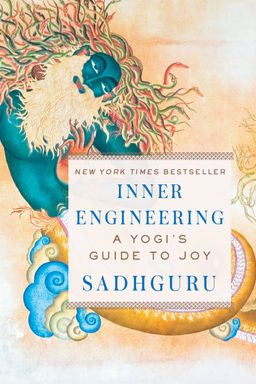
Inner Engineering cover

Inner Engineering

by Sadhguru Jaggi Vasudev

Inner Engineering by Sadhguru Jaggi Vasudev offers a transformative guide to achieving true happiness and fulfillment. Through yogic wisdom, it empowers readers to find peace within, align their inner energies, and consciously shape their life''s experiences. Embrace this journey towards spiritual enlightenment and deeper self-awareness.

Engineering Inner Joy and Conscious Living

What if joy, peace, and balance were not distant goals but the very foundation of your daily life? In Inner Engineering, Sadhguru—Indian mystic and founder of Isha Foundation—argues that true well-being cannot be achieved through external fixes or positive thinking, but only by mastering “the inner technology” of consciousness. He contends that your life is an expression of an inner mechanism so sophisticated that it surpasses any external invention. The problem, he insists, is not that life is complicated—it’s that you haven't learned where your “inner keyboard” is.

Sadhguru’s central message is simple yet profound: The way out is in. For him, joy is not a pursuit but your natural state. Yoga, he explains, is not merely a set of physical postures or breathing techniques—it’s the practice of aligning the body, mind, emotions, and energies to function harmoniously with the cosmic geometry of existence. When these dimensions fall into alignment, you no longer live accidentally; you become the engineer of your own inner experience.

The Paradigm Shift: From Outward Fixing to Inward Mastery

All human beings, Sadhguru writes, seek pleasantness. Whether expressed as health, success, love, or spiritual aspiration, every desire is a pursuit of inner pleasantness by outer means. He illustrates this through humor: we have fixed everything external—food, clothes, houses, technology—but we still struggle to smile. Unlike other creatures, when our stomachs are empty we have one problem. When full, we have a hundred. The issue is not the world outside but the lack of mastery over the inner machine.

This inner machine—your body and mind—is the most complex technology on the planet. Yet, Sadhguru quips, most people try to operate it “with a pickaxe and wrench,” unaware of its control systems. “You are the greatest piece of engineering,” he says, “but you just don’t know where the keyboard is.” The result is accidental living—reacting to situations instead of consciously responding. His solution is Inner Engineering: a practical and experiential path for mastering the mechanisms that generate thought, emotion, and energy.

A Guru as GPS: Guiding the Exploration Within

The book begins by reclaiming the word “guru,” misunderstood as a manipulative teacher. Guru, he clarifies, means “dispeller of darkness,” not a preacher or priest. A true guru simply points out signposts along the inner path—it’s the “Guru Pathfinding System,” or GPS. Sadhguru tells readers that they need not believe in anything he says; yoga is not dogma but a science to be tested. He writes, “You could find your own way, but who knows—it could take lifetimes.” The guru is not the destination but the map.

Through his own story—his moment of awakening on Chamundi Hill, where he experienced unity with all existence—Sadhguru expands the idea of spirituality from belief to direct perception. What happened to him was not mystical exaggeration but simple truth: all boundaries dissolved, space and time vanished, and he realized himself as “everything that is.” This experience of inclusion, which lasted hours but felt like minutes, transformed his life permanently. For him, enlightenment is not achievement but homecoming—the recognition that everything one ever experiences is happening within oneself.

Yoga as Inner Technology

Throughout the book, Sadhguru redefines yoga from postural exercise to the “science of self-creation.” Yoga is not a religion or philosophy; it’s about configuring the human system to download the cosmos. He describes the five layers of the self—from the physical body (annamayakosha), mental body (manomayakosha), and energy body (pranamayakosha), to the transient etheric body (vignanamayakosha) and finally the bliss body (anandamayakosha). Well-being, he insists, comes from mastery over the first three layers. But when these are perfectly aligned, the higher, nonphysical dimensions naturally reveal themselves.

Yoga is, in essence, engineering the inner to reflect the cosmic. When you align your personal geometry—the body, breath, and emotion—with the geometry of the cosmos, you experience inclusion rather than fragmentation. This alignment, the book shows, transforms longing into limitless joy. “When you realize that you can be ecstatic without reason,” he writes, “you have touched your innermost core.”

Why Inner Engineering Matters

In a world obsessed with technological progress, Sadhguru warns that external technologies without inner balance will destroy the planet. Despite unprecedented comfort, humanity is wracked with anxiety, anger, and depression. We’ve fixed the outside but not ourselves. Inner Engineering matters because it offers tools for mental clarity, emotional balance, and spiritual depth—qualities that modern success often strips away.

He concludes with optimism: if we turn inward, we can engineer joy as our constant state. The path is not belief, morality, or philosophy—but experiential transformation. “The only way out,” he insists, “is in.” The book’s message, though ancient in origin, feels revolutionary today. It is a reminder that self-transformation is not about changing who you are; it’s about recognizing that you were never separate from life in the first place.


The Way Out Is In

Sadhguru’s memorable phrase—“The way out is in”—encapsulates his entire philosophy. It means that liberation from suffering, confusion, and limitation doesn’t come from fixing external circumstances but from turning your perception inward. This idea, deeply rooted in the yogic tradition, challenges modern culture’s obsession with problem-solving through external technology, self-help slogans, or distraction.

Pleasantness as the Ultimate Science

According to Sadhguru, every experience in life—joy, love, peace, misery—is simply a matter of inner pleasantness or unpleasantness. He breaks it down into a clear system: when the body feels pleasant, it’s called health; when the mind is pleasant, it’s peace; when emotions are pleasant, it’s love; and when life energies are pleasant, it’s bliss. Every human act, he says, is an attempt to create pleasantness. Even reaching for heaven is seeking pleasantness, only projected elsewhere.

But external pleasantness is unstable: the market, weather, or someone else’s mood can collapse it in a moment. Inner pleasantness, however, is self-generated. “It’s your dream,” he says, using the playful story of a woman who fears a man in her dreams only to realize, “It’s your dream!” Happiness, like a dream, is an internal process. Once you master it, external triggers lose their grip.

Breaking the Dependence on External Triggers

The human mechanism can manufacture its own bliss chemistry. Sadhguru refers to modern findings like the discovery of the “bliss molecule,” anandamide (named after the Sanskrit word for bliss), which the brain naturally produces. Rather than relying on substances or events, you can consciously activate this inner alchemy through yogic practices, attention, and awareness. This is not spiritual escapism—it’s human technology.

Through humor and parables—like the bull and pheasant eating dung to climb a tree—he criticizes shallow quick-fix philosophies like “positive thinking.” These merely “sugarcoat reality.” Yoga, in contrast, is not about denial but harnessing the full spectrum of life’s experiences as tools for expansion. Painfully honest yet deeply compassionate, his warning is clear: if your inner life depends on external triggers, you live in perpetual insecurity.

Turning Inward as Enlightened Engineering

Turning inward begins with recognizing that every human experience happens entirely within you. Light, pain, pleasure—all occur internally, however external their stimuli seem. Once you grasp this, you stop trying to manipulate the world and start upgrading your perception. Sadhguru calls this “inner engineering”—activating your system to generate peace and bliss by design rather than chance.

This message echoes other contemplative traditions such as Eckhart Tolle’s The Power of Now and Stoic philosophy, yet Sadhguru’s emphasis on practical technology—specific yogic methods to transform one’s chemistry—is distinctly empirical. His approach merges scientific pragmatism with spiritual depth: “If you breathe consciously, it can be an enormous pleasure.” Consciousness and chemistry, he implies, are two languages describing the same truth.

Ultimately, the way out is in because you can only remodel your inner experience. External victory without inner mastery is empty; internal mastery makes external challenges irrelevant. “Do not look for a way out of suffering,” writes Sadhguru. “There is only one way—and that is in.”


Designing Your Destiny

Destiny, for Sadhguru, is not a cosmic lottery managed by some divine accountant—it is self-created software. He dismantles fatalistic thinking by illustrating how humans unconsciously write their destinies through repetitive thoughts, emotional patterns, and unconscious behaviors. You are not at the mercy of a script called “fate”; you are the programmer of your own operating system.

From Victimhood to Responsibility

The antidote to fatalism is responsibility. Sadhguru humorously tells the story of a husband and wife arguing over who should close the door—a miniature allegory of how people resist taking charge of life. True responsibility, he says, is not blame but response-ability: the ability to consciously respond to every situation. “If you decide, ‘I am responsible,’ you will have the ability to respond.” Responsibility is not burdensome—it’s liberation.

When you feel victimized—by genes, parents, bosses, or governments—you surrender your agency. But in acknowledging that your inner reactions shape every experience, you reclaim freedom. Your physiology only functions because it is responsive to the entire universe. Becoming conscious of this interdependence, he says, awakens a natural empathy and dissolves the illusion of separateness.

The Physics of Personal Destiny

Destiny, Sadhguru argues, operates on gradients of mastery: those who control their bodies shape 15–20% of their lives; mastery of the mind gives control of 50–60%; mastery of energy makes one’s destiny 100% self-authored. “Even now you are choosing your life,” he says, “but unconsciously.” Awareness transforms this unconscious choosing into deliberate creation.

Designing your destiny doesn’t mean controlling the universe—it means architecting yourself to ride its currents gracefully. External circumstances will never align perfectly; mastery lies in maintaining inner coherence despite external disorder. “You cannot control every situation in the world,” Sadhguru writes, “but you can steadily head toward your well-being and your ultimate nature.”

Responsibility as Divinity

Taking full responsibility, he concludes, is the simplest expression of divinity. Even the word “God,” he reminds readers, signifies “that which is responsible for everything.” Responsibility, therefore, is not moral obligation—it is the gateway to liberation. To become limitless in response is to mirror the Creator. When you acknowledge “My responsibility is limitless,” your identity expands beyond personal boundaries, dissolving fear and longing alike.

This principle echoes Viktor Frankl’s insight in Man’s Search for Meaning: freedom is not the absence of constraint but the ability to choose one’s response. For Sadhguru, when this ability expands to encompass all life, one becomes truly divine. “No boundary, no burden,” he declares. Liberation, then, is not escape—it is total involvement without resistance.


Yoga as the Science of Union

Most people think yoga means stretching or breathing exercises. Sadhguru reclaims its original meaning: “Yoga” literally means “union.” It is the science of aligning a finite human being with the infinite cosmos. In this framework, yoga is not about belief but mastery over inner geometry—the alignment of body, mind, energy, and emotion to experience existence as one seamless whole.

The Five Sheaths of the Self

The yogic physiology describes five “sheaths” (koshas) that comprise the human being: the physical body (annamayakosha), the mind body (manomayakosha), the energy body (pranamayakosha), the transient etheric body (vignanamayakosha), and the bliss body (anandamayakosha). The first three are tangible, the fourth bridges matter and spirit, and the fifth is pure consciousness. Mastery over the first three ensures physical health, mental balance, and energetic vitality. Alignment among them invites access to the bliss body—the realm beyond limitation.

Paths to Union

Depending on temperament, one can reach union through four major yogas: Karma Yoga (action), Gnana Yoga (intelligence), Bhakti Yoga (devotion), and Kriya Yoga (energy transformation). The story of four yogis trapped in a storm—each representing one path—humorously illustrates their divisions until their collective embrace of the deity makes divinity manifest. “At last,” God says, “you four idiots got together.” Yoga, simply put, is getting the four “idiots” within you—body, mind, emotion, and energy—to work together.

Union as the Essence of Science

Sadhguru likens yoga to science in its experimental nature. It asks you not to believe but to observe. Just as physics explains energy transformations, yoga explains consciousness transformations. This parallels Einstein’s insight that energy and matter are one (E=mc²); yoga applies this principle experientially within the human system. The book converts ancient metaphysics into practical methodology: align your inner systems and experience inclusiveness as the natural state.

In Sadhguru’s telling, yoga is not about becoming superhuman—it is realizing that being human itself is super. When you perceive the universe as yourself, compassion and clarity arise effortlessly. “Yoga,” he repeats, “is not a religion. It is a technology.” And it works, even if you begin for the wrong reasons.


The Body: The Ultimate Machine

Sadhguru calls the human body “the ultimate machine.” Every invention, from airplanes to computers, he says, was imagined by the same intelligence that runs your digestion and breath. The body processes a banana into human flesh within hours—a miracle of engineering unmatched by any machine. But this sophistication goes unnoticed because people operate their bodies accidentally.

The Intelligence Within

Contrary to mechanistic thinking, the body is alive with conscious intelligence. Yoga does not seek to dominate or punish the body but to align with this intelligence. If you consciously touch it, even the air and food around you respond differently. Basavanna, a twelfth-century mystic, called the body “a moving temple.” Sadhguru extends that idea: if you learn to operate it consciously, it becomes not only healthy but divine.

Physical Boundaries and Spiritual Grace

Yet, awareness of the body’s perfection must coexist with the recognition of its limitation. The body springs from the earth and returns to it. Within it reside two forces: self-preservation and the longing to expand boundlessly. When confused, these forces create tension—the struggle between material and spiritual yearnings. Gravity anchors you to earth; grace seeks to lift you up. Yoga is the art of becoming receptive to grace while remaining grounded in gravity.

Through daily awareness, Sadhguru suggests you can sense this connection by meditating before trees—recognizing that breath is a shared transaction between you and nature. This small exercise transforms ecological concern into living experience. In his words, “One half of your pulmonary system is hanging on a tree.”

By discovering the divine engineering within your body, you can move from mechanical survival to conscious creation. “If you bring even one drop of that intelligence into your life,” he promises, “you will live magically, not miserably.”


The Mind: From Circus to Symphony

The human mind, Sadhguru says, can be a miraculous gymnast or a tragic clown. Left unmanaged, it becomes a circus of random thoughts; when disciplined, it becomes a symphony conducting life’s perfection. The yogic process aims to replace unconscious mental chaos with conscious mental clarity.

The Trap of Thought

In a humorous parable, a man trying to meditate is told not to think of monkeys—and ends up thinking only of them. This illustrates the mind’s nature: it repeats what you resist. The problem isn’t that you can’t think—it’s that you think compulsively. Sadhguru contrasts this with Aristotle’s claim “I think, therefore I am,” saying instead, “You are, therefore you may think.” Thought, he explains, is a mechanism of memory and repetition, not creation. Existence precedes thought; when you live primarily in your mind, you lose contact with life itself.

Mapping the Mind’s Layers

Sadhguru outlines four key dimensions of mind: buddhi (intellect), manas (memory and emotion), chitta (pure awareness), and ahankara (identity). Modern education overdevelops the intellect—the knife that cuts reality—but leaves it sticky with identification. Once intellect identifies with race, belief, or ideology, clarity collapses. The yogic remedy is to soak the intellect not in memory but in awareness. When dipped in chitta, it becomes razor-sharp, slicing illusion from truth.

Freedom Through Disidentification

Your identity, or ahankara, determines how the intellect functions. When you drop labels—body, nation, gender—you experience thought as a tool instead of a master. At that moment, Sadhguru says, “the mind turns blank and empty” but fully alive. Yoga is chitta vritti nirodha: the cessation of mental activity without dullness. This emptiness is not nihilism but luminous awareness.

Comparable thinkers like Alan Watts and Krishnamurti made similar observations, but Sadhguru grounds them in bodily practice. Meditation and conscious attention transform the intellect from fragmented logic to living intelligence. Then, the mind becomes what it was meant to be: not a maker of misery, but a mirror for truth.


Living as Conscious Energy

At the deepest level, Sadhguru describes existence as pure energy—the same insight Einstein expressed mathematically. Everything from body to cosmos is one continuous vibration. In yoga, this is experienced directly through awakening the energy body, or pranamayakosha. Once you perceive this layer consciously, separateness dissolves and the divine is experienced as immanent, not distant.

The Dance of the Elements

Life, he says, is a game of five elements—earth, water, fire, air, and ether. All yogic practices aim at their purification (bhuta shuddhi). When these work together harmoniously, life blossoms effortlessly. When they clash, suffering arises. Mastery over the elements (bhuta siddhi) yields health, clarity, and even enlightenment. Treating the elements as sacred—air to breathe, water to drink—is not superstition but intelligent reverence.

Energy Paths and Awakening

The energy system contains 72,000 channels (nadis), springing from three primary ones—ida, pingala, and sushumna. Ida represents lunar, feminine, intuitive energy; pingala the solar, masculine, logical energy; sushumna the central channel of balance. When energy flows through sushumna, inner stability arises independent of outside chaos. As Kundalini—the coiled energy symbolized by a serpent—rises through these channels, perception expands from survival to liberation.

This process, described in mystic traditions globally, is not mystical fantasy but energetic reality. When awakened consciously, kundalini transforms awareness into boundless intelligence. “The rising of the snake,” he says, “is the rising of perception.”

Union Through Energy

Yoga uses breathing, attention, and disciplined posture to awaken this dimension. Practices like Surya Namaskar (solar synchronization) and Surya Kriya align the body’s cycles with cosmic ones. These exercises are not fitness regimens but metaphysical tuning forks, helping you resonate with universal rhythms rather than personal compulsions. When your energies are balanced, freedom is not an escape from life—it is full participation without friction.

Through this lens, spirituality and science converge. Both explore energy transformation—one outward, one inward. Sadhguru’s Inner Engineering teaches the inner experiment: to turn the human system from mere survival hardware into an instrument of cosmic harmony.


Self-Transformation and Liberation

Ultimately, Inner Engineering is about transformation—not improvement. Improvement is incremental; transformation is dimensional. It is not about fixing what’s broken but realizing that the old structure no longer applies. “Self-transformation,” Sadhguru writes, “means nothing of the old remains.”

Beyond Morality and Belief

He warns against substituting spirituality with borrowed morality or belief. Morality, drawn from religion or culture, changes with time and breeds guilt. Belief gives false confidence. True transformation comes from direct experience of inclusiveness. When you truly perceive all life as yourself, compassion is not practiced—it flows naturally.

The State of Enlightened Living

Enlightenment, for Sadhguru, is not reaching heaven or acquiring superpowers. It is simple: to be unafraid of suffering, because you’ve realized that pain is inevitable but suffering is optional. Drawing on stories and humor—like the doctor stitching his leg without anesthesia—he distinguishes physical pain from mental drama. Awareness ends suffering because it detaches perception from identification.

Transformation thus means moving from reaction to conscious response—from compulsion to freedom. Once awareness becomes the axis of living, you handle karma consciously rather than mechanically. Every breath becomes liberation instead of bondage.

Life as Possibility

Sadhguru’s optimism culminates in his vision of humanity awakened. With modern resources and ancient wisdom, he believes this generation can combine technology with consciousness to create a world of “love, light, and laughter.” Our external brilliance must be matched by inner balance; otherwise, progress ends in collapse. Self-transformation, then, is not a privilege—it’s a responsibility to life itself.

Sadhguru’s Closing Insight

“Your joy, your misery, your love, your bliss—all lie in your hands. There is a way out. And the way out is in.”

Dig Deeper

Get personalized prompts to apply these lessons to your life and deepen your understanding.

Go Deeper

Get the Full Experience

Download Insight Books for AI-powered reflections, quizzes, and more.