
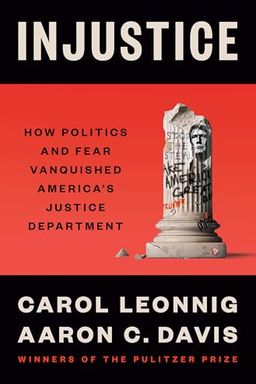
Injustice cover

Injustice

by Carol Leonnig And Aaron C. Davis

The Pulitzer Prize-winning reporters investigate changes and divisions within the Justice Department over the last decade.

The Uncool Truth of High School Life

When you think back on high school, do you remember the grades and the rules—or the lunch table maps, the pop songs, the awkward firsts, and the night you finally felt older than your age? In Fast Times at Ridgemont High, Cameron Crowe argues that American adolescence isn’t a tidy coming-of-age arc; it’s a daily improvisation performed in public, under fluorescent lights, with pop culture as soundtrack and the mall as stage. Crowe contends that if you want the truth about “the kids,” you can’t study them from a podium. You have to sit beside them, count the beeps on the fryer, get written up in Public Speaking, and learn what really rules a campus: jobs, cars, music, and the fragile economies of sex and status.

Undercover as a 17-year-old at Ridgemont High in 1979–80, Crowe embeds for a full year and writes with the precision of a reporter and the empathy of a friend. The book’s core argument is simple and subversive: teens already do adult life—work, love, grief, debt, and discipline—long before adults recognize it. But they’re forced to do it in institutions (school, fast-food franchises, malls) designed for control and profit, not dignity. To see what that means, you must watch how a lunch courtyard enforces class, how a coach lobbies for a film camera like a senator, how a girl finds her way to the clinic, and how a boy learns that bravado doesn’t pay for consequences.

The Setup: Undercover Among "The Kids"

Crowe gains principal-sanctioned access, enrolls in classes, and lets the rhythms of Ridgemont—green-painted walls, seven-minute passing periods, purple mimeos—draw the cast into focus. There’s Stacy Hamilton, a sophomore hostess at Swenson’s who wants to cross the chasm between girls and “women,” and Linda Barrett, her older mentor with a “sexual overview.” Brad Hamilton is the campus king and fast-food royalty whose life is measured in fryer cycles and the shine of his LTD “Cruising Vessel.” Mark “The Rat” Ratner is a heart-on-his-sleeve romantic tutored by Mike Damone, a transfer from Philly who teaches “The Attitude” like a street philosopher. Looming over all is Mr. Hand, the last of the teacher-teachers, battling truancy with Hawaii Five-O steel, while Jeff Spicoli, the stoner-surfer, floats through the narrative as both punchline and Zen koan.

What the Book Contends

Crowe’s reporting insists on three unsettling claims. First, institutions talk about “preparing” teens for adulthood while teens are already doing adulthood—clocking in at Carl’s Jr., navigating sex and birth control, and absorbing blows from economy and authority. Second, power on campus doesn’t come from grades; it flows from paychecks, drive-thrus, and parking lot real estate (the Ridgemont fast-food hierarchy is the real student government). Third, pop culture is curriculum: kids learn scripts for romance from Led Zeppelin IV, posture from Cheap Trick’s Robin Zander, and moral theater from Driver’s Ed gore films, not algebra. In short, adolescence is a working class of its own (compare Paul Willis’s Learning to Labor): it labors at fitting in, at performing cool, and at surviving adult-made systems.

Why It Matters Now

If you’ve ever dismissed teens as unserious or monolithic, Fast Times refutes you. Ridgemont’s kids don’t just “act out”; they act strategically, often kindly, sometimes cruelly, inside brittle structures. You watch a football program wheedle money for jerseys and a movie camera while a cafeteria manager exhausts herself supporting disabled student workers. You see discipline morph into theater (Lt. Flowers’s pistol in Spicoli’s window) and then into liabilities (he’s fired after a lawsuit). You learn how gossip metastasizes into identity, and how a prank on a Mustang becomes a life-derailing felony for Charles Jefferson. The stakes are high because adolescence sits at the intersection of market, media, and authority—and because there’s no privacy to fail in.

What You’ll Learn in This Summary

You’ll map the micro-economies that actually run a high school (fast food, malls, concert tickets) and see how they harden into caste in the lunch courtyard. You’ll trace the gendered scripts of desire—from Linda’s matter-of-fact mentoring to Stacy’s first time with “The Vet” and the aftermath of her abortion—and how sex ed, clinics, and shame collide. You’ll meet the comic and the tragic faces of authority—Mr. Hand’s old-school rigor versus Lt. Flowers’s paramilitary optics—and watch a homecoming literally egged into chaos. You’ll unpack Damone’s “Attitude,” a precursor to later pickup-artist playbooks (see Neil Strauss’s The Game), and watch it fail when empathy is required. You’ll consider Spicoli—first as punchline, then as human—culminating in the book’s most surprising scene: U.S. History comes to his bedroom on Ditch Night. Finally, you’ll see what “growing up” looks like at street level: Brad’s firing, humiliation, and dead-of-night stand at a 7-Eleven; Ratner’s public embarrassment and repair; and a last-bell exhale that feels like both victory lap and eviction.

The Big Idea

High school isn’t a rehearsal. It’s a noisy, green-painted factory floor where kids already do adult work under child rules. Crowe’s year at Ridgemont makes you remember the pressure cooker, re-hear the songs, and re-feel the stakes.


The Lunch Court Economy

Crowe shows you that the real student government at Ridgemont isn’t in a classroom; it sits under a big oak at lunch. The courtyard functions like a visible labor market and caste system where your job equals your status. The closer your crew eats to the tree’s center, the more prestigious your franchise—and the more capital you wield in daily life.

Fast Food as Class System

Start with the map: 7-Eleven kids linger on the outskirts; Burger King and KFC are closer in; Denny’s and Swenson’s notch higher; and at the core sit Carl’s Jr. workers from the top-of-Ridgemont-Drive location—Brad Hamilton’s kingdom. This hierarchy isn’t just food snobbery; it’s an ethic. Carl’s means char-broiled autonomy (“I can tell by the color”), better clientele, and a fountain centerpiece you can be proud to show up at even off-shift. Burger King? Too many kids on bikes and gimmick glasses. Jack-in-the-Box? Rumors of dog-food ownership and heat-lamped meat. Brad’s pride in his fries isn’t a throwaway; it’s a philosophy of self-worth born from mastery (compare to Mihaly Csikszentmihalyi’s flow: mastery begets identity).

Work Before School

At Ridgemont, “I’m in fast food” outranks “I’m in AP.” You watch Brad put school fourth, after Carl’s, girls, and being happy. He charts hours and wages on his closet door, trades friends into better shifts, and runs a calm kitchen like a battlefield medic. Crowe captures what guidance counselors often miss: for many teens, work is the curriculum. It teaches competency (timing fryer beeps by intuition), negotiation (managing intercom Romeos), and even ethics (Brad rubs a jerk’s patties on his shoe, then regrets later, but he protects his crew). When a manager invents a theft accusation (after an I.C.—irate customer—threatens to escalate), Brad’s sense of violated honor is palpable. He quits not as flounce but as refusal to be gaslit by pretend corporate “family.”

The Mall as City Hall

Town Center Mall is Ridgemont’s agora. Swenson’s Ice Cream—a pastel parliament—hosts whispered caucuses. The back kitchen is where girls compare intel, vet “eligible males,” and pass on urban legends of mama’s boys from Toys ‘R’ Us. Randy Eddo, ticket scalper, runs a brisk import-export operation in concert seats; his defense—“I provide a service”—would make Adam Smith grin. Rock city’s pinball arcade is where Spicoli smokes, makes plans, and (later) commandeers a teammate’s car into a late-night error that will shape Homecoming. Malls here aren’t just consumer temples; they’re networking sites, media feeds, and reputational exchanges long before social media existed (compare to Robert Putnam’s Bowling Alone for how public commons knit communities).

A Fall from the Tree

The economy that props you up can also collapse beneath you. Brad’s post-Carl’s journey is the book’s workplace odyssey. Jack-in-the-Box fires him on Thanksgiving for refusing to refund a mostly-eaten “100% Guaranteed Breakfast” on demand; Captain Kidd Fish & Chips humiliates him with a pirate uniform and sword, then asks him to wear it for corporate deliveries. His turning point is existential comedy: he sheds the hat on the freeway en route to IBM, fries still warm next to him, realizing he’s serving a brand, not a person. The bus to adulthood doesn’t have an official stop; it’s a moment in your chest when you refuse to be merchandised.

Guns, Coffee, and Dignity

You won’t forget the 4 a.m. 7-Eleven robbery. “Give me the money, Mr. High School,” says the masked man with a .45. Brad’s legs shake. Then he makes the most adult move in the book: he scalds the gunman with fresh coffee, retrieves the pistol, and takes control. It’s at once small-town heroism and a metaphor: the service job everyone laughs at becomes the stage for courage. The economy that sorted lunch court ends up graduating him: the local news comes; Lisa hears; the lunch tree makes room again. Not because Brad won—but because he grew.

Takeaway

If you want to understand a school, follow the paystubs and the parking permits. Crowe’s anthropology of the lunch court proves that adolescents build and police their own class systems long before diplomas sort them.


Sex, Scripts, And Consequences

Crowe refuses to sentimentalize teenage sex, and that’s why Stacy Hamilton’s story stays under your skin. It’s not a morality play; it’s a ledger of pressures, tips, rumors, and stark logistics—diaphragms versus pills, free clinics with beanbags, and a dugout with graffiti during The Real Thing. Through Stacy and Linda Barrett, you see how girls learn sex as a language of status and strategy, then discover how bodies and feelings complicate the script.

Mentorship in the Back Kitchen

Stacy, fifteen, hosts at Swenson’s in a Peppermint Pattie dress, listening while senior girls vanish to the back to evaluate “that guy in B-9” and swap precise lore: who’s a mama’s boy, whose technique signals insecurity. Linda—dark hair, always self-possessed—speaks with the confidence of someone who’s read The Hite Report. She draws a hard line against weaponized sex (“I’d hate myself if I did that”), but she still frames it as a tool teens must learn to wield—or be crushed by it. At Linda’s urging, Stacy gets the pill at the free clinic by saying she has sex “twice a week,” because honesty gets you a diaphragm “and that might really hurt.” (Compare to Judy Blume’s frankness in Forever: the detail work matters, because shame thrives in generalities.)

Stairway to the Dugout

The Vet—Ron Johnson, 25, blow-dried, from a veterinary clinic—gives Stacy his business card at Swenson’s. On their third date, they make out at “The Point,” migrating to the visitor’s dugout. Crowe writes the scene with teenage sensory honesty: a single dangling bulb, concrete bench, the squeeze of a bra clasp, the awkwardness that flips to hunger, The Vet’s whispered “Is this your first time?” and the graffiti above her as he enters her. Stacy goes home, turns on KXLY, requests “Stairway to Heaven” as a rite-of-passage lullaby, and sleeps, feeling exactly as Linda forecast: relieved and newly voracious.

From Afterglow to Fallout

Then adulthood snaps back: flowers arrive at home from “Ron Johnson,” and Stacy scrambles to hide them from Evelyn, her fox-nosed mother who once sniffed her clothes for marijuana smoke. She writes Ron a Hallmark card confessing she’s fifteen; he ghosts her. In Child Development class—an ironic, under-policed “tax-cut class”—Stacy reads Linda’s eyeliner-penned note: do not confess your age. “Just don’t talk about your age at all.” The clinic, sex ed, and friend counsel triangulate into a truth teens learn early: the system isn’t built for your safety; it’s built for adults’ comfort.

“It’s Up to You, Mike”

Mark Ratner, slow-burning romantic, brings Stacy to the Charthouse, forgets his wallet, and is rescued by Damone delivering it mid-meal with fake nonchalance. The date limps. Later, a playful pool moment with Damone (who preaches that “girls decide in the first five minutes”) turns into impulsive sex in the Hamiltons’ changing room. Damone—leg shaking, teen bravado collapsing—lasts ninety seconds. Still, Stacy feels what so many first-time partners do: “He was so nice.” When she gets pregnant, she tells him by placing his hand on her stomach. His response is textbook cowardice: “You wanted it more than me.” He misses both bill and ride to the clinic—twice. She ends up phoning The Rat, who simply drives her, no questions. (This is the book’s moral fulcrum: bluster fails, tenderness shows up.)

The Clinic, Without Euphemism

Crowe does what few YA or adult novels of the era risked: he reports the abortion as it occurs. Not as sermon, but as procedure—forms, tests, a nurse’s flat “You are pregnant,” the doctor’s brisk “Are you sure?” and the scraped, metallic pain. Stacy asks if she’ll still be able to have children; the doctor replies, “You should. But you mind it less,” about childbirth’s pain versus this. She notices the jar filling with purplish membrane and makes eye contact with another girl entering, “eyes like a deer’s in headlights.” It’s the unglamorous truth of teen sexual agency and the systems it requires. (Peggy Orenstein’s Girls & Sex would later echo how scripts, silence, and logistics converge to hurt girls most.)

Takeaway

Teens don’t need moralizing. They need maps. Crowe gives you the maps—sex-ed clichés, clinic lines, friend codes—and then shows you who actually comes through when it counts.


Authority As Performance

At Ridgemont, power wears costumes. Sometimes it’s funny—the “H.Q.A.”-shouting coach in a megaphone harness. Sometimes it’s chilling—a security chief who seals fences and wields a pistol at a stoned sophomore’s temple. Sometimes it’s deeply human—a sweaty teacher who still takes attendance like Steve McGarrett and shows up on your doorstep on Ditch Night. Crowe’s point isn’t that authority is bad; it’s that, like teen status, it’s performed—and the performance has stakes.

Mr. Hand, Last of the Teacher-Teachers

Arnold Hand barrels into U.S. History, slams shut a green metal door, and writes his rules in chalk like a sheriff: no eating; do your business on your time; Friday quizzes; “Pakalo?” He’s a “Five-O” devotee—barking like McGarrett, enforcing the three-bell system as if it were a constitution. When Jeff Spicoli arrives late, Man vs. Boy plays out theatrically: Hand tears up the add card and salts Spicoli’s identity into the trash, then writes “I DON’T KNOW” on the board to immortalize the stoner’s refrain. But Hand also lives his ethic. On Ditch Night, he appears in Spicoli’s bedroom and calmly “squares accounts,” teaching a seminar on U.S. foreign policy at the foot of Jeff’s bed. It’s ridiculous and profound: instruction, delivered where the student lives.

Coach Ramirez and the Football Dream

Ramirez’s budget appeal is a coach’s soliloquy: jerseys, helmets, “no brain-damaged ball players,” and a movie camera to become “a complete winning football department.” His trump card: Charles Jefferson, a once-in-a-generation end courted by UCLA with a rumored “scholarship Mustang.” Ramirez wins his camera as if Congress had funded a moonshot. But football is frustration theater at Ridgemont; soccer star Steve Shasta draws the media, and Jefferson—baited by racist graffiti like “Send Kunta Kinte Jefferson Back to Africa”—cycles between fury and apathy. When vandals weld his Mustang to the flagpole (spray-painted “LINCOLN SURF NAZIS”), he returns like a superhero, carries tacklers into the end zone, and wins Homecoming. Two days later, tempted by “two dudes” from Richards Bay, he’s busted for a Radio Shack break-in and loses everything. Power can mobilize you for a Friday night and vanish by Monday morning.

Lt. Flowers, Discipline’s PR Problem

Brought from a “hellhole junior high in Pittsburgh,” Lt. Lawrence Flowers reinstitutes student parking tickets, welds shut the Point’s fence, and prowls in a gold name plate and pencil-thin mustache, Nat King Cole with a badge. When he jams a pistol through Spicoli’s cracked window upon seeing a bong flick, it’s not just overreach; it’s a lawsuit. He’s fired after the district investigates and now works security at Knott’s Berry Farm. Crowe shows the cost when discipline borrows policing’s optics: it makes good press until lawyers arrive. (Compare to contemporary debates on SROs and the school-to-prison pipeline.)

The Pageantry of Control

Authority also throws carnivals: TOLO Week (“Totally Outrageous”) dresses kids in Tourist, Li’l Abner, Hollywood, Punk or Disco uniforms to “bring back Crazy Ridgemont Spirit,” while budget meetings fund pep rallies and pie fights over lab equipment. Homecoming crowns a king and queen at halftime, only to see Lincoln’s section pelt them with eggs and rock their limo. The talent show, hosted by Gregg Adams as if he’s on The Tonight Show, crumbles into beeping sabotage (Spicoli’s pocket football game) and a baton twirler melted by hecklers. These rituals aren’t empty; they reveal who’s speaking and who’s paying. Gina George (Public Speaking) lets students grade themselves and invites Frisbee champions and gay activists to class; you learn as much about credibility and courage here as in any textbook.

Takeaway

Every rule at Ridgemont is a performance with an audience. Some performances educate; some intimidate; some implode in court. The difference isn’t firmness—it’s whether the adult shows up where the kid actually lives.


Damone’s Attitude, Rat’s Heart

Mark “The Rat” Ratner and Mike Damone form the book’s odd-couple thesis on masculinity. Damone sells “The Attitude”—act as if you don’t care if she “comes, stays, lays, or prays,” put out a vibe, always call the shots—while Rat believes in eye contact, nerves, and telling the truth. Crowe lets both approaches play out in comedy, then gives you the bill.

The Five-Point Plan

In the mall, Damone demos his five-point plan in front of a cardboard Debbie Harry: never let on how much you like her; call the shots (“You and me are going to the Charthouse…”); act like wherever you are is the place to be; order for both of you (a “classy move”); and, “whenever possible, put on the first side of Led Zeppelin IV.” It’s a proto-pickup routine (long before The Game codified such scripts), equal parts theater and placebo for anxiety. He uses it to cold-open conversations—“Joyce!” “Oh, I’m sorry…”—and sometimes, he connects. The Rat tries it, too, and gets his heart humiliated by logistics (the Charthouse wallet) and fate (Phantasm vomit two rows down).

The Wussy and the Vibe

Damone delights in calling Rat a “wussy,” a Paul Revere holdover blending wimp + pussy. But Rat’s “wussy” virtues are the ones you’d want in a son: he waits in line to ask Stacy a benign locker question; he stops himself on the bleachers; he refuses to follow Damone’s extreme gambits. When Stacy finally gives him her number, he tapes it to his wall and stares, letting the digits taunt him into action. He calls from Damone’s room, Colt 45 for courage, and lands a Saturday night. The date implodes, but Rat’s character doesn’t.

Betrayal, Then Manhood

Damone’s worst day is cowardice dressed as maturity. He insists Stacy can’t be pregnant by him because they “only did it once,” then frames her as aggressor (“You wanted it more than me”) to protect his self-image. He misses her clinic ride twice and hides at home with Tia Maria and Lou Reed’s Rock and Roll Animal. When The Rat asks if anything happened with Stacy, Damone lies, then shrugs—“Girls just go haywire.” Rat’s reply is the book’s cleanest moral sentence: “Hey, FUCK YOU, Damone… Maybe they DO know you pretty GOOD. And I’m just finding out.” They don’t speak for weeks.

Repair by Eraser, Not Apology

In the school-wide group photo, Damone bets he’ll drop his pants for the camera; instead, it’s Rat whose moon is immortalized in the Rapier. Principal Gray orders him to erase his own butt from all 1,500 yearbooks, “without breaking the binding.” Damone volunteers to help. It’s not a speech; it’s a weekend of labor, pencil shavings on a gym floor. The two earn Grad Nite tickets and drift toward truce. Later, they split Disneyland into missions—girls in red and blue gowns, a Jack Daniel’s heist on Tom Sawyer Island (Damone is hauled into “Juvenile Security,” fakes a seizure, bolts), and a dawn bus home. Friendship doesn’t return to high notes; it returns to daily crumbs—quiet rides, in-jokes, and the knowledge that each would show up if the other called from a green payphone.

Takeaway

“The Attitude” can open a door; it can’t keep you in the room. Rat’s tenderness, not Damone’s vibe, drives at 2 p.m. weekday traffic to the clinic. Crowe’s verdict on masculinity is simple: posturing is cheap; presence is expensive—and worth it.


Pop Culture As Curriculum

Fast Times treats music, malls, and media as a shadow school that forms taste, teaches scripts, and sells adolescence back to itself. The curriculum is everywhere: class rings hawked by a wheelchair-bound salesman with a haunted origin story; Driver’s Ed films that ratchet horror until kids shout “SO GROSS!”; and Grad Nite at Disneyland, where rules and romance run on parallel tracks all night long.

Soundtracks for Identity

From Stacy’s “Stairway to Heaven” lullaby to Cheap Trick’s Robin Zander haircuts (three lookalikes who won’t speak to each other), rock tells Ridgemont who to be. At a school-assembly, Bob Savage—class ring rep—admits he lost his legs after “playing chicken” on prom night. He frames the ring as memento and warning. It works; even Spicoli applauds. Later, A.S.B. President Quan scripts “TOLO” week like a jukebox of identities (Tourist Day, Li’l Abner Day, Punk/Disco Day): performance as team-building. The talent show tries to be The Tonight Show: Gregg Adams croons “Wild Feeling,” plugs “Regis Formalwear,” and prays the baton twirler won’t crack. She does; Spicoli beeps a pocket game through it.

Rituals of Belonging

School Picture Day perfumes the gym with English Leather and old socks. The Big Picture is shot by Arthur Chubb from the Tech Arts building roof; legends are made when someone moons the panorama. Homecoming crowns Cindy Carr and Kenneth Quan; Lincoln’s bleachers pelt them with eggs. Prom gowns line cork walls with silver hearts—names as temporary tattoos; later, at Brad’s Wisk-foamed pool, after-prom realigns couplings until sunrise on Mt. Palmer. These rites are silly until you live them; then they become chapters your body remembers.

Disneyland as Moral Lab

Grad Nite is a perfect adolescent microcosm: strict dress code (ties on at all times), anti-contraband pat-downs, and the “Voice”—folksy and omnipresent—steering you toward “Tomorrowland” while hormones steer you elsewhere. Ridgemont kids flatten the system with ingenuity: fruit spiked with vodka; William Desmond sneaking through the chaperone entrance with a found pass; Damone and The Rat rafting across a closed moat to retrieve a hidden fifth of Jack Daniel’s, stuffing it into a knapsack Stephanie and Becky will ferry to the Wagon Train Motel. Damone gets hauled into “Juvenile Security,” fakes a seizure, and escapes. At dawn, the bus reeks of socks and soft hats askew, kids snoring with stuffed animals. It’s the purest Crowe scene: innocence and rule-bending share a bench seat like cousins.

When Pop Hurts

Fantasy frays when real life barges in. In journalism class, Louis Crowley’s father and sister die as their car flies off El Dorado Bridge; the next day, Spicoli bursts in waving a tabloid front page (“Look at these bitchin’ photos of the crash”), and the room freezes. Crowe doesn’t cancel Spicoli; he lets the social penalty land: “It would be another month before anyone spoke to Jeff Spicoli again.” Pop culture can be anesthesia or invitation; picking the wrong one at the wrong time costs you.

Takeaway

Teens learn from posters and playlists as much as from textbooks. The question isn’t whether pop culture teaches—it’s whether adults will admit it and help kids read the hidden syllabus.


Growing Up, One Small Choice At A Time

You won’t find a valedictory speech that “explains it all” in Fast Times. You’ll find countless tiny choices—some brave, some shabby—that add up to adulthood. Crowe tracks those choices like a sportswriter tracking yardage: they don’t look like much individually, but in the fourth quarter, you realize you’ve crossed a field.

Grief, Shame, and Repair

After the Crowley tragedy, the school quiets. Spicoli’s callousness earns him a month of social exile; it’s restorative justice, teen style. Linda Barrett, once a junior-high drug broker who ended up in the hospital after a parking-lot binge, now tutors Stacy, then erupts when Damone abandons Stacy (“THAT LITTLE PRICK!”) and keys his Toyota with “PRICK PRICK PRICK.” It’s not saintly, but it’s loyal. Later, Linda’s own big decision—accept a Students International offer to study in Europe—unspools a tender scene: her fiancé Doug, left behind, still cheers her on. Growing up is often a choice to celebrate someone else’s horizon.

Science Class, Uncensored

Mr. Vargas’s famed field trip to University Hospital culminates in the cadaver lab. He opens a chest cavity and hoists “the human heart” while kids gag or look away; Linda runs out. It’s ghoulish and sacred. Earlier, in Driver’s Ed, Desi Arnaz’s Braking Point decapitates a mother and maims families until the kids shout to turn it off. These are crude pedagogies, but Crowe documents their effect: disgust can teach boundary-setting as surely as any lecture.

Desire vs. Dignity

Prom night is a choreography of Hello Richard phone calls and cork-wall hearts. Steve Shasta arrives in a “Mist-Blue Newport II” tux with tails and top hat, the swagger of a boy who declares himself “celibate” to manage his fan base. Later, he gently pushes Linda’s head down in the car at The Point, and she goes “willingly, like so many before her.” Shasta is not a villain, but the scene stings: his declaration of “no pressure” masks a system whose gravity always favors the boy whose face gets in the paper. (Contrast with contemporary consent education; Crowe’s reportage gives you the before picture.)

Last Bell and Letters to the Future

On the last day, kids sign annuals over a live band. Spicoli delivers a surprisingly lucid, plagiarized-then-personal speech about 60s promise and 70s cynicism, then confesses he’s working at Alpha Beta. Brad delivers his ten-year letter to Mrs. George: he’d have “taken another class with Mr. Hand,” taken Dina Phillips to Hawaii, “then married Linda Barrett.” It’s funny and honest—teens write futures like we make mixtapes, mashing fantasy and regret. After school, Brad drives Stacy past fast-food row and yells at underclassmen, “HEY—WHY DON’T YOU GET A JOB!!!” It’s both a joke and benediction. Adolescence ends not with a diploma, but with muscle memory: the feel of a steering wheel, the impulse to pay forward your own hard-earned map.

Takeaway

Growing up is a thousand tiny reps of dignity: driving a friend, erasing a mistake, brewing a pot of coffee you might need to throw. Fast Times makes those reps visible—and unforgettable.

Dig Deeper

Get personalized prompts to apply these lessons to your life and deepen your understanding.

Go Deeper

Get the Full Experience

Download Insight Books for AI-powered reflections, quizzes, and more.