
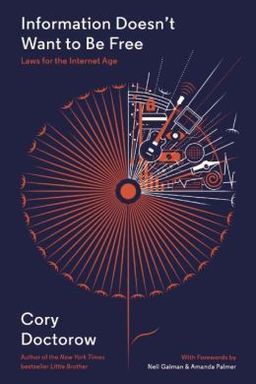
Information Doesn’t Want to Be Free cover

Information Doesn’t Want to Be Free

by Cory Doctorow

Cory Doctorow''s ''Information Doesn’t Want to Be Free'' explores the complex landscape of copyright laws in the internet age, advocating for necessary reforms to foster creativity and freedom online. Discover how digital locks fail creators and the intensifying struggle between censorship and free access.

Information Doesn’t Want to Be Free—People Do

Have you ever wondered why it feels like the Internet gives you freedom and, at the same time, takes some of it away? Cory Doctorow’s Information Doesn’t Want to Be Free tackles that tension, arguing that the most critical debates about copyright, creativity, and technology aren’t about files, data, or even ownership—they’re about people. He reframes Stewart Brand’s old koan, “Information wants to be free,” insisting instead: information doesn’t want to be free—people do.

Doctorow explores how creative and technological freedom are intertwined, showing that the same mechanisms used to protect intellectual property often threaten human rights, security, and autonomy. He sets out three “Doctorow’s Laws” that define how art and technology coexist in the digital age. These laws explain why digital locks fail, how fame and fortune really work online, and why freedom—not information—must be the center of the conversation.

Doctorow’s First Law: Locks Aren’t for You

The first of Doctorow’s laws is simple but radical: any time someone puts a lock on something that belongs to you and won’t give you the key, that lock isn’t there for your benefit. With that idea, he launches into an impassioned critique of digital rights management (DRM) and the global anti-circumvention laws that make it illegal to break or bypass those digital locks. From movies that can only play on specific devices to printers that reject third-party ink cartridges, Doctorow illustrates how these systems give immense power to corporations while stripping control from creators and consumers.

His examples—like Sony’s infamous rootkit scandal and Amazon’s remote deletion of George Orwell’s 1984 from users’ Kindles—show the dangers of designing computers to disobey their owners. What starts as a measure against piracy can easily become a tool of surveillance, censorship, and consumer manipulation. Doctorow reminds you that computers are general-purpose machines; trying to make them selectively obedient leads to insecurity, exploitation, and absurd contradictions.

Doctorow’s Second Law: Fame First, Fortune Follows

Building on this technological foundation, Doctorow’s second law shifts focus to creativity: fame won’t make you rich, but you can’t get paid without it. He explores how fame operates like an audience engine—the Internet makes it easy for creators to be seen and heard by millions, but translating that fame into income requires strategy, honesty, and persistence. Drawing on examples from artists like Jonathan Coulton, Louis C.K., Amanda Palmer, and Randall Munroe (creator of xkcd), he illustrates alternative models for success: direct sales, crowdfunding, merch, commissions, performances, and donations.

Unlike traditional industries that demanded intermediaries—record labels, publishers, and studios—today’s creators can reach audiences directly. Yet this freedom also comes at the cost of increased responsibility and constant adaptation. Doctorow uses the example of Radiohead’s In Rainbows to show that digital openness can coexist with profitability, while Amanda Palmer’s story of street performance and Kickstarter success exemplifies a new model based on trust and voluntary support.

Doctorow’s Third Law: Human Freedom Is the Point

The culmination of Doctorow’s argument is contained in his third law: information doesn’t want to be free—people do. In this section, he moves beyond the world of art and business to the human rights implications of copyright and Internet regulation. He argues that the battle to control copying has led to surveillance, censorship, and technological control of everyday life. From China's Great Firewall to corporate “renewability” systems that secretly update and disable users’ devices, Doctorow shows how anti-piracy logic can destroy individual privacy and liberty.

He believes the Internet should be treated as the nervous system of civilization—not as just another distribution channel for entertainment. Laws meant to regulate Hollywood have spilled into personal communications, education, and civic life. Doctorow warns that when we give companies and governments the tools to monitor our data, we also give them the ability to monitor our thoughts. This is not just an artistic problem—it’s a human one.

Why All This Matters

Doctorow’s larger message is that technology itself is neutral—what matters is how we choose to shape it. The Internet’s capacity to copy isn’t a flaw to be fixed but a fact to be embraced. Regulation should protect creators and audiences without policing daily life. The question you face, Doctorow suggests, isn’t how to stop copying, but how to live well in a world where copying is inevitable.

In the end, Information Doesn’t Want to Be Free is both a manifesto and a roadmap. It invites creators, technologists, and citizens alike to reclaim agency over the systems that govern creativity and communication. Doctorow’s vision is one where artists can thrive, technology remains open, and society resists the creeping normalization of surveillance—all rooted in a simple principle: freedom should serve people, not data.

Key Takeaway

You can’t make copying hard again—but you can make freedom possible. The fight for creativity, fairness, and privacy begins not with information, but with you.


Doctorow’s First Law: Anti-Circumvention and Control

Doctorow’s first law centers on the perils of digital locks—technologies sold under the guise of protecting creators but that, in practice, protect intermediaries instead. The law stems from the WIPO Copyright Treaty and the U.S. Digital Millennium Copyright Act (DMCA), which criminalize breaking locks even when no copyright infringement occurs.

How Locks Turn Against Owners

The rule sounds defensive: make copying harder to stop piracy. But Doctorow shows why it backfires. A lock placed on your computer, phone, or printer that you’re forbidden to open means you no longer control your own device. Whether it’s Apple’s closed iOS ecosystem, HP printers rejecting refilled cartridges, or Amazon’s Kindle deleting purchased books, these acts transfer power away from consumers and creators and give it to corporations.

The story from Norway of “DVD Jon,” the teenager who broke DVD encryption just to watch legal discs on his Linux computer, reveals the absurdity: laws criminalize users for wanting to access media they own. Anti-circumvention transforms copyright from a shield into a sword, punishing legitimate innovation and user autonomy.

The Compatibility Trap

Compatibility, Doctorow explains, used to be the hallmark of progress. When software allowed users to open files created in another program or device, it fostered innovation. Anti-circumvention laws make such interoperability illegal. The result: technological silos and monopolies. Consumers are locked into ecosystems—each book tied to its own reader, each song to its own app. Creators, meanwhile, lose leverage; they can’t move their audiences to new platforms without violating law.

Doctorow’s metaphor of “roach motels”—works check in, but can’t check out—captures this perfectly. Once a distributor like Amazon or Apple applies DRM, neither author nor publisher can free their work without permission from the lock’s owner. Anti-circumvention, then, doesn’t protect copyright; it protects monopoly.

The Human Cost of Broken Systems

Beyond economics, Doctorow highlights moral hazards. When technology is forced to act against its owner’s wishes—disabling recording, deleting media, or hiding files—it becomes inherently untrustworthy. Rootkits and spyware thrive on this principle. His example of Sony’s stealth rootkit installation illustrates how corporate paranoia compromises user safety, echoing how malware spreads through secrecy. Systems that devalue user control ultimately devalue human autonomy.

Key Takeaway

Digital locks make creators hostage to intermediaries. Freedom of art and technology requires systems that obey their owners—not those that spy on or control them.


Fame Before Fortune: Navigating the Arts Online

Doctorow’s second law redefines success for modern creators: “Fame won’t make you rich, but you can’t get paid without it.” This insight reframes the dream of Internet-era wealth. Online fame is easy to come by—the Internet can make anyone visible—but turning visibility into livelihood takes creativity and persistence.

The Economics of Attention

Doctorow argues that attention has become the new currency. Copying, far from theft, is a form of marketing. Singer-songwriter Jonathan Coulton’s project “Thing a Week,” which involved releasing a free song every week, turned into a career of six-figure earnings. Likewise, comedian Louis C.K.’s DRM-free $5 comedy special sold over $1 million in weeks. In both cases, openness built trust; trust translated into participation, and participation into payment.

New Business Models for Creators

Doctorow maps six fundamental ways creators can monetize their art today: selling physical objects (books, prints, albums), ads, merchandise (“swag”), commissions, performances, and donations. Each emphasizes community rather than control. For example, Randall Munroe’s xkcd comics spread freely under Creative Commons, yet he thrives by selling T-shirts and posters—proof that generosity fuels commerce. Amanda Palmer’s million-dollar Kickstarter success echoes the same spirit: voluntary giving as proof of genuine connection.

Doctorow reminds you that failure is normal in creative industries—most artists don’t get rich even when loved. But every new audience increases your odds. In a world of endless intermediaries, exposure is both democratized and fragmented; artists can choose independence or partnership without surrendering freedom.

Fame as Leverage

For established creators, fame shifts negotiation power. When Radiohead or Nine Inch Nails released music independently, they forced record labels to renegotiate standard contracts. Success stories don’t guarantee riches; they guarantee choice. Doctorow urges creators to see fame not as vanity but as leverage—a bargaining chip to secure better terms or escape exploitative systems.

Key Takeaway

Fame is the entry ticket, not the prize. Focus on earning trust and building genuine connections—the wealth follows from participation, not protection.


The War on Intermediaries

Doctorow reveals how the entertainment industry’s crusade against online intermediaries—ISPs, hosting platforms, payment processors—threatens both free speech and creative innovation. Laws such as SOPA, PIPA, and international treaties like ACTA and TPP aimed to make intermediaries liable for everything users post or share. The result? An Internet transformed into a policing apparatus.

Expanding the Chain of Liability

Under traditional liability rules, platforms only respond to takedown notices; under proposed expansions, they’d have to proactively censor uploads. Doctorow demonstrates how these policies morph services like YouTube or Twitter into private surveillance systems. This shift forces businesses to self-censor or require users to “audition” their content for approval.

Voluntary Agreements and Hidden Censorship

Even without official law, corporate consolidation has created informal censorship. Major ISPs have brokered secret deals with entertainment lobbies to block or throttle users based on copyright accusations—often without proof. From France’s Hadopi to New Zealand’s “three strikes” laws, Doctorow shows how governments outsource punishment to corporations, undermining due process and human rights.

Collateral Damage

Doctorow’s illustration of Sweden’s Pirate Bay raid and Russia’s misuse of piracy laws to silence dissent underscores the danger. What begins as a fight against infringement becomes a tool against democracy. Intermediary liability doesn’t merely regulate art—it regulates speech itself.

Key Takeaway

When intermediaries become censors, everyone loses—the artist, the audience, and the society that depends on open conversation.


Copying as a Human Right

In his later chapters, Doctorow broadens the frame from creative freedom to civil liberty. Copying, he insists, isn’t a crime—it’s a form of communication. Every act of reading, sending, or viewing online involves making copies. Regulating copying thus means regulating speech itself.

The Everyday Stakes of Connectivity

Doctorow draws on examples from families in Britain and America whose quality of life improved with Internet access—better health, education, and civic engagement. Restricting or disconnecting users amounts to cutting them off from the modern world. He critiques Vint Cerf’s argument that Internet access is not a human right, showing instead that freedom of expression in the 21st century depends on connectivity.

Censorship and Surveillance

Doctorow dismantles the logic of national firewalls meant to block illegal content, comparing Western copyright filters to China’s Great Firewall. Whether censoring child pornography or unlicensed music, such systems rely on secret blacklists and constant surveillance. Once deployed, they inevitably expand—spying on every citizen to enforce cultural or political norms.

Technology, Morality, and Freedom

The fight over copying is, therefore, a fight over autonomy. Making devices that can’t copy freely means making devices that spy, report, and disable. In one of the book’s most striking metaphors, Doctorow compares this to installing mandatory webcams in every home to prevent bootleg screenings. If even entertainment executives wouldn’t tolerate that privacy invasion, why should anyone else?

Key Takeaway

The right to copy is the right to communicate. Defending digital freedom means defending the dignity and privacy of every person online.


Copyfight and Collective Licensing: What Works

After describing the failures of digital locks and censorship, Doctorow offers pragmatic solutions. His vision of collective or blanket licensing replaces criminalization with fairness—making sharing legal while ensuring creators get paid.

The Blanket License Model

Doctorow points to systems already in use for radio stations and performance venues. Instead of negotiating every song, they pay a flat fee distributed through collection societies. Translating that model online would allow ISPs to charge small per-user fees, granting subscribers legal access to all music. In return, creators would receive royalties proportionate to actual listening patterns—verified through modern analytics rather than opaque sampling.

Fairness and Transparency

Doctorow warns that collective licensing must avoid capture by major labels, which historically distort payouts. His proposed consent decree would require that at least half of all collected funds go directly to artists. With open data tools similar to Google’s analytics and GNU/Linux transparency, distribution could remain equitable and auditable.

Unlike anti-piracy enforcement, this model works. It aligns incentives, encourages innovation, and legitimizes the natural behavior of sharing. It also respects privacy, as regulators wouldn’t need to surveil user activity to ensure compliance.

Key Takeaway

You can’t stop people from copying—but you can ensure they copy ethically. Fair payment systems are better protection for art than locks or lawsuits.


Cathedrals, Dandelions, and the Future of Art

Doctorow ends with evocative metaphors that capture the evolution of creativity. He compares the old entertainment industry to cathedral-building: vast, expensive, and slow. The new era is more like the Protestant Reformation—distributed, personal, and diverse. Where grandeur once required mass coordination, now millions of creators can express themselves independently.

The Mammal and Dandelion Analogy

Doctorow builds on a metaphor originally discussed with Neil Gaiman: mammals invest deeply in each offspring, but dandelions scatter thousands of seeds on the wind. The Internet turns artists into dandelions—you generate as much creative output as possible, knowing some of it will find fertile ground. Copies are no longer products; they’re pollen for ideas.

Loss and Renewal

Doctorow concedes that we may lose certain grand art forms—like the three-hundred-million-dollar blockbuster—but he insists that the trade-off is worth it. The democratization of creation brings a richer, more inclusive culture. Cathedrals are beautiful, but they shouldn’t exist at the cost of freedom. Artistic survival depends not on protecting monuments, but on nurturing abundance.

The same lesson applies to technology itself. Computers must remain general-purpose, networks open, and laws proportionate. As long as creativity flows freely, art will evolve. Humanity thrives not through control but through endless reinvention—the dandelion strategy.

Key Takeaway

Protect freedom, not scarcity. The future of art belongs to those who scatter ideas widely, trusting that enough will take root.

Dig Deeper

Get personalized prompts to apply these lessons to your life and deepen your understanding.

Go Deeper

Get the Full Experience

Download Insight Books for AI-powered reflections, quizzes, and more.