
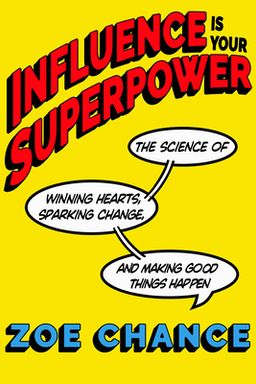
Influence is Your Superpower cover

Influence is Your Superpower

by Zoe Chance

Explore the science of influence with Zoe Chance''s ''Influence is Your Superpower.'' Discover how understanding cognitive processes and strategic communication can empower you to create positive, ethical change in your life and others''.

Influence Is Your Superpower

How can you make people genuinely want to say “yes” to you without feeling manipulative or pushy? In Influence Is Your Superpower, Zoe Chance invites you to rediscover a skill most of us had as children—the natural ability to influence others with curiosity, connection, and sincerity. Chance argues that real influence isn’t coercion or trickery; it’s about authentic connection, emotional intelligence, and understanding how human decision-making truly works. Your influence isn’t about getting your way—it’s about creating alignment, trust, and collaboration that benefits everyone involved.

The book’s core argument is that influence, far from being manipulative, is a human superpower rooted in our biology and social nature. Chance contends that we’re all born influential because it’s our species’ survival instinct—to cry, to connect, to ask, to negotiate. Yet over time, cultural conditioning teaches us to suppress those instincts—to be polite, deferential, or compliant. Her mission is to help you reclaim that innate ability in a mindful, ethical way.

Influence Reimagined

Chance reframes influence from a transactional, win-lose dynamic into a relationship-building process. This transformation shifts influence from something that feels manipulative into something generous. True influence, she explains, means becoming someone people want to say yes to—not someone they say yes to out of fear, obligation, or confusion. Whether you’re negotiating a salary, persuading a colleague, or inspiring your child, the goal is not domination—it’s connection.

Her approach is a synthesis of behavioral economics, social psychology, neuroscience, and practical tools tested through her popular Yale course, “Mastering Influence and Persuasion.” Throughout the book, Chance encourages readers to experiment, ask boldly, and embrace both “no” and “yes” as parts of learning. Influence, she insists, is a lifelong experiment. She even introduces terms like the “Gator” (your instinctive System 1) and the “Judge” (your rational System 2) to help you understand how real decisions get made—often emotionally first, logically second.

Why This Matters in a Digital World

Chance argues that our digital age heightens the need for authentic influence. Algorithms can predict behavior, but only humans can inspire it. As automation expands, our uniquely human capacity for empathy and persuasion becomes our greatest competitive advantage. Jobs that rely on interpersonal influence—from sales to leadership—are not only thriving but among the highest paid and most satisfying because they are fundamentally about relationships.

She situates interpersonal influence at the intersection of science and love. The book begins and ends with the idea that effective influence—done with care and curiosity—is an act of love. Influence isn't about domination; it's about participation in the shared fabric of human connection. This idea makes the book more than a manual on persuasion—it’s a guide for living with intention and empathy.

The Journey You’ll Take

Across twelve chapters and several “half chapters,” Chance offers a toolkit that combines science (how decisions are made), strategy (tools like the Magic Question or Kindly Brontosaurus), and story (examples from her life, her students, and history). You’ll learn how to align with people’s instinctual logic instead of fighting it (using the Gator and Judge model), how to say “no” with power and grace, how to ask for what you want directly, how to craft frames that change perceptions, and how to listen so others feel deeply understood.

You’ll also explore the darker side of influence—how con artists, bullies, and “sharks” twist human psychology for manipulation—and learn how to guard yourself from those tactics. Finally, Chance elevates influence into a broader moral and social responsibility: your power should make life better not just for you, but for those around you.

“Influence is your superpower,” Chance writes, “because it’s already inside you. The secret is learning to use it wisely.”

In the chapters that follow, you’ll discover the psychological mechanics behind influence, ways to handle resistance without force, and strategies to become someone people naturally want to say yes to—while keeping your integrity fully intact.


The Gator and the Judge

What if every decision you and everyone else make begins not with logic but with instinct? Zoe Chance’s model of the Gator and the Judge offers one of her most powerful insights—the two-part system that explains how influence really works. Adapted from Daniel Kahneman’s “System 1 and System 2” theory (Thinking, Fast and Slow), Chance renames them to make them relatable: the Gator, quick and emotional, and the Judge, slow and rational. To influence effectively, you must speak to both—but always start with the Gator.

Meet the Gator

The Gator lives beneath the surface of your mind. It’s fast, instinctive, and rarely conscious. This part of your mind governs gut reactions, emotions, habits, and automatic behaviors. It’s the same system that makes an alligator snap at meat when it lands within its “bite zone”—acting immediately when something feels easy or rewarding. The Gator ignores complexity; it asks only simple questions: “Will it harm me? Will it help me? Is it easy?” Almost every human behavior, from buying coffee to choosing partners, begins with a Gator’s answer.

Chance backs this with examples—from spontaneous reactions to faces predicting election results (a study by Alexander Todorov showed people’s split-second judgments about competence accurately predicted 70% of congressional winners) to how judges deny parole more frequently when hungry. Our gut reactions, she explains, often masquerade as rationality. Even those trained to deliberate—the literal judges—fall back on their Gators when tired or depleted.

Meet the Judge

The Judge is deliberate and rational. It questions, plans, and calculates. The Judge is the voice of logic you hear when you weigh options, analyze data, or solve complex problems. However, the Judge is energy-intensive and prefers conservation; it only activates when necessary. Most of the time, the Gator is steering the ship, especially when we’re busy, emotional, or distracted. As philosopher A.N. Whitehead wrote, “Conscious thought is like cavalry charges in a battle—strictly limited in number.”

Why Gators Win

Chance emphasizes that the Gator always reacts first and sets the tone for every interaction. You feel emotions before reasoning kicks in—whether attraction, suspicion, or trust. Neuroscience confirms this: emotional centers in the limbic system send far more messages to the rational cortex than vice versa. So even when we think we’re being logical, the Gator is calling the shots. This asymmetry explains why facts alone rarely persuade—you must connect emotionally first.

Manipulative influencers exploit this by triggering fear or greed, while ethical influencers engage empathy and curiosity. When you speak directly to someone’s Gator—with warmth, ease, and relevance—you lower resistance and open their Judge to your ideas. The Judge then rationalizes what the Gator already decided. As Chance puts it, “The Gator can make decisions without the Judge, but the Judge can’t make decisions without the Gator.”

How to Use It

If you want your ideas to land, start by appealing to instinct, emotion, and simplicity. Reduce effort, create ease, and make your requests relatable. Ease—“the path of least resistance”—is the Gator’s favorite principle. Then, when logic is required, help the Judge by providing clarity without complexity. As Chance illustrates through real examples (like Google’s health guidelines developed from her research), even rational policies succeed only when they honor how the Gator really operates.

The takeaway: people don’t think the way you think they do. They feel first and reason later. To become truly influential, speak the language of both brains—but start with the one that bites.


The Path of Least Resistance

Why don’t people do what’s obviously good for them? From eating vegetables to saving money, knowing and doing rarely align. Chance explains that the missing ingredient isn’t motivation—it’s ease. People follow the path of least resistance, and ease is the single best predictor of behavior. “Better than motivation, intention, or satisfaction,” she writes. If it’s easy, the Gator will do it; if it’s hard, it won’t.

Ease in Action

Chance tells the story of the U.S. government’s “5 A Day” campaign, designed to encourage Americans to eat five servings of fruits and vegetables. Tens of millions were spent on education, and awareness quadrupled. But actual consumption dropped by 14%. The campaign focused on motivation, not ease, and failed. The Gator doesn’t respond to good intentions—it responds to effort. Buying, preparing, and eating fresh produce requires energy, so people defaulted to the old habits.

Contrast that with Domino’s Pizza’s “AnyWare” campaign. The company made ordering effortless—customers could just text or tweet a pizza emoji and get their favorite delivered. Sales skyrocketed 10%. Domino’s didn’t change hearts; it changed friction. Ease creates loyalty, happiness, and influence.

Why Effort Matters

Chance highlights research on the Customer Effort Score, which measures how easy an experience feels. It predicts one-third of customer loyalty and is even more powerful than satisfaction. People talk glowingly about businesses that make things simple and complain loudly about those that create hassle. In fact, 81% of customers with hard experiences say they’ll spread negativity, while only 1% of those with easy experiences do.

This principle doesn’t apply only to companies—it applies to everyday influence. Want someone to follow through on a request? Make it easy. Want to build a habit? Remove friction. From text reminders that reduce missed appointments to gym audiobooks that lure you back for “just one more chapter,” the secret to changing behavior lies in simplification, not persuasion.

Baby Steps and Bananas

Chance’s memorable story of skydiving shows this perfectly. Terrified before the jump, her “Judge” brain screamed, “You’re going to die!” But her instructor, Alex, guided her gently through each small, easy step—put on the suit, watch the video, scoot over, be a banana. When you reduce big decisions to tiny, manageable actions, the Gator stays calm and keeps going. Influence works the same way: break your request or challenge into effortless micro-steps so people glide into saying yes.

Ease isn’t a luxury—it’s a strategy. When things feel simple and light, people move forward almost automatically. Change the friction, and you change the behavior.


The Power of No

We think influence is about persuading others to say yes—but Zoe Chance begins with the word that saved the world: “No.” On September 26, 1983, Soviet officer Stanislav Petrov refused to launch nuclear retaliation after a false alarm. His decision, guided by calm intuition, prevented World War III. That story anchors Chance’s call to reclaim the power of no—not just globally, but personally.

Why No Is Liberating

Most of us, especially nice or empathetic people, feel guilty saying no. We fear rejection, conflict, or seeming selfish. Yet saying no sets boundaries that preserve energy, integrity, and joy. Chance created her “NOvember” experiment—defaulting to no for a month—to escape burnout from overcommitment. By the end, she felt freer, stronger, and more respected. She teaches her students through a “24-Hour No Challenge” to practice saying no to everything for one day. The result? Exhilaration, not resentment.

Boundaries, Generosity, and Freedom

Drawing from Adam Grant’s Give and Take, Chance explains that successful givers—the kind who thrive rather than burn out—set firm boundaries. They give selectively, block time for their own work, and help in energizing ways. Unbounded generosity drains power; disciplined generosity amplifies it. Saying no protects your freedom to say meaningful yeses.

When you’re clear and warm in declining requests, people trust your judgment more. Chance offers practical phrases like “No, thank you,” “I’m honored, but can’t,” or “That would be my worst nightmare,” delivered with humor and grace. She cites E.B. White’s famous line declining a committee invitation “for secret reasons”—proof that you don’t owe anyone justification.

Through Rejection to Resilience

Learning to say no also teaches you to hear it without fear. Chance shares her early experience as a door-to-door salesperson enduring countless rejections. Hearing “no” didn’t kill her—it empowered her. Over time, she learned that rejection isn’t personal; it’s situational. We process rejection as pain (Naomi Eisenberger’s research shows it activates the same brain regions as physical hurt), but repeated exposure builds tolerance—a “stress immune system.”

Her favorite example is Jia Jiang’s “100 Days of Rejection Therapy,” where he deliberately sought absurd denials—like asking Krispy Kreme for Olympic-themed donuts—and got yeses anyway. Rejection isn’t fatal; persistence creates magic. When you’re comfortable hearing no, you become fearless in asking—and others feel safe being honest with you.

You build influence not by collecting yeses but by mastering nos—with boundaries that keep your power steady and your relationships strong.


Just Ask

After mastering no, Chance flips the coin—most of us don’t ask enough. Her live classroom exercise proves it: she offers $20 to anyone who can persuade her to give it away, yet students rarely ask directly. They hint, justify, or charm, but until someone says, “Can I have the money?” she won’t hand it over. Influence begins with the courage to ask.

Overcoming the Asking Gap

Studies by Vanessa Bohns and Frank Flynn show most people underestimate how likely others are to help. We imagine rejection where there’s willingness. Chance cites research where participants predicted they’d need to ask dozens of strangers for small favors—but needed just a few. People are twice to three times more willing to help than we think. Why? Because saying yes feels good; generosity triggers the brain’s reward circuitry.

By withholding requests, you deny others the joy of helping or feeling generous. Your fear of seeming inconvenient actually deprives them of a dopamine hit. Whether it’s asking for a raise, a favor, or even intimacy, directness is empowering. “People who ask for what they want,” Chance writes, “get better grades, more raises and promotions, bigger opportunities, and even more orgasms.”

The Art of the Soft Ask

Culture, gender, and context affect how direct you can be. Too blunt may seem rude; too subtle gets ignored. Chance recommends a “soft ask” to gauge interest gently: “How would you feel about…?” or “Would it be okay if…?” This hypothetical framing lowers pressure, invites dialogue, and lets people choose freely—making them more willing to say yes. It’s the antidote to manipulation.

Chance also explores “outrageous asks,” drawn from Robert Cialdini’s “door-in-the-face” technique: start big, then scale down. People often agree to the smaller request after rejecting the large one, partly due to reciprocity (you made a concession) and partly contrast (it suddenly feels easy). Even absurd requests, like asking for Olympic donuts or $50,000 consulting work, create opportunities for connection and surprise.

Be Generous in Asking

Chance reframes asking as an act of generosity. Each time you request something, you give others a chance to contribute, connect, or feel good about themselves. Be clear, warm, and direct—then trust that most people want to help. Even Shaquille O’Neal illustrates this by asking waiters, “How much do you want?” His openness inspires big asks—and generosity in return.

Influence starts with asking. The biggest obstacle isn’t refusal—it’s silence. Ask more, ask kindly, and let others surprise you.


The Curious Qualities of Charisma

Charisma seems mystical, but Zoe Chance deconstructs it scientifically. True charisma isn’t about showmanship—it’s about attention. The secret? Stop focusing on yourself. The more self-conscious or submissive you sound—using phrases like “I was just wondering” or “Sorry to bother you”—the less power you project. To be charismatic, redirect attention outward and make others feel seen.

From Self-Focus to Other-Focus

Chance cites James Pennebaker’s linguistic research showing that low-status individuals use “I” more often—followers more than leaders, depressed people more than happy ones. Self-focus correlates with insecurity. Even polite “diminishers” (“Can I ask a silly question?”) are verbal shields signaling submission. Eliminating them clarifies speech and boosts authority. Replace “I” statements with direct questions or confident phrasing: “What if…?” “Could you…?” “Here’s an idea.”

The paradox of charisma is that you attract people’s attention by giving them yours. When you fully focus on another person, they feel valued. Actors train in this through methods that teach presence—being fully with the other character. Great communicators, from Dale Carnegie to Prince, show that charisma is about making people feel they are the most important person in the room.

Voice, Posture, and the Power of Pause

Charisma isn’t just verbal; it’s embodied. A relaxed voice signals confidence. Chance contrasts Margaret Thatcher’s coached low voice with Elizabeth Holmes’s fake one—arguing the goal is not to lower pitch artificially but to relax into your natural register through open posture and deep breathing. She teaches a “thread in the chest” exercise that frees tension and deepens tone. Calm voices show authority; constricted ones show fear.

Equally vital is the power of silence. Nervous speakers rush, creating a “time warp” where their minutes feel long but audience minutes feel short. Pauses recalibrate time, convey confidence, and invite connection. Chance advises “full-body pauses” before speaking and after finishing—moments to breathe, smile, and let your audience catch up. Charisma lives in those pauses.

The Art of Shining

Finally, “shining”—connecting deeply with one person to reach many—is Chance’s ultimate charisma technique. Instead of scanning a crowd, focus on one listener with warmth and vulnerability. The energy of genuine connection radiates outward, lighting up others like “a string of fairy lights.” When you shine, everyone feels it.

Charisma isn’t magic—it’s attention. When you relax, focus outward, and connect from presence, people can’t help but look back.


Defense Against the Dark Arts

Influence isn’t always good. In “Defense Against the Dark Arts,” Chance teaches how to recognize manipulation—and defend yourself from it. Not every influencer is benevolent; some are sharks drawn to power, exploiting emotions through fear, greed, or charm. By learning to spot their red flags, you protect your own integrity and others’ safety.

Red Flags of Manipulation

  • The Ether: The emotional fog where reason shuts down—created by excitement, fear, or pressure. Con artists get victims “under the ether,” where emotions override logic.
  • Urgency and Exclusivity: “Limited time only!” or “Only for special clients” plays on fear of missing out and status. True opportunities rarely evaporate overnight.
  • Too Good to Be True: If it seems impossible, it probably is. Chance points to scams like Bernie Madoff’s Ponzi scheme and fake “black money” cons—proof that greed clouds judgment.
  • Ignoring No: Ethical influencers respect boundaries. Predators push through them.
  • Hot-and-Cold Treatment: Alternating praise and cruelty breeds confusion and compliance—common in toxic leaders and abusers.

How to Protect Yourself

Chance urges you to trust your intuition—your “funny feeling.” Gavin de Becker’s security research shows victims of violence often felt vague unease before danger. The Gator knows before the Judge does. Don’t override that instinct for politeness. Pause, disengage, or walk away. As Chance writes, “We’ll die before being rude”—but sometimes rudeness is safety.

Spotting the Sharks

Manipulators rely on the same psychological principles honest influencers use—but weaponized. They trigger drive (“meat in the bite zone”), seduce certainty (“trust me”), and cloud judgment (“I promise”). Chance highlights that intelligence offers no immunity; even Nobel laureates were duped by Madoff. The antidote isn’t cynicism—it’s awareness, boundaries, and emotional clarity.

Influence can heal or harm. Learn the difference, honor your instincts, and choose connection over control.


Dreaming Bigger and Better

In the book’s stirring finale, Zoe Chance expands influence beyond personal success—to global change. The chapter “Dreaming Bigger and Better” tells the story of Belabbes Benkredda, a Yale fellow who envisioned Tunisia’s first televised presidential debates after the Arab Spring. His dream seemed impossible—until he applied every principle from Chance’s framework: curiosity, the Magic Question, framing, resilience, and timing.

From Vision to Reality

Benkredda asked, “What would it take?”—a question that transformed obstacles into collaboration. Within thirty days, he launched the Munathara Initiative to promote public debate. By 2019, he had mobilized dozens of television networks and government partners under one monumental frame: “Let Tunisia make history once more.” The result? Millions of viewers watched Arab democracy unfold live, a ripple of influence spreading across nations.

Chance reveals that big dreams attract allies, opposition, and doubt in equal measure. Not every idea succeeds—but courage to dream and persist creates possibilities that logic alone can’t. She closes with Neil Gaiman’s story about Neil Armstrong’s self-doubt after walking on the moon, reminding readers that even heroes feel like impostors. If Armstrong can, so can we.

Why Dreaming Is Influential

Big dreams energize others because they signal belief. When someone shares a vision bigger than themselves—with clarity, conviction, and generosity—they invite participation. The Gator loves purpose and belonging. Influence at scale begins with vision that helps people see themselves inside it. Whether transforming democracy, business, or community, dreaming bigger is an act of influence—and of hope.

The Ripple Effect

Chance ends by reminding readers that influence flows like a river—from you to others, and onward. You’re part of a web of mutual inspiration; each small act multiplies. From Petrov’s “no” to Benkredda’s debates, from Jia Jiang’s donuts to Jennifer Lawrence’s courage, every story in the book ties to one theme: influence used for good amplifies goodness. “Maybe together, maybe this,” she writes—transforming persuasion into partnership.

Influence isn’t about domination—it’s about elevation. When you dream bigger and better, you invite the world to rise with you.

Dig Deeper

Get personalized prompts to apply these lessons to your life and deepen your understanding.

Go Deeper

Get the Full Experience

Download Insight Books for AI-powered reflections, quizzes, and more.