
Idea 1
Pleasure, Pain, and the Architecture of Modern Life
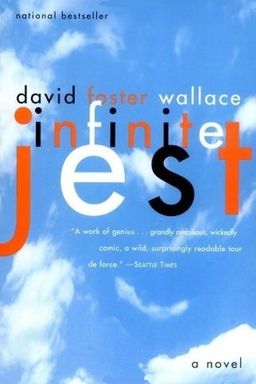
Why do we pursue pleasure knowing it might destroy us? Infinite Jest turns that paradox into a sprawling anatomy of late-modern life. In David Foster Wallace’s future America, addiction, entertainment, and achievement all orbit the same gravitational force: the human appetite for control and comfort. Whether it’s a tennis prodigy chasing perfection, a criminal guarding sobriety, or a viewer glued to a lethal cartridge, every figure struggles between the desire to feel good and the need to feel real.
Wallace designs an intricate system of institutions—the Enfield Tennis Academy (E.T.A.) training children for spectacle and Ennet House rehabilitating adults from dependence. He sets them against a backdrop of political absurdity (O.N.A.N., Québecois terrorism, subsidized time) and technological saturation (InterLace cartridges, videophony, masks). These networks collectively map how culture manufactures both excellence and despair.
Addiction as the human form of technology
Wallace’s addicts—Don Gately, Joelle van Dyne, Kate Gompert—mirror the society they inhabit. The p‑terminal laboratory story and the mythic “Entertainment” cartridge literalize pleasure as lethal circuitry: once stimulation overrides will, freedom collapses into paralysis. Institutions react with equal failure. Ennet House preaches spiritual surrender through AA ritual—“Fake it till you make it”—while E.T.A. enforces discipline until body and mind become machinery. Both promise transcendence by replacing personal desire with ritual submission. Yet both expose the same anguish: to be cured or successful means to be remade by an external system.
Families and figurants
The Incandenza family embodies America’s tragic pedigree of talent. Father James, a filmmaker obsessed with optical perfection, dies by his own technology. Mother Avril, a grammarian of life’s details, mothers through surveillance. Sons Hal, Orin, and Mario attempt divergent salvations—language, sport, compassion—but remain haunted by silence. The father’s ghost—or “wraith”—returns to lament that in creating art to make his child speak, he only turned him into a figurant: visible, voiceless, backgrounded. That image—people alive but unheard—runs through institutions, therapy sessions, even national politics. (Note: Wallace’s metaphor anticipates today’s idea of “performative” existence in social media culture.)
Technology and the failure of intimacy
From the debacle of videophony to the rise of on-demand cartridges, the novel shows how communication technologies amplify shame. Users wear cosmetic masks to look acceptable until everyone returns to voice-only calls, craving the old privacy of unseen imperfection. InterLace’s personalized entertainment grid atomizes public life: viewers gain autonomy but lose common stories. Against this, the lethal “Entertainment” acts as extreme parody—an audiovisual object so pleasurable that it erases the viewer’s will to live. Media evolves from tool to weapon not because of evil intent but because it perfects an existing hunger for effortless absorption.
Institutions as moral laboratories
E.T.A. and Ennet House form twin experiments in human engineering. Schtitt’s training doctrine—self-forgetting through repetition—makes performance transcendence a moral act. Pat Montesian’s and Gately’s recovery model—self-surrender through service—makes humility a survival act. Both convert individual crisis into ritual. Yet their successes depend on community surveillance and suppression of deviation. You come to see freedom not as escape from structure but as the disciplined capacity to inhabit one without vanishing inside it.
A world of collapse and care
Across hundreds of interwoven scenes—Eschaton war-games turning to violence, radio sermons by Madame Psychosis, the A.F.R.’s mirrored murders in Cambridge—Wallace insists that the disorders of attention, media, and addiction are symptoms of a culture that confuses being seen with being known. What redeems characters is rarely insight but labor: the nightly car moving, the thousand serves at dawn, the volunteer shift at a meeting. In their smallest routines, people build temporary order against chaos. The novel’s wager, and your invitation, is that the struggle to stay awake and compassionate inside a culture built to numb you may be the defining sport of our time.