
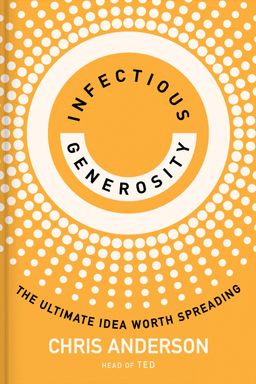
Infectious Generosity cover

Infectious Generosity

by Chris Anderson

Infectious Generosity explores the transformative power of giving in business, demonstrating how strategic philanthropy and accountability can enhance corporate culture, boost customer loyalty, and drive policies for health and equity. Discover practical insights for embedding generosity into business practices for sustainable success.

The Contagious Power of Generosity

When was the last time you did something kind that rippled far beyond your immediate reach? In Infectious Generosity, Chris Anderson—curator of TED—argues that generosity, far from being a quiet, private virtue, can be designed to spread like a contagion. His powerful central claim is that the Internet, which has often amplified anger, division, and despair, could instead become the carrier for humanity’s most beautiful impulse: giving.

Anderson contends that generosity’s time has come. In a connected world, any act of kindness can leap from the personal to the global, igniting chain reactions across boundaries. The same viral dynamic that spreads memes, misinformation, and outrage can, with a few thoughtful tweaks, broadcast goodness with equal speed and scale. But generosity won’t become infectious automatically—it must be shaped, shared, and supported through conscious design and human intention.

Generosity as a Transformative Idea

Anderson opens with the provocative thought that small things can change the world. A single cluster of atoms—the coronavirus—upended human life, yet that same principle of contagious power can be harnessed for good. His belief: generosity can go viral, if we understand its mechanisms. Generosity isn’t just moral goodness; it’s a species-level adaptation, a survival trait that fosters cooperation, builds trust, and fuels civilization.

Throughout the book, he balances data and narrative, personal stories and global trends. Anderson uses examples from his twenty-year TED experience—where sharing ideas freely created unimagined ripple effects—to show how giving without expectation can generate exponential returns. When TED released its talks online for free, global translations poured in, volunteer networks exploded, and viewership soared into billions. This decision to give away intellectual property produced not scarcity but abundance. The phenomenon revealed a profound truth: generosity, when made visible and participatory, multiplies itself.

The Internet as Amplifier—and Risk

Anderson situates his argument within the digital revolution. The Internet’s architecture enables replication and viral spread; humans are the vector, not algorithms alone. Yet social platforms have weaponized outrage rather than kindness. In his view, these dynamics must be reclaimed. He champions two complementary themes: The Internet can turbocharge generosity, and Generosity can transform the Internet. When generosity circulates online, it counters cynicism and helps AI learn from better human data—a crucial factor as artificial intelligence increasingly derives its models from our shared digital footprint.

This reframing gives moral urgency to everyday online behavior. The question becomes: how can we infect others with kindness rather than fear? Anderson believes it starts with visibility—stories like the viral video of a man in Washington, D.C., leaping from his car to give an umbrella to two strangers stuck in a rainstorm. Millions watched, many commented, vowing to carry extra umbrellas. One gesture turned into a movement of imitation. That’s the power of viral generosity.

Human Nature and the New Village

Drawing from evolutionary biology and psychology, Anderson explains that humans are wired to care—but our care evolved in small tribes. The connected era has recreated an “infinite village” where everyone is suddenly visible. This demands rethinking generosity: our moral instincts must stretch beyond proximity to strangers on the other side of the world. The Internet allows acts of giving to scale without limit, from knowledge-sharing to open-source art, mentorship to philanthropy. He cites creators who release documentaries, music, and educational resources freely online, turning creativity itself into global gift economies.

However, Anderson warns against romanticizing purity of intention. True generosity is rarely perfect. People may give for mixed motives—joy, reputation, gratitude—and that’s okay. Judging acts solely on “purity” blinds us to their real impact. What matters most is what generosity accomplishes, not how virtuous it looks. Imperfect generosity still changes lives.

From Personal Acts to Systemic Change

The book progresses from the why to the how and the what if. After exploring why generosity spreads, Anderson maps how anyone—individuals, communities, companies—can make it contagious. His six forms of nonmonetary giving—attention, bridging, knowledge, connection, hospitality, and enchantment—illustrate the diversity of generosity in action. Each example, whether Joshua Coombes offering haircuts to homeless people or artists beautifying neglected streets, shows how creative kindness radiates outward.

In later chapters, Anderson extends the argument to organizations, businesses, and institutions. TED’s transformation from conference to global movement exemplifies how generosity can become operational strategy. Corporations that embrace generosity—for employees, customers, and the planet—will define the next era of capitalism, replacing the “greed-only” model with sustainable, purpose-driven enterprise. This echoes thinkers like Adam Grant (Give and Take) and Rutger Bregman (Humankind)—but Anderson expands the lens to digital systems and collective culture.

A Practical Framework and Hope

Ultimately, Anderson offers a roadmap for personal and societal transformation. His “Mystery Experiment,” where strangers were gifted $10,000, proved scientifically that generosity begets generosity and happiness multiplies. His later chapters propose an annual personal “generosity checkup,” asking: Am I a net giver or a net taker? Through reflection on our time, impact, and contribution, we can orient our lives toward giving more than we take. At global scale, he envisions pledges—echoing religious traditions like tithing and zakat—where people commit 10% of income or 2.5% of wealth to causes that matter most. If widely adopted, such commitments could fund solutions to hunger, climate change, and education worldwide.

In summary, Infectious Generosity isn’t just a philosophy—it’s a call to redesign how we connect, create, give, and inspire. Anderson invites every reader to view generosity not as charity but as strategy; not as sacrifice but as contagion. The message is clear and universal: in an era of viral negativity, we can choose a different infection—one that heals rather than harms, one that proves kindness is not only good but powerful.


Generosity in the Digital Age

Chris Anderson describes how technology has radically expanded our capacity for generosity. The shift from material to digital gifts—what he calls the move from atoms to bits—means that kindness can now spread instantaneously. When you create something online, from a song to a tutorial, giving it away no longer subtracts from your resources. It multiplies value instead.

Nonmaterial Giving

For most of history, generosity meant transferring physical goods. In today’s connected world, gifts can take the form of information, creativity, or knowledge. Anderson recounts how photographer Yann Arthus-Bertrand released his million-dollar documentaries for free online, reaching millions and inspiring admiration worldwide. Likewise, Run the Jewels offered their album free to fans, transforming music into a shared gift economy. Each act demonstrates how intangible gifts can circulate freely, transforming both giver and receiver.

The Infinite Village

The Internet has turned humanity into one global, interconnected village. Reputation, once local, now spreads globally. Acts of kindness aren’t confined to proximity—they can gain immediate visibility across borders. When billionaire Robert Smith erased Morehouse College graduates’ student debt, social media amplified his generosity across the planet. That exposure reinforces a new incentive structure: doing good builds reputation faster and more authentically than traditional marketing ever could.

This logic flips the usual calculus of giving. Generosity becomes a form of enlightened strategy. It’s good ethics and good business combined. The same contagion that can ruin reputations can also raise them in ways that encourage better human behavior.

Case Study: The Artist Support Pledge

One of the most striking examples comes from artist Matthew Burrows, who created the #ArtistSupportPledge during the Covid lockdown. Within months, this social media movement raised £70 million for struggling artists through simple rules: post art under £200; when you sell £1,000 worth, buy from another artist. Burrows described this as generosity spreading like a virus, proving that ancient principles of mutual aid can thrive on modern platforms.

“Kindness is a tough, effective response to the world.” —Matthew Burrows

Burrows’ experiment embodied what Anderson calls the ‘infinite village’—a network where generosity flows through creative reciprocity rather than rigid commerce.

A New Economy of Generosity

Anderson sees these examples as glimpses of a coming gift economy. Sites like Patreon and digital tipping systems hint at a market where appreciation replaces ads and clicks as currency. He suggests creators “give away the most awesome thing you can make, and let others respond generously.” The Internet’s vastness makes this model feasible: even small percentages of generous responses translate to meaningful income and massive cultural impact.

In essence, technology hasn’t diminished generosity—it’s multiplied its reach. The more visible and creative your gifts, the more they inspire others to give. Far from dehumanizing us, the digital age has opened doors to scale compassion in ways traditional philanthropy never could.


Imperfect Generosity and Human Motivation

Can generosity be selfish? Chris Anderson argues that it’s time to stop treating purity as the standard for kindness. In his chapter on imperfect generosity, he dismantles centuries of moral theory—from Immanuel Kant’s duty-based ethics to modern online cynicism—and shows that mixed motives don’t invalidate generosity; they sustain it.

Why Intent Isn’t Everything

Drawing from a social media poll, Anderson narrates respondents’ reactions to a hypothetical donor, Francis, who gives $5,000 to restore a child’s sight. When Francis films the event for YouTube, people call him performative. When others are inspired to give, their judgment flips—now he’s praised. The takeaway: we care more about appearance than effect. Anderson reframes this: intent matters, but results matter more. A world obsessed with purity discourages action. It’s better to do good imperfectly than to do nothing out of fear of hypocrisy.

Multiple Motivations Are Natural

Anderson suggests we liberate generosity from the impossible burden of selflessness. It’s acceptable—even desirable—to give because it feels good, improves reputation, or inspires others. These secondary benefits don’t cancel the primary virtue; they help magnify it. This insight aligns with social science findings (Elizabeth Dunn and Michael Norton, Happy Money) showing that giving genuinely increases happiness, even when mixed motives exist.

“Whenever possible, give someone the benefit of the doubt. That itself is a meaningful act of generosity.” —Chris Anderson

Generosity of Spirit

Anderson extends this principle into perception. He warns that cynicism toward others—especially the wealthy—poisons cultural generosity. While billionaires’ philanthropy must be scrutinized, assuming self-interest by default corrodes trust. Better to encourage more giving and guide it toward effectiveness. He recounts the fierce debates around ultra-rich donors and concludes that instead of attacking them, we should collaborate to make their philanthropy smarter and bolder.

In sum, imperfect generosity recognizes the messy reality of human psychology. It’s inclusive and compassionate. By accepting generosity’s complexity, we invite more people to participate, and paradoxically, the communal good becomes more perfect because it grows.


The Secret Superpowers Within Us

Anderson reveals that generosity isn’t merely moral choice—it’s biological design. Humans are hardwired to empathize, reciprocate, and feel elevated by acts of kindness. From evolutionary psychology to modern neuroscience, he traces the roots of altruism to instincts that enabled survival in small tribes—and now demand expansion to a global scale.

Built for Empathy

The story of Mohammed Mehboob, the carpenter in Bhopal who threw himself under a moving train to save a girl, illustrates our innate impulse to help. “I just acted on instinct,” he said. That same impulse—an automatic empathy response—is the biochemical foundation of generosity. Evolution favored groups that cooperated; genes for gratitude, guilt, and anger at unfairness became tools for fairness and survival.

From Tribes to Humanity

Our empathy evolved for small groups—the famous ‘in-group’ bias. Yet the Internet can extend these boundaries infinitely. Experiments show that storytelling transforms strangers into kin. Anderson describes projects like Pangea Day, a TED initiative where millions watched films from diverse cultures and felt global connection. When empathy widens, generosity follows.

Responding and Mirroring

Generosity is also contagious through reciprocity. Anderson’s Mystery Experiment, gifting $10,000 to strangers, proved that recipients gave away most of the money to others. The instinct to respond mirrors evolutionary reciprocity: kindness begets kindness. Even witnessing generosity triggers ‘moral elevation’—a physiological uplift that inspires imitation. You don’t need proximity; even a video suffices, as seen with viral kindness clips generating waves of pay-it-forward actions.

Generosity and Happiness

Generosity doesn’t just serve society—it serves the individual. Research by Gallup and Elizabeth Dunn confirms that giving leads to enduring happiness, exceeding gains from higher income. Anderson explains this as a psychological correction to “hedonic adaptation.” Material pleasure fades, but giving sustains joy. His prescription: train your reflective mind to overcome “lizard brain” loss aversion that whispers, “If I give, I lose.” You won’t lose—you’ll expand.

Generosity’s secret superpower is that it rewires not only relationships but contentment itself. Once awakened, it becomes self-reinforcing. You feel happier, so you give more; others give back, and the world shifts toward cooperation. Anderson’s message: generosity isn’t extraordinary—it’s our natural state, waiting to be remembered.


Turning Kindness into Contagion

To make generosity truly infectious, Anderson identifies five catalysts—emotion, creativity, courage, collaboration, and amplification. Their interplay transforms one act of kindness into a movement capable of reshaping culture.

Emotional Impact

Stories spread through emotion. Outrage dominates social media because it triggers strong feelings; generosity can do the same if it inspires awe or joy. Jimmy Donaldson (MrBeast), by filming immense acts of giving—like funding cataract surgeries for a thousand blind people—demonstrates this principle. Critics say it’s performative, but Anderson defends it: by evoking empathy and action, emotion becomes amplifier, not manipulation.

Creativity and Humor

Creativity catches attention. In Japan, the Gomi Hiroi Samurai turned litter collection into dramatic street theater, drawing millions of views. Artists like Brazil’s Mundano painted trash collectors’ carts into vibrant ‘superhero’ murals. Humor also spreads kindness: the Ice Bucket Challenge raised over $100 million for ALS precisely because people laughed while doing good.

Courage and Collaboration

Bravery amplifies generosity. Daryl Davis befriended Ku Klux Klan members, risking danger to turn enemies into friends. Captain Tom Moore walked laps with a walker at age 99, raising £32 million for UK healthcare and inspiring hope during lockdown. Courage invites audiences to care deeply.

Collaboration multiplies those sparks. The band OK Go launched #ArtTogetherNow, inviting 15,000 global artists to reinterpret their song for unity. The result: viral beauty born from shared creation. Similarly, Wikipedia’s open-edit model demonstrates collaborative generosity at Internet scale.

Amplification

Finally, amplification—building platforms, hashtags, or apps—turns momentum into movement. Amy Wolff’s “Don’t Give Up” yard sign project began with 20 signs and grew into global phenomenon. Anderson calls this “the butterfly flap of benevolence”: small creative acts, fueled by courage and collaboration, can release hurricanes of empathy.

Master these catalysts, Anderson insists, and your kindness won’t fade. It will replicate, evolve, and spread—digital antibodies against despair. The world doesn’t just need generosity; it needs generosity that travels.


Building a Generous Internet

Anderson’s vision for reclaiming the web hinges on one bold idea: turn the attention economy from exploitation into generosity. Social media algorithms have trained the world’s ‘lizard brains’ to seek outrage, not empathy. But the same systems could be retooled to reward kindness, collaboration, and curiosity.

The Problem with the Current Internet

Platforms optimized for time spent rather than well-being have spread disinformation and division. Anderson draws on voices like Tristan Harris (The Social Dilemma) and Jonathan Haidt to show how technology targets instinctive emotion over reflection. He proposes shifting metrics from “clicks” to “unregretted minutes”—time users feel good about afterward.

The Generosity Mindset Online

Change begins with users themselves. Instead of asking, “What can I get from the Internet?” ask “What can I give?” Anderson urges us to model generous behavior: share inspiring stories, bridge political divides, amplify creators doing good, and respond with kindness even to negativity. He envisions “anti-hate clusters,” communities that drown out extremism by coordinated positivity—akin to the Kindness Pandemic Facebook group of 2020.

What Platforms Could Do

Anderson calls for ending anonymity (except under repression), adding “think-breaks” to app design, and using AI to promote empathy over anger. Algorithms trained to recognize generosity could highlight educational creativity, courage, and beauty rather than scandal. He even imagines social platforms adopting Wikipedia-style crowd moderation to elevate truth and collaboration.

Toward a Reflective Web

The ultimate goal is an Internet that empowers our reflective selves—the part that pauses, thinks, and connects. Anderson points to examples like Milad Mirg, the sandwich shop worker whose TikTok videos of feeding homeless people reversed a destructive trend of wasteful content. His compassion went viral, inspiring copycats worldwide. Proof, Anderson says, that good can compete if given the same attention design as outrage.

Through small conscious choices—sharing empathy instead of anger—we can make the web mirror humanity’s best side. The Internet we want is within reach, if enough of us log on with generosity as our operating system.


Rethinking Business Through Generosity

In the modern economy, Anderson contends, generosity isn’t just moral—it’s strategic. Companies embracing generosity will outperform those stuck in the greed-only mindset. He calls for a radical shift in capitalism’s narrative, from self-interest to shared benefit.

The Rise of Generous Capitalism

Anderson observes that value now lies in ideas and relationships, not resources. Intellectual and social capital flourish through trust and collaboration. Employees, customers, and investors all prefer organizations that act responsibly. Generosity, therefore, becomes competitive advantage. The Internet amplifies this: brands that give—knowledge, transparency, kindness—gain reputation at viral scale.

Corporate Examples

Shipping giant Maersk pledged carbon neutrality by 2050, inviting competitors into research collaborations. Its chairman Jim Hagemann Snabe called it “a bad excuse to say we can’t afford it.” Clothing brand Patagonia donates profits to environmental causes, even giving away ownership for climate action. Chobani’s founder Hamdi Ulukaya made employees part-owners, earning loyalty and record profits. Each proves that generosity and growth can coexist.

“If you are right with your people, if you are right with your community, you will be more profitable.” —Hamdi Ulukaya

A Blueprint for Generous Business

Anderson proposes every company hold a “generosity retreat” to brainstorm its most audacious act of public good: share knowledge, open software, fund social initiatives, or reform damaging practices. The goal isn’t charity but transformative strategy that builds trust, talent, and long-term success. Generosity isn’t distraction—it’s the business model of the future.

When organizations act generously, they spark ripple effects across industries. Their actions inspire competitors, customers, and governments. Anderson’s challenge to corporate leaders: dare to be generous. It is not only right—it will be remembered.


The Generosity Pledge and Collective Future

Anderson ends with a sweeping vision: what if humanity agreed on one global pledge of generosity? He imagines a norm rooted in both spiritual tradition and practical reform—a commitment from individuals and institutions to give meaningfully every year.

Tithing and Zakat Reimagined

Borrowing from religious ethics, Anderson combines the Christian tradition of tithing (10% of income) and the Islamic zakat (2.5% of total wealth). His proposed global pledge asks participants to give at least the higher of these two each year. For the poor, it’s a small aspiration; for the wealthy, it’s transformative. This unites ethical and economic responsibility in a single actionable formula.

The Calculus of Global Impact

He cites research by philosopher Natalie Cargill showing that if one-third of the world adopted such a pledge, $3.5 trillion annually could address virtually all solvable global problems—ending hunger, eradicating disease, restoring forests, empowering education, and preventing future pandemics. Unlike utopian dreams, these are empirically costed goals drawn from data by GiveWell and Longview Philanthropy.

The pledge also corrects the moral fatigue many feel when overwhelmed by suffering. It defines clear boundaries: once you’ve met your commitment, you can rest without guilt, knowing you're contributing to collective good. Ethical clarity replaces endless comparison.

Personal Reflection: The Net-Giver Checkup

Anderson encourages readers to conduct an annual reflection: “Am I a net giver or a net taker?” Examine your work’s impact, time volunteering, carbon footprint, resource sharing, financial donations, and mindset. This holistic metric redefines success from accumulation to contribution. It transforms generosity from sporadic charity into lifestyle philosophy.

In an era of global polarization, Anderson’s pledge could become the moral operating system of the future—a decentralized commitment uniting rich and poor, east and west, around a simple, measurable act of kindness. Infectious generosity, once just a dream, becomes civilization’s next step.

Dig Deeper

Get personalized prompts to apply these lessons to your life and deepen your understanding.

Go Deeper

Get the Full Experience

Download Insight Books for AI-powered reflections, quizzes, and more.