
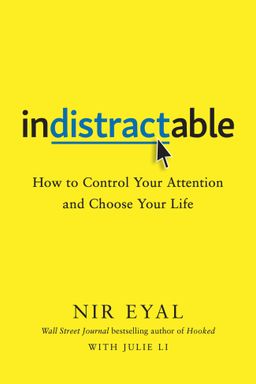
Indistractable cover

Indistractable

by Nir Eyal

Indistractable by Nir Eyal unveils a revolutionary framework to combat modern distractions. By understanding internal triggers and employing practical techniques like timeboxing and pacts, readers can reclaim their focus, improve productivity, and lead more intentional lives.

Becoming Indistractable: The Power to Control Your Attention

What would your life look like if you could fully control your attention—never losing focus to your phone, your impulses, or the endless stream of distractions that tug at you? In Indistractable, Nir Eyal argues that the power to control your attention and choose your life is not about escaping technology or disconnecting entirely, but about mastering the deeper forces that drive distraction. He contends that true focus begins on the inside, not by blaming our devices or workplaces but by understanding our own motivations.

Eyal—who previously wrote Hooked, a guide on how technology companies design habit-forming products—takes the reader behind the mechanics of distraction. Having studied behavioral psychology and design at Stanford, he turns his inside knowledge of how tech hooks us into a manual for reclaiming our time and mental clarity. We live in a world full of tempting pings and notifications, yet Eyal insists these are only proximate causes. The real drivers of distraction are internal, stemming from our discomfort, boredom, anxiety, and the desire to escape unpleasant emotions. Thus, becoming indistractable means rewriting our responses to discomfort itself.

From Hooked to Freedom

Eyal opens with a personal story. Once addicted to devices himself, he missed a tender moment with his young daughter—a turning point that made him realize how much distraction was stealing from his relationships. His failed attempts at a digital detox taught him that simply removing technology wasn’t the solution. The real problem wasn’t the device; it was his reaction to discomfort and the inability to stay present. This insight drives the entire book: escaping distraction isn’t about deleting apps or going offline—it requires mastering the psychological triggers that push you away from what you truly want.

The Indistractable Model

Eyal proposes a four-part model that serves as the blueprint for becoming indistractable:

  • 1. Master internal triggers: Learning to deal with discomfort rather than escaping it. Every distraction begins with an uncomfortable emotion, whether anxiety, boredom, or fatigue.
  • 2. Make time for traction: Planning your time intentionally around your values. You can’t know something’s a distraction unless you’ve decided what it’s distracting you from.
  • 3. Hack back external triggers: Managing the endless pings, rings, and interruptions that fragment your focus by asking, “Is this trigger serving me—or am I serving it?”
  • 4. Prevent distraction with pacts: Creating precommitments—agreements, rules, and boundaries—that help you stick with your intentions.

This model maps out a path from internal mastery to external control. Together, these four steps form a skill set—a way to live deliberately in a world full of seductive pulls. In the same way that Atomic Habits by James Clear helps readers build self-discipline through environment and identity, Eyal's work complements it by focusing specifically on managing distraction through emotional awareness and time design.

Why Attention Matters More Than Ever

Eyal warns that our attention is the rarest resource of the modern age. As philosopher Herbert Simon once said, “A wealth of information means a poverty of attention.” The digital world gives us constant entertainment, yet that abundance can impoverish our focus, creativity, and relationships. In a global economy built around innovation and thought, attention fuels value. Without the ability to stay focused, we risk losing our capacity for creativity and deep work (similar to Cal Newport’s argument in Deep Work).

But while distraction feels inevitable, Eyal insists it’s not. Like Odysseus resisting the call of the Sirens, we can tie ourselves down—not as an act of repression, but as a strategy for freedom. Technology itself isn’t the enemy. What we really battle are the inner and outer forces that pull us away from what we value most. “Being indistractable,” Eyal writes, “means striving to do what you say you will do.” That striving is the essence of integrity.

The Stakes of Distraction

Eyal paints distraction as the silent thief of life’s potential. It erodes productivity, intimacy, empathy, and creativity—all the things that make us human. The example of his daughter shows that losing attention means losing connection, both with others and ourselves. Being indistractable is therefore not just about productivity—it’s a moral and emotional choice. It’s about living a life aligned with your values rather than reacting to every impulse and ping.

The Journey Ahead

Across the book, Eyal takes you through practical strategies that combine behavioral science and personal insight. In Part One, you'll learn how pain—not pleasure—is the true motivator behind distraction. In Part Two, you'll craft a schedule guided by your values rather than your inbox. In Part Three, you'll take back control of technology and your environment. And finally, in Part Four, you’ll use precommitments to lock in behaviors that ensure you keep your promises to yourself. Later sections zoom out to address workplaces, parenting, and relationships, showing that focus is not just personal—it’s cultural and collective. Ultimately, Indistractable teaches that the superpower of the 21st century is not coding, creativity, or productivity—it’s attention. To live the life you want, you must not just do the right things, but stop doing the things that pull you away from what matters most.


Mastering Internal Triggers

Eyal’s most provocative claim is that distraction begins inside us—not in our screens or social media apps. We don’t scroll aimlessly because our devices are irresistible; we scroll because we’re trying to escape discomfort. This idea traces back to philosophers like Epicurus and psychologists like Freud, who saw pain as the root of motivation. Eyal reframes this insight through behavioral science: every act of distraction is an attempt to relieve an internal trigger, such as boredom, loneliness, anxiety, or frustration.

The Root of Distraction Is Discomfort

In Chapter 3, Eyal tells the story of Zoë Chance, a Yale professor who became obsessed with a fitness tracker called “Striiv.” On the surface, she seemed to have fallen for the device’s addictive design. But beneath her obsession lay emotional pain: the stress of a collapsing marriage and anxiety about a job search. The pedometer didn’t cause her distraction—it satisfied her need for relief. Eyal uses this example to highlight that what we perceive as technological addiction often masks deeper psychological needs. Similarly, when we binge Netflix or check email compulsively, we’re avoiding feelings of inadequacy, fear, or fatigue rather than simply responding to stimuli.

Four Psychological Forces of Restlessness

Eyal draws on evolutionary psychology to explain why lasting satisfaction always eludes us. Four built-in psychological tendencies conspire to make us feel perpetually discontent:

  • Boredom: We prefer doing to thinking. A famous study showed that most people would rather electrocute themselves than sit alone with their thoughts for fifteen minutes.
  • Negativity bias: Our brains pay more attention to bad experiences than good ones—a survival mechanism that makes us focus on problems instead of possibilities.
  • Rumination: We replay disappointments to learn from them, but this cycle can doom us to endless distraction.
  • Hedonic adaptation: Even great experiences lose their spark; what thrilled us yesterday becomes mundane today.

Eyal reframes these tendencies not as flaws but as fuel. Evolution designed them to push us forward, to innovate and improve—but only if we learn to manage them. (Like the idea of “pain equals progress” from The Subtle Art of Not Giving a F*ck, Eyal’s argument transforms discomfort into a tool for growth.)

Dealing with Pain Instead of Escaping It

Rather than suppressing discomfort—a strategy that backfires through rumination and irony—Eyal offers acceptance-based strategies rooted in cognitive psychology and mindfulness. In Chapter 6, psychologist Jonathan Bricker’s four-step method teaches you to reframe and record the emotions that lead to distraction. For instance, the “ten-minute rule” helps you resist an urge by promising yourself you'll wait ten minutes before indulging. This delay lets you surf the urge—acknowledging craving without surrendering to it. Other tools, like imagining thoughts as “leaves on a stream,” help you detach from negative sensations without judgment.

Reimagine Tasks and Temperament

To beat internal triggers, Eyal urges you to reimagine even dull work as play. Drawing from game designer Ian Bogost’s concept of “fun without pleasure,” he explains that focusing intensely on a task—like mowing the lawn or writing—can transform it into a creative challenge. He also dismantles the myth of limited willpower (called ego depletion). Research by Carol Dweck shows that willpower is not a finite resource—it depends on belief. If you assume your focus runs out, it will. If you believe motivation ebbs like emotion, you can ride through it. The antidote to distraction isn’t more discipline—it’s self-compassion and curiosity.

Key Reflection

Eyal’s greatest insight is deceptively simple: time management is pain management. Whenever you reach for a distraction, pause and ask: “What discomfort am I trying to escape?” The answer is the first step toward mastery.


Make Time for Traction

Eyal insists you can’t call something a distraction unless you know what it’s distracting you from. This insight redefines productivity. Many of us complain we’re too busy for meaningful work or relationships, but our calendars betray us—we schedule tasks, not intentions. Chapter 9 shows how to reverse that by turning your values into time.

Values Before To-Do Lists

Our culture loves to-do lists, but Eyal argues they’re “seriously flawed.” A list without a schedule is just wishful thinking. Instead, he tells you to start with why before what—to identify your values and allocate time to live them. Drawing from ancient Stoics like Seneca and Hierocles, he defines values as guiding stars. They never end; they direct how you want to be—whether honest, loving, or wise. Once you identify yours, you divide your life into three domains: you (well-being and health), relationships (family and friends), and work (career and contribution).

Timeboxing: Designing Your Day

Instead of vague goals, you build a calendar that reflects these domains through timeboxing. This technique, grounded in psychological research on “implementation intentions,” asks you to decide what you’ll do and when you’ll do it. Fill your calendar completely—even with rest and leisure. The motto: “The time you plan to waste is not wasted time.” Success is measured not by how much you do but by whether you did what you planned. Eyal’s version turns every week into an experiment; each iteration teaches you what works and what must change.

Relationships and Work

In the “relationships” domain, Eyal uses stories about his wife and daughter to show how scheduling time for people you love prevents them from becoming “residual beneficiaries”—those who only get left-over time. He introduces clever rituals like the “fun jar,” where family members draw random activities together. In the “work” domain, he advocates syncing your calendar with managers and coworkers to set expectations. At Boston Consulting Group, teams that instituted predictable time off gained happiness and retention. By aligning expectations, distraction caused by constant interruptions decreases dramatically.

Inputs Over Outcomes

Finally, Eyal adds a twist: focus on inputs, not outcomes. You can’t control results—only the time and effort you invest. He recounts how obsessing over lost sleep made him sleepless until he changed his mantra to “The body gets what the body needs.” Once we stop grasping for outcomes and simply show up—whether to sleep, work, or connect—traction happens naturally. In this framework, freedom doesn’t mean having infinite choices; it means limiting your time intentionally. Every moment becomes a moral decision: Are you moving toward what you value, or away from it?


Hacking Back External Triggers

Our modern environment overflows with external triggers: the phone buzzes, coworkers interrupt, and apps lure our gaze. But Eyal argues these triggers aren’t evil—they’re neutral cues. A trigger leads to distraction only if it doesn’t serve your chosen traction. The question he teaches—the critical one—is simple: “Is this trigger serving me, or am I serving it?”

Email, Chat, and Meetings

In the workplace, triggers abound. Eyal dismantles each systematically. For email, he introduces the “TNT” formula: Time = number of messages × time per message. To reduce “n,” send fewer emails or delay delivery using tools like Mixmax; to reduce “t,” read messages once and tag them by urgency (“Today” or “This Week”). For group chats, he channels Basecamp founder Jason Fried, recommending that chat be treated “like a sauna—stay a while, then get out.” Meetings, Eyal says, should require both an agenda and a proposed solution before callers can book one. If these aren’t provided—no meeting.

Designing Digital Boundaries

Eyal’s “hack back” section reads like a digital minimalist’s practical playbook. He advises cleaning your phone into three categories: primary tools (maps, calendar, messages), aspirations (apps for health or learning), and slot machines (social media, endless feeds). Only the first two belong on your home screen. Notifications must earn their place. Eyal spends hours auditing his phone’s settings, granting sound alerts only to calls and texts. Visual cues—the red badges and banners—get banished. This mirrors minimalist designer Tony Stubblebine’s “Essential Home Screen” method.

Physical and Mental Workspaces

Eyal also explores analog interruptions. In hospitals, bright vests signaled “Do not disturb” to nurses handling medication—a practice that cut errors by nearly 50%. At work, he suggests printed “I’m focused right now—please come back later” signs. At home, his wife’s “concentration crown,” a light-up headpiece, sends the same message. On digital spaces, minimizing clutter—like clearing your desktop or using apps such as Pocket for time-shifted reading—restores sanity. Eyal’s principle is clear: reduce friction for what helps you, and add friction to what distracts you.

Transforming Technology, Not Escaping It

The strength of Eyal’s approach is that it acknowledges we need technology; we just need to wield it wisely. Tools like News Feed Eradicator or DF Tube cleanse your online experience while keeping its utility intact. The idea mirrors Digital Minimalism but adds self-awareness: you don’t have to quit technology—just decide whether it earns your attention. In the end, hacking back external triggers means transforming your relationship with technology from reactive to deliberate: your attention, no longer stolen, becomes a tool of choice rather than chance.


Preventing Distraction with Pacts

After mastering internal and external triggers, Eyal introduces precommitments: deliberate contracts with yourself that link intentions to action. Drawing from Homer’s Odyssey—where Ulysses tied himself to the mast to resist the Sirens—Eyal shows how people can create similar “Ulysses pacts” to stay on course.

Three Kinds of Pacts

Eyal outlines three forms of precommitment, each progressively stronger:

  • 1. Effort pacts: Make distractions harder to access. He cites the Forest app, which grows a virtual tree when you stay off your phone—the guilt of killing the tree adds built-in friction. Similarly, writer Jonathan Franzen used superglue to block his laptop’s internet port.
  • 2. Price pacts: Add financial stakes. Eyal’s own “burn or burn” experiment forced him to either exercise or burn a $100 bill. The idea leverages “loss aversion”—the tendency to fear losses more than we value gains.
  • 3. Identity pacts: Change how you see yourself. Studies at Stanford show people who think of themselves as “voters” vote more than those who merely “intend to vote.” Likewise, calling yourself “indistractable” aligns actions with identity.

Why Pacts Work

Pacts shift focus from motivation to design. As social psychologist Dan Ariely has shown, precommitments bypass willpower by changing context before temptation arises. They also exploit behavioral economics: effort adds friction, money adds pain, and identity adds pride. Together, these create powerful guardrails that keep you on the path of traction, even when motivation wanes.

Identity and Ritual

Eyal deepens identity pacts by invoking ritual. He cites Francesca Gino’s research showing that pre-meal rituals help people eat less—the routine itself builds self-control. Similarly, repeating mantras like “The art of being wise is knowing what to overlook” can reinforce your indistractable identity. Adopting identity-based habits makes behavior not just easier but inevitable: vegetarians don’t choose not to eat meat each day—they simply don’t. You too can become someone who doesn’t give in to distraction.

A Spiritual Superpower

For Eyal, being indistractable is not about perfection; it’s about integrity. To strive means “to struggle or fight vigorously.” Each pact helps you embody that struggle and gradually transform it into strength.


Building Indistractable Workplaces and Cultures

Distraction doesn’t only plague individuals—it infects organizations. Eyal identifies workplace dysfunction as a root cause of constant interruptions. Drawing on Harvard researcher Leslie Perlow’s work at Boston Consulting Group and Google’s internal studies, he argues that companies suffer from distraction when they foster “high expectations and low control.”

The Cycle of Responsiveness

Perlow discovered that BCG’s culture prized availability over effectiveness. Managers sent emails at any hour, employees responded instantly, and burnout followed. These habits created what she called a “cycle of responsiveness”—employees answered because they feared being seen as uncommitted. Technology amplified this fear. Breaking the cycle required dialogue, not decrees. Perlow arranged weekly meetings where teams discussed how to give everyone one predictable night off each week. What resulted wasn’t just rest—it was psychological safety.

Psychological Safety: The Real Cure

Harvard’s Amy Edmondson defines psychological safety as “a belief that one will not be punished or humiliated for speaking up with ideas, questions, concerns, or mistakes.” Google’s research confirmed it as the top predictor of team effectiveness. When people feel safe expressing concerns, tension drops—and so does distraction. They can finally focus on learning and contribution rather than fear. Eyal emphasizes that distraction at work isn’t caused by Slack or email—it’s caused by cultures that lack trust and transparency.

Modeling Focus at the Top

Eyal gives the example of Slack, the company behind the very chat tool many blame for distraction. Slack’s walls feature the mantra “Work hard and go home.” Managers lead by example, blocking uninterrupted work time and discouraging after-hours messages. Channels like #slack-culture and #exec-ama enable open discussions, while emojis like ? and ✅ signal acknowledgment and resolution—small but powerful gestures that make employees feel heard. Even features like automatic “Do Not Disturb” hours serve as corporate precommitments, embodying the same four steps individuals use to be indistractable.

Eyal concludes that fixing distraction is a test of company culture. It’s a reflection of leadership maturity: indistractable organizations don’t demand constant availability—they cultivate clarity, empathy, and trust. When workers feel safe, boundaries become collective, not imposed. The result isn’t less tech—it’s more humanity in how we work together.


Raising Indistractable Children and Strengthening Relationships

Distraction seeps not only into our workplace but into our families. Eyal dedicates later chapters to helping parents and partners reclaim focus together. His approach rejects fear and moral panic, especially around children and technology. He argues that parents must address the root causes of tech overuse: unmet psychological needs for autonomy, competence, and relatedness—a theory developed by psychologists Edward Deci and Richard Ryan.

Children and Psychological Nutrients

Kids turn to screens because offline life often lacks agency. School systems that overcontrol and overtest crush autonomy, while structured play eliminates freedom. Eyal shares Ryan’s view that children deprived of these “nutrients” seek them online, where games offer mastery and social media provides connection. To fix this, parents should not confiscate devices but restore autonomy offline—invite kids to co-create rules, not obey them. As Eyal writes, “Parents who address internet use in an autonomy-supported way have kids who are more self-regulated.”

Family Traction and Agreements

Using his “timeboxing” approach, Eyal helps families design schedules around shared values. Weekly traditions like “Sunday Funday” or family dinners reinforce connection and predictability. Instead of forbidding games like Fortnite, parents can encourage children to allocate explicit time for them. This turns impulse into intention. The goal is teaching self-monitoring and self-regulation rather than imposing control. In his own home, Eyal let his five-year-old decide her daily screen limit; when she chose “two shows” (45 minutes), she gained responsibility for setting and enforcing the timer herself.

Attention Is Contagious

Eyal extends the lesson to friendships and romantic relationships. Distraction, he says, spreads socially like smoking once did. When one person checks their phone during dinner, others follow, creating “social contagion.” The cure is social antibodies: norms that make inattentiveness taboo. Address it kindly—“I see you’re on your phone. Is everything okay?”—to reintroduce presence without shame. For couples, reclaiming intimacy begins with removing devices from bedrooms and setting “effort pacts” like automatic Wi-Fi shutoffs. Eyal and his wife used outlet timers to turn off devices at 10 p.m., transforming nightly distraction into connection.

The Human Center of Indistractability

Ultimately, being indistractable is not a solitary pursuit—it’s social. Teaching children, nurturing partners, and modeling presence all reinforce attention as an act of love. In Eyal’s final story, his daughter says her desired superpower would be “to always be kind.” He concludes the same about focus: the ability to be fully present may be the kindest gift we can offer.

Dig Deeper

Get personalized prompts to apply these lessons to your life and deepen your understanding.

Go Deeper

Get the Full Experience

Download Insight Books for AI-powered reflections, quizzes, and more.