
Idea 1
India’s Democratic Experiment and the Paradox of Unity
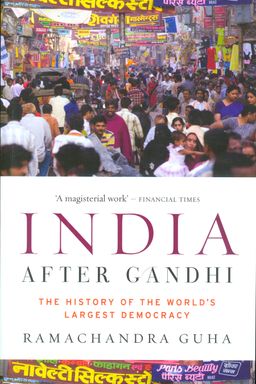
How can a nation so fragmented by language, caste, class, and religion sustain a single democracy for over seven decades? In India After Gandhi, historian Ramachandra Guha argues that India’s endurance as a plural, democratic republic is one of the most improbable achievements of the modern world. The book traces how political institutions, social movements, and cultural currents converged to make this continuity possible despite periodic crises — from Partition and wars to insurgencies and authoritarian turns.
Guha’s central theme is that India appears “unnatural” as a nation — its diversity should have made democracy impossible — yet it survived because of several stabilizing forces: the Constitution, electoral legitimacy, the civil service and army, local accommodation, and the moral imagination of its leadership and citizens. At the book’s heart lies a question you must confront: how did India confound predictions of disintegration, and what conditions make its survival possible?
The improbable birth of a nation
In 1947, colonial withdrawal left behind a devastated, divided subcontinent. Many British and Western thinkers — Strachey, Churchill, even Robert Dahl — believed India too divided to govern itself democratically. Partition’s million deaths and ten million displaced seemed to vindicate the pessimists. Yet leaders like Jawaharlal Nehru, Vallabhbhai Patel and B. R. Ambedkar built the foundations of a constitutional state that chose deliberation over dictatorship. The paradox of unity amid trauma framed India’s modern history.
Institutions that anchored democracy
Guha shows that the Republic’s hardware — courts, Parliament, press, civil service, army — functioned because its software (collective restraint, negotiation, compromise) remained largely intact. Ambedkar’s Constitution balanced individual rights with state-directed welfare. The civil service and judiciary maintained administrative continuity, while Patel’s integration of over 500 princely states stitched the map together. Elections became recurring national rituals of legitimacy, proving that rural citizens could handle universal suffrage as responsibly as urban electorates elsewhere. (Note: Sukumar Sen’s management of the 1952 election is often cited as the largest administrative challenge ever attempted peacefully.)
Cultural and moral glue
Beyond institutions, Guha locates stability in what he calls “habits of accommodation.” Gandhi’s moral influence, Nehru’s modernist optimism, Ambedkar’s insistence on social justice, and cultural forces like cinema and multilingualism acted as centrifugal restraints. Hindi films, English education, and state support for regional languages made citizens participants in a shared culture without suppressing local identities. (Compare this with Pakistan’s failed Urdu imposition or Sri Lanka’s Sinhala-only policy, both of which provoked secessionist wars.)
Recurring crises and resilience
Guha’s narrative is chronological but thematic: each crisis tests national cohesion. Partition’s refugees, linguistic agitations, and wars against China and Pakistan are followed by Nehruvian planning, Indira Gandhi’s Emergency, secessionist insurgencies, and caste and communal realignments. Rather than breaking the state, these shocks often led to institutional correction — from the 44th Amendment after the Emergency to electoral reforms and decentralization in the 1990s. The story is one of adaptation more than perfection. India’s democracy did not arise from harmony; it persisted because conflict was channelled through institutional means.
The civic experiment continues
The book closes by returning to J. B. S. Haldane’s observation that India is “a wonderful experiment” — one that may fail, but is worth attempting. For Guha, survival depends not on divine destiny but on vigilance: maintaining free elections, secular citizenship, press freedom, and an apolitical army. The republic’s endurance proves that democracy can thrive in poverty, pluralism, and noise if citizens keep faith with institutions over identity. The paradox remains, but so does the republic.
When you finish the book, you see India not as an anomaly but as a laboratory of democracy under perpetual stress — an experiment sustained by law, dissent, and everyday acts of forbearance. Its survival is neither miracle nor accident; it is the accumulated work of millions choosing pluralism over purity, inclusion over fear.