
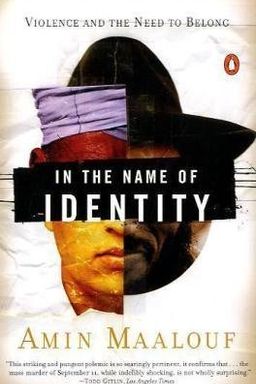
In the Name of Identity cover

In the Name of Identity

by Amin Maalouf

In the Name of Identity delves into the intricate nature of identity, revealing how oversimplified views fuel cultural and political conflicts. Amin Maalouf argues for embracing multifaceted identities to achieve a global community where diversity and unity coexist, offering profound insights for a more peaceful world.

Identity as a Composite of Many Allegiances

What truly defines who you are? Is it your nationality, religion, gender, or perhaps your language? In In the Name of Identity: Violence and the Need to Belong, Lebanese-French writer Amin Maalouf challenges the very notion that identity can be reduced to a single label. Having lived between Lebanon and France—between Arabic and French, Christianity and Islam, East and West—Maalouf explores how our multiplicity of allegiances both enriches us and, paradoxically, can lead to conflict when society insists on dividing people by tribes and boundaries.

Maalouf contends that every individual possesses a unique, composite identity—a mixture of cultural, linguistic, religious, and historical influences that cannot be neatly compartmentalized. Yet, in times of tension, people are pressured to choose one affiliation “deep down inside,” as if there were an immutable essence that makes them belong exclusively to one group. This false simplification, he argues, is dangerous because it transforms identity into a weapon. It is how wars are justified and how massacres begin. The drive to ‘assert’ identity often becomes a drive to annihilate others.

Why Identity Matters

For Maalouf, identity is not just a philosophical question—it is a political and ethical one. He asks, “Would I exist more authentically if I cut off a part of myself?” The answer is no. His own life as both Lebanese and French shows that authenticity comes from embracing complexity, not denying it. The tragedy, however, is that societies often reject complex identities. When a person identifies as both French and Algerian, both Muslim and European, both Hutu and Tutsi, others may see them as traitors. This rejection turns bridges into fault lines. Those who could mediate between cultures instead become casualties of binary thinking.

The Core Argument

Maalouf’s central thesis is that narrowing identity to one overriding affiliation—whether religion, ethnicity, or nationality—fuels violence. The belief that one must ‘choose sides’ between cultural inheritances creates “murderous identities.” He warns that this simplification of self produces fanatics and killers because it links dignity, pride, and belonging exclusively to one tribe. You feel you must defend your tribe at any cost, because everything that defines you seems to depend on its survival.

If identity instead were seen as dynamic and multidimensional—a tapestry in which every thread matters but none dominates—then difference would no longer be a threat. A young Turk in Frankfurt, a mixed-race American with a Jewish mother and Black father, a European torn between nationalism and continental unity—all could be allowed to inhabit their full humanity. Maalouf’s dream is that societies encourage this acceptance of diversity rather than demand allegiance to exclusivity.

Identity’s Evolution and Its Perils

Identity, Maalouf insists, is not fixed at birth; it evolves over a lifetime. It’s formed through countless influences—family, education, language, love, rejection, trauma. These experiences rearrange the hierarchy of allegiances within us. You may emphasize religion when it’s attacked, nationality when it’s questioned, or profession when it gives you pride. But identity is a drum stretched tight: touch one part, and the whole reverberates.

Violence enters when a person’s wounded allegiance becomes their entire identity. When humiliated for their faith or ethnicity, people often retreat into it fiercely, defending it as if survival itself depended on it. Maalouf calls this the mechanism of murderous identity—the moment when belonging becomes conflated with vengeance. The rise of fanaticism isn’t due to religion or ethnicity per se; it’s the result of fear and humiliation. If one’s tribe feels threatened, the inner “Mr. Hyde” awakens. This transforms ordinary people into butchers, each convinced they’re heroic protectors.

Bridges and Global Belonging

As globalisation accelerates, Maalouf sees both opportunity and danger. The world’s cultures intermingle, but many react with fear, clinging to tribal identities as anchors in the storm. Globalisation feels to some like “Americanisation,” an invasion of foreign norms. To others, it’s a chance to build shared allegiances—human rights, global citizenship, ecological care. Maalouf envisions a world where each person embraces their composite identity, adding universal human belonging as one more affiliation among many.

Ultimately, his plea is simple yet urgent: every human being should hold their head high, acknowledging all their allegiances—national, religious, linguistic, and cultural—without shame or aggression. When identity becomes an inclusive sum rather than an exclusive weapon, the panther of belonging can be tamed. Until then, the need to belong will continue to drive violence. In short, Maalouf shows that to save the world from its tribal madness, we must first redefine what it means to be ourselves.


How Identity is Built and Manipulated

Maalouf patiently dismantles the misconception that identity is a fixed, innate entity. He argues instead that it is constructed through life—by choices, encounters, injuries, migrations, and moments of love or rejection. You aren’t born with a pure essence; you become who you are step by step. Even seemingly innate traits such as sex or skin color acquire meaning only through societal context: being a woman in Kabul is not the same as being one in Oslo.

The Apprenticeship of Identity

From early childhood, schooling, family, and neighborhood shape how a person identifies. Words and looks inflict wounds that never fade—mockery of one’s accent, skin tone, creed, or poverty. Each injury rearranges our inner hierarchy of allegiances. The part of ourselves most wounded becomes the most fiercely defended. This explains why ethnic or religious solidarities intensify after humiliation: they mutate into revenge and self-preservation.

The Drum and Its Echo

Maalouf uses the metaphor of a drum stretched tight: touch one part and the entire surface trembles. A person’s identity works like that—the self is not a patchwork of isolated affiliations; it is a living whole. If someone attacks your religion, your entire being responds, even if faith isn’t your strongest component. Thus, oppression of any one affiliation endangers the whole person. People cling to the group that is most under threat and, in extreme cases, use violence to defend it.

The Birth of Fanaticism

When fear and humiliation are repeated, they breed fanaticism. In war zones, Maalouf observed ordinary citizens turning into killers as rumors and terror fed tribal paranoia. In Lebanon’s civil war, he saw that people can kill simply because they believe their community’s survival depends on it. ‘Murderous folly,’ he writes, is not madness—it’s fear distorted by identity. Every culture and faith can fall into it when existential insecurity strikes.

To prevent this, societies must dismantle the tribal concept of identity—the belief that belonging requires exclusion. Identity must instead be seen as fluid, open, and intertwined with others. The “panther” of belonging, if left untamed, becomes a predator; but if nurtured within freedom and reciprocity, it can become a guardian of diversity rather than its destroyer.


When Identity Turns Murderous

One of Maalouf’s most haunting ideas is that identity can kill. When people are forced to choose a single allegiance, they are driven to hatred. History, he reminds us, is filled with wars fought not for economic gain but for the honor of tribes—religious, ethnic, and national. The killer’s conscience is clear because he believes he’s defending his mother, his people, his faith. In this way, identity becomes both justification and weapon.

From Defense to Destruction

Fanatics don’t see themselves as aggressors; they think they’re saving their community from extinction. Maalouf examines atrocities from Rwanda to Yugoslavia and notes the same pattern: communities perceive themselves as victims with rightful revenge to claim. The shift from defending one's rights to slaughtering others happens imperceptibly. “The word identity starts by reflecting a permissible aspiration,” Maalouf writes, “and ends by becoming an instrument of war.” Once identity is purified, massacre feels righteous.

Tribal Thinking Across History

The tribal concept of identity—reducing belonging to one defining essence—has infected all ideologies. It caused religious wars between Catholics and Protestants, ethnic cleansing in Bosnia, and even nationalism in the twentieth century. Maalouf shows how this mindset crosses boundaries: Hutus and Tutsis share language and faith, yet they slaughtered each other; Turks and Kurds share Islam but fight over ethnicity. What makes us murderous is not religion itself but the narrowing of identity to one line of distinction.

An Urgent Need for a New Model

The solution, Maalouf argues, lies in adopting a new concept of identity suited to the global age—one that allows people to be multiple without guilt. Just as women gained rights and races abandoned hierarchies, humanity must abandon the tribal concept of identity. Otherwise, globalisation will merely pit the “lost” against the “fanatics.” To heal murderous identities, we must teach that to be multiple is not to betray; it’s to belong truly.


Migration and the Identity Dilemma

Few experiences reveal the tension of identity more brutally than migration. Maalouf writes as a migrant himself—Lebanese by birth, French by adoption—and portrays the migrant as both insider and outsider, torn between two allegiances. He describes how migrants often live in two worlds: one of nostalgia and one of aspiration, bound by love and guilt to both.

The Migrant’s Double Allegiance

You leave because of repression or poverty, yet carry guilt for abandoning home. In the new land, you seek to belong but face suspicion. Some migrants hide differences to pass as native, while others exaggerate them as acts of pride. Maalouf explains that both responses are reactions to the same wound: the pain of exclusion. When denied recognition by both sides—rejected by the homeland as traitors and by the host as strangers—the migrant becomes fragmented.

Reciprocity: The Moral Contract

Maalouf proposes a “moral contract” between host and immigrant: the host must respect the newcomer’s culture, and the immigrant must engage sincerely with the host’s traditions. “The more you steep yourself in the culture of your host country,” he writes, “the more you can steep yourself in your own.” This reciprocity transforms coexistence into enrichment, not conflict. When both parties uphold dignity and curiosity, identity becomes dialogue.

Wisdom Between Extremes

Two extreme ideas shape migration debates: the tabula rasa view (that the host nation is empty, ready for any culture) and the closed-page view (that it’s fully written and must not change). Both are wrong. Societies are pages being continually rewritten. The migrant’s journey proves that hybrid identity is the future: we must learn to belong to two places without betraying either, for that dual allegiance may be humanity’s greatest hope.


Modernity, Religion, and the Arab Dilemma

Maalouf delves deeply into the Arab and Muslim world, not to condemn but to understand its modern crises. He asks: why do so many societies react violently to modernity? Why do some brandish veils, beards, and bans as symbols of faith? His answer intertwines history, pride, and humiliation rather than theology alone.

Society Shapes Religion

Maalouf reverses a common assumption: religions don’t shape societies as much as societies shape religions. Christianity became tolerant when European societies embraced modernity; Islam became defensive when Muslim societies felt marginalised and humiliated. A confident society expresses a serene faith. An insecure one manifests fanaticism. Thus, the cause of extremism lies not in theology but in social trauma.

The Fall Behind Modernity

The Muslim world once led civilisation, translating Greek and Persian works, advancing science and philosophy. But while the West modernised through centuries of questioning, experimentation, and revolution, Muslim societies remained stagnant under colonial domination and fear of losing identity. Maalouf links this failure not to Islam’s essence but to history: unlike Europe, the Arab world never achieved the social transformation that could modernise its faith.

Humiliation and Reaction

Modernity arrived as conquest, not as partnership—embodied in Napoleon’s expedition to Egypt or Western imperialism. As modernisation became associated with domination, many Arabs began to reject it emotionally, clinging to religion as defense. This explains why radical Islamism emerged only after nationalism failed. It is the ideology of desperation, not devotion. In this view, the veil or beard symbolizes not only piety but protest—a wounded identity demanding dignity against the modern world.


Globalisation and the Age of Universal Belonging

Maalouf sees globalisation as both creative and destructive—a force that unites humanity while threatening cultural diversity. As technology shrinks distances, millions feel their traditions dissolving. Globalisation, he warns, won’t succeed unless everyone can recognize themselves in the emerging world. Otherwise, billions will retreat into ethnic and religious identities.

The Need for Shared Symbols

People identify through symbols—faces, names, languages, music. Maalouf argues that globalization must reflect all cultures, not just Western ones. He offers the United States as both a model and caution. American diversity on screen reassures minorities of belonging, yet global media too often project only Western norms. A balanced universal culture should display songs from Algiers, stories from Seoul, and art from Lima—so that all humanity sees itself reflected.

Diversity in a Global Arena

Globalisation, Maalouf says, is not a top-down system but a vast arena—an Internet-like amphitheatre where anyone can enter. Those who despair and see themselves as victims become self-isolated, breeding resentment. Those who engage—artists, educators, migrants—can shape the future. He insists: the world belongs not to one race or power but to all who participate creatively.

Language and Culture as Lifelines

Cultural survival depends on language. Every person must be free to use the language that defines them. Where language is suppressed, identity collapses and resentment grows. Maalouf calls for multilingualism: each individual should master their mother tongue, English as a global language, and one adopted language for connection. This tri-lingual model preserves diversity while enabling global harmony. It is, in essence, a roadmap for peaceful coexistence in the planetary village.


Taming the Panther: Building Peace Through Identity

In his final chapters, Maalouf likens identity to a panther—beautiful yet deadly. It kills if provoked and kills if ignored. The question is not whether identity can be suppressed but whether it can be tamed. He outlines political and moral principles for managing diversity in democratic societies without sliding into tribalism.

Beyond Quotas and Majorities

Maalouf critiques both Lebanon’s “quota” politics and Western majority rule. Lebanon’s system, which allocates offices to religious groups, breeds resentment: every faction feels cheated. Majority rule, when applied blindly, can turn democracy into tyranny. Rwanda showed how “majority” rhetoric can justify genocide. True democracy safeguards dignity, not numbers. Every citizen must be treated as fully legitimate, whatever their affiliations.

Universality and Democracy

For Maalouf, democracy and multiculturalism must rest on values, not formulas. The sacred principle is human dignity. Mechanisms—elections, quotas, federations—should serve that end, not the other way around. Identity politics should never determine who belongs. Instead, societies should ensure that no one feels excluded from the collective image of humanity they see portrayed.

Toward Universal Belonging

Maalouf ends with hope: a vision of identity as shared adventure. Each of us must learn to belong both to our country and to humanity. Likewise, nations must show, through visible symbols and equal respect, that all colors, creeds, and languages are part of their fabric. “May my grandson,” he writes, “find this book one day and marvel that such things still needed to be said.” His dream is that future generations inherit a world where multiplicity is normal—and where belonging no longer kills.

Dig Deeper

Get personalized prompts to apply these lessons to your life and deepen your understanding.

Go Deeper

Get the Full Experience

Download Insight Books for AI-powered reflections, quizzes, and more.