
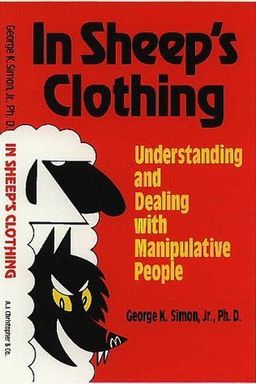
In Sheep’s Clothing cover

In Sheep’s Clothing

by George Simon Jr, PhD

In Sheep''s Clothing reveals the hidden agendas of manipulative individuals and equips you with the strategies to uncover and counter their tactics. Learn to protect yourself from covert aggression and maintain healthier relationships at work and home.

Understanding Manipulation and Covert Aggression

Have you ever walked away from a conversation feeling guilty, confused, or even ashamed—without knowing exactly what went wrong? In In Sheep’s Clothing, psychologist Dr. George K. Simon tackles this unsettling experience head-on, arguing that many of our most draining interactions aren’t accidents of miscommunication but the result of deliberate psychological warfare waged by manipulative, covert-aggressive personalities.

Simon contends that manipulative people don’t fight openly; instead, they fight covertly. They seek power, control, and advantage, but disguise these motives behind charm, innocence, and rational-sounding explanations. Their aggression isn’t about survival or fear—it’s about winning. They are, as Simon puts it, “wolves in sheep’s clothing”—individuals who cloak their domination agendas under humility, care, or moral righteousness.

Why Manipulation Is So Hard to See

Simon’s core argument begins with a simple but unsettling truth: we often misinterpret manipulation because we’re trained by traditional psychology to believe that everyone acts out of insecurity, fear, or emotional wounds. This Freudian worldview encourages empathy—and sometimes, a dangerous naivete. Manipulators exploit this compassion. When someone uses tactics like guilt-tripping, rationalizing, or shaming, we instinctively assume they’re hurting inside instead of attacking us. As a result, we fight back with kindness, analysis, or patience instead of boundaries and assertiveness, becoming trapped in their cycle of control.

Simon rejects this misconception. While neurotic or anxious people act out of internal conflict, character-disordered individuals—including covert-aggressives—lack that inner struggle entirely. They aren’t torn between desire and morality. They want what they want, and they will fight to get it—with sophistication, calculation, and zero self-doubt.

Aggression: Not Always Physical, Sometimes Psychological

Manipulative behavior, Simon explains, stems from our natural human instinct to fight for what we want. There’s nothing wrong with fighting fairly for self-interests—that’s assertiveness. But covert-aggressives take it further. They don’t just fight; they attack quietly. They twist words, distort realities, and use emotional weapons to disarm you while appearing kind or thoughtful. Understanding these forms of nonphysical aggression—guilt-tripping, shaming, playing the victim, seducing with charm—is essential to breaking free from their grip.

The Wolf Hiding Behind the Charm

Simon uses vivid stories to show how covert-aggressives hide in plain sight. You meet Joe, the father who “only wants the best” for his daughter but manipulates his family to feed his ego. James, the minister who equates his ambition with divine calling. Betty, the office “team player” who sabotages newcomers behind the scenes. These are not violent villains—they’re worldly professionals and partners whose niceness masks domination.

What all these cases share is power imbalance. Manipulators push others into one-down positions through subtle fighting tactics—often making you feel selfish or guilty for standing up for yourself. They hide their aggression behind the appearance of reason, forcing you to second-guess your instincts and submit.

Why This Book Matters for Everyday Life

Simon’s work is both psychological analysis and personal empowerment manual. He aims to free readers from the chronic confusion that comes from dealing with people who “say one thing but do another.” This isn’t just about toxic relationships—it’s about recognizing manipulation at work, in families, and even in institutions. By identifying tactics like rationalization, denial, playing the victim, selective attention, and shaming, Simon helps you see through the mask of civility to the fight happening beneath the surface.

He also reframes how we view “power.” Power itself isn’t corrupting, Simon argues—it reveals character. People with sound character wield power responsibly and compassionately (like good parents or leaders). Manipulators, on the other hand, use it as a weapon to dominate and achieve personal gain. The issue isn’t power—it’s unscrupulous pursuit.

From Awareness to Empowerment

Ultimately, Simon’s message is practical: you can’t change a manipulator—at least not until they stop fighting for dominance. What you can change is yourself: your awareness, your boundaries, and your responses. In chapters 9 and 10, he lays out tools for empowerment—learning to judge actions rather than intentions, making direct requests, setting limits, and refusing to buy into excuses. He guides readers toward psychological clarity: stop trying to “fix” manipulators and start owning your power in how you engage them.

By the end of In Sheep’s Clothing, you’re not only able to recognize covert-aggressive people—you’re equipped to disarm them. With sharp insight and empathic realism, Simon transforms the fog of emotional abuse into a map of defense and recovery. His message isn’t cynical—it’s liberating. When you learn to see manipulation for what it truly is—a covert battle for control—you don’t just survive the wolves. You learn to stop feeding them.


The Anatomy of Aggressive Personalities

Simon starts by rethinking what it means to be “aggressive.” It’s not always about shouting or violence—it’s about the drive to overcome obstacles. Everyone fights for what they want, but not everyone fights fairly. Understanding this distinction allows you to tell assertive people apart from manipulative aggressors.

Aggressive vs. Submissive Personalities

Submissive personalities tend to withdraw, doubt themselves, and seek harmony even when mistreated. Aggressive personalities, on the other hand, see life as competition. They frame every interaction as a victory or defeat. For them, to exist is to dominate. Unlike neurotic individuals—who are plagued by guilt and fear—aggressive personalities feel little shame or anxiety. They’ve learned early that fighting yields results, so they double down on it, refining psychological weapons instead of empathy.

Neurotic vs. Character-Disordered

The book distinguishes neurotic personalities—those burdened with excessive conscience—from character-disturbed personalities—those lacking enough conscience. Neurotics suffer too much guilt; manipulators feel none. Simon lists how their thinking diverges: neurotics self-blame, overthink, and fear rejection; disturbed characters justify, fight, and manipulate. Their problem isn’t weakness—it’s moral blindness. They know what’s right but refuse to submit to it because doing so would end their dominance.

From Assertive to Covert-Aggressive

Aggressive personalities fall along a spectrum. Simon identifies five types:

  • Unbridled-Aggressive: openly violent and antisocial persons who disregard laws and norms completely.
  • Channeled-Aggressive: people who compete fiercely in socially approved arenas—business, sports—but can cross ethical lines for gain.
  • Sadistic-Aggressive: those who enjoy others’ suffering and humiliation.
  • Predatory-Aggressive (Psychopathic): manipulators without conscience who view people as prey; dangerous and rare.
  • Covert-Aggressive: the subtle fighters—socially skilled, charming, but quietly ruthless.

Covert-aggressives combine the charm of narcissists with the cunning of predators. They deceive not because they’re afraid, but because overt hostility would make resistance rise. Their talent lies in appearing good while fighting dirty.

Where Manipulators Thrive

Simon warns that certain professions attract covert-aggressives: politics, religion, and law enforcement—anywhere power can be cloaked in service. The minister who “serves” while seeking fame, or the politician “helping the people” while chasing dominance, are archetypal examples. The environments reward ambition wrapped in virtue, making them breeding grounds for manipulation.

Once you see aggression as a spectrum—from fair assertiveness to covert warfare—you start recognizing the wolves not by how loud they bark, but by how gently they speak while moving in for control.

(Note: Similar distinctions appear in Robert Hare’s Without Conscience and M. Scott Peck’s People of the Lie, both describing the same predatory disregard for truth.)


Manipulation Through Deception and Seduction

Covert-aggressives don’t overpower you—they disarm you. Their primary weapons are deception and seduction. They charm you until you relax your guard, then subtly reshape reality to suit their goals. You end up questioning your own judgment while they call it support, guidance, or help.

The Case of Don and Al

Simon’s story of Al, the charismatic supervisor, shows just how powerful this tactic can be. Al was beloved at work—eloquent, positive, and always ready with encouragement. Don, his employee, trusted him completely. When Don began to hear rumors of replacement plans, Al assured him, “You’ll have your job for as long as you want.” Later, Don discovered the truth—Al had hired his replacement weeks earlier. Every soothing compliment had been a calculated lie of omission.

This is what Simon calls lying by omission—telling partial truths to manufacture trust while hiding critical facts. Al never directly lied; he simply sculpted perception. That’s how covert-aggressives operate: they control context, not just content.

The Illusion of Integrity

Manipulators rely on a false face of morality. They appear helpful and humble. The addicted husband says he “just needs support” while blaming you for his drinking. The boss flaunts fairness while rigging promotions. The seduction is emotional first—making you feel valued, understood, or chosen—and ethical second—making you feel judged if you challenge them.

“They’ll show you what you want to see, and tell you what you want to hear.” – Dr. Simon

From Flattery to Exploitation

Flattery is the manipulator’s Trojan horse. By feeding your need for appreciation, they bypass logic. Al’s compliments, James’s spiritual devotion, and Betty’s “loyal teamwork” all serve one aim: your compliance. Once they have emotional control, practical advantage follows. You work harder for less credit, accept unfair terms, or silence your discomfort to “keep the peace.”

Simon stresses that covert seduction isn’t romantic—it’s strategic. They make you dependent on their validation. Every act of kindness becomes a debt. Every gift becomes a hook. Then, when you resist, they withdraw favor. Suddenly, you’re desperate to restore harmony they destroyed in the first place.

The Deception Cycle

The pattern is simple yet devastating:

  • Charm and seduce—make you feel safe.
  • Deceive through omission or distortion.
  • Exploit your trust and vulnerability.
  • Deflect doubt with guilt, shame, or rationalization.

Breaking this cycle requires one core skill: confronting behavior, not excuses. Judge what people do, not what they say or intend. Manipulators thrive on interpretation. Clarity starves them.

Through deception and seduction, covert-aggressives maintain control without detection. Understanding this makes you less likely to mistake toxic charm for kindness—and less likely to hand your power to the person smiling at you while tightening the leash.


Dirty Fighting and Workplace Manipulation

What happens when manipulation enters the workplace? Simon’s story of Betty, the “most dedicated woman in the company,” shows how covert aggression thrives in competitive environments. Betty looks loyal, hardworking, and indispensable—but she’s quietly orchestrating her coworkers’ downfall. Her weapon is rumor and strategic sabotage disguised as professionalism.

The Battle for Power in Disguise

When newcomer Jack arrives as executive assistant, Betty sees him as a threat to her territory. Instead of confronting openly, she pretends friendship—offering help, advice, and praise. Behind the scenes, she poisons the boss’s view of him, suggesting incompetence and hinting at impropriety. When a rumor about Jack’s personal life arises, she subtly mentions it “only out of concern.” Within weeks, Jack loses his job, while Betty’s image of loyalty is stronger than ever.

Predatory vs. Reactive Aggression

Simon uses a vivid analogy—a cat’s behavior. A frightened cat facing a threat arches its back, hisses, and warns its attacker. But a cat stalking prey is quiet and poised. Betty’s aggression is predatory, not reactive. She isn’t acting out of fear; she is calmly planning conquest. Her attacks are deliberate and emotionless, proving that predatory aggression isn’t driven by anger but by desire for control. She is the cat; Jack is the mouse.

This insight reframes how we interpret “office politics.” Many managers mislabel calculated cruelty as a “reaction to stress.” In truth, it’s ambition without ethics—competitive drive turned destructive. Recognizing covert aggression means seeing manipulation not as emotional reaction but premeditated strategy.

Why We Don’t See It

Betty’s peers sense danger but can’t articulate it. Her smile, efficiency, and subtle compliments mask hostility. Simon explains that intuition often detects manipulation before logic does. We get “gut feelings” of threat—unease around someone charming—but self-doubt kills that instinct. We hesitate to call out foul play because nothing overt seems wrong.

The Cost of Workplace Blindness

Jack’s downfall reveals how corporate structures reward manipulation. Charm, competitiveness, and image often count more than integrity. Simon’s point mirrors Adam Grant’s Give and Take: givers often lose to “takers” in power-driven systems. Without a culture that distinguishes assertiveness from deceit, organizations become breeding grounds for covert aggressives who weaponize ambition.

Understanding “dirty fighting” teaches you to trust intuition, demand transparency, and evaluate coworkers by consistent behavior—not charm or gossip. It’s a lesson not just for offices but for any arena where power hides behind politeness.


Recognizing Manipulative Tactics

By Chapter 9, Simon presents a master list of the manipulator’s playbook—twenty tactics of covert control. Once you learn these weapons, manipulation becomes visible everywhere. For Simon, awareness is defense. Manipulators win by keeping you confused and defensive; clarity strips their power.

Common Manipulation Techniques

  • Minimization: Downplaying harm (“I just pushed her a little”).
  • Denial: Refusing responsibility—even with clear evidence.
  • Rationalization: Fabricating logic for wrongdoing to seem reasonable.
  • Diversion and Evasion: Changing topics or vagueness to avoid accountability.
  • Guilt-Tripping: Making you feel cruel for asserting boundaries.
  • Shaming: Undermining confidence through subtle moral judgment.
  • Playing the Victim: Posing as the hurt party to evoke sympathy.
  • Vilifying the Victim: Casting you as aggressive to hide their own hostility.
  • Covert Intimidation: Implied threats—hinting at consequences like loss, rejection, or punishment.
  • Seduction: Charm and flattery to weaken resistance.

These tactics overlap, often appearing in rapid succession. For example, the abusive husband alternates guilt-tripping (“You’re cold to me”), victim-playing (“I’m hurting”), and intimidation (“Don’t make me drink again”). The goal is to keep partners on the defensive, confused, and exhausted.

Offense, Not Defense

Simon insists we stop calling these behaviors “defenses.” Manipulators aren’t protecting wounded egos—they’re fighting. Denial and rationalization aren’t fear; they’re power moves. Understanding this shifts how therapy and relationships must respond. You don’t heal manipulation with empathy; you counter it with boundaries and confrontation.

Spotting the Battle

When you sense confusion or guilt after conflict, assume the fight has already occurred—you just didn’t notice. Manipulators always aim to trigger self-doubt. By naming their tactics aloud (“That sounds like guilt-tripping”), you pull the fight into the open, making covert aggression a losing strategy.

Learning these signs gives you x-ray vision for manipulation. The wolf’s teeth are words, and the eyes are charm. Once you see the pattern, polite warfare loses its disguise.


Redefining the Terms of Engagement

Simon ends with empowerment: if the aggressor sets the rules by attacking first, you must redefine the terms of engagement. To stop being prey, you must act deliberately, not react emotionally. Chapter 10 lays out practical tools—real-world countermeasures for psychological battles.

Confrontation Principles

  • Accept no excuses: Rationalizations are irrelevant; accountability matters.
  • Judge actions, not intentions: Intent is unverifiable; patterns tell truth.
  • Set limits: Define what behaviors you’ll tolerate and what actions you’ll take.
  • Make direct requests: Clarity blocks manipulation. Use “I want…” or “I don’t want…” statements.
  • Stay focused and in the moment: Don’t chase past issues; change happens now.
  • Keep responsibility on the aggressor: Never allow blame-shifting.
  • Avoid threats; take action: Manipulators exploit empty promises.
  • Propose win-win scenarios: Offer outcomes benefiting both; it channels their desire to win.

Examples of Empowered Change

Helen, a wife leaving her manipulative husband, sets clear terms: she’ll support reconciliation only if he demonstrates change through consistent actions. Kelley, a mother, learns to pick her battles with her manipulative son—fighting smart instead of endlessly. Both discover control through clarity, not guilt.

The End of the Losing Battle

A major insight: depression in manipulation victims comes from fighting unwinnable battles—trying to make manipulators change. Power returns when you shift focus to your own behavior. Emotional energy spent on self-respect, not “fixing,” restores strength.

Empowerment means rejecting manipulation as normal conflict. You owe no apology for standing your ground. Simon reframes resistance as moral clarity: you’re not cruel for defending yourself—you’re practicing integrity in a world that rewards deceit.

Dig Deeper

Get personalized prompts to apply these lessons to your life and deepen your understanding.

Go Deeper

Get the Full Experience

Download Insight Books for AI-powered reflections, quizzes, and more.