
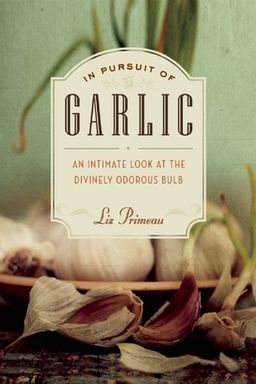
In Pursuit of Garlic cover

In Pursuit of Garlic

by Liz Primeau

In Pursuit of Garlic offers a captivating exploration into the history, cultivation, and diverse uses of garlic. Discover its culinary magic, health benefits, and impressive journey from ancient remedies to a global kitchen staple. Perfect for food enthusiasts and history buffs alike.

The Divine Stink: Humanity’s Love Affair with Garlic

What if one humble bulb could reveal the tangled story of civilization, medicine, and cuisine? Liz Primeau’s Garlic: The Miracle Plant (Greystone Books, 2012) explores our long and complicated love affair with garlic—the “divine stink” that shaped empires, defined cuisines, and charmed both poets and scientists. Primeau argues that garlic is far more than a seasoning; it’s a cultural symbol, a healing ally, and a botanical marvel that has endured for over ten thousand years of human history.

Garlic’s Ancient Roots

Primeau begins by inviting readers back to Neolithic caves and Egyptian pyramids, where garlic was more valuable than silver. Workers on the Great Pyramid of Cheops were paid in garlic and onions, and its image was painted on tomb walls to guard the soul. Mesopotamian cooks inscribed garlic-rich recipes on clay tablets in 1900 BCE, proving that the ancients loved both its flavor and its medicinal promise. By tracing garlic’s genetic lineage—which remains a mystery spanning Central Asia’s rugged mountains—Primeau shows how this tough little plant thrived through climate, migration, and selective breeding. Whether its origins lie in the wild Allium longicuspis or its cousin A. tuncelianum, garlic has always been an extraordinary survivor.

From Medicine to Myth

The book reveals garlic’s split identity: both sacred and profane, curative and cursed. Egyptians saw it as divine sustenance; Romans gave cloves to their soldiers for stamina; medieval monks prized it as an elixir; yet polite English society shunned it as food “fit for peasants.” Primeau explores that cultural bias in humorous, personal detail—like her grandmother’s disdain for “that man with garlic breath”—illustrating how class, religion, and geography shaped garlic’s reputation. From Bram Stoker’s Dracula to Pliny’s medical notes to Hindu Ayurvedic treatises, garlic straddled medicine and magic. It could cure tuberculosis, invigorate desire, or repel evil—all depending on who you asked.

Garlic in the Modern Imagination

Primeau connects ancient folklore with modern science. The sulfur compounds that make garlic smell so potent—especially allicin—also explain its antibiotic power. Citing chemist Eric Block’s research in Garlic and Other Alliums, she describes how chopping a clove instantly triggers a cascade of chemical reactions, producing allicin within seconds. Once dismissed as superstition, garlic’s healing powers now attract biomedical research examining its effects on blood pressure, infections, and even cancer. Yet Primeau thoughtfully acknowledges that clinical trials remain mixed, reminding us that belief and biology still dance together in garlic’s story.

A Personal and Sensory Journey

Part memoir, part travelogue, part horticultural manual, Primeau’s writing is lushly personal. She recalls discovering garlic as a swooning teenager in an Italian restaurant—a moment that awakened her lifelong culinary passion. We follow her to Ontario gardens, California festivals, and the pink-hued fields of Lautrec, France, where garlic is tied into manouilles and celebrated with brass bands. Through these stories, Primeau argues that the bulb’s enduring appeal lies in its sensual duality: pungent yet comforting, earthy yet spiritual, ordinary yet sublime. Her humor and humility remind readers that growing, peeling, and cooking with garlic connect us to a global lineage of people who saw food as both sustenance and story.

Why Garlic Matters

Ultimately, Garlic: The Miracle Plant is a celebration of persistence—of a plant, a taste, and a human fascination that have never faded. Garlic embodies tenacity: its cloves sprout after frost, its scent lingers for days, its presence bridges ancient remedies and modern kitchens. By weaving science, folklore, horticulture, and autobiography, Primeau contends that garlic teaches something profound about resilience and connection. To love garlic, she suggests, is to embrace life’s complexity—the blend of the sacred and the stinky that makes being human deliciously real.


A Pungent Love Affair: Discovering Garlic’s Soul

Primeau turns her personal awakening to garlic into a coming-of-age story that mirrors garlic’s own journey from outcast to culinary saint. At seventeen, she encounters garlic not in a garden but in a steamy Italian restaurant, when a plate of spaghetti and meatballs floods her senses. That meal, she recalls, was a revelation—aromas of tomato, oregano, and roasted garlic merging into something sensual and transformative. It wasn’t just flavor; it was belonging. Like many North Americans of Anglo-Saxon descent, she had grown up in a garlic-free household. Garlic was exotic, even suspicious—a seasoning “fit for peasants.” But in that moment, she breathed in rebellion and culture.

Cultural Prejudice and Culinary Revolution

Through her grandmother’s disdain for “foreign” smells and the British avoidance of pungent foods, Primeau highlights how deeply food prejudice shapes identity. English diets once considered garlic uncouth, while Mediterranean immigrants in postwar Canada clung to it as home. Their small restaurants and backyard gardens—the Luca family’s Italian trattoria, Anna the housekeeper’s sauce recipes—became cultural embassies that transformed the continent’s palate. Primeau’s own education in cooking, from garlic powder to whole bulbs smashed under Anna’s knife, charts North America’s broader acceptance of authentic ethnic flavors. Like Ruth Reichl’s tales in Comfort Me with Apples, Primeau’s journey celebrates garlic as both cultural translator and symbol of openheartedness.

Garlic and Identity

In reclaiming the once-reviled ingredient, Primeau reclaims herself as both gardener and global citizen. Garlic, she notes, unites Italians, Celts, Romans, and monks—it crosses barriers of class, religion, and time. It binds family through sauce simmering on stoves and immigrants through the gardens they tend in new lands. When she receives homegrown garlic from neighbors like Aldo’s father, she realizes food is an unspoken language of generosity. Garlic carries history in each clove—the toil of workers, the rituals of harvest, and the wisdom of women who cooked without recipes but with intuition. That realization fuels her later adventures cultivating her own bulbs.

Lessons from the Kitchen

Primeau concludes that to cook with garlic is to participate in a long human act of communion. Garlic’s scent connects kitchens across centuries, from Roman villas to suburban cooktops. Her anecdote—Anna tossing powdered garlic into the bin and commanding “fresca!”—is both comic and profound: it signals a return to authenticity, to food that carries the earth’s memory. In rediscovering garlic, Primeau learns to taste with her senses rather than social expectations. It is, fittingly, a love affair—not just with one spice, but with life’s rich, messy, flavorful essence.


Down to Earth: Growing the Miracle Bulb

Once entranced by garlic’s flavor, Primeau turns soil scientist, obeying the impulse to grow her own. Encouraged by her friend Judith, she learns that garlic is paradoxically simple yet precise. Each clove already contains an entire plant’s blueprint: roots, leaves, and the future bulb. Yet success, like good cooking, depends on timing, care, and intuition. In learning to cultivate garlic, Primeau uncovers lessons about patience, resilience, and respect for nature’s tempo.

Garlic as Teacher

Her first crop—planted among her ornamental flowers in defiance of neat garden rules—teaches humility. Most bulbs turn out “rounds,” single fat cloves rather than the expected multilayered heads. But she celebrates the one perfect bulb, lifting it from the earth like treasure. That satisfaction, she writes, “was worth more than any bouquet.” Garlic rewards observation, not control: it bends to weather, soil, and the gardener’s patience. Judith’s advice rings true: mulch for warmth, remove scapes so energy feeds the bulbs, and never refrigerate—cold triggers sprouting. Every mishap becomes knowledge, just as garlic itself evolved by adapting to climates and human hands.

Plant, Water, Wait

Primeau’s meticulous explanations—spacing, vernalization, soil preparation—turn the reader into a confidant. Garlic, she learns, thrives in full sun and modest soil but hates soggy feet. Plant in fall, three weeks before frost; harvest in summer when half the leaves are brown. Such detail transforms her memoir into a horticultural handbook, echoing Ted Jordan Meredith’s The Complete Book of Garlic. But beneath the technical guidance lies philosophy: gardening, like cooking, is surrender to natural rhythms. Garlic’s nine-month cycle mirrors human gestation; patience yields flavor.

Pests, Puzzles, and Perseverance

Even garlic, she warns, has enemies—fungus, mites, and the notorious leek moth that terrorizes Canadian growers. Yet garlic itself repels most parasites with its own sulfurous defense, a reminder that strength often smells. Primeau marvels at this biological resilience, seeing in the plant a model of independence: “smelly and strong-tasting—it chases away more monsters than it attracts.” By the time she perfects her harvest, she realizes she’s cultivated more than bulbs—she’s cultivated attentiveness. Growing garlic, she says, means learning to listen to life underground.


The Global Garlic Stage: Gilroy to Lautrec

Primeau’s travels transform garlic from crop to culture. At California’s Gilroy Garlic Festival—the world’s largest—she encounters garlic as spectacle: flames rising from Gourmet Alley, chefs in sunglasses tossing shrimp and calamari, and crowds savoring garlic ice cream. The festival, founded by farmers Don Christopher and Rudy Melone, blends Americana and obsession, proving that community pride can spring from even the humblest bulb. It’s part cook-off, part carnival, part business machine; millions raised for charity; and a symbol of garlic’s victory over old prejudices.

Garlic and Globalization

The joy of Gilroy contrasts sharply with the darker tale of Chinese garlic. Primeau unpacks the economic drama of global trade—how China’s cheap exports flooded North American markets, triggering “garlic wars” and tariff battles. Growers in Ontario saw crops abandoned as Chinese bulbs sold for cents on the pound. Yet behind the statistics, she finds human resilience: small farmers regrouping, planting heritage varieties, and rebuilding local supply. Her account, quoting Canadian growers Mark Wales and Warren Ham, shows garlic’s uncanny ability to embody globalization’s tensions: profit, pride, and survival.

The Pink Pearl of France

From bustling California fields, Primeau journeys to Lautrec, a medieval village framed by the Pyrenees, where every August locals celebrate their cherished Ail Rose de Lautrec. This pink garlic, draped in satiny skins, is so regulated it has “Label Rouge” and “Protected Geographical Indication” certifications—proof of terroir as rigorous as any wine. Parade, song, and ceremony turn garlic into art: men in velvet robes induct new “brothers” by tasting garlic soup, while sculptors build hot-air balloons and roosters from cloves and skins. Primeau’s translator, Pauline Danigo, bridges language and laughter, showing how garlic still unites generations. For Lautrec’s farmers like Jacqueline Barthe, garlic is identity, heritage, and economy in one fragrant knot.

The Meaning of Celebration

Comparing Gilroy’s exuberance to Lautrec’s elegance, Primeau suggests that festivals reveal how cultures express joy. Americans turn garlic into a carnival; the French make it ceremony; Canadians lecture and taste. Yet all share gratitude—for harvest, for community, for flavor. Through these journeys, garlic becomes a metaphor for connection across boundaries. Whether as Gilroy’s smoky sausage or Lautrec’s pink satin braid, it is civilization’s common aroma, proof that good food transcends politics.


The Science and Magic of Garlic

Primeau bridges mythology with molecular biology, showing why garlic straddles medicine and myth. Ancient healers ascribed its power to divine forces; modern chemists trace it to allicin. When garlic is crushed, its enzyme alliinase meets its substrate alliin, sparking an instant reaction that forms allicin—a potent antibacterial compound that gives garlic its sting. This chemistry, discovered by researcher Chester Cavallito in 1944, finally explained what Hippocrates called “nature’s healer.”

Garlic’s Healing Legacy

Across eras, garlic has treated parasites, infections, and heart ailments. Romans fed it to soldiers; Albert Schweitzer used it against dysentery in Africa; World War I medics applied garlic poultices when antibiotics ran out. Modern trials, Primeau notes, explore garlic’s potential to fight fungi, viruses, and even cancer. Epidemiological studies in China suggested lower stomach cancer rates among high-garlic consumers. Still, results vary—garlic performs brilliantly in test tubes, less so in human bodies, where enzymes quickly break down its miracle compounds. Primeau’s balanced view celebrates its promise without turning it into panacea.

The Double-Edged Clove

Garlic’s miraculous chemistry also explains its perils. Allicin’s volatility makes raw garlic potent but unstable; heating or acid destroys it. For diet, a clove a day might aid immunity—though excess can irritate stomachs or thin blood. Primeau quotes the World Health Organization’s guideline of one clove daily and the habits of garlic elders like Chester Aaron and Ted Maczka, both vibrant octogenarian growers who eat three cloves a day with conviction. Yet she warns us of balance: even wonder plants have limits.

From Folk Remedy to Biotech Hope

Ultimately, garlic’s mystery endures because it sits between faith and fact. Scientists dream of targeted capsules that deliver its healing molecules intact; folk healers still mix vodka tinctures for toenail fungus and warm soups to fight colds. Primeau’s tone is pragmatic but reverent: perhaps garlic’s greatest medicine is its capacity to connect science with soul, laboratory with kitchen, through the simple human act of crushing a clove.


In the Kitchen: Mastering Flavor and Form

Cooking with garlic, Primeau writes, is both chemistry and art. Knowing when to chop, crush, or roast transforms dishes and health alike. Each action—a knife’s press, a splash of heat—awakens different compounds and tastes. This chapter is her practical hymn to home cooks, blending culinary science with sensual pleasure.

The Alchemy of the Chop

When you smash a clove, enzymes erupt, producing allicin in ten seconds flat. Letting chopped garlic rest before heating preserves potency; overcooking destroys it. Raw garlic burns bright and sharp, ideal for aioli and vinaigrettes; roasted cloves mellow into sweetness, spreading like butter. Primeau channels both chefs and chemists, echoing food writer Lucy Waverman’s advice to pair science with intuition. She even celebrates tools—ule knives, Zyliss presses, microplane rasps—with equal passion, turning kitchen gadgets into poetry.

Preserving the Harvest

For climates where good bulbs disappear by winter, she details freezing chopped cloves in ice trays or drying them into chips. Garlic oil, she warns, can harbor botulism unless acid-treated. Her experimental trials resemble lab notes—perfect for readers who treat cooking as science. Yet her central rule is joy: even powdered garlic has its place if used with heart. “Don’t apologize,” she quips; “just don’t mistake it for the real thing.”

Trendy Cloves and Timeless Appeal

Primeau explores new obsessions: garlic scapes, green garlic, and fermented black garlic—an invention from South Korea that turns cloves into sweet, umami-rich confections. Once she tastes it atop crusty rolls, she declares conversion. Garlic keeps reinventing itself, she concludes, because it mirrors cuisine’s evolution: from survival food to haute ingredient. Whether whirled into Salsa Verde, stirred into Potage de l’Ail Rose, or baked into a blueberry cobbler, garlic’s essence remains the same—a reminder that flavor is both chemistry and love.


A Primer for the Curious: Varieties and Voices

Primeau closes with a gardener’s encyclopedia and a poet’s nostalgia, listing hardneck and softneck varieties like family names. Each clove tells its own regional tale: the robust Rocamboles from cold Russia, the sweet Creoles of Spain, the glossy Porcelains of Canada. By tracing these differences, she celebrates biodiversity against industrial sameness—and invites readers to taste geography itself.

Hardnecks and Softnecks

Hardnecks send up flowering scapes; softnecks stay pliable for braiding and long storage. Within them lie ten subgroups—from Purple Stripe to Silverskin—each revealing subtle gradients of flavor and form. ‘Music,’ ‘Spanish Roja,’ and Lautrec’s ‘Rose de Lautrec’ exemplify garlic’s diversity and cultural migration. Primeau’s descriptions read like wine notes: “sweet, musky, lingering,” or “hot, crisp, full-bodied.” She argues that these distinctions matter because they preserve the genetic and cultural heritage threatened by global monoculture.

The Philosopher’s Bulb

In the end, Primeau elevates garlic as symbol of human resilience. Its long life, adaptability, and layered form become metaphors for history itself. Garlic unites ancient healers, immigrant cooks, and modern scientists in one fragrant continuum. “A day without garlic,” says a Lautrec market sign she quotes, “is a day without sunshine.” After reading this book, you believe it.

Dig Deeper

Get personalized prompts to apply these lessons to your life and deepen your understanding.

Go Deeper

Get the Full Experience

Download Insight Books for AI-powered reflections, quizzes, and more.