
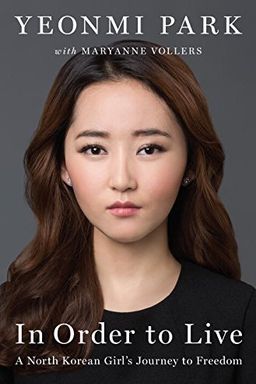
In Order to Live cover

In Order to Live

by Yeonmi Park

In Order to Live is Yeonmi Park''s gripping memoir of her escape from North Korea''s brutal regime. Facing human trafficking and countless hardships, Yeonmi''s inspiring journey to freedom and her advocacy for human rights illuminate the power of resilience and hope.

Across the River and Into the Light: The Journey from Oppression to Freedom

What would you risk to be free? Would you cross an icy river under threat of death, leave behind everyone you’ve ever known, or abandon the language and beliefs that shaped your life? In In Order to Live: A North Korean Girl's Journey to Freedom, Yeonmi Park tells the riveting true story of her escape from North Korea and her transformation from a child of oppression into a global voice for liberty. Her memoir is both a survival story and a moral awakening—a stark reminder that freedom is not an abstract ideal but a daily, human necessity purchased at unimaginable cost.

Park argues that the struggle for freedom begins within the self. Oppression thrives not only through walls and prisons but through indoctrination, language, and fear. Her journey—from hunger in the totalitarian North, to human trafficking in China, and finally to intellectual rebirth in South Korea—shows how reclaiming one’s humanity can be the ultimate act of resistance.

The World You’re Not Supposed to Know

Park grew up in Hyesan, a border city where she could see the glitter of lights across the Yalu River in China—an impossible contrast to North Korea’s darkness. Her childhood unfolded beneath a regime that outlawed curiosity, privacy, even love. She was taught to fear birds and mice as spies, to worship the Kim family as gods, and to silence her own mind. Yet even as famine struck in the 1990s and survival meant bending laws and bartering for food, small glimpses of color—illicit movies, foreign goods—hinted at another kind of life.

The first half of her story immerses you in this closed world, where Orwellian doublethink reigns. The regime’s mantra—self-reliance through juche—masks dependence on fear. Everyone lies to survive, and lying becomes its own truth. Comparing this reality to George Orwell’s 1984, Park later understood how controlling language controls thought: words like “freedom” or “love” had no real equivalents in her vocabulary.

From Escape to Enslavement

At thirteen, desperate to find food and her missing sister, Park crossed the frozen Yalu River with her mother. But China, the land of electric lights and noodles she’d dreamed about, turned out to be another prison. Betrayed by traffickers, she was sold into servitude, and to save her daughter, her mother offered herself to a rapist. Later, Park was sold again to a man named Hongwei, who—through a mix of exploitation and strange devotion—became both her captor and her rescuer. In this paradox of abuse and protection, the lines between victim and survivor blur.

Her story forces uncomfortable questions about moral agency under extreme coercion. Like Viktor Frankl in Man’s Search for Meaning, Park discovers that even in captivity one can choose how to respond to suffering. She bargains not for her own survival, but to save her family—and in doing so reclaims fragments of power within a system designed to erase it.

The Long Road to Freedom and the Awakening of the Mind

Park’s physical escape from China—through the frozen Gobi Desert into Mongolia—marks only the beginning of her transformation. The second act of her life begins in South Korea, where freedom itself becomes a new challenge. She describes how the abundance, noise, and moral complexity of a democratic society can overwhelm someone raised in total conformity. The hardest part, she writes, was not leaving North Korea but unlearning it—learning to ask questions, to think in shades of gray, and to believe she deserved happiness.

In South Korea, Park rebuilds her identity through education. Discovering books banned in her homeland—like Orwell’s Animal Farm—she realizes her life is an embodiment of those allegories. Reading becomes an act of freedom as she devours philosophy, politics, and literature, reconstructing her mind piece by piece. Her later work as an activist on global stages, including her famous One Young World speech, reflects this intellectual rebirth: every story she tells is a weapon against silence.

Why Her Story Matters to You

Yeonmi Park’s story isn’t just about North Korea—it’s about what happens when fear replaces truth, when authoritarian control numbs a population into obedience, and when survival requires moral compromises no one should face. Her life challenges you to examine freedom as something fragile and living, sustained not only by law but by conscience. You don’t need to flee a dictatorship to learn her lesson: protecting your ability to think, feel, and speak truth is a form of daily courage.

“I wasn’t dreaming of freedom when I escaped from North Korea,” she writes. “I didn’t even know what it meant to be free. All I knew was that if we stayed, we would die.”

Through that simple act of survival grew a moral compass that now guides millions who hear her speak. Park’s memoir thus becomes more than a testimony—it’s an invitation to cherish truth, to defend dignity, and to uphold the light that flickers even in the darkest night.


Growing Up in the Hermit Kingdom

Yeonmi Park’s early years in Hyesan reveal how ideology replaces reality in totalitarian systems. From infancy she was taught to love the Great Leader Kim Jong Il more than her family, to fear her own thoughts, and to praise the regime for every bowl of food. Even playground games were political—killing imaginary American soldiers rather than fairy-tale dragons. Childhood innocence was domesticated into loyalty.

A Childhood of Fear and Hunger

The economic collapse after the fall of the Soviet Union turned North Korea’s proclaiming paradise into famine. Park recalls scavenging for weeds and insects, watching people starve in the streets, and being told that hunger was patriotic. Her father, once a mid-level party member, began smuggling metal and other goods to provide for his family. In this underground market life—what Park calls the jangmadang generation—ordinary citizens began to teach themselves capitalism despite lethal risks. They learned to bribe, trade, and question authority. For Yeonmi, this quiet defiance became an early education in self-reliance.

Language as a Tool of Control

What most shaped her world was the manipulation of words. There was no vocabulary for individuality or dissent. Even the word “love” referred only to devotion toward the Kim family. When citizens lack language for emotions or freedom, Park notes, they lose the ability to imagine alternatives (Orwell’s concept of Newspeak applies perfectly here). As a child, she learned to lie instinctively, smiling while hiding terror—skills that would later save her life. Her mother’s warning, “Even the birds and mice can hear you whisper,” captured the paranoia of a society built on informing. Trust was dangerous; silence was survival.

The Moment of Awakening

Ironically, Park’s first spark of curiosity came through forbidden films smuggled from China. Watching the movie Titanic, she was mesmerized: how could a man die for love instead of the Dear Leader? That revelation—human love as an independent moral choice—defined her first act of rebellion. Such glimpses across the border planted the seed that would someday push her to cross it physically. The gap between what she saw and what she was taught became unbearable.

Park’s childhood reminds us that dictatorships don’t just demand obedience—they reengineer imagination. The fight for truth begins with learning to see what’s missing from the picture you’re given.


Crossing the River into Darkness

The act that defined Yeonmi Park’s life happened on a freezing night in March 2007. At thirteen, weighing barely sixty pounds, she crossed the Yalu River with her mother, guided by smugglers and haunted by soldiers’ floodlights. Freedom, she thought, was just on the other side. Instead, she and her mother walked directly into a human trafficking network that preyed on North Korean women.

From Hope to Betrayal

Minutes after stepping onto Chinese soil, Park heard her mother scream “No!”—her first warning that freedom could be another illusion. The broker who promised safety demanded to rape Park, but her mother intervened, sacrificing herself. This moment revealed the moral cost of survival under coercion. In a single night, Park lost her innocence and her belief in a just world.

Bought and Sold

In China, mother and daughter were sold as commodities: $650 for the mother, $2,000 for the daughter. The buyers justified their acts as rescue—rationalizing profit with pity. Park’s eventual owner, Hongwei, was a mid-level trafficker who oscillated between cruelty and care. To keep her and her mother, he paid to re-purchase them from others. His possessiveness, twisted into protection, embodied the contradiction of human evil: you can abuse and protect someone in the same breath. Caught between disgust and gratitude, Park learned how survival sometimes demands negotiating with monsters.

Choosing to Live

When Hongwei offered to help retrieve her mother from servitude in exchange for her submission, Park agreed—not out of acceptance, but out of duty. By surrendering herself, she reclaimed agency; she chose to suffer for someone else, not because she was powerless, but because she still had love. In captivity, this moral decision became her first experience of freedom. She turned pain into purpose—the same transformation that later defines survivors who refuse to become victims. As she writes, “I learned that you can lose part of your humanity to survive, but the spark of dignity is never completely extinguished.”


Following the Stars to Freedom

Escaping China required luck, faith, and desperation in equal measure. With the help of Christian missionaries—some of whom risked prison—Yeonmi, her mother, and a group of defectors set out across the Gobi Desert into Mongolia, following the starlight on a frozen night in 2009. It was an act of faith against impossible odds. Every step could have meant execution if caught by Chinese patrols or death by exposure.

The Desert of Testing

The journey across five barbed-wire fences epitomized the boundary between slavery and freedom. Park carried a razor blade, prepared to slit her throat rather than be sent back. The little boy in their group was sedated to keep him from crying. After hours of freezing wind and hallucinations, dawn brought the first Mongolian soldier—and rescue. Her words, “Jesus’ blood is my blood,” whispered in fear, became both a prayer and mantra. The border crossing became symbolic: every person must sometimes wander through a personal desert before finding safety.

Rebirth Through Exile

In Mongolia, refugees were detained and interrogated, but Park found compassion there for the first time. From Mongolia she was flown to South Korea—her mythical homeland—where the bright airport lights and automated faucets stunned her. For a girl raised in blackout nights, these small things confirmed she had entered another world. Yet true freedom, she soon realized, was not a place but a discipline: learning how to live unafraid.

“When I crossed the desert,” writes Park, “I wasn’t afraid of dying as much as I was afraid of being forgotten.”

Her terror of disappearance—shared by millions whose suffering the world never sees—became the fuel for her future activism. To be remembered, she decided, you have to speak.


Learning to Live Free in South Korea

Freedom arrived not as joy, but as confusion. After years of silence, Yeonmi Park entered a world where everyone had opinions, choices, and voices. At first, she despised the noise and complexity. The resettlement center, Hanawon, taught defectors how to operate ATMs, buy groceries, and choose their own futures. Yet, as Park admits, thinking for herself was the hardest part: in North Korea, choice didn’t exist; in freedom, it was endless.

Unlearning Tyranny

North Korea had governed her imagination. When South Korean teachers asked about her favorite color or hobby, she froze—there were no correct answers in her old world. Discovering that personal preference even existed was revolutionary. Park compared herself to a time traveler from the 1950s suddenly launched into a world of smartphones and credit cards. Like many defectors, she also faced prejudice; South Koreans viewed Northerners as backward. The loneliness of exile, she writes, can be sharper than hunger.

The Power of Education

Education became her new religion. She read children’s books, then biographies of Lincoln and Orwell, devouring any story that turned hardship into heroism. Discovering Animal Farm was a revelation—it was North Korea in disguise, and Orwell seemed to be telling her secret. Language itself rebuilt her brain: the more words she learned, the more she could think. Freedom, she realized, begins when you can articulate your own feelings. “You can’t grow,” she writes, “unless you have a language to grow within.”

A New Purpose

While Park pursued a degree in police administration, dreaming of justice, she struggled with depression and nightmares. But the rediscovery of her sister after seven years apart rekindled her strength. South Korea’s consumer abundance and emotional openness taught her that freedom wasn’t about wealth but self-expression—the right to choose, to love, and to dissent. What she calls “learning to live free” turns out to be a second, invisible escape.


Breaking the Silence: Speaking for the Voiceless

Once Yeonmi had rebuilt her life, a new question emerged: what was freedom for? Having survived when so many others did not, she chose to use her voice as a platform for those still trapped behind the world’s most impenetrable border. Through television appearances, university speeches, and her iconic 2014 address at the One Young World Summit in Dublin, she transformed her personal trauma into universal witness.

Finding Her Voice

In her televised debut on South Korea’s Now on My Way to Meet You, Park appeared in bright clothes and makeup, a crafted image of confidence. But what began as entertainment evolved into activism. Listening to other defectors share the same pain, she began piecing together memories she had tried to bury. By the time of her Dublin speech, she no longer hid her past. The words “My mother was raped… I was sold” broke centuries of Korean silence surrounding shame and honor. Vulnerability became her rebellion.

The Risks of Truth

Publicly denouncing a totalitarian regime meant inviting its wrath. North Korean state media soon released propaganda calling her “a poisonous mushroom” and denouncing her family. As she watched her surviving relatives recite lies on camera, Park experienced the ultimate absurdity of authoritarian power: even truth-telling could endanger the innocent. Yet she refused to retreat. Like Malala Yousafzai or Elie Wiesel, she treats testimony itself as resistance.

Advocacy as Healing

Telling her story publicly became not only activism but therapy. For the first time, she allowed herself to cry for others as well as for herself. Her humanitarian work with global organizations like Liberty in North Korea and the Human Rights Foundation transformed private suffering into public service. “If I don’t speak,” she says, “who will?” In that question lies the answer to her title: to live is to use one’s freedom to affirm the dignity of others.


The Meaning of Freedom

By the end of her memoir, Yeonmi Park comes to a profound realization: freedom isn’t merely political; it’s human. It’s the ability to think your own thoughts, tell your own story, and love without fear. Her journey—from propaganda to awareness, bondage to expression—draws a map of liberation applicable far beyond Korea.

Freedom as Inner Reclamation

Freedom, Park argues, begins inside. North Korea imprisons minds before bodies. Her survival depended on changing her own consciousness—to stop believing that obedience was virtue and pain was destiny. Each new language she learned—Korean without censorship, Chinese for survival, English for advocacy—expanded the boundaries of her mind. Knowledge doesn’t just illuminate; it resurrects.

The Cost of Freedom

Freedom exacts a price. For Park, it meant confronting trauma, losing family, and living under threat from a regime that still calls for her death. But she embraces that cost because silence would be worse. Freedom is not comfort, she insists; it’s the courage to remember when forgetting would be easier. Her story converges with others like Nelson Mandela’s: those who endure captivity often understand liberty most deeply.

“Sometimes,” she writes, “the only way we can survive our own memories is to shape them into a story that makes sense.”

In the end, Park’s quest is not only for freedom but meaning—the same reason she began writing. Her life reminds you that survival without truth is just existence; to live freely is to give that survival purpose.

Dig Deeper

Get personalized prompts to apply these lessons to your life and deepen your understanding.

Go Deeper

Get the Full Experience

Download Insight Books for AI-powered reflections, quizzes, and more.