
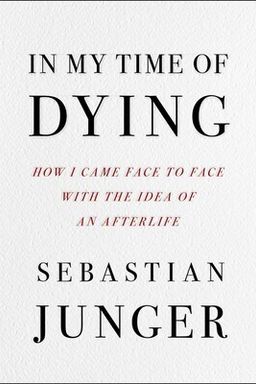
In My Time Of Dying cover

In My Time Of Dying

by Sebastian Junger

After suffering a ruptured aneurysm, the author of “Tribe” and "The Perfect Storm” addresses some imponderables related to mortality.

Living Fully by Facing Death

When was the last time you let the nearness of death sharpen the way you live today? In In My Time of Dying, Sebastian Junger argues that you only grasp life’s value by looking unflinchingly at its end. He contends that death is not merely an event but a meaning-making force—our choices, risks, and loves derive significance because they are fragile and time-bound. But to see that clearly, you must understand both the biology that almost killed him and the mysteries he glimpsed as his heart and blood pressure collapsed.

Junger’s story is anchored in a single June afternoon in 2020, when abdominal pain he’d ignored for months ripped into a fatal hemorrhage from a tiny pancreatic artery. An hour-plus ambulance run, a near-miss in the ER, and a surgical moonshot through a wrist artery later, he was back among the living—with a memory of a black void tugging at him and his long-dead father’s presence calmly inviting him to let go. Around that core crisis, he braids a lifetime of brushes with mortality—from winter surf detonations off Cape Cod and chainsaw mishaps in tree canopies to bullets snapping sand into his face in Afghanistan and the random meteor that missed a woman’s head by inches in British Columbia. He makes a stark claim: randomness rules far more than we admit, and danger’s real stakes are what make moments meaningful.

What You’ll Learn in This Summary

You’ll see, first, how randomness and risk inject consequence into ordinary lives—and why our illusion of control is so persistent. Then you’ll move inside his medical crisis: how hemorrhagic shock actually kills you, what “tamponade” means, and how a team threading coils through spaghetti-thick collateral arteries pulled him back. From there, you’ll step into the threshold experience itself—the black pit, the paternal visitation, and the curious calm—and compare it with combat medic Tyler Carroll’s life review, pilots’ centrifuge-induced reveries, and the Estonian EEG that recorded a final burst of gamma waves at death.

You’ll also get a tour of the science and metaphysics: how near-death experiences (NDEs) are studied (Bruce Greyson’s After; Sam Parnia’s Erasing Death), how skeptics explain them (ketamine-like states, temporal-lobe discharges, endogenous DMT), and why one recurring element—the dead arriving for the dying—remains stubbornly hard to dismiss. Junger then pushes further, into quantum strangeness (Planck, Heisenberg, Schrödinger), delayed-choice “quantum eraser” experiments, and the audacious suggestion that consciousness might be braided into reality itself (biocentrism; panpsychist echoes). He does this in the voice of a rationalist raised by a rationalist—his father, an MIT-trained physicist who once read equations like love poems—and a son who, when he was dying, found that same father waiting for him in the dark.

Why This Matters to You

This isn’t a “near-death memoir” designed to comfort you with certainty. It’s a rigorous invitation to live differently: to treat randomness with humility; to prepare practically for the ruptures all bodies are heir to; to practice awe daily so presence isn’t something you postpone; to speak openly about death so the sacred can show up before the scary does. It’s also a call to service: those ten anonymous units of blood that kept him alive? They came from ordinary people who took an hour to donate. In a world where we can’t control meteorites, aneurysms, or incoming fire, we can still hold the line for one another.

Core Claim

“Dying is the most ordinary thing you will ever do and also the most radical. Without death, life would be meaningless; because of death, it overflows with meaning.”

By the end, you’ll have a vocabulary for both the physiology and the metaphysics of dying, a set of practices for living with more courage and tenderness, and a bracing new respect for the thin seam that holds you here. You’ll be invited to do simple, human things—leave the driveway passable for ambulances, learn basic vital-signs red flags, talk with your family, and give blood—precisely because the universe often does not notice us. And you’ll be given permission to call what you can’t explain sacred, even if you still think like a scientist.


Randomness, Risk, and Meaning

Junger opens with winter surf on Cape Cod—a solitary weekday in January, head-high waves detonating on a steep bar. He’s surfed since he was eight, yet cold water is denser; bars are steeper; hydraulics hold longer. His leash snaps. He’s somersaulted in a cement mixer of sand and green-black water until the circle of light in his vision shrinks to a pinprick. He surfaces, just in time to meet a second wave. He survives—but only because turbulence slackens when his lungs are a breath away from surrender. This is how he learns the world can “want you,” how malevolent randomness can feel, and how casually nature can end you.

The Illusion of Control

As a tree climber with chainsaws and carabiners, he thrived in a realm where physics feels knowable: lock the carabiner, tie the knot, rig the load. Error is yours alone. He cut his Achilles with a saw, topped a tree that came back on him, and watched a red oak crack and fall on a windless day because ants had hollowed it out. Still, the existential bargain seemed fair: chess, not roulette. But a meteor once crashed into a woman’s pillow in British Columbia. In Afghanistan, sand flicked his cheek before the gunfire reached his ears; a British friend, Tim Hetherington, bled out in the back of a Libyan pickup after a single shard severed an artery. Randomness rules more often than mastery does.

You feel this in traffic, medicine, war: you can make every right move and still be inches away from the end. Junger frames the psychological cost: to live, you need the helpful illusion that “that kind of thing” won’t happen to you. Yet the athletes, climbers, and war reporters among us seek “consequence,” not just adrenaline. He reframes “adrenaline junkies” as “meaning junkies.” Consequence is the currency of meaning; golf, by comparison, rarely delivers it.

Consequence as Meaning

Consider two scenes. In Misrata, Libya, a mortar strike kills photographer Chris Hondros and mortally wounds Hetherington. Hetherington’s last words to a Spanish journalist are, “Please help me.” When randomness kills a friend, grief can flip into superstition: Junger convinces himself Tim died in his place—an echo of survivor guilt described in combat psychology (see Jonathan Shay’s Achilles in Vietnam). Years later, in a crowded New York bar, he meets Barbara—now his wife—via a different kind of randomness that gives instead of takes. Your meaning system must hold both: death’s indifference and love’s contingency.

He also shares his daughter Xana’s child-logic: “Love means, stay here.” It’s an ethic for adults too. The discipline isn’t to pretend you’re safe; it’s to keep choosing presence anyway. The day he later hemorrhages, he clears underbrush so an ambulance could reach their home—a mundane act of love that turns out to matter more than any heroics.

Randomness Cuts Both Ways

Junger returns to a core point: the same dice that kill you also save you. In Salamanca as a teen, a stranger slows his car on a dark, snowy road and says, “Yo también,” when Junger says he’s going back to town. He’s spared a freezing night under a pine. In New York, his front wheel catches a crack at walking speed; a gypsy cab misses his head by inches. The storylines that follow—marriage, fatherhood, the books you’re reading now—hinge on moments that feel trivial until later.

Takeaway

You can master knots, training cycles, and protocols—but prepare your soul for the meteor and your heart for the stranger who stops. Meaning lives where consequence lives. That’s uncomfortable—and freeing.

(Context: Ernest Becker’s The Denial of Death argues we erect culture to buffer mortality terror; Junger’s twist is practical—train, decide, and love in full view of risk. Like Atul Gawande in Being Mortal, he urges presence over control.)

For you, this means attending to small, consequential choices—clearing the driveway, learning first-aid basics, noticing warning signs—without pretending these insulate you completely. It also means allowing high-consequence moments—childbirth, illness, disasters, deployments—to deepen rather than deaden you. The price of consequence is vulnerability. The payoff is meaning that doesn’t disappear with the scorecard on hole 18.


The Day the Body Fails

The pain arrives “without fanfare” one morning—burning below the sternum, intermittently flattening him with a sick heat. He ignores it through a new baby, Covid lockdown, and chores on a Cape Cod farm. One dawn, a dream shocks him awake: he’s hovering over his weeping wife and children, unable to reach them, accused by a voice of not taking life seriously. Thirty-six hours later, in Waldo Frank’s writing cabin atop his property, pain rips through his abdomen. The floor reels. There’s no cell service. Barbara half-carries him down the hill to the car; he’s cycling in and out of consciousness, words slurring; his vision whites out. The ambulance suggests heat exhaustion. Barbara insists: hospital now.

From Twinge to Collapse

In the rig, the medic—Joe—hangs an IV for presumed dehydration. Junger calls home to tell Xana he loves her “to the moon and back.” Halfway, he spasms “like hot lava” and soils himself with blood-streaked fluid—classic lower GI bleeding. He arrives in Hyannis gray, minimally interactive. ER head Dr. Craig Cornwall and Dr. Steve Kohler clock him as a “zebra.” Hemoglobin is cratering; blood pressure is 68 systolic—below the threshold for consciousness. He’s convulsing from hypothermia, not cold air but oxygen-starved blood and a metabolic tailspin called the trauma triad of death: hypothermia, acidosis, coagulopathy.

How Hemorrhagic Shock Kills You

Lose 15% of your blood and you can compensate; at ~30%, your heart races, skin blanches, thinking blurs; at ~40%, the cascade begins. Coagulation factors dilute; lactic acid rises; the heart itself becomes starved. Ironically, extra saline can worsen things by diluting clotting factors. In end-stage shock, you can seem alert between blackouts. Junger’s athletic heart masks the crisis—his pulse doesn’t spike—tricking first responders. He’s “the sickest person in the hospital,” Kohler later says, and ten to fifteen minutes from arrest.

The Diagnosis Behind the Curtain

A CT shows his abdomen pooling blood. Not a ruptured aorta—a young nurse whispers the “good news”—but still catastrophic. The source: a tiny branch in the pancreatic arcade fed by tortuous collateral arteries. Why there? He has median arcuate ligament syndrome (MALS): a tight ligament crushes his celiac artery, rerouting blood through smaller vessels that dilate over decades to maintain organ perfusion. One dilated spot ballooned into a grape-sized aneurysm that tore. This is why abdominal pain months prior mattered—and why it didn’t fit any easy box.

The Save: Cordis and Coils

Dr. Spencer Wilson threads a large-bore Cordis into Junger’s jugular for a massive transfusion: nine units initially, ultimately ten. In the interventional radiology (IR) suite, Dr. Phil Dombrowski and vascular surgeon Dr. Dan Gorin fight upstream with microcatheters. The groin route fails; the vessels are too twisted. They switch to the left wrist (radial artery), force a balloon through the crushed celiac, and finally reach the rupture by approaching “through the back door” of the splenic and mesenteric branches. They deploy micro-coils—pipe-cleaner-like scaffolds—both sides of the leak to clot it off. At 1:20 a.m., they break scrub: the bleeding has stopped.

The choreography is harrowing: while a technician squeezes O+ red cells like a steak to push them in, nurses avoid over-sedation that could crater his vitals; someone “kicks a stroke off the table”—averted by seconds. Meanwhile, in a basement room chilled by overzealous AC, a young med student named Charlotte takes Barbara’s hand and says the only human thing a stranger can: “They’re still searching.”

Plain-English Medicine

• Hemorrhagic shock is not just “low blood.” It’s a metabolic spiral that disables clotting and heart function.
• Tamponade is back-pressure that can temporarily slow internal bleeding; opening the abdomen risks losing it.
• “Massive transfusion protocol” is a timed sequence of red cells, plasma, and platelets; more blood isn’t always better if coagulopathy has begun.

(Context: If you’ve read Paul Kalanithi’s When Breath Becomes Air, you’ll recognize the dual gaze—clinician’s precision and patient’s astonishment. Junger adds the rescuers’ view: signatures required for each un-crossmatched unit read, “I accept responsibility for adverse reaction.”)

For you: don’t ignore persistent abdominal pain, black/bloody stool, fainting, or sudden vision whiteouts with belly pain—especially if you’re athletic enough to “look fine.” And make your home “ambulance-friendly.” The chainsaw work Junger did clearing underbrush down his long dirt road days before? It likely bought him minutes he didn’t know he’d need.


What Dying Felt Like

When his heart and oxygen delivery falter, the room splits in two. On his right: the living—the doctors, the nurses, the rapid infuser, the signatures and syringes. On his left: a black pit, perfectly silent and bottomless, pulling at him with calm inevitability. Above him and slightly left, a presence coalesces—not a hazy metaphor but his father, Miguel, dead eight years, the MIT-trained physicist who teased his macrobiotic mother for saying “energy” when she didn’t mean joules. His father radiates reassurance: Don’t fight it. It’s okay. I’ll take care of you. “Doctor, you’ve got to hurry,” Junger says. “You’re losing me. I’m going right now.” Then: blackout.

The Black Pit and the Invitation

He doesn’t float above the table with panoramic clarity. He doesn’t tour the hospital corridors reporting license-plate details. He faces a choice that doesn’t feel like a choice—gravity without air. The invitation from his father is grotesquely out of place to his conscious mind (“He had no business being here”), but his body knows what’s happening even if he doesn’t: the “you” that thinks in language is the last to know. This is not romanticized; it’s bewildering and oddly impersonal, like surf hydraulics deciding your fate. Later he will wonder whether his decades of life since that childhood winter wave—marriage, daughters, books—were an anoxic brain’s elaborate fantasy as he drowned. That’s the mind’s way of metabolizing this kind of nearness.

The Dream Before

Thirty-six hours earlier, a dream yanked him into shame: Barbara and the girls cry together; he hovers, mute and useless; a voice indicts him for not taking his life seriously. His rationalist father would say dreams have no predictive value; body and brain are different operating systems. But Junger had another eerie echo at 3:15 a.m. years earlier, hearing his father shout his name in New York at the exact hour nurses in Boston said his father had tried to climb from bed. “The problem with rationality is that things keep happening that you can’t explain,” he writes, without discarding the scientific mind he inherited.

The ICU Return

Morning light, Hyannis harbor, a nurse with Boston vowels: “You almost died last night. In fact, no one can believe you’re alive.” He vomits a dark arc of blood. His lungs start to collapse at the bases; he feels like a fish beached and panting. A Nigerian tech turns up the oxygen. The “I give up” call button becomes the “I need help” button. Transfusion teams return. By day three, he shuffles the ICU loop with an IV pole. By discharge, he can ride home with windows open to “remember what the world smells like.” The terror doesn’t dissipate; it reframes everything. A crab apple tree waving in June wind becomes almost unbearably beautiful—because it would be doing so if he were already gone.

A Nurse’s Reframe

“Instead of thinking of it as something scary,” the ICU nurse tells him, “try thinking of it as something sacred.”

He later calls this the only language big enough for the experience. Sacred doesn’t mean certain. It names the ordinary when seen under ultimate light. You live under a permanent indictment: did you squander presence when it was on offer? But you also live with a permanent benediction: somehow, you’re still here. His little girl once defined love as “stay here.” Sacred means honoring that—and admitting you won’t, one day.

(Context: Joan Didion’s The Year of Magical Thinking shows grief as a private physics that breaks causality; Junger shows dying as a physics lesson with a leak in the lab—a father who shouldn’t be there, showing up anyway.)

For you: if you’ve waited to integrate mortality until the diagnosis arrives, you risk panic substituting for meaning. Practice now. Talk to the people you’d hover over if the pit opened this afternoon. And if you’ve had a threshold experience, you don’t need to solve it to honor it. Call it sacred, then let it change your day’s priorities.


What Science Says About Near-Death

Junger doesn’t proselytize an afterlife; he investigates. He interviews cardiologists, ER chiefs, ICU nurses, and researchers who’ve tracked thousands of NDEs. He listens to combat medic Tyler Carroll—wounded and cycling in and out of consciousness while working on a dying buddy in Afghanistan—describe a life review so total that love itself is the final verdict. Then the rush: Wake up! Back to the friend on the floor. Then the peace: You loved and were loved. Let go. Carroll survives. The pattern—clarity, expansiveness, an encounter with love or the dead—shows up across cultures and contexts.

Common Patterns

Bruce Greyson (After) and Sam Parnia (Erasing Death) document recurring features: leaving the body; moving through darkness or a tunnel; encountering a loving presence or dead relatives; panoramic memory; return to the body because “someone still needs me.” A Dutch study of 344 cardiac arrests found 12–18% had deep threshold experiences. Māori accounts (Michael King) mirror this: Nga travels north to Te Rerenga Wairua, “the leaping-off place,” is told it’s not her time, and returns to a body that had stopped breathing.

Brains Under Siege

An Estonian team recorded the first continuous EEG of a dying human: during the 30 seconds before and after cardiac arrest, the brain surges with gamma waves tied to memory and dreaming—echoing animal studies. Fighter pilots in centrifuges (G-LOC) lose vision, then consciousness, then experience warm-ocean reveries or out-of-body sensations—without a metaphysical crisis necessarily in play (James Whinnery’s work). These data suggest the dying brain may produce intense, structured experiences even as oxygen plummets. That doesn’t decide metaphysics, but it explains vividness.

The Contested Cases

Pam Reynolds’s hypothermic cardiac arrest case tempts believers: flat EEG, blood drained from her head, yet accurate surgical perceptions reported post-op. Skeptics note timing ambiguities: when, precisely, did those memories encode—during induction, warming, or recovery? Christof Koch, a leading consciousness scholar, is “extremely skeptical” of claims of lucidity with a flat EEG—but admits his own blissful ego-dissolution during a medical crisis haunts him daily. He can’t rule out universal consciousness on logical grounds, only on likelihood.

Chemistry of Mercy

Alternative mechanisms include endogenous compounds (DMT-like states, ketamine analogs), temporal-lobe discharges, and limbic surges that protect neurons and soothe terror. Lab analysis shows near-death narratives semantically mirror psychedelic reports more than other drug states (see studies comparing psilocybin and DMT experiences). Yet counterpoints remain: people falling from buildings report panoramic life reviews without oxygen deprivation; asthmatics with hypoxia rarely report dead relatives. The chemistry is persuasive; the content’s sameness—especially “the dead who come”—is harder to file away.

Junger’s Position

He refuses certainty. The experiences are real to the people who have them. Biology can explain much, perhaps most. The dead showing up for the dying remains the great unsolved piece.

(Context: Compare Oliver Sacks’s neurological humility—honoring odd subjective states without inflating them into metaphysics—with Greyson’s careful catalog of veridical perceptions. Both stances live in Junger’s pages.)

For you: you don’t have to choose between superstition and skepticism. You can learn how bodies fail and still leave room for mystery. Know the signs of hypoxia, hemorrhage, and shock. Also let the phrase “sacred not scary” be a working hypothesis for your own end—because terror rarely helps anyone survive the crucial minutes, and peace sometimes does.


The Dead Who Come Calling

After he survives, Junger asks a delicate question of clinicians: have your dying patients seen the dead? No one wants to talk on the record. But the literature—and countless bedside stories—say yes. Sir William Barrett’s century-old Deathbed Visions compiled reports long before ventilators and morphine blurred edges: startled recognition, calm reunions, sometimes the very recently dead unknown to the room. Junger’s own mother, hours from death, squints at a corner: “What’s he doing here?” He guesses it’s her estranged brother George. “We’ll see about that,” she says, with her last good humor.

Startled Recognition

A paramedic tells Junger about a 70-year-old woman who suddenly sits bolt upright and says, “I’m about to die,” with astonished calm—then lies back and does. A nurse shares a dying father repeating his daughter Barbara’s name; the family explains Barbara was their nineteen-year-old who’d died years earlier. In Vietnam, an American soldier in an NDE says he “floats inches above the ground” with dead Viet Cong and senses “we are dead”—no animus, only solidarity. These aren’t culture-bound tunnels; they are human encounters.

Children and the Recently Dead

Barrett viewed children’s cases and visits by the recently dead as the strongest data points. One 1870 account: a boy near death tells his father that his brother Harry—who had died fourteen miles away the day before, unbeknownst to them—is calling him. Or consider Paul Durocq in 1894, dying of yellow fever in Venezuela, visited by a close friend who had died while Durocq was abroad; the funeral notice awaited the family’s return. Such anecdotes don’t settle science, but their consistency across time, technology, and geography is striking.

Skeptics’ Gap

Skeptical accounts explain tunnels (retinal hypoxia), bliss (opioids, ketamine-like states), and panorama (gamma surges). They have less to say about why dying brains consistently people the room with the dead—often specific, sometimes unknown-to-be-dead, rarely monsters or celebrities. Cultural expectation explains some; placebo calm explains some; suggestion explains some. But Junger argues this one element remains genuinely puzzling even to hardened rationalists—his father probably included.

Humane Middle Path

You can keep your pulse-ox, your massive transfusion protocol, your evidence hierarchies—and still say to a dying person who is speaking to their mother: “Tell her I’m here too.”

(Context: Kellehear’s A Social History of Dying shows that “the dead arriving for the dying” is a global motif. Kübler-Ross popularized listening at the bedside; Greyson gave it a research spine. Junger brings it back to the family kitchen table.)

For you: rehearse kindness. If your parent sees someone you can’t, don’t correct; accompany. If you’re the one departing, perhaps what you’ll want most is permission—not to go, but to trust what you see. The living will hold the rest.


Quantum Puzzles and Consciousness

Junger ventures where many memoirs won’t: into subatomic physics, because that was his father’s native language—and because reality’s foundations might bear on his father’s appearance in the trauma bay. Planck’s “quanta,” Einstein’s photons as particles and waves, Heisenberg’s uncertainty principle, Schrödinger’s wave functions: at the smallest scales, matter exists as probabilities that “collapse” when observed. That’s not metaphor; it’s math predicting experiments with absurd precision. Consciousness, or at least observation, seems entangled with what becomes real.

When Observation Makes Reality

The double-slit experiment is the classic: unobserved photons act like waves and go through both slits; observed, they commit to one. Entanglement deepens the weird: change one particle here and its twin across the lab—or galaxy—changes instantaneously. Einstein called it “spooky action”; Bell’s inequalities and later experiments closed loopholes. Most physicists don’t claim “mind creates matter,” but they do concede that measurement affects what is.

Retrocausality and Erasure

Delayed-choice quantum eraser experiments go further: choose to measure a particle’s path information after its twin has already hit the detector, and you can “erase” the interference pattern retroactively. In one Canary Islands setup, choices on Tenerife appear to rewrite outcomes on La Palma 88 miles away. The common-sense upshot is unnerving: knowledge, or the possibility of knowledge, can reach back and change what “already happened.”

Is Mind Built-In?

Some thinkers—Robert Lanza’s biocentrism; panpsychist philosophers—propose consciousness as a fundamental property, like mass or charge. Donald Hoffman flips the hard problem: maybe take consciousness as given and derive matter, not vice versa. Junger quotes physicists suggesting that a “consciousness particle” might one day be to mind what the Higgs boson is to mass. That’s speculative, but it explains why sober scientists sometimes sound like mystics. Schrödinger himself leaned on the Upanishads.

What His Father Might Say

Over lunch with his father’s colleagues—Joel Garrelick and Rudolph Martinez—Junger asks what Miguel would have made of the visitation. As a “romantic rationalist,” he might allow for unknowns while insisting on physics. Asked to compute the odds of his father “materializing” in a corner, Rudolph deadpans: on the order of 10^-60—a way of saying “not impossible, just unspeakably unlikely.” Junger can hold that number and still hold his father’s blue eyes above the gurney.

Humility Before the Real

“We assume that life is the most real thing we will ever experience,” Junger writes, “but it might turn out to be the least real.”

(Context: Jim Holt’s Why Does the World Exist? maps the same vertigo; Carlo Rovelli’s Helgoland is a gentle tour of quantum-relational reality. Junger’s gift is translating that awe into bedside stakes.)

For you: you don’t need a PhD to absorb the moral: certainty is scarce; reality accommodates both numbers and visitation. Let physics breed humility, not nihilism. That humility is a good way to talk to the dying—and a better way to live with the living.


Aftermath: Terror, Reverence, and Living

Survival isn’t a parade; it’s a reckoning. Back home, Junger feels stalked: if I lived, who will die instead? Survivor guilt from Libya blooms again in the shower. He starts avoiding any place more than an hour from an interventional radiologist. He writes emergency notes to stuff into his pocket when alone. A follow-up scan shows a five-centimeter “neoplasm” by the pancreas—likely clot and scar, but “you could still have pancreatic cancer,” a doctor says. Weeks of tests stretch into a summer where every bedtime story feels like a goodbye. He becomes a little insane.

The Curse of Awareness

Awareness cuts both ways. Reverence spikes—trees, clouds, rain on porch screens become overwhelming—and terror stalks—why isn’t everyone crying all the time? He reframes “blessing” via its etymology (bledsian: blood). Blessing and sacrifice are paired; Jacob wrestles with God, wins a blessing, and limps forever. Junger’s blessing required ten strangers’ blood and a wrist-scar coil-pack; the limp is his permanent intimacy with death.

Practicing Presence

Barbara offers the sternest kindness: “You get the insights of terminal illness without paying the price. What are you learning?” He tests what would still matter under a death sentence: music, books, running, singing with his daughters. If presence isn’t possible now, it won’t be available later. He thinks of a South Texas bar photo of a rebel at a firing squad: a cigar, old boots, an expression that makes the riflemen look like children. A day or an hour is as precious as a decade; you just don’t know that yet.

Risk, Choice, Becoming

In the Sahara years earlier, a Sahrawi headman invites him and Sarah to leave in five days with the camel traders. At dawn, he runs into the desert to decide: am I the person who disappears into the unknown, or turns back? He turns back. “Whatever I choose, I will always choose,” he thinks. That’s vanity, but it’s also a mirror. Your daily choices calcify into character. Junger’s post-ICU version: he still seeks consequence, but he won’t mistake it for invincibility; he’ll pursue the unfamiliar without pretending risk is a talisman against grief.

Making Peace with Uncertainty

Entropy is merciless; bodies fail; the universe cools toward dark quiet. Yet there’s a human countercurrent: we push the boulder up the hill with food, breath, song, love, service. Junger closes on a mountain in New Hampshire with his father growing hypothermic at treeline—childlike, compliant, incoherent—while teenage Sebastian lights birch bark and stirs soup in tin cups. His father warms, returns. That’s all he’s arguing for now: be the person who sits watch in the wind, who knows how to build a small, sustaining fire, and who will not leave the beloved alone in the dark.

Working Definition

Courage is not out-shouting death; it’s staying tender and useful with full knowledge of the bill that’s coming due.

(Context: Viktor Frankl’s Man’s Search for Meaning links suffering, choice, and purpose; Junger adds triage and radiology to Frankl’s logotherapy—and folds in a father’s hand on a cold ridge.)

For you: set up rituals of attention (awe walks, phones down at dinner), guardrails for fear (news fasts, therapy if hypervigilance takes over), and simple services (donate blood, learn CPR, keep friends’ driveways passable). Reverence without service curdles into performance; service without reverence dries into duty. You need both.


What To Do With This Knowledge

Junger ends where your day can begin: with small, durable acts. Facing death is not a mood; it’s a practice. It looks like clearing brush, insisting on the ambulance, holding a hand, and giving what you’ll one day need. It also looks like learning how bodies die so you can spot trouble sooner—and talking about death at the kitchen table so the sacred has time to arrive before the scary.

Prepare Your Life

• Make your home reachable: visible house numbers, clear drive, unlocked gates if safe, porch light on for responders.
• Build a practical file: meds, allergies, blood type if you know it, emergency contacts, a one-page summary for EMTs (Junger prepped a note after his scare).
• Learn red flags: sudden severe abdominal pain with fainting or white-out vision; black or bloody stools; chest pressure with sweating; one-sided weakness—don’t self-diagnose on Google. Go.

Honor the Body

• Don’t over-normalize pain that’s new and weird. Junger’s months of gut pain weren’t “toughness”; they were a warning.
• Know shock signs: cool clammy skin, lingering white press marks (cap refill), confusion, fast shallow breaths, weak “thready” pulse. Lay flat, legs slightly up unless trauma suspected; call 911.

Train for Awe

• Ritualize presence: a daily five-minute “look hard” at something ordinary—a tree, steam on tea, a child’s breath. That’s how you practice “sacred not scary.”
• Speak love in declarative sentences now. Xana’s definition—“Love means, stay here”—benefits from saying it out loud while you can still answer back.

Serve the Chain of Survival

• Donate blood. Junger lived on ten anonymous units. Your hour may one day pour into someone else’s jugular (see his Author’s Note: donatingblood.org).
• Learn CPR and how to use an AED; teach your teens; map the nearest hospital with IR capability if you live rural.
• Write an emergency script: what to say to 911; who grabs kids; who meets the ambulance; which neighbor you text “Come now.” Barbara’s clarity saved minutes he didn’t have.

A Compact to Keep

You don’t control meteorites, aneurysms, or mortars. You do control whether the people you love have to face them alone.

(Context: Like Atul Gawande’s call to name your “goals and fears,” Junger’s practical ethic anchors awe in logistics. It’s not morbid; it’s merciful.)

Start where you are. Clear a path. Say the words. Schedule the blood appointment. And tonight, for five minutes, let the day’s ordinary drift into the realm that nurse named for him: sacred.

Dig Deeper

Get personalized prompts to apply these lessons to your life and deepen your understanding.

Go Deeper

Get the Full Experience

Download Insight Books for AI-powered reflections, quizzes, and more.