
Idea 1
Australia: A Continent of Extremes and Ironies
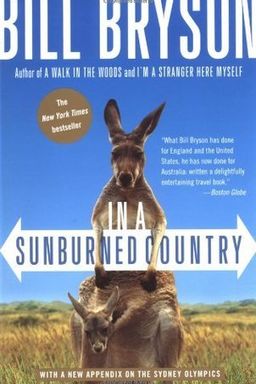
How do you reconcile beauty, danger, humor, and history in one landscape? In Down Under (also published as In a Sunburned Country), Bill Bryson argues that Australia is not merely a nation—it’s a living paradox. It is both rich and isolated, ancient and modern, deadly yet dazzling. Through journeys from Sydney to Perth, the tropics to Tasmania, Bryson weaves geography, ecology, history, and comedy into a portrait of a continent that surprises you at every turn.
Bryson’s core argument is that Australia’s vastness, isolation, and extremes create a culture and environment found nowhere else. The land itself shapes everything—its people’s temperament, its animals’ oddities, its politics, and its myths. And while Australians appear relaxed on the surface, their country demands constant respect—whether for the heat, the history, or the hazards.
The physical revelation: distance as destiny
You start with the geography. The interior emptiness—the Nullarbor Plain’s 297-mile straight rail line, Cook’s population forty, and warning signs promising no food or fuel for 862 kilometers—defines Australian life. Bryson’s travels prove that space itself is a force. Journeys across the outback or down the Stuart Highway are not mere sightseeing—they’re acts of endurance and humility. Isolation here isn’t just physical; it’s psychological. You learn to respect scale as survival’s first rule.
This emptiness also explains why chance plays such a large role in discovery (such as the Poochera government crew randomly finding the long-lost ant Nothomyrmecia macrops after a van breakdown). In this landscape, accidents often become science because so few people pass through the right places at the right moments.
The evolutionary and environmental mystery
Australia’s geological calm over sixty million years preserved ancient life forms: stromatolites pulse quietly in Shark Bay, echoing the beginnings of oxygen on Earth. Monotremes—a platypus that lays eggs and echidnas with electric snouts—reveal evolution’s whimsy. Bryson’s delight at the Giant Worm of Gippsland and stromatolite colonies mirrors his larger fascination with oddity. You sense a continent frozen between epochs. Yet these wonders exist alongside ecological crises caused by human introductions—rabbits, foxes, prickly pear—and the loneliness of environmental misjudgment.
This tension between scientific marvel and human folly is one of Bryson’s key lessons: what Australians add—animals, weeds, mining—often unravels what nature perfected. He shows how well-meaning adaptation became an ecological experiment that the country still struggles to control.
A history of exile and reinvention
No book on Australia can skip its origins. Bryson traces how the First Fleet’s arrival in 1788—with hundreds of convicts, a handful of soldiers, and little skill—set up one of history’s most improbable colonies. From penal roots grew pride and ambivalence; the so-called “stain” of Australia’s convict past lingers beneath modern confidence. The explorers who followed—Burke and Wills, Giles, Stuart—extend that theme: ambition colliding with incomprehension of the land. Bryson re-creates their starvations and missteps not for melodrama but as reminders of human arrogance against nature’s enormity.
Later chapters about immigration—1850s gold rushers, postwar Europeans and Asians—reveal reinvention as a national constant. Each wave redefines identity: from imprisonment to prosperity, from exclusion to multiculturalism. Bryson’s encounters with Greek cafés in Melbourne or new Sydney suburbs make you realize why Australia’s success now depends on openness rather than isolation.
Political spectacle and evolving identity
In Canberra, the purpose-built capital, Bryson watches bureaucracy translated into parkland and wide boulevards. He tells of Walter Burley Griffin’s idealism and the 1975 Whitlam dismissal, using both to illustrate how Australia’s political theatre mirrors its landscape: orderly designs undermined by sudden upheavals. Paul Keating’s brilliant insults epitomize a parliamentary culture brimming with wit and combat—a mix of pomposity and punk.
Against this modern civic backdrop stands the silence around Aboriginal injustices—the Myall Creek massacre’s half-forgotten memorial, the Stolen Generations’ lingering scars, and the grim life expectancy statistics. Bryson insists that traveling Australia means learning to see what’s invisible: the civilizations erased, the centuries ignored. The country’s age—60,000 years of Indigenous presence—makes colonial time look momentary and moral responsibility unending.
The mood: humor and humility
Bryson’s method is comic realism. He slips on beaches, misjudges surf conditions, panics over bluebottles, and laughs at animatronic Ned Kellys. Yet his humor never erases awe. Whether marooned in the wet tropics among cassowaries and jellyfish or exploring Sydney’s architectural triumphs, his laughter becomes empathy—a way of dealing with distance and uncertainty. Even the Sydney Olympics, with their polished logistics and DNA souvenir pins, receive equal measures of admiration and amused critique.
By the end, you understand Bryson’s central contention: Australia is both impossible and irresistible. It demands your respect—not just for its perils but for its persistence. The land keeps secrets for millions of years; its people keep reinventing themselves with cheerful stubbornness. To read Bryson’s journey is to measure wonder against warning and see the world’s most remote continent as humanity’s ultimate classroom in curiosity and humility.