
Idea 1
Amplifying Humanity Through AI
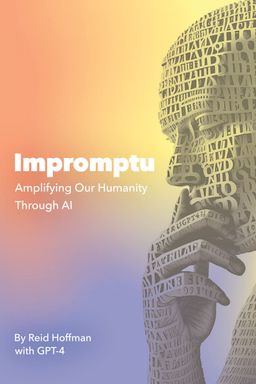
What if artificial intelligence could make you more human, not less? That’s the provocative starting point of Impromptu: Amplifying Our Humanity Through AI by Reid Hoffman in collaboration with GPT-4. Written as both dialogue and travelogue, the book treats AI not as a distant threat or miracle but as an immediate companion—one that can help you think better, write faster, and act more ethically, provided you approach it with curiosity and responsibility. Hoffman argues that AI doesn’t replace human intelligence—it amplifies it.
At the heart of Hoffman’s argument is what he calls the “AHA! moment,” which stands for Amplifying Human Abilities. He suggests that large language models like GPT-4 represent a turning point on par with the invention of the printing press or the smartphone. Just as those tools expanded humanity’s collective reach and capacity for expression, AI gives us a new way to extend our thinking. Hoffman contends that whether AI leads to human flourishing or decline depends mostly on how we choose to understand and use it.
A Travelogue of Human-AI Collaboration
The book invites you along as Hoffman experiments with GPT-4 in real time, treating it as a co-author, idea partner, and sometimes comic foil. Through examples ranging from lightbulb jokes to deep philosophical discussions, he demonstrates the uncanny generative power of AI. For instance, a simple query about how many inspectors it takes to change a lightbulb becomes a layered, witty dialogue written in the styles of Jerry Seinfeld and Ludwig Wittgenstein. These exchanges illustrate that GPT-4 is not conscious—but it can simulate understanding well enough to stretch your perspective.
(Compared to philosophical treatments like Sherry Turkle’s Alone Together, which warns about technology eroding empathy, Hoffman leans toward optimism. He frames GPT-4 as a mirror of human potential, not a usurper.) The book is filled with reflective moments where AI’s creativity and limitations intermingle, revealing both its brilliance and “bullshit,” as Hoffman candidly puts it. Yet he insists this combination is precisely what makes AI useful for humans who stay in the driver’s seat.
A Framework of Domains: Education, Creativity, Work, and Justice
Each major chapter explores how AI is transforming a different sphere of human life. In education, GPT-4 becomes a co-teacher helping professors like Steven Mintz and high school educators such as Cherie Shields rethink what learning means in an era of instant knowledge. In creativity, it becomes a co-artist, helping musicians, writers, and designers generate new material faster and explore uncharted artistic spaces. In the realm of justice, it becomes an equalizer, giving public defenders and prisoners tools that can democratize access to legal aid and education. And in work, it becomes a partner rather than a predator, augmenting the capabilities of everyone from sales professionals to lawyers and consultants.
Underlying all these examples is Hoffman’s conviction that AI is not the end of human agency but a multiplier for it. You can think of GPT-4, he suggests, as a “12-in-1 multi-tool for your brain.” It helps you research, synthesize, draft, and imagine with astounding speed, but it still needs you to provide intent, discernment, and ethical direction. In this sense, AI marks a continuation—not a contradiction—of humanity’s age-old story of technological progress from stone tools to smartphones.
The Moral Core: Hope, Risk, and Responsibility
For Hoffman, the moral challenge of the 21st century lies in deciding how to guide technologies that evolve faster than our institutions. He acknowledges the dangers ahead—bias, misinformation, automation anxiety—but maintains that fear without hope leads to paralysis. Like the scientific pioneers he invokes, from Ada Lovelace to Isaac Newton, he insists that boldness and optimism are moral virtues when coupled with responsibility. GPT-4’s real promise is not omniscience but co-creation: it opens a frontier where your curiosity and ethics determine the outcome.
Why It Matters Now
Why does this matter for you? Because the way you choose to relate to AI will soon shape your ability to learn, create, and work competitively. Hoffman foresees that within just a few years, anyone not using AI as a cognitive copilot will be operating at a “massive disadvantage.” He views this as analogous to the smartphone revolution—inescapable and transformative. Yet this isn’t just about productivity: it’s also about identity. Every technological leap, he argues, redefines what it means to be human. GPT-4, by externalizing thought itself, forces us to look inward and ask what uniquely human value we bring to the table. His answer is simple: judgment, empathy, and moral purpose.
Thus, Impromptu is both an intellectual adventure and a manifesto. Hoffman invites you to see AI as a mirror that reflects your own potential—highlighting both your creative spark and your ethical responsibilities. The book’s journey, moving from playful experiments to profound social questions, argues that the future of AI will not be written by machines but by the humans who choose how to wield them.