
Idea 1
Impeachment and the American Idea of Accountability
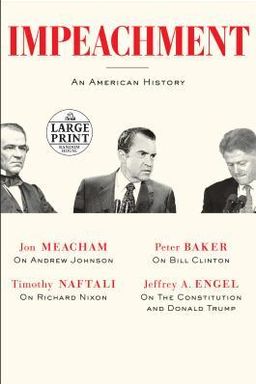
What happens when the most powerful person in the country breaks trust with those he serves? In Impeachment: An American History, historian Jeffrey A. Engel and his colleagues ask a question that echoes in every democracy: how do you hold a president accountable without destroying the republic itself? Their answer, drawn from three presidential crises—Andrew Johnson’s bitter clash with Congress, Richard Nixon’s downfall amid Watergate, and Bill Clinton’s scandalous survival—reveals the tension at the heart of America’s constitutional design.
Engel, with contributions from Jon Meacham, Timothy Naftali, and Peter Baker, argues that impeachment has always been a moral test as much as a legal one. The framers of the Constitution, he shows, didn’t design impeachment to punish honest mistakes; they crafted it to remove leaders who betrayed public trust or subordinated the common good to private gain. As readers, you’re invited to think not just about the presidents who faced impeachment—but about what those episodes reveal regarding civic virtue, partisanship, and the fragility of democratic institutions.
The Birth of a Safeguard
The story begins in 1787, when the founders debated in Philadelphia how much power a president should have. They were haunted by past tyrants—from Britain’s George III to the Caesars of Rome—and were determined not to hand America’s new executive a crown in disguise. Engel unpacks how George Washington’s moral character shaped those debates. Delegates trusted him personally but distrusted power itself. Hence they added impeachment—a mechanism to remove anyone who might betray Washington’s level of integrity in the future. The phrase they settled on, “treason, bribery, or other high crimes and misdemeanors,” didn’t mean ordinary criminal acts but violations of public duty so grave they tore at the fabric of constitutional order.
Through deft storytelling, Engel reminds you that the founders’ greatest fear wasn’t incompetence; it was corruption. They believed, as Virginia’s George Mason declared, that “no man is above justice.” Impeachment would thus become democracy’s emergency brake—a way to preserve liberty without risking revolution. Understanding this eighteenth-century logic, Engel emphasizes, is the key to grasping every impeachment since.
Three Tests of the Constitution
Each of the three presidents profiled faced uniquely American versions of this test. Jon Meacham explores Andrew Johnson’s defiance after the Civil War, when Reconstruction divided the nation more deeply than the battlefields had. Johnson wasn’t ousted for a single crime so much as for moral blindness—a belief in white supremacy that opposed the liberating spirit of the Union’s victory. Timothy Naftali’s narrative of Richard Nixon reveals how executive secrecy metastasized into criminal conspiracy. Nixon’s “Saturday Night Massacre,” firing the Watergate prosecutor, convinced Americans he had become what he condemned: a monarch indifferent to law. Peter Baker’s account of Bill Clinton turns the lens toward how personal indiscretion collided with partisan polarization, showing how public morality and private behavior became entangled in American politics.
Across these stories, Engel threads a central insight: impeachment exposes not only the character of presidents but also the character of citizens. When leaders abuse power, Congress must decide if the nation’s principles outweigh party loyalty. That decision, Engel suggests, defines the health of the republic far more than any individual scandal does.
Why It Matters Now
Engel’s closing reflections circle back to the present. He points out that after 2016, talk of impeachment reentered political conversation before a president even took office—a sign of accelerating partisanship. Yet history warns that frequent impeachment debates erode public faith, turning the Constitution’s “nuclear option” into just another campaign weapon. Engel invites you to see impeachment not as destruction but as preservation: a reminder that integrity is the true foundation of leadership. When power tempts those in authority, the Constitution’s greatest safeguard rests not on procedure but on the moral courage of those willing to enforce it.
Core Message
Impeachment isn’t just an act against presidents—it’s a reaffirmation of the nation’s ideals. From Washington’s precedent to modern political storms, Engel and his coauthors show that democracy survives only when those entrusted with power are reminded that the people, not the office, are sovereign.