
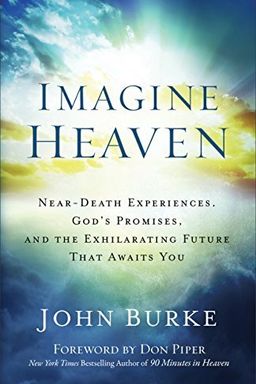
Imagine Heaven cover

Imagine Heaven

by John Burke

Imagine Heaven delves into the fascinating world of near-death experiences, revealing how they align with biblical visions of the afterlife. Through compelling personal stories and scientific evidence, John Burke offers a hopeful and insightful exploration of what awaits us beyond this life.

Imagining Heaven: Evidence, Experience, and Transformation

How can you imagine Heaven in a way that transforms how you live now? In Imagining Heaven, John Burke argues that thousands of near-death experiences (NDEs), studied across decades and cultures, offer converging insights that harmonize with biblical depictions of life beyond death. Burke contends that NDEs are not wishful myths but verifiable testimonies that reveal a consistent vision of love, relational restoration, and divine purpose. His goal is practical: if you picture Heaven rightly, you’ll live with hope, courage, and love today.

From Skepticism to Scientific Curiosity

The book begins by acknowledging common skepticism. Early physicians like Dr. Michael Sabom and Dr. Jeffrey Long entered NDE research expecting fantasy but encountered data that startled them—patients describing surgical scenes from above with details later confirmed. Studies from journals like The Lancet and Resuscitation, as well as peer-reviewed meta-analyses, found 92% accuracy rates in verifiable out-of-body observations. These cases—such as 'Maria’s shoe' on a hospital ledge or a comatose patient identifying where his dentures were stored—moved discussion from hearsay to empirical inquiry.

Blind and deaf participants reporting 'mindsight' (Kenneth Ring, Pim van Lommel) further stretched assumptions that NDEs are hallucinations. The suggestion: consciousness may survive clinical death, urging a more nuanced view of mind-body relations. While Burke insists on critical testing, he highlights that many converted skeptics became rigorous evidence gatherers.

The Shared Anatomy of the Experience

Across continents, ages, and belief systems, survivors describe a repeating sequence: detachment from the body, tunnel passage, encounter with a radiant Being, panoramic life review, and return after a choice or command. Dr. Jeffrey Long’s database of over 1,300 NDEs finds this framework repeating with striking regularity—even among children too young to know religious tropes. The experiences differ in language (some see 'the Light', others 'Jesus'), yet the core emotions—peace, acceptance, and awe—anchor their authenticity.

Burke distinguishes between experience (what people saw and felt) and interpretation (how they label it). Cultural lenses shape meaning, but the experiential structure—love, knowledge, and relational awareness—remains constant. This universality suggests a shared spiritual reality underlying different theological vocabularies.

Heaven as Relationship, Not Cloudscape

NDEs portray Heaven not as abstraction but as community, reunion, and continuity. Don Piper met a chorus of friends and mentors at Heaven’s gate; children like Colton Burpo reported meeting miscarried siblings and great-grandparents they’d never known. Communication happens heart-to-heart—telepathic, transparent, intimate. This picture redefines Heaven’s purpose: the restoration of relationship, not escape from reality.

You remain yourself—recognizable, relational, yet transformed. The spiritual body described by Mary Neal and Richard Eby feels physical but perfected, radiant with light, pain-free, and clothed in glory. Instead of floating spirits, NDErs report enhanced embodiment and identity more vivid than ever. Disabilities vanish; age reverses; individuality flourishes.

The Being of Light and the Life Review

At the center of these experiences stands a Living Light—personal, loving, and morally searching. Identified most often as Jesus, this Being radiates acceptance while revealing truth. People like Ian McCormack, Howard Storm, and Crystal McVea describe eyes that see everything yet condemn nothing, prompting repentance rather than terror. The accompanying life review exposes one’s actions through the feelings of others, focusing less on achievements and more on love’s expression or absence.

Howard Storm, whose NDE began in hellish torment, changed entirely after being rescued by the Light. The review transforms priorities: kindness outweighs ambition, compassion outranks status.

Transformation and the Invitation to Live Differently

Burke’s larger argument is ethical: what you imagine about eternity directs your daily choices. Those who glimpse Heaven return less materialistic, more forgiving, and oriented toward service. The book’s closing chapters echo C. S. Lewis’s maxim—aim at Heaven and you’ll get earth thrown in. You live toward whatever future you hold in mind. If Heaven is love lived to completion, then living lovingly now means aligning with ultimate reality.

Burke leaves you with a choice: treat these experiences as hints or dismiss them as anomalies. But if even a fraction are true, they reframe not only death but life—inviting you to practice Heaven’s reality here, one act of love at a time.

In sum, Imagining Heaven integrates empirical research, personal testimony, and biblical theology to argue that Heaven is both reasonable and relational. It urges you to embrace imagination as a moral faculty—seeing your world through the horizon of eternity so that fear of death gives way to courage to love.


The Evidence for Consciousness Beyond Death

Scientific inquiry into near-death experiences has shifted from ridicule to cautious respect. Physicians who first dismissed NDEs as oxygen-deprivation hallucinations gathered data that challenged materialist assumptions. Dr. Michael Sabom’s study of cardiac arrest patients documented cases—like Pete Morton describing medical shocks and doctor gestures—that matched hospital records. Similarly, Dr. Jeffrey Long compiled thousands of accounts in his NDERF database demonstrating cross-cultural consistency and verifiable perception during clinical unconsciousness.

Corroborated Observation and Blind Testimonies

Empirically significant NDEs include testable claims. Maria’s vision of a blue sneaker found on a ledge, or the Dutch patient identifying his dentures’ location during cardiac arrest, transcend coincidence. Kenneth Ring and Pim van Lommel extended research to the congenitally blind: participants like Vicki reported 'seeing' scenes and people through an unfamiliar sensory mode—mindsight—later corroborated by observers. These anomalies don’t confirm metaphysical claims but demand explanations beyond imagination theories.

Method, Caution, and Scope

Over 900 scholarly publications before 2011 across disciplines (medicine, psychology, theology) now examine NDE phenomena. Roughly 4% of adults report them—tens of millions worldwide. Burke stresses discernment: some cases are likely confabulated or culturally influenced. Yet when independent witnesses without financial motive—doctors, children, blind individuals—describe parallel structures, it legitimizes continued investigation rather than dismissal.

Scientific Modesty

The point is not proof beyond doubt; it is openness to data that stretch current paradigms. Consciousness may not be fully reducible to brain activity—an insight increasingly entertained in neuroscience studies of terminal lucidity and cardiac arrest awareness (see Parnia et al., 2014).

The cumulative evidence reframes the conversation: rather than fringe mysticism, NDEs now represent a frontier of consciousness studies. For you, it means that rational faith need not fear empirical scrutiny—sometimes the data themselves invite awe.


Love, Light, and the Life Review

At the heart of most credible NDEs is the encounter with a Being of radiant love. People report meeting a Living Light—tender yet overwhelmingly powerful—identified frequently as Jesus. The Being radiates knowledge and compassion, filling NDErs with awe and conviction. Ian McCormack’s vision of forgiveness and Howard Storm’s rescue from darkness exemplify the moral seriousness of these meetings: love penetrates but also transforms.

The Panorama of the Soul

During the life review, individuals witness the full ripple of their actions—not as detached observers but through the emotions of others. Jeff Olsen felt his wife’s grief; Dr. Mary Neal saw generational consequences of kindness. The review emphasizes relational integrity, not punishment. What matters most is how you loved, forgave, and uplifted others. It’s not legal judgment but moral awakening.

Light as Relationship

Encounters vary in imagery: Vicki, blind since birth, described golden eyes 'like flames' and a white robe with a gold sash; children like Colton Burpo identified Jesus visually from art that matched their memories. Across testimonies, the Light is interactive—seeing through you, inviting truth. Transformation depends on your response, echoing scriptural portrayals of God’s invitation to communion rather than coercion.

Moral and Emotional Aftermath

The life review erases complacency. NDErs return reoriented: material success fades, relational depth matters. Howard Storm left atheism to teach compassion; Crystal McVea’s trauma turned to worship. These outcomes mirror biblical promises of new hearts and minds aligned with divine love. In this way, NDEs function as moral pedagogy—personal proof that love is the measure of life.

Key insight: the Being of Light embodies perfect justice through perfect love. The review exposes truth not to shame you but to heal and redirect your life’s trajectory.

For you, that means the most enduring preparation for eternity is to practice relational love daily—because that’s the substance of the Light you’ll one day meet.


Suffering, Choice, and Redemption

Burke doesn’t shy away from the hardest question: if God is loving, why is life filled with pain? Drawing on stories like Crystal McVea’s abuse and Howard Storm’s temporary descent into darkness, he argues that suffering exists because love requires freedom. Coerced goodness would negate personhood. God allows consequence but participates in our sorrow—seen supremely in Christ’s scars, reported glowing in many NDE visions.

Hellish Experiences and Their Mercy

Roughly one-quarter of NDEs include distressing or hellish imagery: voids, pits, or grotesque torment. These aren’t divine cruelty but mirrors of separation—what it feels like to live cut off from love. Yet many, like Storm and Paul Ojeda, experience rescue after calling to God. Such reversals show that NDE 'hells' are warnings, not final sentences.

Suffering That Becomes Healing

McVea’s realization—'God had always been there'—illustrates the redemptive pattern Burke highlights. Pain becomes soil for deeper compassion when reinterpreted through eternity. Revelation’s promise that God will wipe every tear is not metaphor but fulfillment of this restorative arc. NDErs internalize this insight, often becoming healers and encouragers themselves.

The book insists: suffering does not undermine God’s love; it demonstrates its cost. Freedom and redemption are two sides of the same moral cosmos.

For you, this framework reframes hardship. You can see current pain as temporary participation in a larger healing story—a perspective that cultivates endurance, empathy, and faith instead of bitterness.


Heaven’s Landscape and Community

When NDErs describe Heaven, their accounts resonate with both Revelation’s imagery and sensory realism. The world they witness feels more substantial than earth—a super-reality of vibrant color, sound, and relational presence. Captain Dale Black spoke of living hues that danced midair; the blind Brad Barrows perceived landscapes alive with consciousness. The universe there breathes music.

A Recreated Earth

Descriptions echo biblical prophecies: rivers of life, flowering fields uncrushed underfoot, a golden city with gates of light. Movement is at 'thought speed,' showing time as flexible rather than linear. Burke uses this to connect edifyingly to modern physics metaphors: if our world is three-dimensional, Heaven could be the higher-dimensional source in which it is embedded—explaining tunnel imagery as dimensional transition.

Relational and Cultural Continuity

Heavenly life pulses with relationship. Families rejoin, friends recognize each other in their prime, and communication happens directly from soul to soul. Don Piper’s 'crowd of greeters' encapsulates Heaven’s welcoming atmosphere. Rather than erasing individuality, divine unity magnifies it—'distinct persons yet perfect oneness' as Eben Alexander noted. Every redeemed bond enriches the collective joy.

Purpose, Work, and Joy

NDEs often unveil purposeful activity: learning, art, service, exploration. Heaven is not idleness but participation in divine creativity. Gary’s vision of heavenly libraries and gardeners echoes Revelation’s portrayal of the redeemed city as active community. Eternal life, then, is not escape from creation—it is creation perfected.

Heaven’s realism corrects caricature. It’s not clouds and harps—it’s home restored, love multiplied, and purpose expanded.

If you let such imagery reshape imagination, you’ll view death not as disappearance but as arrival to greater aliveness—and that vision can make ordinary relationships on earth feel sacred by anticipation.


Living Now in Light of Eternity

Burke ends with a call to imagination as moral orientation. How you picture the afterlife shapes your ethics. Those convinced Heaven is relational invest in people; those who believe it’s inert drift toward apathy. Imagining Heaven is therefore a manual for eternal perspective. Relationships matter because love lasts.

Reordering Earthly Priorities

NDErs return profoundly changed: materialism wanes, compassion intensifies. Practically, Burke urges you to live as if already preparing for your life review—daily choices accumulating eternal significance. Forgiveness, generosity, and service become investments in Heaven’s economy. The wise steward parables gain empirical resonance through this lens.

Imagination as Discipleship

To imagine Heaven isn't escapism—it’s aligning your inner vision with divine reality. C. S. Lewis noted that you aim where you imagine. Burke’s dying mother found comfort hearing these stories aloud, turning fear into expectation. That is the book’s pastoral core: envision a destiny so thrilling that living rightly now becomes your joy.

You live toward your vision. Imagining Heaven vividly is practice for loving well, enduring hardship, and seeing beauty in the ordinary.

The book closes where it began—with imagination grounded in evidence and Scripture. NDEs are not meant to replace faith but to illustrate its promises. Live with Heaven in mind, and you will become its living preview on earth.

Dig Deeper

Get personalized prompts to apply these lessons to your life and deepen your understanding.

Go Deeper

Get the Full Experience

Download Insight Books for AI-powered reflections, quizzes, and more.