
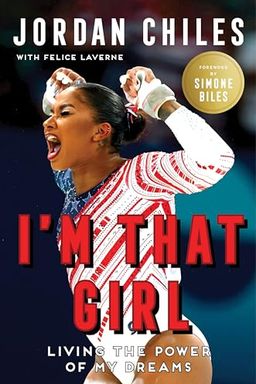
I'm That Girl cover

I'm That Girl

by Jordan Chiles With Felice Laverne

The two-time Olympian gymnast delves into the challenges she faced.

Becoming “That Girl”: Power, Voice, and Sport

When was the last time you owned your gifts so fully that you could look in the mirror and say, “I’m that girl”? In I’m That Girl, Olympic and World Champion gymnast Jordan Chiles argues that greatness isn’t only about medals—it’s about refusing to shrink yourself in spaces that weren’t built for you. Chiles contends that the most important podium you’ll ever climb is the one inside your own head—where identity, voice, culture, and mental health stand shoulder to shoulder with ambition.

Drawing on a life begun with springboard energy—flipping off couches as a six-year-old and rocketing from a first class to pre-team in days—Chiles takes you from her Vancouver, Washington childhood to the world’s biggest stages in Tokyo (2021) and Paris (2024). Her story covers the ecstasy of team gold and the agony of a contested floor bronze, but more importantly, it maps the terrain so many high-achievers traverse: racialized scrutiny, body policing, abusive authority, and the slow, stubborn work of healing. She shows you how she found sanctuary—first in family, then in sisterhood with Simone Biles, and finally in her own voice—so you can, too.

What This Book Argues

Chiles makes a core claim: if you want sustainable excellence, you must build a life that protects your humanity as fiercely as your dreams. That means practicing self-advocacy in hostile systems, refusing to outsource your worth to judges or scoreboards, and choosing community over isolation. It also means recognizing how gendered and racialized standards in aesthetics (hair, body shape, “grace”) distort what counts as talent—and then disrupting those standards with unapologetic presence.

Mantra

“Gymnastics is what you do, not who you are.”

What You’ll Learn Here

First, you’ll see how a kid named after Michael Jordan became “that girl”—the one who turns a pre-team tryout into a pipeline to elite gymnastics, learns scoring the hard way, and absorbs early lessons about competition and character from a boisterous, close-knit family. Then you’ll encounter the sport’s harder truths: a coach who policed her hair and body, normalized starvation, and showed up drunk; racist taunts at meets; and the lonely pressure of a system that rewards silence. These chapters read like a survival guide to toxic excellence (compare: Aly Raisman’s Fierce; Simone Biles’s Courage to Soar).

Next, you’ll watch her choose a different way. After hitting breaking points (including nearly quitting in 2018), Chiles follows the lifeline Simone Biles throws her—an invitation to train at World Champions Centre with coaches Cécile and Laurent Landi. There, with therapy, faith, and sisterhood, she reclaims the joy in her sport and helps shift elite culture toward mental-health-first performance (a movement also amplified by Naomi Osaka and Michael Phelps in their sports).

Why This Story Matters Now

Chiles’s narrative sits at the intersection of three cultural pivots. First, elite sport is finally contending with mental health. Her Tokyo 2021 experience—stepping in after Biles’s “twisties” and reframing silver as won, not “lost”—puts a human face on that shift. Second, athlete identity is expanding. In NCAA competition at UCLA, Chiles turns hip-hop medleys and cultural styling into artistry on par with traditional European aesthetics—proof that excellence and authenticity can be the same move. Third, Paris 2024 crystallizes both progress and backlash: the “Golden Girls” redeem team gold, Chiles shares an all-Black Olympic floor podium with Simone Biles and Rebeca Andrade—and days later she’s stripped of her floor bronze after a rushed arbitration, even as Netflix footage later appears to validate her coach’s timely inquiry. It’s a case study in procedural power and who gets believed.

How to Read This Summary

We’ll move through ten big ideas you can use anywhere you pursue high stakes goals. You’ll see how to pick a team (and how to leave one), how to process bias without letting it define you, and how to build rituals—affirmations, therapy tools, faith—that hold when crowds go silent. You’ll learn how to compete without erasing yourself, why “quit on a good day” is world-class decision hygiene, and how to stay both fierce and kind when institutions fail you.

By the end, you’ll have a playbook for transforming pressure into presence. Whether you’re chasing a promotion, building a company, or raising a kid who flies too close to the furniture, Chiles’s arc says you can win big without losing who you are—and if you get knocked off the podium, there are still a thousand ways to land on your feet.


From Couch Flips to Pre‑Team

Jordan Chiles wasn’t born into gymnastics royalty—she was launched there by restless energy, a family that joked like teammates, and a mother who believed miracles start in living rooms. Named for Michael Jordan (“I know she will do great things,” her mom said at birth), Jordan grew up in Vancouver, Washington, flipping on couches, cartwheeling in the kitchen while Dad cooked, and outrunning kids older than her. At six, after a week of solo parenting, her father drove straight from the airport to Naydenov Gymnastics to enroll her. The surprise? Jordan cried because she wanted a puppy. Two classes later, a coach asked how long she’d been in gymnastics. “Forty-five minutes,” her mother replied.

Learning the Score—Literally

Pre-team meets felt like recess until Jordan realized why her name never got called to the podium. Her mom explained the truth gently: others are scoring in the 9s; you’re in the 7s. That sting flipped a competitive switch. The youngest of five, Jordan had learned to fight for Scrabble points and cul-de-sac basketball shots; now she aimed that fire at beam, vault, bars, and floor. Within months she advanced from Level 4 to 5, started crafting her own floor routines at home, and learned the rituals her parents insisted on: win with humility, lose with grace, hug the girl you beat and the one who beat you. (Compare with Angela Duckworth’s Grit: Jordan’s grit is born in family culture as much as personal drive.)

Early Joy Meets Early Injustice

At a Seattle-area meet, a white parent marched to the floor and screamed, “Get that thing off the floor—she doesn’t belong with our girls.” Police escorted the woman out while some parents muttered agreement. Jordan’s family shielded her from explicit racial explanations—she was seven—but the scar settled in. She understood: I’m different here. That moment foreshadows a throughline of the book—the way Black girls in predominantly white sports must become fluent in grace under insult, long before the world cares about their medal count.

The Plaque That Wasn’t

By Level 7, Jordan was winning big. At a December meet that awarded a trip to Disney World, she declared, “I’m going to win this,” and did—then learned her head coach (nicknamed here “Coach X”) refused to travel to Disney meets. A judge walked over and took the champion’s plaque out of eight-year-old Jordan’s hands. Her parents, furious, quietly commissioned a replica and placed it under the tree. Message received: systems might shortchange you, but your village will not. (Note: moments like this echo themes in Ibtihaj Muhammad’s Proud, where family buffers institutional bias.)

Racing Through Levels, Paying the Cost

Jordan hit Level 10 by age ten—an athletic comet. But the cost rose: $400/month training fees (in 2008), travel, leotards with Swarovski crystals, boosters, physio. Uncle Joe helped cover half; the rest came from parents who juggled social services and property management jobs. The family mantra—“Last name Chiles!”—became a call-and-response with life: if you rise, we rise.

Why This Chapter Matters to You

There’s a blueprint here for your early growth spurts. First, clarity beats comfort: knowing the “score” (where you stand, what excellence looks like) turns effort into progress. Second, values outrun victory: Jordan’s parents modeled sportsmanship so thoroughly that it became armor when institutions failed her. Third, craft your own rituals—from personal choreography to family phrases—because identity made at home can survive scrutiny elsewhere.

Try This

Ask yourself where you’re still waiting for a judge to call your name. Then do Jordan’s move: study the scoring rubric, set one change that moves you a tenth today, and create a two-word mantra you can shout in your kitchen when doubt shows up.


Hair, Body, and Belonging

One of the bravest strands in Chiles’s memoir is how directly she names the “aesthetic tax” Black girls pay in white-coded sports. With Coach X, it started at the scalp: two Afro puffs drew sneers—“You look like you have two heads.” Cornrows? Worse. Braids? “Not the elite international look.” At a national camp, Coach X went further—she cut Jordan’s hair herself, with random scissors in a hotel bathroom, to force conformity. Jordan sobbed on the phone to her mother. The message was chillingly clear: your success is conditional on erasing yourself.

Body Policing Disguised as Coaching

“Bubble butt.” “Frumpy.” “Pudgy.” The insults landed daily. Despite near-zero body fat, Jordan was told to subsist on clear soups and police every snack; coaches inspected her lunchbox and scolded Uncrustables. Like many gymnasts, she internalized it—binging secretly at school and then restricting. She even asked a doctor if obliques could be shaved down. This is not fringe; it’s the water many female athletes swim in (see Mary Cain’s account of Nike Oregon Project, or the eating-disorder prevalence data in women’s sports).

Race, “Grace,” and What Gets Rewarded

Gymnastics, like ballet and figure skating, fetishizes “clean lines” and effortlessness. Historically that’s meant slender, long-limbed, Eurocentric bodies. A powerful frame like Shawn Johnson’s—one of Jordan’s heroes—was an exception that proved the rule. When Simone Biles expanded the Code of Points with the Biles (Floor) and other eponymous skills, some coaches muttered that the code now favored “power” over “grace.” Valeri Liukin even implied Black athletes had a “natural” edge because they’re “explosive” (he later led the U.S. women’s program). Chiles connects these dots: what we reward as “artistry” is not neutral—it's political.

Hyper-Scrutiny and Drug Testing

Jordan has been drug-tested since age eleven, sometimes three times in a month. She notices the asymmetry: Black excellence routinely draws suspicion (“steroids like Skittles,” one parent whispered about her eight-pack), while white doping cases often simmer for years before exposure. She can’t prove bias in testing frequency—but she names the cultural bias: talent in a Black girl’s body is “unbelievable” until audited.

Reclaiming the Mirror

How do you keep showing up when the system keeps telling you to disappear? Jordan builds a counter-aesthetic: hair as personality, floor music as culture, tattoos as testimony (Philippians 4:13; roses for her grandmother; koi fish for serenity). Her family’s daily affirmations—“Who are you?” “I’m Jordan Chiles”—turned into armor. She learned to separate form as technique from form as identity; the former she refined, the latter she refused to surrender. (Note: this echoes themes in Misty Copeland’s Life in Motion—another Black woman redefining “line” and “grace.”)

What This Means for You

Any space that pretends to be objective but relies on taste will try to edit you. Your job is to learn the rubric and then refuse the erasure. Chiles shows a two-part move: (1) master the skill standard so precisely that judges have to score you; (2) signal your humanity in the same space—through hair, music, expression—so you never forget who’s wearing the leotard.

Practice

Write two lists: “What the system requires of my craft” and “What I require of myself.” Where those lists clash, design one brave micro-act of self-definition you’ll bring to your next presentation, sales call, or performance.


Abuse, Boundaries, and Breaking Points

At first, Coach X looked like a golden ticket. She’d produced elites; she promised Jordan’s parents she could do the same. Then the cracks widened: slurred words during practice, vodka in water bottles, obsessive control—calling other parents to police Jordan’s cake intake, tracking missed days in a spiral calendar and shaming her in front of teammates. She isolated Jordan socially and turned the team against her (“You see how Jordan does it? Why can’t you?”), a classic tactic that leaves the target both envied and alone.

The Cost of a Dream

Jordan excelled anyway—winning meets, earning National Team invitations—while dreading practice and travel. She hid much of the ugliness from her family because this is how it is seemed to be the price of admission. Her parents, pastors by calling and protectors by instinct, tried interventions: reporting to the gym owner, confronting Coach X directly, even driving her to rehab. For a stretch, sobriety softened the tone. Then the cycle returned.

The Ranch, the Safe Word, and the Ban

At the Karolyi Ranch—then the epicenter of elite women’s gymnastics—Jordan witnessed a new regime under Rhonda Faehn and Valeri Liukin. When Coach X left her unattended during a session, Faehn gave Jordan a safe word—“pineapple”—if she felt unsafe. Soon after, at the 2017 camp, Coach X drunkenly insulted gymnasts in a dance room. Faehn and Liukin banned her from National Team activities. Jordan still wasn’t told the full story—only that she wasn’t selected for the Jesolo team. She sobbed at LAX, convinced she’d failed. Back home, her mother told her the truth: it’s not your fault. Relief mixed with fury. Boundaries began.

Quitting on a Good Day

Chiles’s decision hygiene is a gift you can borrow. Whenever despair surged, she and her mom used a rule Nastia Liukin’s mom once shared: you may quit, but not on a bad day. If, after a strong practice or good competition, you still want out—walk. The rule punctures impulsive exits and re-centers agency. (This mirrors Annie Duke’s work in Quit on setting exit criteria before emotions overwhelm you.)

Lessons You Can Use

Abusers conflate excellence with dependence. Jordan’s escape plan shows how to unwind that lie: gather evidence, recruit allies, set bright-line rules (no unsupervised travel; no late-night calls), and—when the system finally responds—tell yourself the truth faster than it tells you: I didn’t fail; the structure failed me. Then choose what you’ll fight for next.

Signal

If a coach, boss, or mentor says “Without me, you’d be nothing,” treat it as a fire alarm. Excellence partners with you; it never kidnaps you.


Sisterhood and Sanctuary at WCC

In 2018, after finishing 11th at U.S. Nationals and watching her joy drain away, Chiles considered leaving the sport. Then at Worlds camp, Simone Biles—already the GOAT—made a simple offer: come train at World Champions Centre (WCC) with me. That invitation re-routed a career and, more importantly, a life.

A Different Gym Feels Different

Under Cécile and Laurent Landi, Jordan felt something she hadn’t in years: safety. The coaching was exacting but human; her personality (the dancing, the hype-woman energy) was welcomed as an asset. She trained alongside athletes who looked like her. She cooked with Simone, made TikToks she swore she didn’t want to make, and learned how to breathe again on bars.

COVID, Surgery, and the 2021 Reboot

A wrist surgery and then the pandemic might have derailed momentum. Instead, the postponed Tokyo Games bought Jordan time to heal and sharpen. Winning the 2021 Winter Cup and podium finishes at Classics and Nationals signaled she was back—this time with joy visible from the stands. (Compare to Jonny Wilkinson’s Thinking Body, Dancing Mind-style resets: injury as a tempo change, not a stop sign.)

Therapy: Tools in the Toolbelt

After Simone’s mom, Nellie Biles, noticed Jordan’s spiraling self-critique, her parents suggested therapy—again. This time, Jordan went. She cried through sessions, then taped affirmations to her mirror, replaced self-attacks with two positives, and scheduled extra check-ins before meets. Therapy didn’t erase nerves; it re-wired her response. Faith anchored it—Philippians 4:13 became a competed-on mantra, not just ink on skin.

What You Can Steal

High performance needs belonging as much as biomechanics. Seek rooms where your full self serves the work. Make mental skills part of training (Jordan bribed herself with Dairy Queen to attend session #1; do what you must). And remember: the right teammate at the right time can be a life raft. Accept it—and then become it for someone else.

Team Rule

At WCC, if Jordan isn’t dancing, her parents know something’s wrong. Build your own visible tells with your inner circle so people can spot the dip before you crash.


Tokyo: Silver Won, Stigma Shaken

Tokyo’s COVID-delayed Olympics layered isolation on top of pressure. The team couldn’t stay in the Village at first; daily tests threatened everyone’s dream; alternates quarantined after positives. In Qualifications, Jordan missed individual finals and called home in tears, convinced she didn’t belong. Two days later, everything flipped.

When the GOAT Says “I Can’t”

During team finals warm-up, Simone Biles got lost in the air on vault. After her first competition vault, she walked out, regrouped with doctors, and came back to tell the team: continue without me. Cécile turned to Jordan: “Put your grips on. You’re going on bars for Simone.” The ask was seismic; the response simple—do it for the team. Jordan hit bars, helped steady beam, and anchored a silver the U.S. won, not “lost.”

Reframing the Medal

Chiles initially cried on the podium—she felt she’d disappointed Simone. Biles stopped her spiral: We didn’t lose; we won this silver. In a sport long allergic to mental health, that moment mainstreamed a new ethic: safeguarding minds is part of safeguarding bodies. It also reset Jordan’s self-story: she was not just a supporting cast to greatness; she was a clutch teammate in a global crucible.

After Tokyo: Owning the Mic

On Taraji P. Henson’s Peace of Mind, Jordan publicly discussed abusive coaching and the therapy that helped her heal. It wasn’t a tell-all; it was a tell-truth, and it helped recode the next quad. That fall’s Gold Over America Tour felt like a victory lap not just for medals, but for a new contract with audiences: joy counts, too.

Your Takeaway

When circumstances force a role change—project lead out, you in—borrow Jordan’s template: acknowledge the grief, stick the assignment, reframe the outcome, and honor the person who stepped aside. That’s how teams become families without blurring boundaries.

Language Shift

Never say “only a silver.” Say “we won silver.” It retrains your brain to see value beyond a single rung of the podium.


College Freedom, Culture on the Floor

NIL changed everything. Jordan signed with GK Elite and Nike, then headed to UCLA in 2022. NCAA scoring is its own ecosystem—lower difficulty ceilings, perfect 10s possible—and its own theatre. Jordan used it to do what she’d been punished for as a kid: perform as herself. Her viral routines to Normani and Lizzo brought hip‑hop, R&B, and ’90s moves to a floor long coded as classical. Some judges frowned; the internet didn’t. The culture said: this is artistry, too.

Campus Realities

UCLA wasn’t a utopia. A white teammate sang the n‑word at practice; staff urged “openness to her perspective.” Meanwhile, stalker letters reached campus. The dissonance reinforced what Jordan already knew: harm can coexist with opportunity. She stayed anchored to her why—team, expression, school—while planning a return to elite for unfinished business: making her first Worlds team.

All‑Black Podiums, New Precedents

In 2022, Jordan made the Worlds team, won team gold, and took individual silvers on vault and floor. Earlier that season, U.S. Nationals saw the first-ever all-Black all-around podium: Konnor McClain, Shilese Jones, and Jordan Chiles—history made in a sport that once could barely imagine one Black star at a time. Online grumbling (“Why make it about race?”) only underscored the win’s meaning. As Jordan notes, visibility isn’t a side effect; it’s a strategy.

Grief and Leadership

2023 brought loss—her beloved Auntie Crystal and then Grandpa Gene. She memorialized them in tattoos and turned to Netflix, naps, and poodles (Chanel and Ace) for comfort. At Pan Ams, she served as flag bearer and senior leader, winning team gold and individual medals. Grief didn’t pause excellence; it deepened it.

A Note for Your Playbook

If your field polices “professionalism,” ask: professionalism for whom? Chiles shows how cultural fluency can raise—not lower—standards. When your output is undeniable, your inputs can be unmistakably you.


Paris Push: Trials, Themes, and Team

Jordan’s 2024 motto came from Beyoncé’s Renaissance tour: “I’m That Girl.” She’d need it. A sprained AC joint, then a fibula fracture with LCL tear left her racing the clock. She kept injuries quiet, rehabbed hard, and placed third at Classics, fifth at Championships—enough to contend.

Trials: The Hardest Meet on Earth

At Minneapolis Trials, day one put Jordan in third behind Biles and Suni Lee. Day two brought a beam fall and an emotional reset before floor. Choosing a Beyoncé medley, she stuck the final pass, burst into tears, and reminded herself aloud: I’m that girl. Twenty minutes later, the committee named Team USA: Simone Biles, Suni Lee, Jade Carey, Hezly Rivera—and Jordan Chiles. Nike whisked the team into custom Sami Miró–designed cream kits; confetti snow angels followed.

A Culture of Care—On Purpose

That night, Biles gifted Jordan an Olympic rings necklace she’d pre-bought because she “knew” Jordan would make the team. The message was bigger than jewelry: on this squad, belief circulates. Later, texts from Michael Jordan (“love the name”) and a handwritten note from Beyoncé (“your twin”) underscored a new reality: the communities Jordan represents were watching—and covering her back.

Lesson for Your Team

Selection rooms are foggy; feedback is late. Counter that with proactive signals of belonging. Pre-buy the necklace. Send the “I see you” text. Design traditions that compress doubt after the buzzer sounds.


Team Gold and the Floor Bronze

In Paris, Team USA’s “Golden Girls”—the oldest U.S. women’s Olympic team since 1952—delivered a clinic. Vault: powerful. Bars: floaty. Beam: Jordan fell, then stuck a double pike dismount cold while Suni and Simone nailed theirs. Floor sealed it. Gold by nearly six points. On the podium, Jordan slipped in diamond-and-gold grillz—an unapologetic wink at the culture she brings with her.

The Floor Final: A Beyoncé Medley and a Tenth

In the event final, Jordan competed last of nine because two athletes were tied in qualifying. After a hop on her first pass and stung ankles on her last, she posted a 13.666 (that ominous “666” would become an internet meme). Coaches Cécile and Laurent filed an inquiry on a leap (tour jeté full) they believed was undervalued. The inquiry was accepted; her difficulty rose by a tenth. Jordan moved to bronze, behind Rebeca Andrade (gold) and Simone Biles (silver). On the podium, Simone and Jordan bowed, smiling, to Rebeca—the first all‑Black Olympic gymnastics podium in history.

Backlash Arrives on Cue

Within hours, Romanian legends and officials amplified outrage that their gymnast Ana Bărbosu had been “robbed.” Social media flooded Jordan’s accounts with racist slurs (“sneaky Black… ape lover”). Meanwhile, a separate Romanian inquiry for Sabrina Maneca‑Voinea’s score (aimed at leap difficulty rather than the neutral out-of-bounds deduction that mattered) had already been denied. Facts didn’t slow the fury.

What to Notice

Inquiries are routine. Accepted inquiries often adjust medals—Aly Raisman’s 2012 bronze involved one. Jordan’s acceptance was not extraordinary; the optics of an all‑Black podium were. Chiles’s chapter invites you to see how procedural normalcy can be reframed as scandal when identity politics get involved.

Refrain

“We didn’t lose the gold; we won it.” Apply it anywhere your team meets a target with turbulence—and let joy be defiance.


Thirty‑Six Minutes and a Broken System

Five days after the floor final, Chiles’s media tour in New York was interrupted by a call: Romania had filed with the Court of Arbitration for Sport (CAS) to challenge the results. Due to an email error, USA Gymnastics learned of the hearing with only 36 minutes to file—a timeline CAS refused to extend. The argument shifted from Sabrina’s difficulty (already denied) to a new claim: Cécile filed Jordan’s inquiry 64 seconds after the score posted—four seconds past the 60‑second limit.

Procedure Over Evidence

The role of the floor “inquiry table” is crucial: coaches make verbal inquiries; a technical assistant then enters them into the Omega timing system. CAS leaned on the Omega timestamp, not on when Cécile verbally lodged the inquiry—because FIG has no mechanism to log verbal time. CAS stripped Jordan’s bronze and moved Ana to third, Sabrina to fourth. Jordan learned the result in an Uber, tears hidden behind sunglasses. She finished her interviews anyway.

Then Came the Tape

On the flight home, Cécile sent Jordan’s family Netflix’s behind-the-scenes audio from Simone Biles Rising. The clip shows Cécile at the inquiry table at 47 seconds, audibly repeating “Inquiry for Jordan” again at 55 seconds because the official didn’t respond—clear evidence the verbal inquiry was timely. CAS’s Ad Hoc Division said its award couldn’t be reconsidered—even with conclusive new evidence—because the Olympics had ended. USA Today and The Washington Post published scathing critiques; pro bono firms volunteered. Jordan retained Gibson Dunn and a Swiss team to appeal on procedural grounds to Switzerland’s federal tribunal (success rates <8%).

Why This Matters Beyond Gymnastics

This case is a masterclass in institutional power: when timing protocols don’t track the moment that actually matters, and errors by officials get laundered into “rules,” outcomes can become both legal and unjust. Jordan reframes the fight: at this point, it’s about peace and justice, not metal. She keeps the physical bronze (no one formally reclaimed it), walks New York Fashion Week, and dances on the Gold Over America Tour—and presses her case for road‑level fairness so the next girl’s medal isn’t a moving target.

Institutional Lesson

If your process can’t absorb new evidence quickly, it’s not a process—it’s a posture. Build feedback loops that can course‑correct when the truth catches up.


The Tools That Kept Her Whole

Underneath every stuck landing in this memoir is an invisible system—rituals, relationships, and rules—that lets Jordan stay Jordan when the ground moves. You can build your version, too.

Faith and Mantras

As a pastor’s kid, Chiles carries scripture onto the floor: “I can do all things through Christ who strengthens me” (Philippians 4:13). Tattoos turn belief into body memory. Before big moments, she, Dad, and Mom pray for protection and presence. Faith doesn’t promise medals; it promises steadiness.

Therapy and Thought Rewrites

Affirmations on the mirror. Two positives for every self-attack. Extra sessions before meets. Therapy reframed competition anxiety as an energy to surf, not proof of inadequacy (akin to Kelly McGonigal’s “stress mindset” research). When motivation lagged, she gamified the first step (“If I go in, I get Dairy Queen”).

Boundaries and Decision Rules

“Quit on a good day.” “Gymnastics is what you do, not who you are.” “Pay attention to yourself; be in your own bubble.” These phrases function like code comments in high-stakes life: they prevent silent regressions into old harm. In Paris, when tension bubbled between roommates after all‑around qualification, Jordan pulled Simone into a late-night huddle with Suni Lee. They named the feelings, reset the standard—team first—and slept with peace.

Identity Practices

Hair as joy. Grillz on the podium. Beyoncé on floor. Roses and koi on skin. These aren’t extras; they’re anchors. They remind Jordan—and everyone watching—who owns the performance. They also model permission for the next generation: bring all of you.

Your Toolkit

Write your three rules for hard days. Pick one physical reminder (bracelet, lock screen, lyric) you’ll carry into pressure rooms. Create a two-person hotline for late-night resets. And adopt Jordan’s competitive reframe: you don’t “lose” a medal you didn’t get—you win the one you did. That single sentence will protect months of work from one bad minute.

Bottom Line

To become “that girl” is to win the right to be yourself under lights. Build systems that make that choice automatic.

Dig Deeper

Get personalized prompts to apply these lessons to your life and deepen your understanding.

Go Deeper

Get the Full Experience

Download Insight Books for AI-powered reflections, quizzes, and more.