
Idea 1
Transactional Analysis: Understanding the Mind’s Dialogue
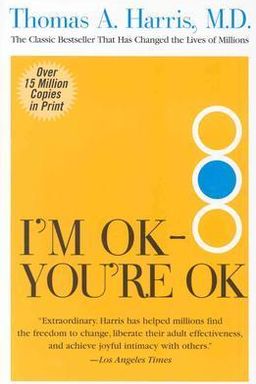
Have you ever caught yourself arguing inside your own head—one part of you lecturing, another sulking, and a third trying to make sense of it all? In I'm OK – You're OK, psychiatrist Thomas A. Harris takes that familiar internal battle and turns it into one of the simplest yet most powerful models for understanding human behavior ever devised: Transactional Analysis (TA).
Harris contends that each of us carries within our personality three distinct voices—the Parent, Adult, and Child. These three selves shape how we think, feel, and interact with others every day. The Parent embodies all the rules, admonitions, and moral codes we absorbed in childhood; the Child is the emotional, spontaneous self that remembers how things felt; and the Adult is our rational, objective self that can analyze what’s happening now. Through the interactions—or “transactions”—between these parts, Harris says we can uncover why we act as we do, retrace the origins of misery, and decide to change.
The Breakthrough in Communication
Harris builds on Dr. Eric Berne’s pioneering work, which introduced TA as a clear, accessible language for psychology. Just as Berne’s earlier book Games People Play demystified therapy for ordinary people, Harris offers a vocabulary that anyone can use: phrases like “Stay in your Adult” or “Your Child is hooked” convey complex interactions in everyday terms. This precision of language, he argues, allows communication between therapist and patient—or between any two people—to become meaningful instead of vague or mystical.
Why does this matter? Because much of traditional psychology has spoken in incomprehensible jargon, leaving ordinary people helpless to understand their own minds. Harris wanted a system anyone could learn to apply—not to merely adjust to life, but to transform it. Transactional Analysis, when practiced, becomes a method for gaining self-control, self-direction, and emotional freedom.
The Universal Problem: Feeling “Not OK”
At the heart of human unhappiness, Harris identifies the foundational decision we all make in childhood: the Life Position. Each baby begins by concluding, “I’m not OK—you’re OK.” This early verdict arises from helplessness—the small child, dependent on powerful adults, believes they’re good and he’s inadequate. For most people, this becomes the lifelong script that governs relationships and self-esteem. Later variations develop: “I’m not OK—you’re not OK” (the hopeless position of despair) and “I’m OK—you’re not OK” (the stance of hostility or moral superiority). The healthy position is the fourth: “I’m OK—you’re OK.” Harris insists this isn’t a feeling but a decision—a conscious choice that can liberate us from the tyranny of our past recordings.
The Science of Memory: Reliving the Past
Before laying out TA’s practical tools, Harris connects psychology with neurology through the work of brain surgeon Dr. Wilder Penfield, whose experiments showed that memory isn’t just a vague impression—it’s a vivid, biological recording. When Penfield electronically stimulated parts of patients’ brains, they not only recalled scenes from years before but relived the emotions attached to them. A song could evoke childhood joy; a melody could trigger grief as if a loved one had just died. This discovery confirmed Freud’s intuition that the past shapes the present, but it offered biological proof and clarity. It also showed why we “act like children” when stressed—because we literally replay recorded emotions.
Freedom through Awareness
The promise of Harris’s book is that with awareness and conscious choice, these internal tapes need not ruler our lives. By learning to identify which part of the personality is speaking or reacting—your Parent, Adult, or Child—you can change conversations, relationships, and life patterns. “Transactional Analysis,” he writes, “is a teaching and learning device rather than a confessional or archaeological exploration of the psychic cellars.” In contrast to long, indefinite psychoanalysis, TA offers tools people can use immediately to change their actions and reinforce healthy patterns.
Across thirteen chapters, Harris applies this model to everyday life—from marriage and child-rearing to moral values and global politics—arguing that the world’s conflicts mirror the same interior struggles between Parent, Adult, and Child. By transforming individual transactions, he suggests, we can ultimately transform society. The book’s enduring power rests on this conviction: when we say, “I’m OK—you’re OK,” we affirm not just our own worth but the potential for peace between individuals, communities, and nations.