
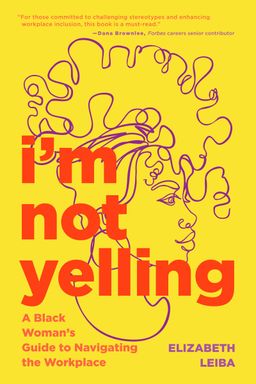
I''m Not Yelling cover

I''m Not Yelling

by Elizabeth Leiba

I''m Not Yelling is a powerful guide and memoir for Black women navigating corporate America. Elizabeth Leiba shares personal stories, strategies, and affirmations to empower you to overcome racial challenges in the workplace and embrace your true self, paving the way for future generations of leaders.

Reclaiming Your Voice as a Black Woman in the Workplace

Have you ever been told that you're too loud, too assertive, or too emotional at work? In I'm Not Yelling: A Black Woman’s Guide to Navigating the Workplace, Elizabeth Leiba invites you to rethink those labels and to reclaim your voice as a source of power rather than a point of contention. She argues that Black women aren’t yelling—they’re asserting their right to be heard in spaces that have long silenced them. The challenge, Leiba contends, is not to make yourself more palatable, but to shed the masks, code-switching, and self-censorship that dilute your authenticity.

At its core, the book is both a manifesto and a guide: part memoir, part social analysis, part toolkit for thriving. Drawing on her own experience as a first‑generation Caribbean American, an educator, and a social justice advocate who grew a global following after George Floyd’s murder, Leiba offers practical wisdom for navigating corporate America while staying true to yourself. She reveals that the stereotypes Black women face—the “Angry Black Woman” trope, the pressure to code-switch, and the constant questioning of professionalism—are not personal shortcomings but systemic injustices that require new language, community, and self‑definition to overcome.

The Crisis of Silence

Leiba opens with a painful truth: too many Black women have been taught that their voices are dangerous. As a child, Leiba internalized this fear after reading Maya Angelou’s I Know Why the Caged Bird Sings—and learning how Angelou’s childhood trauma led her to silence for years. Leiba’s own experience mirrored this symbolism: her voice became a site of anxiety, suppressed by bullying, stereotypes, and professional norms that prized restraint over self-expression. Her story of being racially profiled and falsely arrested as a college student becomes the emotional foundation for the book’s argument: when you are silenced or dehumanized, reclaiming your voice is a revolutionary act.

The COVID‑19 pandemic and the social upheaval following George Floyd’s murder mark Leiba’s turning point. Watching Floyd’s final moments on screen triggered memories of her own injustice, compelling her to speak out online. What began as personal catharsis blossomed into a powerful activist platform: in one year, her follower base grew to over 100,000 people who resonated with the raw honesty of her posts about race, workplace inequity, and identity. In doing so, she discovered a paradox—her voice, long stifled, became the very instrument that healed her and built community around authenticity.

Finding Freedom Through Authenticity

Leiba asserts that authenticity is both a right and a tool for liberation. For many Black women, “professionalism” has meant conformity to white cultural norms—modulating speech, straightening natural hair, or suppressing assertiveness to avoid being labeled intimidating. She weaves psychological insights and historical context, from W. E. B. Du Bois’s “double consciousness” to modern research on microaggressions, to show how internalized racism shapes behavior. The antidote, she argues, is unlearning these patterns by embracing your full identity: your tone, your natural hair, your cultural expression, and your emotions. Authenticity, in her words, “isn’t yelling; it’s truth spoken out loud.”

Throughout the book, Leiba incorporates reflection questions and affirmations, transforming it into a workbook for self-actualization. She prompts readers to examine childhood experiences, professional insecurities, and self‑limiting beliefs. Each chapter ends with statements affirming self-worth and strength (“My voice is power,” “My natural hair is my crown”), offering meditative reinforcement. This combination of introspection and affirmation echoes other self‑development luminaries like Brené Brown, yet roots its power in Black feminist theory akin to Audre Lorde’s insistence that self‑care is political resistance.

From Survival to Sisterhood

While Leiba’s story starts as one woman’s awakening, it expands into a communal narrative. Her conversations with other Black professionals reveal a pattern: the exhaustion of code‑switching, the pain of microaggressions, and the loneliness of being “the only one” in boardrooms. The book champions mentorship and sponsorship—particularly among Black women—as antidotes to isolation. By cultivating “literary sister circles,” as her supporters describe, Leiba redefines success not as assimilation but as solidarity. Black women, she reminds readers, have always led revolutions through collective courage—from Sojourner Truth’s speeches to contemporary movements like #BlackLinkedIn and the CROWN Act combating hair discrimination.

Why It Matters Now

Leiba’s work appears at a historical intersection. The overlap of pandemic stress, racial reckoning, and the mass exodus of Black women from corporate jobs (the “Great Resignation”) has exposed systemic inequities that silence voices. Her message—that reclaiming one’s narrative is a form of healing and leadership—responds to this cultural moment. You don’t need institutional permission to speak; you only need self‑acceptance and purpose. In her conclusion, she reframes “yelling” as advocacy and survival, urging readers to become architects of their own tables instead of fighting for a seat at someone else’s.

In essence, I'm Not Yelling is not just a workplace guide. It’s a spiritual and strategic map for Black women—and allies—to transform pain into power, reclaim authenticity, and create spaces where all voices can resonate freely. Leiba’s rallying cry is simple yet profound: you are not yelling; you are finally being heard.


How It Began: Reclaiming Self After Trauma

Elizabeth Leiba’s journey begins with a childhood shaped by resilience and cultural dislocation. Born in London to Jamaican immigrants, she moved to South Florida at age twelve, where she encountered both the pride and the challenges of Black American identity. Her teenage years, marked by academic excellence and bold self-expression, collided sharply with the predominantly white environment of the University of Florida. There, a traumatic event—a false accusation of shoplifting that led to her arrest—became a defining wound that shaped her understanding of voice, fear, and silence.

The Trauma of Injustice

When a store clerk accused her of stealing $2.49 batteries and called the police, Leiba experienced firsthand the machinery of racial profiling. Despite being innocent, she was handcuffed, jailed, and humiliated. The charges were dropped, and she later won a civil lawsuit, but the scars persisted. The episode revealed to her the precariousness of Black life—the sense that dignity and security could be stolen in a moment, regardless of merit. This incident mirrors countless others she later cites, connecting her personal trauma to systemic injustice against Black women like Sandra Bland and Breonna Taylor.

Unable to find emotional validation from counselors who didn’t understand Black experience, she internalized the lesson that survival required silence and perfection. This pattern—working twice as hard, performing professionalism, and suppressing self-expression—followed her through adulthood. She calls it her “one‑note safety,” a self‑protective monotone designed to avoid scrutiny but erasing joy in the process.

From Suppression to Awakening

The 2020 murder of George Floyd shattered that silence. Watching the video with her young son at her feet, Leiba broke down in anguish. That grief became her catalyst for transformation—a demand to stop performing and start speaking. She began sharing her thoughts on LinkedIn, initially writing about racial inequity and identity. Her authentic posts resonated deeply, attracting thousands of followers and creating a safe online space for other Black women to share their experiences. It was, she says, the moment she “put down the mask.”

Her early chapters pair autobiography with research and interviews from other thought leaders, including Dr. Wizdom Powell and Ashley McGirt, who discuss racial trauma and the importance of culturally competent therapy. By intertwining personal healing with data about Black mental health disparities, Leiba demonstrates how personal narrative can become collective medicine.

Rediscovering the Authentic Self

Leiba urges readers to examine formative experiences that shaped their behavior: childhood messages about being quiet, early encounters with authority, and the microtraumas that packed those warnings with fear. She encourages self‑reflection through journaling questions—such as recalling the happiest childhood memory or identifying the fear holding you back—and complements them with daily affirmations to reframe negative self‑talk. She defines this as “reclaiming the power of your story.” It’s not about erasing pain but transforming it into purpose.

By aligning research, history, and healing practice, Leiba demonstrates that rediscovery is not an endpoint but a lifelong process. Knowing where you came from, as Maya Angelou writes—whom Leiba quotes repeatedly—is the first step to understanding where you’re going. For many Black women, that path begins by remembering that you were never voiceless; you were simply unheard.


Finding Your Voice and Owning Your Story

In Chapter Two, Leiba turns from silence to speech. She reveals that finding one’s voice is not just about speaking louder—it’s about recognizing that your story matters. Inspired again by Maya Angelou’s quote, “There is no agony like bearing an untold story inside you,” Leiba portrays storytelling as both a healing act and a strategy for empowerment. Her breakthrough came when she began sharing brutally honest posts on LinkedIn about her false arrest and racial injustice. Contrary to warnings that such transparency might hurt her career, it skyrocketed her visibility, leading to media appearances and partnerships with organizations like Dove and Forever 21.

The Power of Vulnerability

Leiba’s success demonstrates that vulnerability, when used with intention, builds trust and influence. She noticed that colleagues who once dismissed her began to respect her expertise after she spoke openly. This reversal echoes Brené Brown’s research that vulnerability breeds connection, not weakness. Yet, for Black women historically punished for emotional expression, this practice requires courage. Leiba uses case studies—from social justice pioneers like Ida B. Wells and contemporary influencers such as Beyoncé and Michelle Obama—to show how truth-telling reshapes perception and asserts control over narrative.

Rewriting Stereotypes Through Truth

Leiba unpacks how the “Angry Black Woman” stereotype polices tone and emotion. She dissects examples of workplace misinterpretations—when assertive ideas are labeled confrontational or passion is framed as aggression. She draws parallels to Sojourner Truth’s distorted speech transcript, “Ain’t I a Woman?,” showing how Black women’s words have historically been rewritten to fit white comfort. The lesson: if you don’t define your story, someone else will. Taking ownership means correcting misquotes in meetings, clarifying your intent, and refusing to shrink from truth.

Building a Personal Brand Around Authenticity

Leiba reframes branding not as self‑promotion but as storytelling: “Your brand is your narrative told consistently.” She advises crafting messages that integrate personal history and purpose, much like Oprah Winfrey and Rihanna turned personal authenticity into billion‑dollar brands. Drawing from McKinsey’s research on Black consumer power, she underscores that authenticity meets a $300 billion market hungry for representation. Telling your story authentically, she argues, connects you to that ecosystem emotionally and economically.

Ultimately, this chapter teaches that storytelling is leadership. Leiba’s call—echoing Zora Neale Hurston—reminds you: if you stay silent about your pain, the world will rewrite it for you. The antidote is to speak, even if your voice shakes.


Beyond Imposter Syndrome: Confronting Imposter Treatment

In one of the book’s most provocative chapters, Leiba challenges the widespread belief that high‑achieving women—and Black women in particular—suffer from “imposter syndrome.” She doesn’t deny the anxiety of not feeling enough; instead, she argues that the problem isn’t internal but environmental. What Black women experience, she insists, is “imposter treatment”—a set of external behaviors that signal they don’t belong.

Drawing on psychological research, Leiba traces how the concept was coined in the 1970s by Suzanne Imes and Pauline Clance to describe high‑achieving women who couldn’t internalize success. But when applied to Black women, it erases context. When workplaces undervalue, interrupt, and second‑guess you, self‑doubt is a rational response to bias, not a disorder to diagnose. Michelle Obama’s admission that she still feels imposter syndrome, despite her credentials, epitomizes this paradox.

The System, Not the Self

Leiba compiles research from the American Psychological Association and journals such as Frontiers in Psychology to reveal how race, gender, and social cues foster imposter perceptions. When colleagues interrupt your presentations, overlook your credentials, or question your expertise, the environment enforces marginality. Over time, these micro‑humiliations trigger self‑surveillance: checking tone, body language, even hair. Instead of asking women to “fix” confidence, Leiba calls on organizations to fix culture.

Reclaiming Confidence

To reframe self‑doubt, she offers affirmations—“I am not an imposter. I bring value to every space I inhabit”—and exercises for identifying when feelings of inadequacy stem from external invalidation. She also distinguishes humility from self‑erasure: acknowledging growth areas should not mean denying competence. Her own breakthrough came when a white male colleague, upon reviewing her speaking résumé, told her, “You are a DEI expert.” Hearing validation from someone in power mirrored what she already knew—she just needed to stop outsourcing belief.

Leiba’s reinterpretation liberates women from shame. You were never an imposter; you were treated like one. When you internalize that distinction, self-doubt transforms into self‑possession. The shift is subtle but revolutionary: from “I need to prove I belong” to “I am the proof.”


Code-Switching and Other Exhausting Acts

“Code-switching,” Leiba writes, “is emotional labor disguised as professionalism.” For years she mastered it—softening her tone, flattening her accent, straightening her hair—to fit white comfort. It began as self‑preservation but turned into self‑suppression. Her turning point came in 2020, after co‑hosting a podcast with white peers who noticed how lively she sounded off‑air compared to her restrained on‑air demeanor. That feedback, coupled with the trauma of George Floyd’s murder, pushed her to reject the need to perform. From then on, she decided, Angela—the “work persona” her husband jokingly named—was retired for good.

The Roots of Double Consciousness

Leiba situates code‑switching within W. E. B. Du Bois’s theory of double consciousness—the internal conflict of looking at oneself through the lens of a society that devalues Blackness. She contrasts the vibrancy of her South Florida upbringing, where loud laughter and expressive gestures were celebrated, with the chill of boardrooms where her same traits signaled unprofessionalism. Research from Harvard Business Review supports her claim: code‑switching may advance careers temporarily but depletes mental health and fuels burnout.

Authenticity as Resistance

After dropping the act, Leiba reports an energy surge—a literal lightness from no longer policing expression. She replaced fear with intentional authenticity, wearing bold colors, laughing freely, and speaking in her natural cadence. Contrary to expectations, this didn’t limit opportunities; it multiplied them. Corporations and media outlets were drawn to her genuine presence, proof that authenticity is magnetism, not liability.

Choosing Self Over Comfort

Leiba challenges readers: “Whose comfort are you protecting when you shrink?” She recounts exchanges with white professionals who equate Black authenticity with crudeness—a bias underpinning the “professionalism” myth. By unpacking those assumptions through research and reflective exercises, she argues that true professionalism is excellence rooted in wholeness, not mimicry. The chapter ends with self‑reflection questions and an invitation: shed the mimicry, choose yourself.

Leiba’s message is clear: the energy spent editing yourself could fuel innovation, leadership, and joy. The liberation begins when you decide you no longer owe the world your dilution.


Hair Politics: The Crown We Wear

For Black women, hair is more than style—it is identity, history, and battleground. Leiba’s story of being dismissed during a job interview while proudly wearing an afro introduces the chapter’s thesis: natural hair discrimination is not aesthetic; it’s systemic. Tracing from 18th‑century tignon laws to modern workplace bias, she shows how Black women’s hair has been policed for centuries to enforce racial hierarchy. Her reflections echo India Arie’s mantra, “I am not my hair,” reframed as “I am my wholeness.”

Historical Roots of Shame

Leiba outlines how colonial authorities forced Black women to cover their curls, equating natural texture with inferiority. Later, chemical straighteners marketed by entrepreneurs like Madam C. J. Walker reflected both empowerment and conformity pressures. The eurocentric “good hair” ideal, she notes, internalized oppression under the guise of professionalism. Her own ambivalence—wondering if her afro cost her a job—illustrates how deep this conditioning runs.

The Modern Struggle and the CROWN Act

Using contemporary research from Duke University and Dove’s CROWN Study, Leiba shows that Black women with natural hairstyles are rated as less competent and less likely to be hired. She highlights activist Adjoa Asamoah’s work on the CROWN Act (“Creating a Respectful and Open World for Natural Hair”) that bans race‑based hair discrimination in multiple U.S. states. Through interviews with image consultant Solita C. Roberts, she explores how embracing natural aesthetics redefines beauty and confidence at work.

Beyond legislation, Leiba emphasizes mindset shift: embracing your own standard of beauty. Confidence, not conformity, determines professionalism. She assures readers that how they wear their hair—fro, locs, braids, or straight—is secondary to why they wear it: choice, not coercion.

This chapter closes with ten affirmations celebrating natural hair as a crown and symbol of sovereignty. The message: your curls don’t need approval to be powerful. They already are.


Surviving Microaggressions and Gaslighting

Few experiences exhaust Black women more than constant microaggressions—the small slights with heavy weight. Leiba opens with a workplace story where male colleagues repeatedly interrupted and undermined her expertise during a merger meeting. When she finally asked to finish her point, she was scolded by her Black female supervisor: “You need to fix your face.” This moment captures the psychological toll of being policed for both competence and composure.

Defining the Invisible Wound

Leiba defines microaggressions not as “small offenses” but as cumulative abuse normalized by power. She critiques the dictionary’s downplaying of intent, arguing that harm is harm, whether conscious or not. Drawing from Forbes and the Harvard Business Review, she details common patterns: colleagues mistaking Black professionals for assistants, saying “you’re so articulate,” or labeling normal assertiveness as anger. Each instance, she notes, chips away at energy and belonging.

Breaking the Silence

Rather than suffering quietly, Leiba urges real‑time correction: pause the conversation, name the behavior, and claim your space. She likens this to her years teaching college—students only respect boundaries clearly enforced. By addressing slights early, she found aggressors adjusted behavior, and workplaces slowly followed. She pairs this with building support networks—sister circles, ERGs, and online communities—to validate shared experiences and combat gaslighting.

Healing Through Community and Boundaries

Leiba collaborates with experts like Kanika Tolver and Solita Roberts to highlight the link between racial trauma and burnout. She declares that healing requires both institutional accountability and personal boundary‑setting. You cannot control others’ ignorance, but you can control access to your peace. Her affirmations—“I protect my space and my peace,” “I demand respect in every space I inhabit”—serve as mantras for emotional hygiene in hostile environments.

Ultimately, Leiba reframes confrontation as self‑care. You are not being “too sensitive”; you are insisting on your humanity. The goal is not just resilience—it’s reciprocity of respect.


Mentorship, Sponsorship, and the Power of Sisterhood

For Leiba, mentorship is the bridge between isolation and empowerment. After years without one, she realized how vital mentors and sponsors are for Black women navigating workplaces that offer little guidance. She weaves insights from figures like Stephanie Sylvestre and Christy Rutherford, as well as research from McKinsey & Company and the Black Girl Ventures Foundation, to map how structured support transforms careers and confidence.

The Mentorship Gap

Leiba cites sobering statistics: while 82% of women say mentorship is critical, one in five never have one—especially Black women, who make up only 4% of C‑suite roles. Without role models who look like them, many feel directionless. Yet she emphasizes that mentors need not mirror identity; allies of all backgrounds can play pivotal roles if they act with empathy and advocacy.

Difference Between Mentors and Sponsors

Drawing from Harvard Business Review, she explains that mentors offer advice, while sponsors amplify your visibility. She summarizes Rosalind Chow’s “ABCD” framework of sponsorship—Amplify, Boost, Connect, and Defend—as a career game‑changer. The key takeaway: mentorship shapes you privately; sponsorship elevates you publicly. Black women need both.

Building Authentic Sister Circles

Beyond formal programs, Leiba champions informal “sister circles.” These communities, online and offline, offer mentorship through reciprocity rather than hierarchy. Her relationship with journalist Ashanti Martin—who featured her in The New York Times—epitomizes this synergy: mutual respect evolving into opportunity. By lifting one another, they both rise.

This chapter reframes networking as collective healing. Every connection is a chance to mentor or be mentored. The lesson: don’t wait for a seat at someone else’s table—build a circle where every voice feeds the other.


From a Seat at the Table to Building Your Own Empire

In the book’s climactic chapter, Leiba expands the metaphor of “the table.” Echoing Shirley Chisholm’s famous line—“If they don’t give you a seat, bring a folding chair”—she argues that folding chairs are no longer enough. Black women must design and own the tables themselves. It’s both an invitation and a declaration: liberation means self‑determination.

Leaving Tables That Don’t Serve You

Leiba recounts reaching the C‑suite after twenty years in higher education only to find mediocrity and microaggressions waiting there. “I realized the table was too small for my dreams,” she writes. Like many Black women in the pandemic‑era workforce, she witnessed mass departures from corporate America—driven not by disinterest, but by exhaustion. Citing Lean In’s “State of Black Women in Corporate America,” she shows that 71% would leave jobs lacking advancement and emotional safety. So they do.

Entrepreneurship as Liberation

Leiba highlights entrepreneurship as both refuge and revolution. With Black women leading the nation in new business creation, she frames the surge as a migration from exploitation to ownership. She shares her own pivot—launching Black History & Culture Academy and the Black Power Moves podcast—as proof that voice can become vocation. Advice from mentors like Madison Butler and Kanika Tolver reinforces this ethos: treat jobs like partnerships, not prison sentences; interrogate whether workplaces deserve you.

Defining Success on Your Terms

True power, Leiba concludes, lies in alignment—between purpose, passion, and productivity. That might mean launching a business, joining a mission‑driven enterprise, or simply declaring boundaries within existing roles. She ends with affirmations that sound like a coronation: “I am a queen. I walk in my truth.” It’s not hyperbole but reclamation.

Her final charge redefines success from surviving to self‑sovereignty. The revolution begins not with yelling but with building spaces where no one has to mute themselves again.

Dig Deeper

Get personalized prompts to apply these lessons to your life and deepen your understanding.

Go Deeper

Get the Full Experience

Download Insight Books for AI-powered reflections, quizzes, and more.