
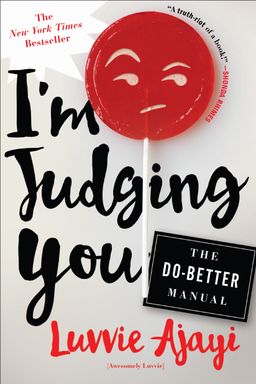
I''m Judging You cover

I''m Judging You

by Luvvie Ajayi

Luvvie Ajayi''s ''I''m Judging You: The Do-Better Manual'' delivers a biting yet humorous critique of modern societal norms. Through sharp wit, Ajayi tackles issues like racism, sexism, and social media pitfalls, offering readers an engaging guide on how to improve themselves and the world around them.

Living Better in an Age of Hypocrisy and Foolishness

Have you ever scrolled your social feed and thought, “Have we all lost our minds?” Luvvie Ajayi’s I’m Judging You: The Do-Better Manual was written as a witty, side-eye-filled response to that feeling. Drawing from her Nigerian upbringing, her love of Internet culture, and her sharp moral compass, Ajayi argues that too many people have abandoned common sense, empathy, and responsibility in favor of self-importance, laziness, or fear. Her cure isn’t complicated: she calls for each of us to “get some behavior” and live with richer integrity, humor, and courage.

A Comedic Call for Moral Clarity

Underneath her humor, Ajayi delivers a moral wake-up call for a society obsessed with itself. Through dozens of essays divided into four parts—Life, Culture, Social Media, and Fame—she exposes the absurdities of everything from late friends and bad hygiene to racism, sexism, and online hypocrisy. She contends that we have turned ordinary mistakes into cultural epidemics—ranging from group dinners gone wrong to moral paralysis in the face of injustice. The book’s biting tone disguises a simple question: What would happen if people actually took responsibility for being decent human beings?

Judgment as a Form of Care

Ajayi reclaims the word “judgment,” normally viewed as sanctimonious. For her, judgment isn’t cruelty—it’s a sign of standards. When she calls out people for posting dead relatives’ photos online or for refusing to shower, it’s not self-righteousness; it’s love for a social fabric that’s unraveling. Judgment, she argues, is a tool for accountability, not shame. In this sense, Ajayi’s cultural humor resembles the work of writers like Samantha Irby or Tina Fey—comedy that stings because it’s true. (Like Irby’s We Are Never Meeting in Real Life, Ajayi’s laughter hides grief for a world losing its empathy.)

From Everyday Etiquette to Systemic Evil

The author moves gracefully between the trivial and the timeless. One chapter judges people who can’t wash their bras; the next denounces white supremacy, rape culture, and “colorblind” privilege. This wide range shows Ajayi’s moral philosophy: oppression and discourtesy come from the same root—a failure to see other people as fully human. In her world, having dirty laundry and ignoring police brutality both demand public side-eye, even if the consequences differ. She makes readers laugh at themselves so that they’re prepared to examine the power systems they also maintain.

Why These Ideas Matter

Ajayi published I’m Judging You in 2016, at a time when social media outrage was peaking and political division widening. But her message remains timeless: living consciously is an act of rebellion. She examines racial injustice in “Racism Is for Assholes,” hypocrisy in religion in “#FixItJesus,” and online delusion in “About Microwave Fame.” Every essay pleads for awareness: of our privilege, of our platforms, and of our impact. Through humor, Ajayi offers something like a modern-day etiquette book crossed with a civil rights manifesto. She wants her readers to laugh, but also to act—to stop being “extra shitty” and start building a less terrible world.

A Roadmap for Living with Integrity

Ultimately, I’m Judging You is less a rant and more a guide to living well despite chaos. Ajayi provides the reader with what she calls “new rules for a new world”: respect your body, your friendships, your platform, and your fellow humans. She demonstrates that decency can—and must—coexist with humor. Her command for readers is to judge injustice, inequality, and ignorance relentlessly, but to do so with compassion and wit. In a culture obsessed with being liked, her judgment feels radical because it calls us back to self-respect.

As you move through the key ideas that follow—from relationships and privilege to social-media ethics and moral courage—you’ll see how Ajayi translates side-eye into strategy. Beneath the jokes and hashtags lies a complete philosophy: being good isn’t about perfection. It’s about having the courage to care enough to do better, every single day.


The Basics of Being a Decent Human

Ajayi opens with simple but surprisingly rare principles: show up on time, keep your word, and wash yourself. In the first part of the book, “Life,” she skewers everyday selfishness—those late friends, dinner freeloaders, toxic friendships, and hygiene disasters we all know. Her point isn’t just manners; it’s mindfulness. When we ignore others' needs, we reinforce a culture of disregard that eventually enables larger injustices. Being a good person starts with not being a jerk at the table—or in the shower.

Friendship and Responsibility

In “Why Must You Suck at Friendship?,” Ajayi outlines the archetypes of bad friends: the competitor, the user, the flake, and the frenemy. She humorously catalogues their offenses—borrowed money never returned, canceled plans, gossip disguised as concern—and delivers a universal truth: friendship is a mirror for personal ethics. Good friends practice empathy, which is training for resisting indifference on a global scale. You can’t claim to care about justice if you can’t even call your friend back.

Love Without Foolishness

In “When Baehood Goes Bad,” Ajayi warns against mistaking emotional chaos for romance. Through her friend Tina’s disastrous relationship with a gambling, bike-riding scammer named Carlos, she illustrates how desire blinds judgment. Her comedy serves as therapy, but underneath lies a feminist message: love should elevate, not entrap. Real love requires boundaries and self-respect—what she calls escaping “ride-or-die foolishness.” (She echoes bell hooks’s insistence in All About Love that affection must include responsibility.)

Body and Authenticity

Her essays “Under the Knife,” “Weight a Minute,” and “Don’t Be Pigpen” expose how shame distorts self-image. Ajayi attacks impossible beauty standards with earthy humor—ridiculing anal bleaching and Botox while promoting genuine self-acceptance. Her argument: society manipulates people by profiting from their dissatisfaction. She reminds readers that confidence is an act of rebellion for women conditioned to self-loathe. “Don’t die in the pursuit of different body parts,” she warns. Cleanliness and confidence, not conformity, are moral issues for her: both are forms of self-respect and respect for others.

This first section functions like a mirror held to mundane life: your time, your friends, your habits all reveal your character. Ajayi uses laughter as moral polishing; if you can laugh at your own nonsense, maybe you can fix it too.


Culture, Conscience, and Calling Out Oppression

Ajayi’s second section turns from manners to morality, dissecting how privilege, racism, sexism, and religious hypocrisy infect the culture. Her tone sharpens: humor becomes a scalpel exposing systemic wounds. Essays like “Racism Is for Assholes,” “The Privilege Principle,” “Rape Culture Is Real and It Sucks,” and “#FixItJesus” situate comedy within activism. For Ajayi, laughter and justice aren’t opposites—they’re allies in truth-telling.

Seeing Privilege Clearly

In “The Privilege Principle,” Ajayi distills the concept of social privilege into a vivid classroom exercise: participants step forward or backward based on statements such as “I’ve never worried about my next meal.” The resulting human spacing shows invisible inequality. She argues that privilege isn’t guilt—it’s awareness. White privilege, in particular, is “the ability to live without having to be defined by your skin color.” (This echoes Peggy McIntosh’s classic essay “Unpacking the Invisible Knapsack.”) Her message to privileged readers: don’t be “colorblind”—be accountable.

Racism, Religion, and the Power of Honesty

In “Racism Is for Assholes,” Ajayi blends outrage with wit as she chronicles racial violence—from church burnings to police brutality—and insists that racism is not merely personal hatred but “a system of oppression with blood in its soil.” Her solution? Active allyship: call out family jokes, confront silence, and resist the impulse to “get over it.” In “#FixItJesus,” she turns her satirical eye on organized religion, specifically hypocrisy within Christianity. She skewers pastors with private jets, misogynistic interpretations of scripture, and homophobic congregations who weaponize Jesus while ignoring His compassion. Her faith coexists with criticism; belief, she shows, requires accountability, not blind obedience.

Feminism, Sexism, and Consent

“Nobody Wins at the Feminism Olympics” and “Rape Culture Is Real” articulate an inclusive feminism that celebrates choice rather than conformity. Ajayi denounces double standards in body image and professional advancement, but she also critiques the exclusion of women of color from mainstream feminism. Her essay on rape culture is particularly powerful: combining humor with horror, she recounts how society teaches women to avoid being raped instead of teaching men not to rape. Her moral stance is explicit: equality requires unflinching honesty about patriarchy’s violence.

Throughout this section, Ajayi acts as both satirist and preacher, asking readers to convert not to a creed, but to conscience. The through-line is simple: empathy without engagement is empty. You can’t call yourself decent if you’re comfortable in systems that crush others.


Digital Life and the Cult of Oversharing

Ajayi’s third act—“Social Media”—is both hilarious and haunting. She chronicles how social networks amplify vanity and erode privacy. In essays like “#Hashtag Abuse,” “Your Facebook Is My Favorite Soap Opera,” “For Shame: Get Some eBehavior,” and “Real Gs Move in Silence,” she blends etiquette, critique, and sociology. Her plea: use your online presence with intention, not desperation.

The Hashtag Hangover

For Ajayi, hashtags reveal the Internet’s addiction to attention. Her mock dictionary defines offenders: those who #hashtag #every #word and those who hijack serious movements (#BlackLivesMatter) for self-promotion. The problem isn’t technology—it’s ego. Hashtags could build movements, as in activism led by women like Tarana Burke, but careless overuse turns activism into noise. Her humor becomes a moral critique of performative virtue: public outrage without private integrity.

Social Media Morality

“For Shame” takes aim at digital indecency—from flirting on LinkedIn to taking selfies at funerals. She argues that online etiquette reflects inner ethics. If you wouldn’t do it at a wake, don’t do it on Instagram. She describes the loneliness behind constant posting and the cruelty behind public trolling. The Internet, she writes, is a magnifier of who we already are: gracious people become kinder, while jerks become full-time trolls. The solution is spiritual hygiene—be as decent online as in person.

Privacy and Authenticity

Ajayi’s essay “Your Facebook Is My Favorite Soap Opera” reads like a modern morality play. Following a “Bleeding Heart” friend’s exhausting pattern of oversharing relationships, she demonstrates how public validation destroys intimacy. Real relationships thrive in silence, she advises; “real Gs move in silence like gnats.” This echoes Sherry Turkle’s research in Alone Together, warning that connection without boundaries breeds emptiness. For Ajayi, mystery is maturity. Keep your love life, and your bowel movements, off the timeline.

These essays critique digital narcissism while offering a quiet rebellion: honesty, restraint, and community. She reminds us that social media is an amplifier, not a confessor. What we say reflects our character, so we’d better clean our digital mouths.


Fame, Hypocrisy, and the Price of Visibility

In the final section, “Fame,” Ajayi exposes society’s obsession with attention and the emptiness beneath it. Fame, she suggests, has become a replacement for purpose. Through essays like “About Microwave Fame,” “So You’re Kind of a Big Deal,” and “The Unreal World,” she dissects the moral and emotional inflation caused by digital celebrity culture.

Microwave Fame and Moral Dehydration

“About Microwave Fame” critiques the kind of instant notoriety won through viral videos and shameless stunts. Ajayi recounts absurd examples—people faking pregnancies online, manufacturing tragedy, or buying followers—to show how “fifteen seconds of infamy” has replaced personal integrity. Her metaphor of a “fame flu” diagnoses a culture infected by validation hunger. As social scientist Sherry Turk or psychologist Jean Twenge might argue, Ajayi connects this to loneliness: people would rather be seen for foolishness than be unseen in substance.

Online Celebrity and Authentic Work

In “So You’re Kind of a Big Deal,” she mocks digital influencers who confuse followers with worth. She lists archetypes—the Number Dropper, the Brand, the Revolutionary—and skewers their vanity. Her point: true influence isn’t measured in clicks but in contribution. Like Seth Godin’s Tribes, she believes leadership is service, not spotlight. The Internet might make stars overnight, but it also erases them by morning. Real impact, she insists, outlasts algorithms.

Reality TV and the Collapse of Decency

“The Unreal World” traces reality TV’s fall from genuine human experiment (The Real World) to moral dumpster fire (Flavor of Love). Ajayi sees voyeurism as modern gladiator sport; we gawk at dysfunction to feel superior. Her critique expands to politics itself, comparing presidential debates to reunion shows. When public life becomes entertainment, empathy dies. She reminds readers that consuming foolishness makes us complicit. She laughs—but with teeth.

Across this section, Ajayi calls for substance over spectacle. She urges creators and audiences alike to trade visibility for value. The real fame worth having, she concludes, is being known by those you’ve genuinely helped.


Doing Something That Matters

Ajayi’s epilogue brings her humor full circle to moral action. She recounts a childhood memory of her mother forcing her to give away her favorite doll to a less fortunate child—a painful early lesson in sacrifice. Only later did she realize that this act embodied the book’s final message: giving back is not optional; it’s obligation. Doing something that matters, she writes, means using whatever privilege or platform you have to make the world “a little less terrible.”

Service as Social Rent

Quoting Shirley Chisholm—“Service to others is the rent you pay for your room here on earth”—Ajayi urges readers to pay their overdue moral rent. She defines service expansively: speaking against oppression, mentoring a child, donating time or money. Not everyone must become Malcolm X, she jokes, but no one gets to be useless. Even a whisper of truth can counter an “echo chamber of lies.” Courage, not comfort, is the rent collector at humanity’s door.

Privilege as Responsibility

Ajayi redefines privilege not as guilt but as opportunity. You don’t have to be wealthy to contribute: “If you have a microphone plugged into an amplifier, it is wrong for you not to sing.” She calls out celebrities afraid of losing fans by speaking about injustice, reminding them that influence without ethics is waste. Yet she also invites ordinary readers to see that silence itself is complicity; doing nothing is a moral luxury the oppressed cannot afford. (Her message parallels Bryan Stevenson’s in Just Mercy: justice begins when you get proximate.)

Small Acts, Big Ripples

Ajayi dismantles the fear of not doing “enough.” Grand gestures aren’t required; intention is. Help one person, tell one truth, give one resource, she insists, and you’ve already shifted the current. Drawing on her career as a writer and activist, she models using humor as service—because making people think critically is itself an act of love. Her words mirror the spirit of modern changemakers who insist that everyday kindness alters systems as surely as protests do.

The book closes not with judgment, but hope. After 300 pages of laughter, scolding, and truth-telling, Ajayi leaves readers with a simple assignment: start now. Examine your life, use your gifts, and do something that matters. Because silence is complicity, ignorance is a choice, and decency—still—needs its champions.

Dig Deeper

Get personalized prompts to apply these lessons to your life and deepen your understanding.

Go Deeper

Get the Full Experience

Download Insight Books for AI-powered reflections, quizzes, and more.