
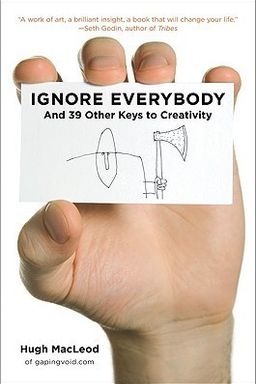
Ignore Everybody cover

Ignore Everybody

by Hugh MacLeod

In ''Ignore Everybody,'' Hugh MacLeod empowers you to embrace your creative spirit and pursue your artistic dreams. Drawing from personal experiences, MacLeod provides practical advice to navigate criticism, seize inspiration, and effectively share your work with the world. Discover how to balance passion with practicality and turn your creative vision into reality.

The Creative Sovereignty Manifesto

What would happen if you stopped waiting for permission to create, and just made something that was truly yours? In Ignore Everybody: and 39 Other Keys to Creativity, cartoonist, blogger, and entrepreneur Hugh MacLeod issues a bold manifesto for creative independence in a noisy, conventional world. He argues that the most radical—and rewarding—act you can take is to listen to your own ideas more than you listen to anyone else. Creativity, he insists, isn’t about brilliance bestowed by the heavens, but about courage, persistence, and ownership.

MacLeod’s central message is both refreshingly simple and deeply subversive: ignore everybody. The more original your concept is, the less likely others are to understand or support it at first. True ideas alter power dynamics, which makes people uncomfortable. And yet, those are exactly the kinds of ideas that change everything—for the creator and the world around them. Through forty compact chapters drawn from his own career—stints in advertising, artistic obscurity, blogging fame, and business—MacLeod weaves a conversational guide to making authentic work in an inauthentic age.

From Bar Napkins to Global Audience

The story begins in Manhattan, where MacLeod began doodling cartoons on the backs of business cards just to amuse himself during late nights at the bar. This small act of personal expression—tiny, portable, and free from external approval—evolved into his signature creative identity. Years later, it became the foundation for a multimillion-read blog (gapingvoid.com) and ultimately this book. The message is clear: innovation often starts with something humble and personal. The best ideas don’t have to be big; they just have to be yours.

The Myth of Being Discovered

In a world obsessed with social validation—viral success, book deals, record contracts—MacLeod cuts through the illusion. If your plan depends on being “discovered,” you’re doomed. Nobody is waiting to rescue you. Creative success, he says, is not a lightning bolt but a slow burn. You earn attention not through brilliance alone, but through stamina: putting in countless unseen hours and doing it anyway, even when nobody notices. (This view echoes Steven Pressfield’s call in The War of Art to treat creativity as daily discipline, not divine inspiration.)

The Sex & Cash Theory: Balancing Passion and Pragmatism

MacLeod makes one pragmatic addition to the creative canon—what he calls “The Sex and Cash Theory.” Every creative person has two kinds of work: the sexy kind (what they love) and the cash kind (what pays the bills). You will always need both. The myth of quitting your day job to chase a dream is just that—a myth. Real freedom lies in maintaining financial safety while creating work on your own terms. Picasso painted commissions (“cash”) and masterpieces (“sex”); successful people learn to dance between the two without shame or burnout.

Freedom Through Constraint

One of MacLeod’s sharpest insights is that sovereignty—total ownership of what you make—matters more than audience size or profit. Your sense of freedom and autonomy gives your work power. His own medium—a 3.5”x2” card—was both a literal and creative constraint that offered infinite freedom within tiny boundaries. By limiting options, he removed excuses. Great creators, he says, use tools that strip pretension away. Lincoln wrote on borrowed stationery; Van Gogh painted with six colors; you don’t need fancy software or a perfect studio—you need a pen and a conviction.

The Human Side of Creativity

MacLeod doesn’t romanticize creative life. He’s brutally honest about its pain: loneliness, resistance, and the slow death of idealism. Real creativity changes you, and those changes often cost relationships, comfort, and security. His recurring metaphor of “the private Mount Everest” captures that truth—each of us has a personal mountain to climb, and the only tragedy is never trying. The challenge, he explains, isn’t external validation but the internal reckoning required to accept the creative calling and live with it.

Why This Matters Now

In an era of performative productivity and algorithmic creativity, MacLeod’s manifesto feels prophetic. It demands that you build meaning at human scale, not follower scale. His later ideas—“meaning scales, people don’t” and “the best way to get approval is not to need it”—could double as warnings for creators in the social media age. Ultimately, Ignore Everybody is not about art or business alone; it’s a philosophy of life. Do it for yourself, own your voice, protect your freedom, and remember that creation is less about genius and more about grit.

Key takeaway: Creative sovereignty isn’t granted—it’s seized. The only person who needs to believe in your work at the start is you, and that belief, fueled by patience and persistence, will do more than any gatekeeper ever could.


Why You Must Ignore Everybody

Hugh MacLeod opens with a provocation: ignore everybody. It’s not an act of arrogance; it’s survival. The more original your idea, the less other people will understand it, at least at first. Good ideas threaten the existing balance of power—they shift relationships, hierarchies, and expectations. That’s why even your loved ones might subconsciously resist your growth.

The Burden of a Good Idea

Creative people look for validation when they should be cultivating courage. When MacLeod began drawing cartoons on business cards, colleagues and friends dismissed it as a strange, unmarketable habit. Yet it was precisely this act of working on something “pointless” that freed him from corporate mediocrity. He didn’t need a market angle; he needed honesty. As he puts it, “Good ideas alter the power balance in relationships—that’s why good ideas are always initially resisted.”

Lonely Beginnings

Every creative project has a lonely childhood. In the early days, you’ll face blank stares, indifference, or even hostility. Your friends may worry not because your idea is bad, but because it means you’re changing—and if you change, their relationship to you might change too. In many organizations, colleagues will resist anything that challenges the hierarchy. MacLeod is unsentimental about this: it’s human nature, not malice. Expect resistance. Keep going anyway.

The Myth of Permission

By telling you to ignore everybody, MacLeod is really telling you to stop asking for permission to begin. You don’t need someone else to declare your work “good.” The harsh truth is that nobody—not even experts—really knows whether an idea will succeed. You are responsible for your own experience. (This mirrors Seth Godin’s mantra in Linchpin: “The indispensable creative doesn't wait to be picked.”)

Why Listening Can Be Dangerous

MacLeod warns that listening to too many opinions can dilute the very idea that makes you stand out. “Crowds homogenize,” he says—if you aim to please everyone, you’ll please no one. The creative act always introduces imbalance before harmony, and your job is to survive that imbalance long enough for the world to catch up. Sometimes, that means walking alone for years.

Key takeaway: The earliest feedback you get is rarely an accurate reflection of your idea’s value—it’s a reflection of other people’s need for safety. Ignore them until your creation speaks for itself.


Own Your Work Completely

The second major principle of the book—“The idea doesn’t have to be big. It just has to be yours”—cuts to the core of creative authenticity. We're conditioned to idolize viral products, bestselling authors, or unicorn startups, but MacLeod argues that chasing bigness kills originality. When you stop trying to impress and start trying to express, your work takes on power.

Sovereignty as a Creative Asset

MacLeod’s insight is that sovereignty inspires more than content ever could. When someone sees you fully own your creative life—doing something purely because it’s yours—they feel permission to do the same. That’s contagious. People follow creative integrity more than they follow trends. This explains why his whimsical card doodles resonated far beyond their medium: they felt like pure play, not self-promotion.

Freedom over Fame

Creativity flourishes when you create something that doesn’t depend on someone else’s paycheck or opinion. The smallness of your project can become a fortress of freedom. MacLeod calls this “the sovereignty of your work”—a kind of personal kingdom where outside standards don’t apply. Ironically, once he stopped trying to commercialize his art, the world came knocking. That’s the paradox: success tends to come when you no longer need it.

A Modern Parallel

In modern creator culture, his advice feels prophetic. Whether you’re a YouTuber, designer, or indie coder, your strength lies in protecting your unique perspective from being reshaped into the market’s mold. (Author Austin Kleon echoes this in Show Your Work: “Share what you love, not what you think will gain followers.”) When your ideas come from genuine curiosity rather than checklist ambition, they become unmistakably yours.

Key takeaway: The creative economy rewards self-ownership. Your work doesn’t need to be famous—it needs to be free. Sovereignty scales; imitation dies.


Creativity Requires Stamina

For MacLeod, inspiration is easy; endurance is rare. In chapter three, “Put the hours in,” he dismantles the myth of overnight success. Ninety percent of what separates successful creatives from failed ones, he argues, is time, effort, and stamina. There’s no magical shortcut—just habitual persistence.

The Discipline of Practice

MacLeod has drawn tens of thousands of miniature cartoons over decades. That accumulation—more than any single stroke of brilliance—is what gave his work substance. If someone copied his business-card art format, he’d shrug and say, “Only if they can draw more of them than I can.” That is the essence of mastery: putting in so many hours that imitation becomes irrelevant.

The Role of the Day Job

His practical solution to creative burnout is counterintuitive: keep your day job. Having steady income creates psychological space. It allows you to make bold artistic choices without financial panic. MacLeod confesses that his advertising work grounded him—even as his cartoons soared online. Without that balance, he might have crumbled under creative pressure. (Elizabeth Gilbert makes a similar argument in Big Magic, urging creators not to burden their art with the need to pay rent.)

Trade Intensity for Longevity

MacLeod cautions against “big heroic creative bursts.” True progress comes in small, consistent doses. Creativity is a marathon, not a manic sprint. When you learn to pace yourself, the act of creation stops being an existential crisis and becomes a rhythm. The secret weapon of all great artists, founders, and writers isn’t genius—it’s stamina.

Key takeaway: Inspiration might start the fire, but endurance keeps it burning. Guard your energy; creative success is built one disciplined hour at a time.


Balance Passion and Income

Among MacLeod’s most enduring ideas is the Sex & Cash Theory—a blunt framework for creative survival. Every creator has two parallel careers: the “sex” projects that ignite their soul, and the “cash” projects that pay for groceries. Both are essential, and neither should dominate completely.

Embracing the Duality

MacLeod illustrates this with examples from photographers to coders. A photographer might spend weekends shooting wild editorial spreads for art magazines (“sex”), but weekdays snapping glossy catalog photos for corporate clients (“cash”). Even celebrities oscillate this way—John Travolta moves from indie hits like Pulp Fiction to blockbuster paydays like Broken Arrow. The tension never disappears, no matter your success level.

Freedom through Pragmatism

Accepting this duality paradoxically liberates you. Once you stop fantasizing about escaping your day job forever, you can start managing your two worlds intelligently. Your artistic work stays fresh because it’s not burdened by financial panic, and your professional work improves because you bring creative vitality into it. Rather than aspiring to “quit your job and follow your dreams,” MacLeod suggests integrating both halves of yourself.

Why This Principle Endures

In today’s creator economy, where side hustles blur with full-time jobs, this theory feels prophetic. The healthiest creative lives are hybrid ones. You can thrive in contradiction—doing something for love and something for livelihood—without shame or burnout. The creative world rewards resilience, not purity.

Key takeaway: You can’t eat inspiration. Balance “sex” and “cash”—your art will stay honest, and your life sustainable.


Draw Your Red Line

Every creative person must learn where to draw the line—literally and figuratively. MacLeod calls it the Red Line that separates what you are willing to do from what you are not. Creativity thrives within sovereignty; it withers under servitude. No one else can define your boundaries—you must.

The Cost of Compromise

Art suffers when it becomes too dependent on external money or validation. The more you need a paycheck, the more susceptible you become to compromise. MacLeod illustrates this through his friend, comic artist Chris Ware, who described his own acclaimed career as “unrewarding.” Ware’s fame didn’t protect him from the pressures of an industry that wanted ownership of his creativity. MacLeod saw this and chose a different route—keeping advertising as a shield rather than letting cartooning be controlled.

Knowing When to Say No

The Red Line isn’t about arrogance or purity—it’s about survival. Whether you’re a filmmaker resisting an exploitative producer, or a startup founder declining a toxic investor, knowing your limits protects your creative integrity. As MacLeod puts it, “The more you need the money, the more people will tell you what to do.” Planning for this reality ensures your joy and autonomy survive success.

Key takeaway: Defining your Red Line early is not about rebellion—it’s about preservation. Boundaries are the scaffolding of creative freedom.


Define Success on Your Terms

In his later chapters, MacLeod turns philosophical. He insists that success cannot be borrowed—it must be defined personally. “Never compare your inside to someone else’s outside,” he writes. The artist envying another’s fame rarely sees the trade-offs that come with it. Likewise, careers that seem modest can contain immense satisfaction if achieved authentically.

Revising the Meaning of Work

Through anecdotes like the Scottish “fireplace dealer” who refused to sell what he loved most, MacLeod illustrates that balance again—love what you do, but don’t let what you love enslave you. Selling something you adore can be as painful as “selling your children.” Real mastery requires detachment as much as devotion.

The Joy of Obscurity

Fame, in MacLeod’s telling, often dulls creativity. Before success, you’re free to invent a new language; after success, you must keep feeding everyone else’s expectations. He urges creators to savor obscurity—to relish the early, private years before anyone is watching. Those are the times when your work becomes uniquely yours.

The Modern Lesson

In a world obsessed with metrics—likes, views, contracts—MacLeod’s counsel is radical: focus on meaning, not measurement. As he writes, “Meaning scales, people don’t.” True fulfillment isn’t found in expanding your reach, but in deepening your contribution. The goal is not to win the Internet; it’s to win yourself.

Key takeaway: Real success means feeling whole, not famous. When your definition of success is self-determined, no one can take it from you.


Creativity as a Way of Life

MacLeod’s final chapters pull his 39 laws into a unified philosophy: creativity isn’t an activity—it’s a worldview. He declares that power is never given, only taken; inspiration cannot be forced but arrives through immersion; and whatever path you choose, the devil eventually collects his due. The creative life is full of contradictions, but those contradictions are precisely what make it worth living.

Accepting the Pain

MacLeod tells you to “accept the pain”—to assume that your work will cost more emotionally, socially, and financially than you expect. That way, pain loses its power to stop you. The real agony isn’t in failing to succeed—it’s in never starting when you knew you could have. By detaching from outcomes, you free yourself to make something real.

Be Ready for Change

He warns that “when your dreams become reality, they’re no longer your dreams.” Once the world catches up, you must evolve. Your dreams will always mutate—new mountains will appear as others fade. Aging, frugality, humility, and perseverance become virtues. Remaining light—financially and emotionally—keeps you adaptable when markets or inspiration shift.

Creativity in the Modern World

Finally, MacLeod pushes you to build trust in a changing landscape. Technology will transform industries, but only trust—between creators, collaborators, and audiences—will sustain you. His advice to “start blogging” wasn’t just about online presence; it was about replacing gatekeepers with direct connection. Creativity thrives where trust lives.

Key takeaway: Living creatively is not about what you make—it’s about how you move through the world: curious, courageous, disciplined, and true to yourself, even when nobody’s watching.

Dig Deeper

Get personalized prompts to apply these lessons to your life and deepen your understanding.

Go Deeper

Get the Full Experience

Download Insight Books for AI-powered reflections, quizzes, and more.