
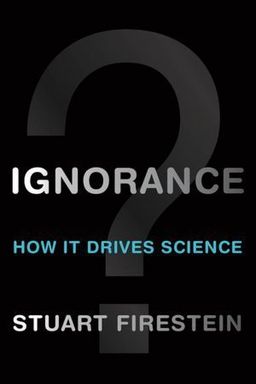
Ignorance cover

Ignorance

by Stuart Firestein

Stuart Firestein''s ''Ignorance'' reimagines the scientific method, highlighting the power of unknowing as a driver for discovery. Through compelling historical examples, Firestein reveals how questioning what we don''t know spurs innovation and enhances our understanding of the world.

Ignorance as the Engine of Discovery

What if everything you thought you knew about science was upside down? In Ignorance: How It Drives Science, neuroscientist Stuart Firestein makes the bold claim that science isn’t built on certainties and facts at all—it’s built on ignorance. Not ignorance in the sense of stupidity or denial, but a dynamic, productive form: the recognition of what we don’t know. For Firestein, this conscious ignorance is not an obstacle to overcome—it’s the very fuel that drives discovery and creativity.

Firestein argues that the public view of science—as an encyclopedia of facts, tidy methods, and predictable results—is dangerously misleading. In reality, the day-to-day life of a scientist is more like stumbling around, flashlight in hand, looking for a black cat in a dark room (that might not even exist). Each discovery only expands the horizon of what we don’t yet understand. It’s a counterintuitive, exhilarating idea: the more we know, the more we realize we don’t know.

The Black Cat and the Dark Room

Firestein opens with a vivid metaphor: science, he says, is not a puzzle with a guaranteed solution, but a hunt through dark rooms for black cats that may or may not exist. This image captures what he calls the exhilaration of ignorance—scientific progress as a process of “dis-covering,” literally uncovering what’s hidden. While non-scientists often see science as a methodical march toward certainty, scientists themselves thrive in uncertainty. What keeps them going is not answers, but better questions.

He recounts his revelation as a neuroscience professor at Columbia University: while teaching 1,400 dense textbook pages of “known” brain science, he realized he was giving students the false impression that everything was already known. In truth, most of neuroscience is still a vast frontier. This recognition led him to create an experimental course—with the provocative title "Ignorance"—where scientists come together to discuss not what they know, but what they don’t.

Ignorance as a Productive Force

Ignorance, in Firestein’s view, is not the absence of knowledge, but the awareness of limits. It’s communal rather than individual; it’s when existing data no longer make sense, when predictions fail, when explanations break down. This kind of ignorance—what he calls insightful ignorance—is the engine of science. The physicist James Clerk Maxwell once wrote, “Thoroughly conscious ignorance is the prelude to every real advance in science,” and Firestein builds his entire philosophy around that idea.

The book’s core declares that the story of science is not the acquisition of knowledge but the growth of productive ignorance. Each discovery opens new questions and creates new mysteries. For every “known,” there are ten new “unknowns.” The better we map what’s known, the sharper the edges of what remains unknown—an ever-expanding frontier rather than a diminishing one.

Reclaiming Science as an Adventure

Firestein is on a mission to liberate science from the stereotype of dry facts and rigid formulas. He paints scientists not as cold rationalists but as explorers and gamblers, guided as much by doubt as by data. The book’s tone—which balances humor, philosophy, and vivid storytelling—invites readers to see science as accessible, fallible, and deeply human. It’s about trial and error, curiosity and failure, not neat progressions of logic. As he puts it, “Science is a revision in progress, always.”

This perspective has profound implications beyond the lab. It redefines how we think about knowledge itself, education, and even citizenship in an era overloaded with information. Firestein urges us to stop fetishizing certainty and instead cultivate curiosity. He wants you to ask less “What do we know?” and more “What can’t we yet explain—and why?”

What You’ll Discover in This Summary

Over the journey of this summary, you’ll explore how Firestein unfolds this vision of science as an ignorance-driven enterprise. You’ll learn why questions are more valuable than answers, how “controlled neglect” allows scientists to focus on what matters, and why failed experiments often signal real progress. You’ll examine how scientific predictions often implode, how limits like Gödel’s incompleteness theorems and Heisenberg’s uncertainty principle actually deepen inquiry, and how teaching ignorance can radically transform science education.

Finally, you’ll meet real scientists—like animal-cognition researcher Diana Reiss, cosmologist Brian Greene, and neurophysiologist Larry Abbott—whose stories illustrate how embracing the unknown leads to discovery. Firestein concludes with a call to action for both scientists and citizens: to bring ignorance back into our public understanding and classrooms. Because in the end, the most powerful scientific statement may be not “I know,” but “I don’t know—yet.”


Questions Are Bigger Than Answers

In the opening chapters, Firestein argues that questions—not answers—are the real currency of science. Using the witty retort of Gertrude Stein on her deathbed, “What is the question?” he reveals that the true scientific mindset revolves around asking the right things, not amassing the most facts. A good question, Firestein explains, can survive decades, inspire entire fields, and open layers of investigation that multiply answers. Answers end things; questions start them.

Living in the Age of Overwhelm

Firestein observes that we live in an unprecedented age of data saturation—where Google yields billions of results in seconds and the global production of information is doubling at staggering rates. But in a world drowning in information, scientists practice what he calls “controlled neglect.” They focus selectively—not on everything known but on the edges where knowledge stops. In his view, “facts are raw materials, not finished products.” It’s how scientists use the known to reach the unknown that matters.

The Usefulness of Ignorance

He distinguishes between two types of ignorance: willful ignorance—stubbornly rejecting evidence—and informed ignorance, the awareness of what’s missing. The latter is essential for progress. Paradoxically, as knowledge grows, ignorance grows faster. Newton may have once known nearly all the science available in his era, but today, even the most brilliant specialist knows only a microscopic fragment of the total. And that’s the point: every discovery expands the circumference of the unknown. The more light we shed, the larger the perimeter of mystery becomes.

Comfort in Uncertainty

Firestein borrows John Keats’s notion of “negative capability”—the capacity to dwell “in uncertainties, mysteries, doubts, without any irritable reaching after fact and reason.” For a scientist, he says, this tolerance for ambiguity isn’t weakness—it’s a tool. Every hypothesis begins with an admission of ignorance. The laboratory, after all, is not where we confirm what we already know but where we stretch into the darkness of what we don’t.

By reframing ignorance this way, Firestein turns science into something closer to art. Both demand imagination, humility, and playfulness. The creative act begins not with a statement, but with a question: “What if?” The implication is radical: if you want to think scientifically—not just professionally, but in life—you must learn to befriend your own uncertainty.


How Science Finds Out

Firestein next lifts the curtain on how science actually works, revealing it to be far from the neat loops of ‘observe, hypothesize, experiment, conclude’ you might remember from school. Real science, he says, is messy, nonlinear, and often fueled by luck and missteps. In the lab, failure isn’t a dead end—it’s usually the beginning of something new. As George Bernard Shaw once joked, “Science is always wrong; it never solves a problem without creating ten more.”

The Fragility of Facts

To illustrate, Firestein recounts the many “known facts” later proven false: the 19th-century belief in the luminiferous ether, the outdated “tongue map” showing different taste zones (a myth born from a mistranslation), and the century-long obsession with brain “spikes” as the only language of neurons. He even dismantles a myth he himself taught for years—that the brain has 100 billion neurons and ten times more glial cells. An Argentinian anatomist, Suzana Herculano-Houzel, later proved there’s roughly an equal number of each. “In one fell swoop,” Firestein writes, “we lost almost a trillion brain cells.”

The Beauty of Being Wrong

Being wrong, Firestein insists, isn’t failure—it’s discovery. Science doesn’t collapse when new findings overturn old ones; it grows stronger. False ideas, just like dying stars, enrich the universe with new material for creation. Each generation’s “truth” becomes the next generation’s fertilizer. He reminds us that Albert Michelson won a Nobel Prize for disproving the ether—a prize for an experiment that didn’t work. Real science, Firestein notes, celebrates uncertainty. As Max Planck dryly observed, progress happens “with every funeral.”

Knowledge Creates More Ignorance

Each discovery spreads the ripples of the unknown wider, like waves in a pond. The interior of the circle—what we know—grows, but so does its circumference, where the known meets the unknown. It’s there, on that uncertain frontier, that real science happens. Firestein captures this paradox eloquently: “Science produces ignorance, possibly at a faster rate than it produces knowledge.”

What makes this view empowering is that anyone—scientist or not—can participate. You don’t need a lab to live with questions. You only need curiosity and the humility to say, “I don’t know, but I’d like to find out.”


Limits that Expand Thinking

From here, Firestein explores the fascinating paradox that the limits of knowledge often fuel, rather than restrict, scientific progress. He draws from physics, mathematics, and philosophy to show that boundaries—what we cannot know—are often the most generative spaces of all.

The Heisenberg and Gödel Lessons

Two major limits loom large: Heisenberg’s Uncertainty Principle in physics and Gödel’s Incompleteness Theorem in mathematics. Both show that certain truths will always remain beyond reach. Heisenberg revealed that we can’t know both a particle’s position and momentum exactly at the same time—reality itself is uncertain. Gödel proved that any logical system complex enough to be interesting will contain truths that can’t be proven within it. Together, they transform ignorance from error into structure—our minds and universe are built to have boundaries.

When Not Knowing Helps You Know

Firestein relishes the irony: uncertainty and incompleteness are not failures but fertile soil for creativity. From the impossibility of absolute knowledge in quantum physics came new ideas like entanglement and relativity. From Gödel’s paradox emerged computer science and deeper inquiry into consciousness. Even ancient puzzles—like the irrational square root of 2 that scandalized the Pythagoreans—tell us that we progress not by eliminating the unknowable, but by dancing with it.

Copernican Cognitivism

Firestein introduces philosopher Nicholas Rescher’s idea of “Copernican cognitivism.” Just as Copernicus showed Earth is not the center of the universe, Rescher suggests our brains are not cognitively privileged—we cannot assume reality is shaped for our perception. Like the two-dimensional creatures in Edwin Abbott’s 1884 novella Flatland, confined to imagining a 3D world, we too may be missing whole dimensions of truth. This humbling idea—there’s more we can’t conceive than we can—turns ignorance into a kind of awe.

For Firestein, acknowledging our cognitive limits isn’t pessimism. It’s liberation. Once we stop expecting omniscience, we become better at managing uncertainty, designing creative experiments, and asking better questions. Ignorance, managed wisely, reveals reality’s most astonishing truths.


Predicting Ignorance, Not Answers

We love predicting the future—what technology will transform society, what breakthroughs will occur, what diseases we’ll cure. But Firestein warns that these forecasts often miss the point. The real art of prediction in science is not guessing solutions, but identifying the right questions. Predict ignorance, not knowledge.

Hilbert’s 23 Problems

The best example comes from mathematician David Hilbert, who in 1900 challenged his peers with 23 unsolved problems rather than declaring future discoveries. A century later, those problems continued to direct the math world; some were solved, others reformulated, and many remain open. Hilbert didn’t foretell answers—he mapped ignorance.

The Dirac–Anderson Surprise

Firestein also recounts how unpredictable breakthroughs emerge from curiosity, not forecasts. When physicist Paul Dirac derived the existence of the positron in 1928 from his equations, he could hardly imagine it would one day lead to the PET scanner used in hospitals worldwide. Science, he suggests, is less like following GPS directions and more like bushwhacking through wild terrain—each step reveals what the map can’t.

Enumerating Ignorance Is Dangerous

Firestein cautions against “numbered lists” of future discoveries—like magazines promising “10 Discoveries That Will Change Science.” Counting implies closure, as if ignorance were finite. Instead, science should embrace an open horizon. “Numbering leads to prioritizing,” he writes, “and prioritizing leads to accounting rather than creativity.” The point isn’t to close the circle, but to keep expanding it.

What’s liberating is that this approach doesn’t just belong to scientists. You can apply the same principle to your life and work: spend less energy predicting what will happen and more attention identifying what you don’t yet understand. That’s how real breakthroughs—personal or scientific—take shape.


The Quality of Ignorance

Not all ignorance is created equal. Firestein devotes a significant portion of his argument to showing that high-quality ignorance is what distinguishes great science from bad science. A scientist’s career depends less on what they know than on how skillfully they frame and manage the unknown.

Grants, Questions, and Controlled Neglect

Firestein jokes that scientists are perhaps the only professionals paid for what they don’t know—grant proposals are documents that explain what researchers aim to find out. But writing a good proposal isn’t easy. The best scientists, he says, must become “connoisseurs of ignorance,” distinguishing tractable questions from impossible ones, interesting mysteries from dead ends. Maria Chudnovsky, a mathematician he interviews, says a good question “leads somewhere and connects to other questions.” That connectedness defines quality.

Curiosity vs. Hypotheses

Firestein distrusts the overreliance on formal hypotheses. They can confine thinking, bias data, and turn scientists into defenders rather than explorers. He prefers curiosity-driven science—the freedom to “go fishing” in untested waters. The greatest discoveries, from thermophile bacteria (that later enabled PCR) to strange model systems like salamanders’ smell receptors, arose from simple curiosity, not strategic planning. Chance, as Louis Pasteur said, “favors the prepared mind.”

Model Systems and Misconceptions

A recurring theme is the value of studying the small to understand the large. Scientists often use model systems—worms, mice, or even salamanders—as manageable stand-ins for complex organisms. Firestein defends this practice, arguing that critics who mock “studying salamander smell” miss that every specialized experiment contributes to understanding broader biological principles. “All models are wrong,” statistician George Box once said, “but some are useful.”

Ultimately, Firestein argues that quality ignorance requires imagination, humility, and strategic focus. You can’t chase every mystery at once. But you can cultivate the questions that deepen the mystery usefully—the ones that keep the story going rather than closing it.


You and the Adventure of Ignorance

Firestein insists that ignorance isn’t just for scientists—it’s for you, too. Knowing how to ask good questions can make you a better thinker, listener, and citizen. When you meet scientists, he suggests, don’t ask them what they do; ask them what they’re trying to find out. The difference shifts the conversation from sterile facts to living curiosity.

Becoming Comfortable with Not Knowing

In his course, Firestein encourages students to interact with guest scientists by asking about their unsolved problems, their “stuck points,” or what ignorance has grown since their previous discoveries. These questions open up science as a human endeavor—filled with laughter, uncertainty, and surprise. Even reading scientific papers, he suggests, becomes easier once you stop fixating on the technical details and aim instead to grasp the underlying questions.

Ignorance as Empowerment

Firestein’s invitation is democratic: science should not feel exclusive or forbidding. Just as you can attend a symphony without reading sheet music, you can appreciate science by understanding its mysteries rather than its equations. Ignorance is the great equalizer—it puts everyone, scientist and layperson alike, on the same infinite playing field searching for meaning.

He challenges you to treat your own areas of ignorance as opportunities. Don’t rush to judgment or pretend to know. Instead, ask better, deeper questions. In a world too often dominated by overconfidence and noise, curiosity becomes an act of humility—and of rebellion.


Science, Society, and the Future of Education

In his final chapters and “Coda,” Firestein extends his argument beyond the lab to the entire culture. If ignorance drives science, he says, then teaching only known facts—as we do in most schools—is like teaching an art class that forbids painting. To revitalize public understanding of science, we must teach curiosity itself.

Citizen Science and the Public

Firestein laments that modern science writing has become inaccessible—dense, “as if written in Latin.” Yet during the Renaissance, scientists like Galileo broke barriers by writing in vernacular languages, inviting the public into discovery. Today, he urges a return to that spirit. Scientists, he says, must communicate not just what they’ve found but what remains unexplained. “In science, dumb and ignorant are not the same,” he reminds us; talking openly about ignorance isn’t weakness, it’s honesty.

Teaching the Fire of Curiosity

Firestein’s closing plea is directed squarely at educators: stop treating teaching as the “filling of a pail” and start “lighting a fire,” echoing Yeats. In the age of Google, where facts are seconds away, the real skill is to frame problems—to “see beyond the limits of the subject.” He quotes a visionary 1949 German university report that urged teachers to show students where their field meets life, not where it ends. That, he argues, is how you train real scientists—and thoughtful citizens.

Firestein leaves us with this paradoxical truth: the more you educate yourself, the more aware you become of your ignorance. And that’s a good thing. Because curiosity doesn’t end in knowledge—it ends in wonder. And wonder just happens to be where science begins.

Dig Deeper

Get personalized prompts to apply these lessons to your life and deepen your understanding.

Go Deeper

Get the Full Experience

Download Insight Books for AI-powered reflections, quizzes, and more.