
Idea 1
What Animal Intelligence Reveals About Human Stupidity
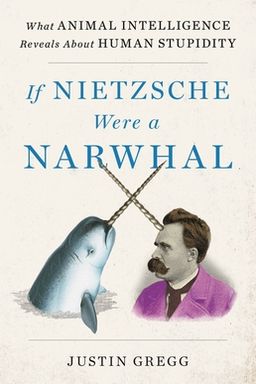
Have you ever wondered if being highly intelligent actually makes life better? In If Nietzsche Were a Narwhal, Justin Gregg flips our usual assumptions about human superiority. He argues that what we call 'intelligence'—our capacity for abstract thought, reflection, language, and moral reasoning—might not always be a blessing. In fact, Gregg suggests that humanity’s brilliance has created as much suffering and destruction as it has progress and innovation.
Gregg’s provocative idea begins with philosopher Friedrich Nietzsche’s tortured intellect. Through Nietzsche’s life and breakdown, Gregg asks: what if being less reflective—like a cow, a narwhal, or a crow—actually leads to more happiness and evolutionary success? This question drives the book: is human-style thinking evolution’s greatest triumph, or its biggest mistake?
The Core Argument: Intelligence Isn’t Necessarily Good
Gregg contends that our complex reasoning, consciousness, and moral awareness come with heavy costs. Unlike most animals who live in the moment, we carry existential dread, guilt, denial, and the relentless need to justify our actions. Our cognitive sophistication enables science, art, and technology—but also genocide, climate change, and anxiety. Intelligence might make us exceptional, but it rarely makes us wise.
To illustrate, Gregg contrasts Nietzsche’s suffering mind with a narwhal’s simple contentment. A narwhal doesn’t lament meaninglessness, doesn’t create elaborate moral rules, and doesn’t destroy its habitat for philosophical ambition. It just lives and thrives. The book, therefore, asks readers to question whether our obsession with thinking, progress, and meaning truly improves life—or whether stupidity, in its animal forms, is underrated.
From Cows to Consciousness: Rethinking Intelligence
Over seven main chapters, Gregg explores different facets of 'human stupidity,' each measured against the more adaptive, sustainable behaviors of other species. He dives into our 'why specialist' nature—our compulsive drive to ask questions—and shows how that curiosity, though powerful, often leads to bad reasoning and destructive inventions. He examines lying, death awareness, morality, consciousness, short-term thinking, and our tendency toward self-delusion.
Throughout, animal intelligence becomes a mirror for human folly. Crows solve puzzles without philosophy. Dolphins grieve without existential despair. Bees display consciousness-like focus without self-torment. By comparing human cognition to simpler creatures, Gregg paints intelligence as one evolutionary path among many—not the pinnacle we imagine it to be.
Why This Matters
Gregg’s argument matters because it cuts to the root of ecological and psychological crises. Humanity’s unique mental tools give us immense creative power—but they also make us anxious, exploitative, and shortsighted. Our intelligence lets us destroy forests for lawns, invent nuclear weapons, and rationalize moral atrocities like genocide and slavery. Meanwhile, animals—driven by instinct and simple cognition—maintain balance with their ecosystems. Their “stupidity” becomes a form of survival wisdom.
Gregg’s core message is not anti-human but deeply humbling: we are exceptional, yes—but perhaps not in ways that serve our long-term survival. Our mental gifts may be evolution’s most catastrophic mistake.
What You’ll Learn
In this summary, you’ll explore:
- How our obsession with asking “why” makes us more self-destructive than wise
- Why lying and deceit are central to human success—and our undoing
- How our understanding of death, morality, and the future sets us apart but also makes us miserable
- Why other species’ simpler cognition might be more adaptive and sustainable
- Whether intelligence should be seen as valuable—or simply as evolution’s failed experiment
Gregg invites you to rethink what it means to be “smart.” Maybe, he suggests, being a narwhal—or living with animal-like simplicity and acceptance—is the sanest way to exist. His sharp humor and scientific grounding make this philosophical journey as entertaining as it is unsettling—a reminder that the smartest species on Earth might also be the stupidest.