
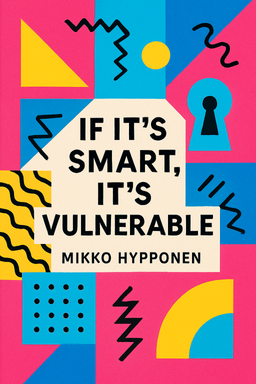
If It''s Smart, It''s Vulnerable cover

If It''s Smart, It''s Vulnerable

by Mikko Hypponen

Mikko Hypponen''s ''If It''s Smart, It''s Vulnerable'' explores the complex world of cybersecurity, tracing the internet''s evolution from its inception to today''s digital threats. The book provides practical strategies and philosophical insights for balancing innovation with security in an interconnected world.

If It’s Smart, It’s Vulnerable: Living in the Age of Connected Risk

Have you ever wondered just how much of your daily life now depends on devices and systems you can’t even see? In If It’s Smart, It’s Vulnerable, cybersecurity pioneer Mikko Hypponen asks that very question—and answers it with decades of hard-earned insight. He argues that humanity is living through one of the most transformative and perilous moments in history: the era when everything—from your watch to your car and power grid—is being connected to the Internet. These connections bring unprecedented convenience and global reach but also create invisible cracks through which crime, espionage, and chaos can slip.

Hypponen’s core claim is as simple as it is alarming: if something is smart—meaning it contains software and connects online—it is automatically vulnerable. His sweeping view of technology’s evolution is shaped not from a scholar’s desk but from the front lines, where he has spent over thirty years hunting cybercriminals and studying how digital threats evolve. That makes the book not just a history of malware or data breaches but a meditation on what it means to live, work, and exist when our lives are split between the physical and digital worlds.

The Internet: Humanity’s Best and Worst Invention

Hypponen begins by embracing the paradox: the Internet is both the best and worst thing that ever happened to us. It supercharged human creativity, knowledge sharing, and collaboration. Yet, it also gave rise to novel forms of crime, manipulation, and surveillance. These two sides cannot be separated, because they are baked into the nature of connected systems. You experience this duality daily—when you search information in seconds, stream movies effortlessly, or pay bills online, yet trade away privacy and expose yourself to digital risk.

Tracing the arc from ARPANET to artificial intelligence, Hypponen shows how the Internet morphed from a nuclear-war–resilient scientific network into the infrastructure of civilization. He reminds readers that it wasn't designed for security or privacy; those were afterthoughts. By the time everyday objects joined the network—smartphones, cars, doorbells—the vulnerabilities multiplied geometrically.

The Changing Face of Threats

Through personal stories—from meeting teenage virus creators in Finland to negotiating with cybercriminals and government spies—Hypponen charts the rise of organized cybercrime. In the early days, viruses were written for curiosity; today, they fuel billion-dollar ransomware empires and nation-state conflicts. The narrative feels almost cinematic, moving from floppy disks to Bitcoin transactions, from hacker bedrooms to the offices of Interpol and the NSA. Each stage adds one more layer to the web of interdependence that defines modern technology.

He warns that these threats evolve alongside our inventions. Malware today is a professional tool: built, purchased, and deployed like conventional weapons. Governments now use malware for espionage and warfare. “Cyberweapons,” Hypponen writes, are effective, cheap, and deniable—a perfect recipe for modern conflict. Instead of bombs and bullets, nations now attack with code.

The Human Element and the Unfixable Error

More unsettling than any technical flaw, Hypponen insists, is the human brain itself. It’s the one system you can’t patch. People will keep clicking shady links, using weak passwords, and falling for scams—no matter how often they’re warned. In his words, we don’t need better humans; we need systems that protect us from ourselves. Companies and governments must design safer networks and assume failure from the outset, because people will always be the weak link.

Looking Forward: IoT, AI, and the Future Internet

The book culminates in Hypponen’s Law: “If it’s smart, it’s vulnerable.” Soon, dumb devices will join the digital ecosystem—not just smart TVs, but coffee machines and toasters. And because everything online can be hacked, the second wave of the Internet revolution—the rise of the Internet of Things (IoT)—may be as dangerous as asbestos was for construction. He also discusses artificial intelligence and machine learning as the next revolution: powerful tools that can defend against attacks but may also enable smarter malware and predictive policing straight out of science fiction.

Ultimately, Hypponen calls for balance: innovation should not be slowed by fear, but we must accept responsibility for this connected world. We can’t hide from technology; we can only shape how it’s built. Through storytelling, technical insight, and hard-won lessons, he delivers a clear message for everyone living online—you are part of the first generation whose life is both virtual and real. And that means learning to protect both.


The Birth and Evolution of the Internet

Hypponen’s historical lens shows that the Internet wasn’t born perfect—it evolved through improvisation and accidents. Designed in the 1960s as ARPANET, it began as a military project for survivable communication during nuclear war. By connecting disparate systems through TCP/IP and Ethernet, it set the groundwork for a self-repairing global network.

As the personal computer revolution merged with networking innovations, openness became the Internet’s defining feature. IBM's decision to create an open PC architecture and Microsoft’s contribution of software combined with Berners-Lee’s development of HTTP and HTML to make the Web accessible for everyone. But openness, Hypponen reminds you, is a double-edged sword—it fosters creativity yet invites exploitation.

From Mosaic to Smartphones

The first browsers—Mosaic, Netscape, and Erwise in Finland—turned a technical network into a mass medium. Hypponen’s personal anecdote about launching his company’s first Finnish website in 1994 highlights how primitive online access once was: users needed modems, TCP/IP stacks, and text gateways. In this wild frontier, deleting the wrong directory meant erasing the entire site—something he did by accident—but it also revealed how fragile and revolutionary this technology was.

Linux and the Age of Open Systems

Another Finnish innovation transformed everything: Linus Torvalds’ creation of Linux in 1991. Hypponen celebrates Torvalds as perhaps “the greatest Finn who ever lived,” arguing that Linux powers more of our world than any other system—from Android phones and Tesla cars to Hollywood studios and Mars rovers. The openness of Linux made it the backbone of the Internet—ironically, the same trait that once made ARPANET possible.

By contrasting Windows’ closed ecosystem with Linux’s collaborative design, Hypponen emphasizes a recurring theme of his book: openness brings power, but it also brings risk. You benefit from open standards every time you connect devices—while attackers exploit them the same way.

Why This History Matters

Understanding the Internet’s “prehistoric” origins helps you realize that our current vulnerabilities aren’t new—they are structural. A system built for sharing, not protection, cannot easily be secured. Hypponen’s account turns technological milestones into cautionary tales: each stage—PC, smartphone, IoT—makes connection easier yet deepens societal dependence. The Internet’s openness was an accident of design; its fragility, an inevitability.

Core Lesson

The systems that connect us were never built for safety—they were built for communication. In fixing what we’ve inherited, we’re not protecting the Internet; we’re retrofitting it to survive itself.


The Rise of Malware and Cybercrime

For Hypponen, understanding modern cybersecurity begins with the story of malware—the digital pathogen that evolved from harmless curiosity to industrialized crime. His career parallels this transformation, and he brings rare intimacy to what might otherwise be abstract history.

From Hobbyists to Billion-Dollar Gangs

Early virus authors were teenagers testing their skills. Hypponen’s tale of tracking “Cinderella II,” created by a lonely Finnish boy who wanted his code to travel where he couldn’t, humanizes the early Internet’s pioneers. That innocence disappeared by the 2000s: spammers partnered with virus writers to build global botnets. What began as rebellion evolved into organized profit. These “cybercrime unicorns,” as Hypponen calls them, now rival legitimate startups in wealth and sophistication, storing profits in Bitcoin and recruiting professionals under false corporate fronts.

Malware’s Evolutionary Chain

Hypponen divides malware history into epochs: floppy disk viruses, file infections, macro viruses, email worms, Internet worms, and ransomware. Each breakthrough was driven not by new ideology but by new connectivity. “As soon as something connects to something else,” he writes, “a virus will follow.” His vivid accounts—like the Brain.A investigation that led him to Pakistan to meet the original creators—make this evolution real. From the nostalgic chaos of Y2K to destructive trojans like NotPetya and WannaCry, the pattern is clear: connectedness empowers contagion.

Ransomware and Cyberweapons

By the 2010s, money became the motive. Ransomware like CryptoLocker and Reveton turned code into extortion tools, locking people out of their memories—photos, documents, entire businesses—until they paid in cryptocurrency. Hypponen’s concept of “honest criminals” is chilling: most follow through on their promises because reputation is good for business. But when governments entered the game, honesty vanished. Russian and North Korean cyberweapons masquerading as ransomware unleashed global destruction, costing companies like Maersk and Merck billions.

Through these stories, Hypponen establishes an uncomfortable symmetry: malware is no longer fringe, it mirrors legitimate enterprise. It innovates, scales, and markets itself—proof that technology, good or bad, grows like any industry.

Core Lesson

Every stage of Internet advancement—from floppy drives to AI—creates new surfaces for exploitation. As long as progress means connection, vulnerability is the price of innovation.


The Human Element: The Unpatchable Problem

If malware is the Internet’s chronic disease, human behavior is its immune deficiency. Hypponen insists that most breaches aren’t failures of technology—they’re failures of people. You might trust your firewall and antivirus software, but one click from an unaware employee can nullify it all.

Why Humans Are the Weakest Link

People reuse passwords, install shady plugins, click “Enable Content” without thinking, and open suspicious attachments because curiosity and habit overpower caution. As Hypponen jokes, “There’s no patch for the human brain.” His call isn’t for more user training—it’s for systemic design changes that make mistakes less catastrophic. Responsibility should shift from end users to those building the systems: developers, OS designers, and policy makers.

Real-World Lessons

In an unforgettable story, Hypponen describes a red-team consultant infiltrating a major bank using a forged press invitation and cleverly modified USB drives. Once inside, he harvested administrator passwords and even snapped a selfie with the bank’s mainframe. It’s funny—until you realize this is the same methodology criminals use daily. Hypponen’s anecdotes—from CEO frauds impersonating executives to the revelation that even tech-savvy companies can be duped—expose how trust itself has become a vulnerability.

Designing for Human Failure

Hypponen offers practical advice: separate work and leisure computers, monitor internal networks, and expect that attackers will get in anyway. His metaphor of “Information Security Tetris” is memorable—successes disappear, failures pile up. Like a clean office that justifies firing the janitor, companies often misunderstand prevention because it’s invisible. True resilience means preparing for the inevitable mistake, not pretending it won’t happen.

Core Lesson

You can’t patch human nature—but you can design systems that anticipate it. Assume breach, automate protection, and make security the default, not the option.


Hypponen’s Law and the Internet of Things

“If it’s smart, it’s vulnerable” isn’t just a warning—it’s a prediction. Hypponen’s Law captures the essence of our next technological leap: the Internet of Things (IoT). The first wave of connectivity put computers online; the second is connecting everything else. Smart homes, cars, TVs, even toasters will soon form an ecosystem of billions of online endpoints—and every one is a target.

Smart vs. Dumb Devices

You expect security flaws in smart devices, but Hypponen warns of a subtler risk: dumb devices going online without your knowledge. Manufacturers integrate connectivity not to serve you but to collect data about usage patterns, location, or demographics. Your mixer or coffee machine might already be transmitting analytics. These hidden connections create unprecedented privacy erosion—what he calls the “asbestos of the Internet.” Like asbestos, IoT technology seems miraculous now but may one day be recognized as a toxic mistake.

Regulation and Responsibility

Hypponen, often skeptical of regulation, concedes that IoT may require laws to hold manufacturers liable for insecure devices—just as they’re liable for physical defects. If your smart dishwasher catches fire, the maker pays; if it lets ransomware into your network, they should be accountable too. He contrasts this with Europe’s ineffective cookie-legislation, warning that poorly implemented laws won’t fix systemic insecurity. True accountability demands standards and longevity—IoT firmware must be updated for decades, not years.

Dependence and Future Failure

By connecting everyday objects to electricity and data networks, society intertwines its survival with both. When the power grid fails, we lose more than light; we lose communication, commerce, and safety. A large-scale blackout could unravel civilization within days. Hypponen extends this logic: eventually, power networks will depend so heavily on Internet connectivity that one outage will trigger the other. It’s not dystopian fear—it’s mathematical inevitability when every “dumb” thing becomes “smart.”

Core Lesson

Connectivity is irreversible. As we wire the Earth, we also create a single global point of failure. Hypponen’s Law isn’t a prophecy—it’s an engineering truth we choose to ignore.


Technology, Warfare, and the Fog of Cyberwar

Hypponen redefines warfare for the digital age. Traditional conflicts relied on steel and soldiers; now nations fight with code. Cyberweapons, he argues, are perfect imperial instruments: powerful, cheap, and—most crucially—deniable. They can cripple infrastructure, manipulate economies, and steal intelligence, all while hiding the attacker’s identity.

Cyberweapons in Practice

The 2015 attack on Ukraine’s power grid and the 2018 Pyeongchang Olympics hack exemplify how warfare has migrated into networks. Hypponen walks readers through these incidents like a forensic investigator: employees locked out of systems; power grids shut down; athletes’ data leaked. The real horror isn’t just sabotage—it’s plausible deniability. False-flag operations blur lines between nations, making retaliation legally and morally murky. When the U.S., Russia, Israel, and China deploy state-made malware like Flame or Stuxnet, attribution becomes almost impossible. Code doesn’t wear uniforms.

The Economics of Digital War

Hypponen reveals that a single advanced worm can be cheaper—and more effective—than flying bombers halfway across the world. Stuxnet, built for crippling Iran’s uranium enrichment facilities, cost about $20 million, less than one airstrike. He likens modern cyber arsenals to nuclear weapons but notes a key difference: nukes deter conflict because everyone knows who has them; cyberweapons encourage it because nobody does.

The “Fog of Cyberwar”

Where Cold War generals feared mushroom clouds, today’s leaders fear silence—unknown breaches, invisible infiltrations. Hypponen’s concept of the “fog of cyberwar” describes this uncertainty. Nations don’t know the real extent of others’ capabilities, or even their own. With vulnerabilities constantly patched and rediscovered, the digital battlefield resets every few years. This forces governments to buy fresh exploits from private brokers—“merchants of insecurity”—who profit by keeping the world vulnerable. The result is perpetual escalation without deterrence.

Core Lesson

In cyberwar, weapons decay fast, enemies are invisible, and victories are temporary. The only constant is vulnerability—both as a tactic and a condition of modern life.


Artificial Intelligence and the Next Revolution

Hypponen closes the book by peering into the future—where machine learning and AI will both defend and endanger humanity. His approach is philosophical yet grounded in decades of observing how technological promises mutate into risks. Just as artificial power replaced human labor, artificial intelligence may soon replace human thought.

From Machine Learning to Mind Simulation

He explores the possibility of computers simulating entire human brains—a finite but monumental task. Such intelligence would feel joy, write poetry, and perhaps even fall in love. Once machines can self-code, improving their own versions recursively, the limits vanish. Humanity would become the second most intelligent species on Earth. And if supreme intelligence emerges, Hypponen muses, it might not destroy us—it might ignore us, as we ignore wolverines. The metaphor captures optimism and humility simultaneously.

AI, Work, and the Economy

AI’s first victims, he predicts, are creative professionals—programmers, composers, poets—whose cognitive outputs are now replicable by algorithms. Just as industrial machines replaced muscle, digital ones replace imagination. Yet Hypponen is not fatalistic: displacement can lead to transformation. If directed wisely, AI automation could free humans for more meaningful tasks. The threat lies not in losing jobs but in losing control over systems whose motivations we don’t understand.

Smarter Malware and Predictive Policing

AI will soon be weaponized by criminals, enabling self-learning malware and data-driven crime prediction. Hypponen references real experiments like Chicago’s Strategic Subject Algorithm, which tried—and failed—to foresee crimes based on data patterns. Predictive policing, like Philip K. Dick’s “precrime,” risks algorithmic injustice where machines mistake correlation for guilt. In cybersecurity, AI could equally automate defense and offense, pushing conflict to speeds humans can’t manage.

Core Lesson

Artificial intelligence will magnify human capability and human error alike. Its true danger isn’t rebellion—it’s indifference. Like a god that neither loves nor hates, AI will simply do what it’s told—perfectly.

Dig Deeper

Get personalized prompts to apply these lessons to your life and deepen your understanding.

Go Deeper

Get the Full Experience

Download Insight Books for AI-powered reflections, quizzes, and more.