
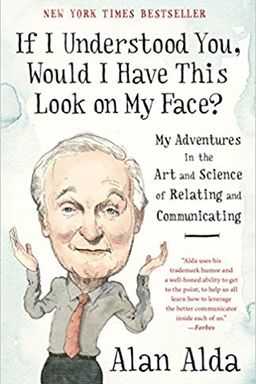
If I Understood You, Would I Have This Look On My Face cover

If I Understood You, Would I Have This Look On My Face

by Alan Alda

Alan Alda explores the transformative power of improvisation techniques for improving communication. Through relatable anecdotes and practical advice, he teaches how to connect authentically, understand others deeply, and communicate effectively in any situation.

The Art and Science of Relating

How many times have you thought you were being perfectly clear—only to realize the other person heard something entirely different? Alan Alda’s If I Understood You, Would I Have This Look on My Face? asks that question with humor and urgency. Why do we so often miss each other, even when our intentions are good? And what can we do to fix it?

Alda, known for his warmth on screen and his curiosity off of it, argues that the secret lies in learning to relate—not just to talk, teach, or lecture, but to create genuine connection. His message goes far beyond polished presentations or effective interviews: communication is a human art deeply tied to empathy, imagination, and the ability to see through another person’s eyes. You don’t just deliver information; you dance with someone else’s mind.

From the Dentist’s Chair to the Science Lab

The book opens with a striking moment: Alda’s dentist impatiently barked out the word “tethering” while wielding a scalpel. Alda, confused and powerless, was about to be cut, both literally and metaphorically, off from understanding. That moment became a lifelong symbol for him—the frenum of friendship severed by poor communication. It taught him that disengagement, not ignorance, is the real enemy of understanding.

Determined to bridge these gaps, Alda embarked on decades of experiments. His laboratory wasn’t just scientific—it was theatrical. Hosting PBS’s Scientific American Frontiers, he discovered how to make scientists sound human, how to translate discoveries into stories. His approach was grounded in acting techniques, especially improvisation. These games, refined from Viola Spolin’s early theater exercises, helped scientists, doctors, and executives learn what he calls “total listening.”

The Core Argument: Relating Is Everything

Alda contends that communication fails not because of complexity but because we ignore human connection. His thesis is simple yet profound: real communication begins when you stop performing and start paying attention. He insists that empathic awareness—recognizing another person’s feelings and thoughts—is the foundation of every meaningful exchange.

This idea runs through the book’s two sections: “Relating Is Everything” and “Getting Better at Reading Others.” In the first, Alda reveals how empathy and improvisational games cultivate responsiveness. In the second, he explores how neuroscience, mindfulness, and storytelling deepen understanding.

Empathy Meets Theory of Mind

Alda builds his philosophy on two cognitive pillars: empathy (feeling what others feel) and Theory of Mind (understanding what others think). He weaves neuroscience—from Marco Iacoboni’s mirror neuron studies to Uri Alon’s improvisation research—with practical applications. In communication, emotion and reason, what Jefferson once called “Head and Heart,” must collaborate. Alda shows that empathy without intellect is chaos, and intellect without empathy is cold.

He also cautions that empathy isn’t always moral. “Dark empathy,” as he calls it, can be twisted to manipulate others. True connection demands compassion and boundaries—an ability to feel with others without drowning in their emotions.

Why It Matters

Poor communication isn’t just inconvenient; it’s dangerous. Alda recalls patients suffering because doctors speak in jargon, engineers unable to warn towns about failing dams, and scientists losing funding because they can't explain their work clearly. Understanding isn’t academic—it saves lives. At its heart, his argument echoes the Shaw quote that opens the book: “The single biggest problem in communication is the illusion that it has taken place.”

By the end, Alda offers more than techniques—he offers a mindset. If you slow down, listen responsively, and practice empathy daily, communication becomes improvisation in real life: unpredictable, joyous, and profoundly human. Whether you’re teaching science, talking to a loved one, or writing to an invisible reader, the secret isn’t performing—it’s relating.

“Relating isn’t the icing on the cake,” Mike Nichols once told younger Alda, “It’s the cake.” That’s the essence of Alda’s message: until your words touch another human heart, you haven’t truly communicated anything at all.


The Power of Improvisation

Alda discovered that improvisation—often seen as playful or comedic—can be a powerful scientific tool. When he led engineers and scientists through improvisation workshops at USC and Stony Brook, he wasn’t teaching them to joke; he was teaching them to observe, empathize, and respond dynamically. After hours of games, the transformation was visible: once-stiff speakers came alive, made eye contact, and dropped their PowerPoint scripts.

Observation and Synchrony

Many exercises, like the “mirror game,” train people to read subtle cues—the flicker of a muscle, the tilt of a head, the rhythm of a breath. As partners mirror each other’s actions, they learn to predict what the other will do next until neither leads nor follows. This physical synchrony deepens empathic resonance. Similar phenomena appear in scientific studies: synchronized marching, tapping, and leaderless mirroring, shown by researchers like Scott Wiltermuth, Chip Heath, and Uri Alon, foster trust and group cohesion.

Leaderless Communication

The most fascinating discovery: communication improves when no one is clearly in charge. Uri Alon’s studies at the Weizmann Institute demonstrated that two improvisers syncing movements without a designated leader were even more coordinated than when one “led.” Alda interprets this as a metaphor for teamwork and conversation: true understanding happens when both people lead and follow simultaneously.

Responsibility for Understanding

The leader’s task isn’t just to transmit information—it’s to make sure it lands. Alda insists that if someone doesn’t follow you, that’s not their fault; it’s your job to slow down and adjust. Communication isn’t about showing how much you know, but ensuring the other person can join you on the journey. In improvisation as in dialogue, connection is the measure of success, not cleverness.

(Note: This principle parallels the “Yes, And” philosophy of theater, later applied by scientists and teams in business leadership research. Accept what the other person offers, build on it, and keep the flow alive.)

Synchrony brings us together—and when two minds dance in time, understanding isn’t taught; it’s created.


Empathy and Theory of Mind

At the heart of Alda’s framework lie two mental abilities: empathy and Theory of Mind. He defines empathy as feeling what others feel, and Theory of Mind as grasping what they know or intend. Together, they allow you to “read minds” in conversation—the combination of emotional intuition and rational perspective-taking that makes mutual understanding possible.

The Science Behind Connection

Research on mirror neurons (from Marco Iacoboni and his Italian collaborators) suggests the brain mirrors others’ actions and emotions. Alda uses this to explain why watching someone smile can make you feel happy and why readers feel empathy for fictional characters. However, he cautions that science is still debating the exact mechanisms—what matters is the observable truth: humans are built to simulate one another’s minds.

Heart and Head

Alda borrows from Thomas Jefferson’s dialogue between “Head and Heart” to symbolically capture the dual nature of communication. Logic alone alienates; emotion alone overwhelms. The magic happens when both collaborate—when your rational mind and emotional awareness pull together to understand the person in front of you.

Reading Minds in Practice

The improv classes at the Center for Communicating Science train professionals to track expressions, tone, and micro-movements to intuit what others are thinking. This mirrors how children develop Theory of Mind—learning that others can hold beliefs different from their own. Alda likens this developmental leap to communication maturity: without acknowledging another’s separate mental world, we’re doomed to talk at them instead of with them.

Empathy gives you insight into the heart; Theory of Mind gives you access to the head. Together, they open the door to that rare miracle—being understood.


Storytelling and Emotion

Alda insists that people remember stories far better than facts. “Tell me a story,” Don Hewitt, the creator of 60 Minutes, once said—words that Alda believes hold the formula for unforgettable communication. From ancient myths to scientific lectures, stories connect people emotionally, give facts a heartbeat, and make ideas memorable.

The Neuroscience of Story

Princeton neuroscientist Uri Hasson found that when someone listens to a story, their brain patterns synchronize with the storyteller’s. As Alda explains, storytelling literally “couples” minds, aligning the listener’s neural rhythms with the speaker’s. It’s not metaphor—it’s measurable empathy. You and your audience begin to think together.

Emotional Memory

Emotion strengthens memory. Alda draws on the work of neuroscientist James McGaugh, who demonstrates that emotionally charged experiences—especially fear, joy, or embarrassment—activate the amygdala and cement memories. Alda’s own chaotic day juggling a Broadway opening, a medical conference, and a lemon-deodorant fiasco stayed vivid precisely because stress and emotion combined to form an indelible imprint.

The Arc of a Story

Borrowing from Aristotle, Alda breaks storytelling into three parts: a goal, an obstacle, and a resolution. Without obstacles, stories and lectures alike are lifeless. For example, one of his teaching analogies—a volunteer carrying a glass of water across a stage where “if she spills even one drop, the whole village dies”—captures the essence of tension. It transforms a simple act into drama and engagement.

He uses real examples like the Flame Challenge, where scientists must explain “What is a flame?” to eleven-year-olds. Children judge the entries, forcing scientists to use story and emotion rather than jargon. Those who do, succeed. The lesson: information without emotion vanishes; emotion without structure confuses. The sweet spot is story.

Facts inform, but stories transform. Whether you’re teaching physics or confessing love, story turns knowledge into connection.


Empathy in Medicine and Leadership

In hospitals and boardrooms alike, Alda shows how empathy changes outcomes. Psychiatrist Helen Riess’s skin-conductance experiments at Massachusetts General revealed that doctors who truly perceive patients’ emotional states deliver better care—and patients recover faster. Similarly, executives who understand their employees’ feelings lead more motivated teams.

Training Doctors to Feel

Riess found that medical empathy isn’t innate—it can be taught. When doctors learned to notice micro-expressions and regulate their reactions (“affective resonance”), their relationships deepened. Meta-analyses later confirmed that empathic physicians not only reduce malpractice suits but also improve outcomes in diabetes, flu recovery, and patient trust.

Evonne Kaplan-Liss and Communication as Healing

Alda profiles pediatrician Evonne Kaplan-Liss, whose traumatic experiences as a patient led her to teach medical empathy through storytelling and clarity. When doctors replaced clinical phrases like “I’ll drape your face” with “I’ll protect your eye,” patients visibly relaxed. Simple linguistic empathy—saying “I’m here to keep you comfortable”—builds trust instantly.

Leadership with Heart

In the corporate world, empathy boosts performance. Studies cited by Alda (Golnaz Sadri, Todd Weber, and William Gentry, among others) show that managers rated empathetic by subordinates are judged by superiors as high performers. CEOs like Warren Buffett demonstrate this pragmatically, communicating honestly and concisely because they understand what readers and employees feel and need. Alda distills this down to a mantra: When people don’t get it—it’s not their fault; it’s yours.

Empathy isn’t weakness—it’s precision. Whether healing a body or leading a team, you succeed by seeing the world through someone else’s eyes.


Learning Empathy Alone

Can you build empathy without classes or improv partners? Alda’s later chapters explore how solitary practice can sharpen your ability to “read minds.” He becomes his own laboratory rat, silently naming strangers’ emotions, meditating, watching Scandinavian crime dramas with the volume muted, and even practicing eye contact with dogs (which, he notes, raises oxytocin in both species).

The Naming Experiment

Alda’s collaboration with researcher Matt Lerner tested whether naming emotions increases empathy. Participants used smartphone apps to label emotions during daily interactions. The more they practiced, the more empathetic they became—a dose-response relationship that proved attention itself heightens compassion. Simply noticing others carefully changed brain responsiveness to social cues.

Meditation and Fiction

He complements this with studies showing meditation and reading literary fiction raise “Theory of Mind” scores (Emory University’s research by Simon Baron-Cohen and others). For Alda, sitting quietly and observing breath parallels observing others: both sharpen awareness. Fiction, too, trains empathy—Justice Stephen Breyer tells Alda that reading Proust reveals “all mankind.”

This self-directed form of empathic fitness, Alda admits, is exhausting but transformative. His takeaway is that empathy works like a muscle—you grow it through daily reps of attention, naming, and perspective-shifting. In his playful words, “It’s not lifting weights; it feels good while you’re doing it.”

Empathy isn’t mystical—it’s practical training. The more you pay attention, the more emotionally fit you become for connection.


The Curse of Knowledge and Jargon

Alda warns against “the curse of knowledge”—our inability to remember what it was like not to know something. Scientists, doctors, and experts suffer from this most. Once we know, we forget how others think. We hear melodies in our heads while others hear only tapping. Alda illustrates this vividly through Elizabeth Newton’s experiment where tappers and listeners failed to communicate tunes—capturing how experts often leave audiences lost.

The Seduction of Jargon

Jargon, Alda jokes, is like his invented flower “hydrofloxia”—a private language that feels smart but alienates everyone else. Scientists, like those fooled by fake research papers generated through the SCIgen program, often mistake obscurity for credibility. Jargon creates barriers exactly where clarity matters most. Instead of sounding brilliant, it sounds confusing or even dishonest.

Breaking the Curse

To reverse the curse, Alda urges readers to remember beginner’s mind—think like someone hearing your subject for the first time. He connects this to the improv idea of slowing down: give others time to catch up. The curse of knowledge isn’t arrogance—it’s blindness. The cure is empathy, the effort to reexperience ignorance, curiosity, and wonder alongside your listener.

(This echoes Chip and Dan Heath’s Made to Stick, which also uses the tapping experiment to illustrate why experts underestimate confusion.)

You can’t teach clearly until you remember how it felt not to understand. Simplicity isn’t dumbing down—it’s reconnecting.


The Improvisation of Daily Life

Alda closes with a beautiful reflection: life itself is improvisation. Every conversation is a scene without a script. Every shift in mood or misunderstanding is part of a dance of discovery. Echoing Samuel Beckett’s words—“Try again. Fail again. Fail better.”—he celebrates mistakes as steps toward deeper connection.

No Formula, Just Flow

Communication isn’t a checklist; it’s a rhythm you learn by doing. Alda compares it to dancing without printed footprints on the floor—formulas can’t teach grace. Instead, practice attention. When two people sync emotionally, their exchange releases dopamine, the brain’s reward hormone. It literally feels good to connect.

Failure as Fuel

For scientists and communicators alike, failure isn’t defeat—it’s data. Every misstep tests connection. Alda urges us to cherish failure as much as success because it teaches what doesn’t work. He recalls teaching his grandson about evolution during a long discussion—only to learn that grand explanation backfired hilariously. Communication, he learned, depends on timing and empathy more than knowledge.

Community Through Relating

Former director Liz Bass put it simply: “Pay attention to what you pay attention to.” The joy of engaging with others is self-reinforcing when we identify its source: relationship itself. We crave connection because it makes us feel seen and alive. Alda’s ultimate advice is to practice communication like going to the gym—except that instead of lifting weights, you lift relationships.

To live well is to improvise with others—gracefully failing, joyfully connecting, and paying exquisite attention.

Dig Deeper

Get personalized prompts to apply these lessons to your life and deepen your understanding.

Go Deeper

Get the Full Experience

Download Insight Books for AI-powered reflections, quizzes, and more.