
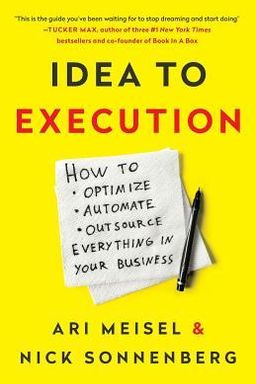
Idea to Execution cover

Idea to Execution

by Ari Meisel and Nick Sonnenberg

Idea to Execution reveals how two friends turned a dinner conversation into a thriving business in just 24 hours. This engaging book outlines practical strategies for launching and scaling a startup with no financial investment, using optimization, automation, and outsourcing.

From Chaos to Clarity: Building a Business Through Optimization

Have you ever felt that the busier you get, the less progress you actually make? Idea to Execution by Ari Meisel and Nick Sonnenberg is a masterclass in flipping that script. The authors argue that the path to both entrepreneurial success and personal freedom lies not in doing more, but in doing less—more intelligently. Their framework—Optimize, Automate, Outsource (OAO)—lays out a precise, repeatable process for building a scalable business and a more intentional life.

This is not just theory. Meisel and Sonnenberg built their virtual assistant company—Less Doing, which later became Leverage—from a chance dinner conversation to a six-figure enterprise in under a year. They used free tools, remote teams, and automation sequences to handle everything from client work to internal systems. Their story is an experiment in entrepreneurial minimalism, showing how efficiency can replace capital as the key to growth.

From Serendipity to System

On a hot summer evening in 2015, as chaos erupted in the virtual assistant world after the shutdown of Zirtual, Meisel and Sonnenberg seized an opportunity. Ari, a productivity coach, and Nick, a former Wall Street algorithmic trader turned app developer, decided to launch their own VA company—overnight. With no investors, no business plan, and no office, they used existing tech tools—Trello, Toggl, Slack, Zapier—to cobble together a functioning backend system.

Within 24 hours, they had paying clients, assistants, and a brand-new business model. Instead of a traditional hierarchical VA company, they built a hybrid model—blending on-demand flexibility with dedicated accountability. By paying freelancers by the second and maintaining total transparency, they eliminated waste and inefficiency at every step. In other words, their experiment became an embodiment of their OAO philosophy.

The Philosophy of OAO: Optimize, Automate, Outsource

The backbone of their method is deceptively simple. First, Optimize: examine your current processes and identify bottlenecks and redundancies. Second, Automate: use tools or scripts to accomplish repetitive tasks consistently. Third, Outsource: delegate the remaining human-dependent work to someone else—ideally, someone specialized who can do it faster and cheaper.

This framework originated from Meisel’s earlier work (Less Doing, More Living), where he refined it as a means to reclaim energy after battling Crohn’s disease. Sonnenberg brought a mathematician’s mindset to the model—running A/B tests, analyzing bottlenecks, and coding solutions to automate decisions. Together, their approach turned abstract productivity philosophy into repeatable entrepreneurial science.

Why Simplicity Scales

Their underlying argument is not just about saving time—it’s about protecting cognitive bandwidth. By transferring repetitive or low-value tasks to systems and people, you create space for your ‘unique genius’—the work only you can do. In the foreword, business strategist Jay Abraham emphasizes this point: inefficiency is the hidden tax destroying most entrepreneurs’ potential. By continually optimizing and off-loading, you ensure you stay inside your zone of contribution.

Throughout the narrative, we see how OAO cascades into every part of their company. Hiring is automated with video applications and auto-responders; client billing is integrated through Chargify and Stripe; dashboards track both VA activity and client engagement in real time. At each stage, a process that once required manual oversight becomes systematized. This ongoing simplification creates a compound effect of saved time and reduced stress.

Core Principle

Every inefficiency tolerated compounds over time; every optimized process compounds toward freedom.

Beyond Efficiency: Leveraging People and Technology

Once the technical infrastructure was set, they faced the next challenge: building culture and relationships in a fully remote team. They discovered that clarity and self-management—not physical proximity—drive productivity. Weekly Zoom check-ins, digital dashboards, and a transparent reward system replaced the need for traditional office hierarchies. Incentivizing initiative rather than micromanagement became their secret weapon.

Their transition from Less Doing to Leverage as a brand symbolized a deeper realization: they weren’t in the business of helping clients “do less”—they were helping them make more of what they have. The company’s real product was time: giving clients back the bandwidth to focus on core innovation while their assistants, systems, and automations handled the rest.

Why This Matters to You

In a world drowning in distractions, this book offers more than an entrepreneurial story—it offers a blueprint for living intentionally. Whether you’re launching a start-up, scaling a side hustle, or just trying to manage your day job more efficiently, the principles here apply universally. You don’t need a huge team, fancy office, or deep pockets; you just need discipline to refine your systems and courage to let go of what doesn’t require your touch.

By the time you finish their story, you’ll recognize that the real art of productivity isn’t about managing time—it’s about engineering it. As Ari and Nick demonstrate, freedom isn’t built by working harder; it’s built by working smarter through constant experimentation, transparent systems, and leveraging every tool at your disposal.


The 24-Hour Launch: Speed Through Simplicity

The origin story of Ari and Nick’s company is more than startup folklore—it’s proof that speed favors simplicity. Within a single day—without investors, a website, or even a name—they launched what would evolve into Leverage, their virtual assistant company. The lesson: when your systems are lean and your vision is clear, execution replaces planning.

Zero-Overhead Startup

Instead of building custom software, they used free tools. Trello became their project manager; Slack replaced internal e-mail; Toggl tracked time; Zapier connected functionalities between services. These off-the-shelf tools let them operate like a mature company from day one without spending a dollar in development. For Ari, who had once burned out juggling projects manually, this minimalistic architecture was the embodiment of his Less Doing philosophy. For Nick, with a background in algorithmic trading, it was an elegant experiment in systems design.

Validation Before Perfection

They didn’t aim for flawless execution; they aimed for validation. Instead of obsessing over branding or long-term strategy, they focused on answering one question: does the market actually want this? The Zirtual collapse provided an instant test group—hundreds of stranded clients in need of assistants. Ari secured first customers using nothing but Trello boards and direct outreach. In contrast to typical startups that spend months coding or fundraising, they validated demand within hours.

The Antidote to Perfectionism

This approach mirrors the Lean Startup method popularized by Eric Ries—launch, learn, iterate—but executed on warp speed. Their motto might as well have been, “Done is better than perfect.” Early imperfections were data points, not failures. For instance, in the first month, Ari and Nick personally fulfilled VA requests under aliases. This direct contact gave them granular insights into what customers cared about: responsiveness, specialization, and trust. They later systematized those insights into training protocols and automation scripts.

Why It Works

Launching with minimal resources forced them into a state of focused creativity. Constraints bred innovation: by committing to zero monetary investment, they had to rely on intellectual capital—ideas, tools, and network. That commitment also eliminated analysis paralysis; decisions had to be made fast, so they made them with data instead of debate. Many entrepreneurs wait until conditions are perfect before starting. Ari and Nick’s story is a living rebuttal: start now, optimize along the way, and let momentum be your mentor.

Key Takeaway

Every business begins as an experiment. The faster you run it, the quicker you get real data—and the shorter your path to success.


Optimize Before You Automate

Most people leap into automation too soon. Ari and Nick learned early that optimization must come first—you can’t automate or outsource a bad process. The magic of OAO isn’t in outsourcing everything; it’s in refining everything until what’s left is worthy of automation. This mindset became their foundation for intelligent scaling.

Optimization Through Constraints

During their early hiring surge, the duo faced overwhelming numbers of applicants for virtual assistant positions. Instead of wading through résumés, they optimized the process with one clever filter: applicants had to film a two-minute introduction video and send it via YouTube link. This simple requirement screened for tech literacy, communication skills, and initiative. Eighty percent of applicants disqualified themselves—without consuming a second of Ari or Nick’s time. Optimization had removed inefficiency before automation even began.

Systematic Simplification

They built each company process around a single question: “Can this be simplified by 10x?” Using tools like Intuit Workforce, HelloSign, and Checkr, they transformed onboarding from days of paperwork into automated digital flows. Their philosophy echoed Toyota's Kaizen—continuous improvement driven by incremental fixes. When they introduced the 5 Whys technique (from lean manufacturing), they found root causes of client issues—late tasks, miscommunication, or dropped handoffs—and refined systems to eliminate those problems permanently.

The Feedback Loop

Optimization never ended. Each month, client feedback, technician pain points, and data dashboards fed back into new workflows. For example, when task delays arose from assistants juggling too many projects, they created the 5-5-5 rule to limit active tasks per person. That micro-constraint improved focus, reduced stress, and increased output quality—proof that optimization often means subtracting, not adding.

Optimization Mindset

Never ask, “How can I do this faster?” Ask, “Should I be doing this at all?”


Automate Everything Repeatable

Once processes are clean, automation becomes the entrepreneur’s quiet superpower. Ari and Nick automated everything from payroll to client onboarding with free or low-cost tools, achieving results that would have required entire departments in traditional companies. Their insight: if a task happens more than twice, it can likely be automated.

Turning Tools into Teams

Zapier was their invisible assistant—triggering Trello tasks when payments came in through Chargify, updating Slack when projects changed status, sending receipts automatically. Mode Analytics integrated all of their data sources so key metrics—client churn, lifetime value, total hours—were updated in real time. These automations were so robust that Ari could step away for weeks without disruption. The company had, in essence, created a living organism of interconnected apps.

The Human-Data Hybrid

But automation wasn’t soulless. Human insight remained crucial where empathy and judgment were required. Tasks like onboarding new clients were partially automated but always accompanied by human touchpoints—like hour-long calls inspired by behavioral psychologist Nir Eyal’s advice. Automation handled consistency; people handled connection. This careful balance turned Leverage from a VA service into a sophisticated orchestration platform for human talent enhanced by software.

Automation as Liberation

Nick often equated automation to algorithmic trading—machines handling precision work while humans decide strategy. The payoff wasn’t just saved hours but reduced cognitive tax. With routine workflows automated, the founders could turn their attention to company vision, partnerships, and personal life. Ari even used automation to manage his own health and family logistics, freeing himself from admin drudgery that once dominated his days.


Outsource for Leverage, Not Laziness

To Meisel and Sonnenberg, outsourcing isn’t abdication—it’s amplification. True outsourcing happens when you hand off clearly defined, optimized, and automated tasks to specialists who can perform them better, faster, and with measurable results. They flipped the myth of the lone genius, arguing instead that sustainable success depends on building systems that outthink and outwork you.

From Virtual Assistants to Strategic Partners

In the beginning, their VAs simply executed client tasks—booking travel, creating presentations, managing e-mails. Over time, the assistants became strategic extensions of the clients’ workflows. They evolved into specialists managing social media, dashboards, and even business development. Instead of being replaceable labor, they became relationship managers trained in anticipating needs—a competitive advantage no app could replicate.

Training for Initiative

Their recruitment process selected for proactivity—the ability to think ahead and act without instruction. One VA noticed a client’s favorite whiskey from a Facebook post and arranged a birthday delivery. Another fixed an obsolete baby monitor using Sugru after the manufacturer refused support. These examples illustrate the deeper point: outsourcing isn’t about cheap labor—it’s about multiplying creative problem solvers through systems and trust.

Scaling Yourself

Once Ari and Nick applied OAO internally, they practically cloned themselves. Ari’s semi-dedicated VA, Alana, ran team oversight using a dashboard, while Casey handled finance and payroll. By documenting every process—screening, onboarding, communication—they turned tacit knowledge into teachable modules. Their business began operating as though each founder had three or four additional versions of themselves working in parallel. That’s the essence of leverage: not delegation, but disciplined multiplication.


Building Culture in a Virtual World

Can remote teams have culture? Ari and Nick’s answer was a resounding yes—but only when culture is built around clarity, feedback, and autonomy. With dozens of assistants scattered globally, they created cohesion not through Zoom happy hours, but through transparent systems, consistent communication rhythms, and shared ownership of improvement.

Transparency as Trust

Every VA’s performance metrics—response times, task completions, errors—were visible to everyone. Bonuses were announced publicly each week. This radical transparency gamified excellence while removing politics. At the same time, feedback flowed in structured formats: 5 Whys analyses for mistakes, Kaizen ideas for continuous upgrades, and quarterly OKR-style check-ins borrowed from Google. This infrastructure turned feedback into habit.

Continuous Improvement Everywhere

The Kaizen initiative—asking each team member to propose one improvement per week—became a defining feature of their culture. Small changes, like clarifying what time was billable or simplifying dashboard displays, had outsized impact. Over months, hundreds of small optimizations compounded into large leaps in efficiency. The sense of ownership that grew among the VAs was extraordinary: they weren’t cogs to be managed—they were co-designers in a living experiment.

Lesson

Culture isn’t about where you work from—it’s about how you improve together.


The Shift to Business Process Optimization (BPO)

As Leverage matured, Ari and Nick realized their product was bigger than virtual assistance. Their true offer was Business Process Optimization—helping organizations streamline through tools, automation, and delegation. A turning point came when they consulted for a legendary entrepreneur (pseudonymously called Craig Maxwell). The experience taught them the difference between teaching individuals to save time and transforming entire companies to scale efficiently.

Consulting the Giants

Maxwell’s team—powerful but overwhelmed—invited them to demonstrate Slack and Trello integrations. What began as a two-hour presentation stretched to seven as Nick showcased live automations that reduced team e-mails by half within a day. Their client’s excitement confirmed what Jay Abraham had told them earlier: sell a process, not a product. From that point forward, BPO became a core service line, integrating Lean principles with modern digital tools.

Enterprise Learnings

The engagement wasn’t flawless. They encountered resistance from employees invested in outdated workflows—a reminder of behavioral biases Michael Norton calls the “effort heuristic” (we value tasks more if we perceive them as harder). Their misstep—implementing simultaneous Slack and Trello adoptions—became a future blueprint: start with quick wins (communication), then move to project systems. BPO taught them organizational psychology as much as process design.

Scale Beyond Self

BPO marked their transition from doers to designers. They began licensing their systems, training VAs as certified consultants, and building software dashboards for other businesses. The move underscored an evolution common in great companies—from service delivery to system architecture. By documenting their wins and failures, they turned OAO into a methodology that others could adopt—effectively outsourcing optimization itself.


Working by the Numbers: Data-Driven Entrepreneurship

Meisel and Sonnenberg’s final pivot was philosophical: intuition gave way to information. They transitioned from running on instinct to running on metrics—embracing data as the compass for every decision. As Nick, the former quant trader, often said, “If you can’t measure it, don’t change it.”

The Metrics That Matter

They tracked churn (clients leaving), lifetime value (LTV), and internal-to-external work ratio. Tools like ChartMogul, Mode Analytics, and segment.io fused all their systems into one real-time database. The result was an x-ray view of business health: who was using the service weekly, which sources produced loyal clients, and when automation saved most hours. These dashboards informed every strategic tweak—from pricing experiments to Facebook ad spend.

From Data to Decisions

When a price increase from $40/hr to $50/hr slowed signups, they rolled back within days, driven by data rather than pride. While many founders cling to gut feeling, Ari and Nick treated each experiment as code: adjust variables, observe outcomes, iterate. Their key advantage was feedback speed—decisions validated within hours, not quarters. The company became a living algorithm of improvement.

Quantitative Alignment

Their final year-end metric told the story: churn below 3 percent, revenue over $100,000 per month. Most importantly, they measured internal alignment—how much of each founder’s time was spent in his “zone of genius.” The closer they got to 100 percent alignment, the faster the company grew. In essence, their data didn’t just quantify performance; it quantified purpose.


Freedom Through Systems

At its core, Idea to Execution is a book about freedom—the kind achieved not by working harder, but by designing smarter systems. Ari and Nick’s journey from overwhelm to optimization demonstrates that entrepreneurship can be artful, methodical, and humane. They prove that systems don’t limit creativity—they liberate it.

Beyond Hustle Culture

While startup lore glorifies sleepless grinding, Ari’s battle with chronic illness taught him that health and efficiency are inseparable. Scaling Less Doing required structure, rest, and respect for cognitive load. Their business model was designed not for more work, but for more time with family, learning, and creativity. This redefines success from constant activity to optimized impact—a subtle but profound shift mirroring thinkers like Tim Ferriss and Cal Newport.

Evolving With Intention

Over twelve months, they built, broke, and rebuilt systems with humility. They rebranded, retrained, and refocused their network toward long-term sustainability. Each iteration was a mini-experiment in mastery: prove, measure, simplify, repeat. Through OAO, they built not just a business but a self-perpetuating ecosystem—where technology, people, and philosophy align toward leverage. The result? A living proof that true freedom isn’t won through chaos—it’s engineered through clarity.

Dig Deeper

Get personalized prompts to apply these lessons to your life and deepen your understanding.

Go Deeper

Get the Full Experience

Download Insight Books for AI-powered reflections, quizzes, and more.