
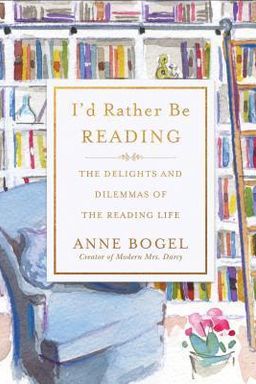
I’d Rather Be Reading cover

I’d Rather Be Reading

by Anne Bogel

Anne Bogel''s ''I’d Rather Be Reading'' is a heartfelt exploration of the reading life. Through humorous anecdotes and insightful stories, Bogel captures the joys and challenges bibliophiles face, from organizing shelves to the transformative power of rereading. This book is a celebration of literature''s profound impact on our lives.

The Reading Life as a Mirror of Who We Are

When was the last time a book felt like it was written just for you? In I’d Rather Be Reading, Anne Bogel invites readers into a warm, deeply personal meditation on what it means to live a life anchored by books. Bogel—known from her blog Modern Mrs. Darcy and the podcast What Should I Read Next?—offers a series of reflective essays that together form a love letter to reading itself. For her, reading is not simply a pastime but a mirror that shows us who we are and how we change over time.

The book’s central argument is that the reading life is as personal and revealing as any autobiography. The stories we read, the books we abandon, the titles we recommend, and even the ways we organize our shelves—all of these choices tell the story of who we are. Bogel contends that reading shapes the interior architecture of our minds: the words we absorb from childhood forward build the framework of our inner worlds. To understand our reading lives is to understand ourselves.

Books as Companions and Confessors

Bogel begins with an idea familiar to every avid reader: books are not inanimate objects but companions. Whether she’s recalling weeping over Where the Red Fern Grows in fifth grade or standing in front of her overflowing library shelves, Bogel reminds us that the books we’ve loved (and even the ones that disappointed us) mark the milestones of our inner growth. They are repositories of our emotion, memory, and imagination. She argues that readers have their own version of a spiritual practice—the act of reading, reflecting, and connecting meanings that gives shape to a life of imagination and empathy.

Reading as Identity

To Bogel, the kinds of books you read—and how you interact with them—reveal essential truths about your values and temperament. A reader’s shelves are like a personality profile: what you keep, what you lend, and even what you hide behind another dust jacket says something about you. She describes literary “sins” such as never having read Pride and Prejudice or secretly loving “lowbrow” fiction, and she insists that shame and guilt have no place in authentic reading. Every preference, from high literature to cozy mysteries, is part of your readerly fingerprint. By embracing these quirks instead of apologizing for them, you become more honest about your identity as a reader and person.

The Serendipity of the Right Book at the Right Time

Another recurring theme is serendipity: the uncanny way books appear in our lives at precisely the right moment. Bogel calls this phenomenon “books that find you.” She recounts reading Dallas Willard’s The Divine Conspiracy just when her son faced a sudden medical crisis, finding in its pages spiritual insight she hadn’t known she needed. Books, she argues, are not merely chosen—they sometimes choose us. When a certain title speaks perfectly into a season of grief, joy, or transition, it feels less like coincidence and more like grace. (Similar to Maria Popova’s reflections on “the soul’s dialog with books” in Figuring.)

The Social Dimension of Reading

Although reading is often solitary, Bogel explores its communal power. She discusses the thrill of finding a “book twin” whose tastes align perfectly with yours, or the exhilaration of book clubs where the right story deepens friendships. Conversely, she warns against being “book bossy”—forcing recommendations as if they were moral imperatives. True literary community honors choice and personality; it’s about connection, not correction. When you share a book authentically, you’re extending a piece of yourself.

Living Through Books

Bogel also reflects on how life imitates art. Stories are rehearsal spaces where we practice emotions and experiences before living them. Bookish characters teach us courage, compassion, and resilience, and sometimes the stories we consume inspire us to act—like visiting a real-life bookstore that mirrors a favorite film scene. For Bogel, a life rich with reading is a life of emotional rehearsal, empathy, and curiosity.

The Architecture of a Reader’s Life

Ultimately, she sees reading as an architecture of being. Just as novels have settings and arcs, so do our reading lives: they trace how we evolve across time. The books of our childhood, the novels that first broke our hearts, the nonfiction that challenged our worldviews—they all form a self-portrait. The reading life is cumulative: once a reader, always all the readers you’ve been. Bogel’s essays celebrate these layers with both humor and tenderness, arguing that readers inhabit multiple selves that coexist in memory and imagination.

Why It Matters Today

In an age of digital distraction, Bogel’s appeal is both nostalgic and timely. She’s not merely praising books; she’s defending intentional living. To embrace reading is to resist the noise and reclaim attention for what nourishes your inner life. Her stories remind us that reading keeps us human—it tunes us to empathy, wonder, and reflection. The simple act of choosing a book, lingering with it, and documenting what you’ve read (as in her final essay about keeping a reading journal) becomes a radical act of remembering who you are.

“We are readers,” Bogel concludes. “Books are an essential part of our life stories.”

This expansive love letter to the reading life is not merely about collecting books or tracking pages—it’s about seeing your life through the lens of stories. Bogel reminds you that every title you read becomes a thread in your autobiography, every reading season marks another chapter, and every bookshelf is a portrait of the person you’re still becoming.


Owning Your Reading Confessions

Anne Bogel opens the book with one of its most charming and relatable truths: every reader has literary secrets. There are books we pretend to have read, authors who intimidate us, or guilty pleasures hidden behind more respectable dust jackets. In her essay “Confess Your Literary Sins,” Bogel dismantles the shame surrounding these small hypocrisies and turns them into invitations for community.

Why Readers Feel Guilt

Bogel observes that many readers carry what she calls “the comedy gap” between who they think they should be and who they are as readers. One person hides the fact that they’ve never read Shakespeare; another secretly binge-reads romance novels while teaching literature by day. These confessions, Bogel shows, both amuse and comfort us. They’re proof that what connects readers is not perfection but the vulnerability of being human.

From Shame to Connection

By sharing thousands of conversations with book lovers through her blog and podcast, Bogel discovered that confessions often open doors to friendship. When a reader admits, “I hate Moby-Dick” or “I’ve never read Austen,” someone else inevitably replies, “What, you too?”—echoing C.S. Lewis’s famous line that friendship begins with shared recognition. These exchanges, she argues, become the foundation for genuine literary community. There’s no need for absolution: the act of reading—or not reading—is never a moral failure.

Creating Safe Spaces for Reading Honesty

Bogel encourages readers to move beyond the pretense of being “well read.” Instead of chasing classics for social approval, she invites you to acknowledge the real reasons you read: curiosity, comfort, escape, connection. In doing so, you return reading to what it should be—joyful, exploratory, and human. Admitting your unread shelves or unpopular opinions doesn’t make you less of a reader; it affirms your individuality within the shared landscape of book lovers.

“Whatever secret you’re keeping,” Bogel writes, “it’s time to spill it. These secrets aren’t sins—they’re just secrets.”

Her message is playful yet profound: stop apologizing for your unorthodox tastes. A healthier reading life starts when you stop pretending and start connecting through your authentic experiences with books.


When the Right Book Finds You

Some books don’t just entertain; they arrive like gifts precisely when you need them most. In “The Books That Find You,” Bogel explores the almost mystical timing of reading experiences. She recounts stories where seemingly random choices—plucking a title off her shelf, following a friend’s offhand suggestion—led her to exactly the wisdom or comfort she needed at that moment.

The Magic of Book Fate

Referencing Sarah Addison Allen’s novel Garden Spells, Bogel draws a parallel between magical gifts that appear at the right time and the mysterious arrival of meaningful reading. One example is her encounter with Dallas Willard’s The Divine Conspiracy, which became a lifeline when her son faced an unexpected medical diagnosis. Another is her experience with Parker Palmer’s Let Your Life Speak, which confronted her with questions about vocation and purpose just when she was struggling with them herself.

Recognizing Reading Serendipity

Bogel suggests that these coincidences aren’t mere chance. Instead, they reflect the way our subconscious—or something larger—draws us to the stories we most need. Readers who develop sensitivity to these “nudges” will find their reading life enriched. When the same title crosses your path repeatedly, when a book unexpectedly falls into your hands, pay attention; it might be your next teacher. (Philosopher Alain de Botton has argued something similar—that books appear as emotional tools for life’s problems, a notion called “bibliotherapy.”)

Following the Clues of Chance

Bogel’s tone is whimsical but also practical. She urges you to follow curiosity, to buy or borrow the book that seems to be calling your name, even if it’s not on your planned reading list. Sometimes, she notes, “the book seeks you.” Her examples of coincidental reads—encountering urban planning books before visiting Chicago or Manhattan, reading negotiation tips before selling her house—demonstrate that stories and timing intertwine in ways that make life richer and more prepared.

In short, Bogel asks you to stay open to literary serendipity. She redefines great reading not as a meticulously curated plan, but as an ongoing conversation between reader and fate.


The Books That Break Us (and Heal Us)

Few experiences are as formative for a reader as the first book that truly makes them cry. In “I’m Begging You to Break My Heart,” Bogel traces how emotionally devastating novels teach empathy and resilience. She recalls her fifth-grade class sobbing collectively during Where the Red Fern Grows, realizing for the first time that invented characters could provoke real grief. That moment marked her initiation into literature’s emotional power.

Why We Cry at Fiction

Tear-jerkers like The Fault in Our Stars or Bridge to Terabithia are often dismissed as sentimental, but Bogel argues they serve an essential function: they help us practice heartache safely. When a book breaks your heart in the right way, it validates your ability to feel deeply. Whether you grieve for a character’s death or mourn the end of a beautiful story, the emotional catharsis strengthens you for real-world pain.

Tears as Connection

Bogel connects this emotional response to empathy. Crying over Lincoln’s assassination in Doris Kearns Goodwin’s Team of Rivals or weeping at the close of Holly Goldberg Sloan’s Short is not indulgence—it’s participation. To grieve with fictional characters is to acknowledge our shared humanity. Books give a safe space to express sorrow, and the ache they cause is proof that we’ve truly inhabited another life for a time.

Heartbreak as a Badge of the Reader

“It’s not easy to earn a reader’s tears,” Bogel concludes, “and if an author writes well enough to earn mine, I’m in.” For her, heartbreak isn’t a sign of fragility but of engagement. The books that shatter you often become the ones you treasure most. They remind you that vulnerability—on the page and in life—is not a weakness but a testament to being fully alive.


Reading Shapes a Life

Midway through the book, Bogel steps back to reflect on the long arc of the reader’s evolution. In “The Readers I Have Been” and “A Reader’s Coming of Age,” she examines how books become the scaffolding of our development. Each stage of life, she argues, creates a new kind of reader within us—and all those readers continue to coexist.

All the Readers You’ve Been

Drawing inspiration from Madeleine L’Engle, who said we never lose the ages we’ve been, Bogel applies this truth to reading: we never lose the readers we were. The three-year-old absorbed in The Monster at the End of This Book, the teenager enthralled by The Great Gatsby, the young mother reading Frog and Toad aloud—all coexist within us. Our preferences evolve, but the tenderness and curiosity that drew us to books in the first place remain constant.

Building a Mind with Books

Bogel compares the mind to a house built from literary bricks. The voices of beloved authors—Madeleine L’Engle, Wendell Berry, Jane Austen—have formed her cognitive architecture, laying foundation beams of imagination, empathy, and moral reasoning. Even if you can’t remember every story, their ideas have shaped how you think. This metaphor captures reading not as entertainment but as construction: over time, books become the home of your inner life.

Coming of Age as a Self-Guided Reader

Her essay “A Reader’s Coming of Age” revisits the pivotal transition from assigned reading to self-directed reading. The moment you choose books for yourself—driven by curiosity, not curriculum—is the moment you take ownership of your intellectual life. Bogel’s own coming-of-age titles ranged from Jane Eyre and David Copperfield to pop nonfiction about personality and romance, showing that maturity in reading is about autonomy, not sophistication. You become a lifelong reader not when you master the “canon,” but when reading becomes your way of making sense of life.


Living Among Books

The physical space books occupy is central to Bogel’s reading philosophy. Essays like “The Books Next Door” and “How to Organize Your Bookshelves” celebrate the domestic rituals of a reader’s environment. Her years living beside a public library shaped her habits and even her family’s rhythms; proximity to books, she argues, altered not just her reading quantity but her worldview.

Home as a Reading Ecosystem

Bogel’s first house, a modest cottage “next door to the library,” became her personal Eden. She describes daily walks to borrow and return stacks, teaching her kids to see the library as an extension of home. When she moved away, she mourned not the square footage but the loss of immediacy—the ability to fetch a new story on a moment’s whim. For Bogel, place and reading entwine; geography shapes the kind of reader you can be.

The Art of Shelf-Curation

In “How to Organize Your Bookshelves,” Bogel turns delightfully tongue-in-cheek, parodying decorator rules about arranging books by color or leaving empty space: “You’re a reader; ignore the decorators.” Her humor conceals a truth: shelving is an act of identity. Do you sort by author, genre, or emotional resonance? Do you keep duplicates, collect first editions, or “friends and family shelves”? Every choice expresses your relationship with reading—both aesthetic and emotional. (It echoes Susan Sontag’s idea that shelving is the autobiography of a reader’s taste.)

Readers as Curators of Meaning

Bogel’s reflections remind you that books aren’t static objects; they’re extensions of your mind and memory. Organizing, cataloging, and even dusting them can become a meditative act—a way of re-engaging with your intellectual and emotional past. A true reader, she insists, decorates life with ideas.


The Discipline of Joyful Reading

At first glance, deadlines and reading sound incompatible. Yet in “What I Need Is a Deadline,” Bogel argues that constraints actually protect and energize your reading life. She humorously recalls juggling library due dates and book club meetings, only to realize that without such limitations, she would read far less.

Deadlines as Motivation

Bogel borrows Duke Ellington’s insight—“I don’t need time; what I need is a deadline.” Library due dates serve that function: they keep her accountable, forcing quick decisions about what really matters to read now. She contrasts this with the endless possibilities of her own shelves, where abundance breeds paralysis. The modest pressure of a return date or upcoming book club turns reading from a vague intention into a joyful urgency.

The Paradox of Too Many Books

Modern readers, Bogel notes, live in an age of dizzying abundance. A steady flow of new releases and recommendations can overwhelm rather than inspire. Deadlines create boundaries that help us prioritize—reminding us that time, not books, is the ultimate finite resource. In setting gentle constraints, you protect reading from both procrastination and overconsumption.

Deadlines as Delight

Surprisingly, Bogel portrays deadlines as part of the pleasure of the reading life. They turn each finished book into a small victory against time’s rush. When you race to finish a library title before it’s due, you reclaim the satisfaction of focus—a kind of joyous discipline that keeps reading alive amid daily distractions.


Books, Memory, and the Self

In her concluding essays—“Take Me Back,” “Windows to the Soul,” and the title piece “I’d Rather Be Reading”—Bogel explores how books serve as memory anchors and mirrors of identity. If photographs capture faces, books capture who we were at specific moments in time.

Remembering Through Reading

She dreams of accessing her childhood library records—the long-forgotten lists of everything she borrowed. To her, those titles would be a map of her life’s turning points: the months she prepared for marriage, motherhood, travel, or grief. Books provide chronological and emotional history, reminding you where you’ve been and how far you’ve come. Reading logs or journals, she suggests, are gifts to your future self.

Your Favorite Books as Windows

In “Windows to the Soul,” she recounts being asked to name a favorite book—a deceptively simple question that felt as intimate as revealing her diary. For Bogel, books act like windows showing who you really are: to share what you love to read is to share what you love, period. She notes that even our hesitation to answer—our awareness of being judged by our literary choices—reveals how entwined reading and identity have become.

Why Record the Reading Life

In her final essay, Bogel champions the humble reading journal. Listing what you read and when may seem trivial, but she insists it transforms how you experience books. When you look back on your log, each title resurrects its context—the season, the emotions, the person you were. Over time, this record becomes a narrative of growth, reminding you that books are not just what you read but how you lived. To document reading is to keep a living autobiography in titles.

Dig Deeper

Get personalized prompts to apply these lessons to your life and deepen your understanding.

Go Deeper

Get the Full Experience

Download Insight Books for AI-powered reflections, quizzes, and more.