
Idea 1
We Are Ecological Selfhoods
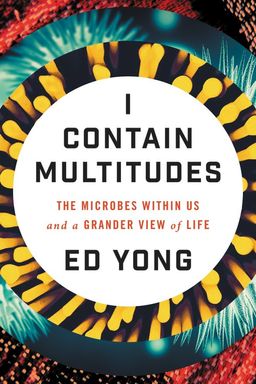
You are not a solitary organism; you are a multi-species collective. In I Contain Multitudes, science writer Ed Yong reveals how every animal, including you, lives as an ecosystem — a densely populated archipelago of microbes intricately intertwined with its host’s biology. This idea overturns centuries of thinking that saw germs only as enemies. Instead, Yong shows that microbes built us, shape us, defend us, and sometimes betray us. The book moves from the first discoveries of microscopic life to the most daring modern microbiome treatments, asking a radical question: where does “you” end and “they” begin?
From enemies to partners
For centuries microbiology was dominated by disease — Pasteur and Koch defined microbes as weapons of illness. But Carl Woese, Norman Pace, and Jo Handelsman changed that narrative with molecular sequencing and metagenomics, revealing vast hidden worlds of bacteria that cannot be cultured and are fundamental to life. The microbial focus shifted from pathology to ecology. Yong modernizes this new view: we are islands of interdependent species, where each body part — like a forest, desert, or coral reef — hosts unique communities governed by resource flows, chemistry, and physical barriers.
A self that blurs at the edges
When Rob Knight swabs a pangolin’s scales or a baby’s skin, he is mapping evolved ecosystems, not dirt. The composition of your microbiome depends on how you were born, what you eat, whom you live with, and where you travel. Infants inherit microbes from mothers and environments, and their microbial successions parallel ecological colonization on islands. These early interactions influence later immunity, digestion, and even mental health. Yong argues that individuality must be redefined: “you” are an ecological entity whose traits emerge from the collective metabolism of human and microbial cells together.
The book’s structure: from micro to global
Yong’s narrative unfolds like a natural history of companionship. It begins with the discovery of microbes, then moves through symbioses that sculpt animal development — such as the Hawaiian bobtail squid whose light organ grows only when colonized by Vibrio fischeri. From developmental biology, the story scales up to microbial relationships governing disease, behavior, evolution, and ecosystems. You travel from subcellular signals that induce organ construction to the coral reefs that collapse when microbial communities tip from harmony to chaos. By the end, the line connecting your gut to the planet’s reefs feels surprisingly direct.
Rethinking control and coexistence
The book makes you rethink your posture toward microbes — not as invaders to purge but as citizens to manage. Health becomes an ecological balance, not an antibiotic arms race. Through examples like Wolbachia’s manipulation of insect reproduction, Yong shows that microbes follow their own evolutionary logic; what looks cooperative from one viewpoint may be coercive from another. Every relationship has terms and conditions that must be enforced by immune systems, behaviors, or anatomy. When those terms break — through antibiotics, nutrient shifts, or pollution — disease emerges as the ecological consequence of imbalance.
The human and planetary stakes
The later chapters turn inward to the gut-brain axis and outward to entire environments — hospitals, homes, oceans. Inside, microbes may affect mood, immunity, and cognition. Outside, human architecture and pollution can either sterilize or support microbial life essential for resilience. Forest Rohwer’s coral reef model mirrors your immune system: too much nutrient input, too little regulation, and the ecosystem tips into pathogenic dominance. The same ecological logic governs your body, your home, and the planet.
A vision of microbial literacy
Ultimately, Yong calls for a new kind of literacy — to see health, evolution, and civilization through microbial eyes. From Antony van Leeuwenhoek’s first glimpse of “animalcules” to the precision of modern metagenomics and bioinformed architecture, the journey changes both how you understand life and how you live it. To care for yourself is to manage an ecosystem; to design cities responsibly is to cultivate symbiosis. The book closes with quiet awe: we are not surrounded by microbes — we are made of, sustained by, and inseparable from them. Selfhood is ecological.