
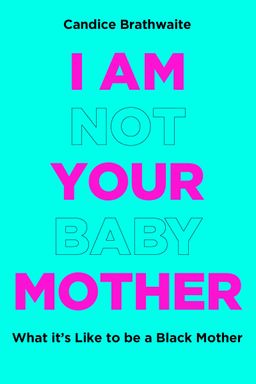
I Am Not Your Baby Mother cover

I Am Not Your Baby Mother

by Candice Brathwaite

I Am Not Your Baby Mother is a compelling memoir by Candice Brathwaite that explores the unique challenges of being a Black British mother. From confronting stereotypes to battling systemic racism, Brathwaite offers an honest and insightful look into the realities of motherhood, inspiring a movement for diverse representation and community support.

Reclaiming Black British Motherhood

What does it mean to be a Black British mother in a world that consistently misrepresents—or worse, ignores—you? In I Am Not Your Baby Mother, Candice Brathwaite confronts a media and cultural landscape where Black women’s motherhood is either invisible or vilified. Through her blend of memoir, social commentary, and manifesto, Brathwaite redefines what it means to mother while Black in the UK—asserting that Black motherhood is neither shame nor stereotype but sacred, complex, and worthy of celebration. The book takes its title from a defiant declaration: she may be a mother, but she refuses to be flattened into society’s reductive label of “baby mother.”

Brathwaite’s central argument is simple but daring: Black British motherhood is both deeply personal and profoundly political. Her mission is to reclaim the narrative stolen by stigmas, statistics, and stereotypes—the image of the loud, unwed, struggling “baby mother” that looms over every Black British woman who dares to parent. Instead, she invites you to see Black mothers in their full humanity: educated, joyful, flawed, loving, fearful, fierce, and aspirational. This reframing is not just about representation—it’s about survival and dignity.

Why This Conversation Matters

The book emerges in a very British silence around race and class. While American conversations about race in motherhood are more visible, the UK context is haunted by a tendency to avoid naming racism outright. Brathwaite refuses that quiet. She exposes how Black mothers face systemic disadvantages that can be fatal—such as being five times more likely to die in childbirth than white women—and everyday indignities, from being misnamed to being underrepresented in media or treated with pity rather than respect.

What distinguishes Brathwaite’s writing is her ability to link the intimate details of her pregnancy, labour, and parenting with structural racism and cultural identity. The book is both a personal reckoning and a social diagnosis: she recounts near-death experiences in childbirth, the exhaustion of “securing the (baby) bag” under financial strain, the anxiety of raising Black children in white spaces, and the microaggressions that shape their everyday lives. Yet, through humour and fierce honesty, she prevents the story from becoming one of despair.

From Memoir to Manifesto

Part memoir, part cultural study, each chapter connects Brathwaite’s story to a bigger truth. She explores generational trauma, financial literacy, education, racism, and representation with storytelling that is both deeply personal and widely relatable. We meet her Caribbean grandfather, a domestic patriarch who raised her with tenderness and discipline; her mother, plagued by depression in a system that pathologises Black suffering; and her partner Bode, whose Nigerian roots add another layer to the complex intersections of identity and heritage within their family.

Fatherhood and Black masculinity also receive honest critique. From absent fathers to model parents, Brathwaite complicates the narrative, showing that love and presence can coexist with patriarchy and cultural misunderstanding. Through these stories, she builds an intergenerational tapestry showing that parenthood is inseparable from the historical and political forces that define Black British identity—from Windrush to gentrified Brixton.

A Blueprint for Visibility and Change

Throughout the book, Brathwaite’s voice balances vulnerability with authority. She acknowledges her fears—of being a single mother, of financial ruin, of her child’s safety—but transforms them into fuel for advocacy. The final chapters chart her journey from media invisibility to digital activism: founding Make Motherhood Diverse, an online platform encouraging honest representation of mothers across race, class, and sexuality. Her online experiences—trolling, tokenism, backlash from white peers—illustrate both the risk and necessity of confronting racial bias in public spaces.

With humour and sharp social insight, Brathwaite challenges readers who aren’t Black mothers to reckon with their blind spots. Dismantling stereotypes, she reminds us that allyship means more than applause—it requires effort, self-education, and giving up comfort. Her final declaration—“I may have a baby. I may be a mother. But I am not your baby mother.”—is a battle cry against a society quick to judge but slow to care.

In the chapters that follow, you’ll explore how Brathwaite redefines the language of motherhood, sheds light on Britain’s hidden racial divides, explores mental health taboos in Black families, exposes inequalities in education and healthcare, and builds a politics of pride around visibility. Ultimately, this is not only a story about motherhood, but about the power of voice—the courage to take up space and rewrite the narrative for an entire generation of Black British mothers and their children.


The Weight of History and Stereotypes

Candice Brathwaite begins by unpacking where the term “baby mother” comes from and why it carries such stigma. In Caribbean English, the phrase simply meant the mother of one’s child—neutral, descriptive. But once Britain adopted it, it became a weapon, reducing Black women to irresponsible, unwed mothers and stripping their maternal experience of dignity. Growing up, Brathwaite heard warnings from family—“Don’t become someone’s baby mother”—and from men who boasted they would never marry one. Being labeled a ‘baby mother’ thus meant social failure.

She situates this within a long history of controlling Black womanhood. From the stereotype of the “mammy” figure—a domestic servant devoted to raising white children while neglecting her own—to modern depictions of the “angry” or “welfare-dependent” Black mother, society has long defined Black women through service or shame. These narratives shape not only how Black mothers are treated by institutions but also how they perceive themselves.

Generational Lessons

Brathwaite draws on her own family history to show how these stereotypes echo across generations. Her grandmother Vern—sharp, busy, and pragmatic—valued survival over tenderness. Her mother, struggling with depression and singleparenthood, reinforced the idea that “strong” means silent. This emotional inheritance created a tension: strength was necessary, but it often came at the cost of vulnerability. When Brathwaite herself became pregnant, she realized she was carrying not just a baby but also a legacy of expectations about what kind of mother a Black woman could be.

Public Stereotypes, Private Pain

The author connects these personal stories to public perception. In British media, Black mothers appear rarely and when they do, it’s often in headlines about poverty, crime, or welfare dependency. Popular culture imports American “baby mama drama” tropes, painting Black women as confrontational and undesirable. This invisibility fuels both racism and misogyny: without positive examples, individual Black mothers are forced to represent or defend their entire race. Brathwaite’s mission is thus both intimate and collective—to reclaim the right to narrate Black motherhood in her own voice.

By understanding how the stigma of “baby mother” developed—from colonial hierarchies to tabloid culture—you begin to see the broader pattern: Black motherhood has always been policed and politicized. Brathwaite’s declaration “I am not your baby mother” is therefore not just personal pride; it’s an act of resistance against a system that defines Black mothers as less than.


Motherhood, Class, and Money

In one of the book’s most practical and eye-opening sections, Brathwaite dissects the intersection between race, class, and finances during motherhood. “Secure the (Baby) Bag”—a play on both hip-hop slang and survival strategy—captures the stress of raising a child when you lack generational wealth, savings, or financial literacy. She candidly details the financial precarity many working-class Black families face: payday loans, unreliable housing, and the near-taboo of discussing money. Where white middle-class mothers plan maternity leaves and nursery schedules, she and her partner Bode faced the immediate realities of making ends meet.

Poverty as Inheritance

Brathwaite reflects on what she calls “the secret garden” of Black financial silence. Her mother, raised in post-divorce poverty, and her grandparents—migrants struggling to build stability—taught her to work hard but not how to build wealth. This generational trend, common among Black British families, stems from structural exclusion (such as being denied loans or fair-wage jobs) and cultural guilt: asking for help or talking about money was seen as shameful. She juxtaposes this with the “Bank of Mum and Dad” often available to white peers—a symbol of generational privilege Black families rarely enjoy.

The Price of Image and Aspiration

Black culture, she notes, uses appearance as access. Well-dressed bodies in poverty signal dignity—a survival tactic shaped by colonial scrutiny. For Brathwaite, buying a prized Bugaboo stroller wasn’t about vanity but about legitimacy. In a society that stereotypes Black mothers as poor and irresponsible, looking composed was a shield. Still, she admits that the pressure to appear “put together” often deepened financial strain. Her story about traveling across London to buy a second-hand Bugaboo becomes a parable of both resilience and irony: pride and survival intertwined.

Ultimately, “securing the baby bag” becomes a metaphor for Black women’s double labour: not only earning money but also proving worthiness. By sharing both her missteps and lessons, Brathwaite urges Black mothers to talk openly about money and refuse the silence that keeps poverty cyclical. Just as importantly, she challenges others—especially readers from privileged backgrounds—to see how race and economics collude to make motherhood unequal.


Naming, Identity, and Respectability

What’s in a name? For Brathwaite, everything. In her chapter on naming—humorously titled “Iso Omo Loruko (Naming Ceremony)”—she explores how choosing a baby’s name becomes an act of cultural navigation and protection. She recalls obsessing over names like “Brixton” before realizing how class and race affect how a child’s name is received. Studies prove that job applicants with white-sounding names are far more likely to be hired than those with ethnic names. So, for many Black British parents, naming becomes less a creative joy and more an act of strategic camouflage.

The Politics of Assimilation

This dilemma—between authenticity and assimilation—hits deeply. Brathwaite’s father named her Candice after a beloved actress, a choice neutral enough to open doors yet rooted in Black culture. She wants the same balance for her children: names that travel well in white spaces without erasing their heritage. Her partner’s Nigerian background brings another layer: choosing Yoruba names that preserve ancestral pride even within a prejudiced system. Through this, she shows how even personal decisions like naming reveal the daily micro-political negotiations of Black life in Britain.

Breaking Free from Respectability

Beneath the humor, Brathwaite challenges the “respectability” politics that demand Black women perform middle-class decorum to be accepted. From avoiding “ghetto” names to double-barrelling surnames for status, these pressures teach Black parents to shrink themselves to fit white comfort. Her own family’s surname debates—choosing between Brathwaite and her partner Bode’s Aboderin—show how love, feminism, and history collide in something as simple as paperwork. Ultimately, she decides that true empowerment lies in honesty rather than perfection: choosing names, partners, and lives that affirm Blackness instead of apologizing for it.

By examining the politics of names, Brathwaite reveals how identity formation begins before birth. In navigating these choices, she models how Black parents can honor their heritage without surrendering their future—a balancing act that defines much of the Black British experience.


The Danger of Birth and Bias

“Black British women are five times more likely to die in childbirth than their white counterparts.” This chilling statistic anchors one of Brathwaite’s most harrowing chapters, “Black Girls Don’t Cry.” Using her own near-death experience after a C-section, she exposes the systemic neglect of Black women within the UK’s National Health Service. Her postoperative infection, misdiagnosed and dismissed multiple times by midwives, nearly cost her life—and typifies the data she later found in the MBRRACE-UK report confirming racism’s deadly effects in maternity care.

Invisible Pain, Fatal Consequences

Brathwaite recounts the dismissive tone of healthcare workers, the assumption that she was exaggerating pain, and the lack of compassion even from Black staff conditioned by the same system. When her wound later burst with infection, it was proof of what she already knew: she hadn’t been believed. Her story mirrors American narratives from figures like Serena Williams or Beyoncé, whose wealth didn’t shield them from racial bias in hospitals (as documented by scholars like Dána-Ain Davis in Reproductive Injustice). The message is consistent—medical racism kills, and silence sustains it.

From Personal Suffering to Public Advocacy

Rather than remaining a victim, Brathwaite transforms her trauma into activism. She joins campaigns to petition Parliament and interviews for national media about maternal mortality among Black women. Yet she also critiques the public apathy she encounters: despite millions of social-media shares, government petitions didn’t meet the threshold for debate. By highlighting this, she reveals Britain’s uncomfortable denial of racial healthcare disparities—and the emotional toll of fighting while still healing. Her survival becomes testimony, urging all mothers, regardless of race, to demand accountability and safer care for everyone.

In placing her own story within this system, Brathwaite turns personal crisis into collective cause. “Black Girls Don’t Cry” becomes both a warning and a rallying call—for compassion, reform, and the validation of Black women’s pain.


Mental Health and the Myth of Strength

Black women, Brathwaite argues, are taught to be pillars rather than people. In her brutally honest section “(senti)Mental tings,” she dismantles the cultural myth that Black women are too strong to break. She shares her descent into postnatal depression after giving birth, tracing its roots to a childhood spent caring for a mentally unwell mother while being told that therapy or antidepressants were signs of weakness. Her candid admission—that she once took her mother’s medication in secret—illuminates how stigma multiplies in silence.

Inherited Silence

Growing up, mental illness was never discussed; it was prayed over or punished away. Depression was labelled laziness, anxiety “bad nerves.” By the time Brathwaite became a mother herself, she internalized the same toughness that nearly destroyed her. The compounding expectations—raising a baby, managing finances, maintaining a relationship, performing constant strength—led to rage and isolation. When she finally sought help, she discovered how poorly the healthcare system serves Black women’s mental health, often seeing their pain as attitude rather than illness.

Defining a New Kind of Strength

Through therapy and self-reflection, Brathwaite redefines strength not as endurance but as expression. The chapter’s humour softens difficult truths: throwing a TV during an argument becomes both breakdown and metaphor for breaking cycles. By naming her depression and publicly discussing it, she gives language to generations denied that right. She also contextualizes mental health disparities with systemic data: Black people in Britain are four times more likely to be detained under the Mental Health Act, highlighting why many avoid seeking help at all. Healing, she insists, begins with refusing silence.

By rewriting what resilience looks like, Brathwaite liberates Black mothers to prioritize self-care without guilt. Her message resonates far beyond race: strength without softness isn’t survival—it’s suppression.


Raising Black Children in White Spaces

In “Brown Girl in the Ring,” Brathwaite captures both the pride and peril of raising Black children in environments where they are the minority. After moving from London to Milton Keynes for safety, she finds herself and her daughter Esmé surrounded by whiteness—from the playground to the classroom. What she calls “the Two Days”—the day a Black child realizes they are Black and the day someone ostracizes them for it—arrives brutally when Esmé’s classmate refuses to play with her because of her dark skin. Brathwaite’s retelling of that phone call from the school is rage-laced and heartbreaking.

The Subtle and the Systemic

Racism, she observes, doesn’t always announce itself through violence. It hides in teachers’ excuses, in five-minute “time outs” for racist remarks, and in the absence of school policies about diversity. When she challenges Esmé’s school, the leadership’s awkward defensiveness—complete with suggestions to hire “African drummers” for cultural awareness—reveals Britain’s unexamined ignorance. The experience forces Brathwaite and her Nigerian husband to confront differences in their understanding of race: his upbringing in majority-Black Nigeria couldn’t prepare him for raising a child marked as “other.”

Choosing Protection Over Pretence

Determined to protect her children, Brathwaite removes Esmé from the school and considers private education—not out of elitism, but as defence against bias. She transforms this choice into a critique of education inequality: state schools often fail Black students through implicit bias, low expectations, and exclusion rates that pave the “school-to-prison pipeline.” For her, paying for schooling is less about privilege than about access to fairness. This nuanced reflection avoids simple answers, reminding readers that race and class shape parenthood decisions in unequal societies.

Through Esmé’s story, Brathwaite invites readers to confront the cost of whiteness—not in ideology, but in daily childhood experiences of belonging and rejection. Her lesson is both tender and radical: Black children deserve joy before resilience.


Motherhood, Activism, and Digital Visibility

In the closing sections, Brathwaite turns outward—toward the online world that first excluded her and then amplified her voice. Social media, she explains, became her window into motherhood when no books or magazines showed Black British mothers. But what she found was a sea of white, middle-class “Instagram mums” sipping lattes and posting curated joy. So she built her own platform. Her blog and later the collective Make Motherhood Diverse challenged that monotony by sharing hundreds of stories from mothers across races, classes, and abilities.

Challenging the Whitewashed Internet

Brathwaite’s rise as an influencer paralleled painful lessons about tokenism and racism online. Calling out a major brand for excluding women of colour turned her into a public target: white “mummy bloggers” and even some Black peers dismissed her as “angry” or opportunistic. Later, she discovered that one of her collaborators—a white midwife influencer—had been trolling her anonymously, calling her “aggressive” and accusing her of “using race as a weapon.” The betrayal stung but didn’t silence her. Instead, she used it to expose how performative allyship masks deeper bias, echoing Audre Lorde’s idea that “the master’s tools will never dismantle the master’s house.”

Action Beyond Hashtags

Brathwaite critiques “callout culture” while advocating for systemic change: genuine inclusion in creative industries, fair pay for Black creators, and accountability when racism occurs behind screens—not just when it trends. She insists activism must extend beyond retweets and photo ops to boardrooms, editorial teams, and budgets. As she consults on more inclusive campaigns, she proves that progress happens through consistent, behind-the-scenes work as much as public confrontation.

Ultimately, her digital journey represents modern motherhood’s new frontier: balancing vulnerability with visibility. For Brathwaite, posting online is not self-promotion—it’s survival and representation. Her final message is a challenge to all readers: What will you do when nobody is watching? Visibility is a beginning, not an end.

Dig Deeper

Get personalized prompts to apply these lessons to your life and deepen your understanding.

Go Deeper

Get the Full Experience

Download Insight Books for AI-powered reflections, quizzes, and more.