
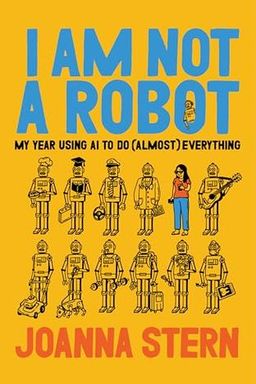
I Am Not A Robot cover

I Am Not A Robot

by Joanna Stern

The Emmy-winning tech journalist describes using artificial intelligence for a myriad of activities over the course of a year.

Your Human Edge With AI

When your tools get smarter, do you catch yourself trying to work like them—faster, more precise, more optimized—only to feel less like yourself? In I Am Not A Robot, Joanna Stern uses the page-turning story of Michael Davis, a veteran engineer laid off by an AI upgrade, to argue for a different approach: stop competing with machines by acting machine-like and start collaborating with them by doubling down on what makes you human. Stern contends that AI’s superpower is optimization, but yours is meaning-making, ethical judgment, creativity, and relationship-building. Put together, those intelligences create “collaborative intelligence,” a capability that outperforms either humans or AI alone.

At its heart, this is a practical fable about how you re-center your value in a world of GPT-5-level systems. The novel tracks Michael from a sterile home office where a Zoom call ends his 23-year career to a coffee table where he admits, “Honey, I think I am a robot.” That confession ignites a rehumanizing journey—reconnecting with his wife Sarah (an organizational psychologist), learning from his son Tyler (an AI-native musician), and then returning to his former company to fix its AI by fixing the question it was asked to answer.

What the Book Argues

Stern’s core claim: AI should not be your rival; it should be your partner. The danger isn’t “smart machines,” it’s humans who train themselves to be replaceable by copying what machines do best. The antidote is to design work, teams, and institutions so that AI optimizes tasks while humans define aims, sense context, build trust, and make meaning. This shift—from productivity to purpose, from oversight to partnership—becomes the thread that pulls Michael out of obsolescence and into leadership.

A Story That Teaches by Example

The narrative progresses through vivid scenes: a rain-streaked window framing Michael’s layoff; a son mixing tracks where AI shapes harmonies but the human chooses why the song should exist; a consulting comeback in which Michael discovers QuantumTech’s issue isn’t “broken code” but “beautiful math solving the wrong problem”—like demanding users enter data in seven-dimensional arrays. The fix is not dumbing down the AI; it is widening the frame so the system optimizes for usefulness and human purpose, not abstract elegance.

The Human Edge Framework

From these episodes emerges a three-part framework—Contextual Awareness (meaning, ethics, empathy), Technical Fluency (knowing AI’s strengths and limits), and Integrative Thinking (combining human judgment with algorithmic power). This is not a theoretical flourish; the family pilots it inside companies, universities, and creative studios. The results: systems that perform better on traditional metrics while also becoming more humane. In parallel, Stern shows how the same approach revitalizes Michael’s identity, marriage, and parenting—proof that collaboration with AI can make you more, not less, human. (Compare to Cal Newport’s argument for “deep work” and Daniel Pink’s focus on autonomy, mastery, and purpose—Stern adds a concrete AI-era playbook.)

Why It Matters Now

This story lands in the uncomfortable present: tools like GPT-5 can do in seconds what used to take you days. The temptation is to speed up and strip out nuance. Stern shows the cost of that mindset through Michael’s past—teenage cool optimized like an algorithm, fatherhood managed like a sprint, marriage debugged instead of nourished. Then she shows the alternative: AI handles the precision; you hold the purpose. Taken seriously, this reframes layoffs, reskilling, and strategy. You don’t need to out-compute AI; you need to out-human it.

What You’ll Learn in This Summary

You’ll see how optimizing yourself to be “indispensable” can paradoxically make you most replaceable—and what to do instead. You’ll study a live case where human-AI partnership rescued a failing rollout by changing what the system was told to optimize. You’ll unpack the Human Edge Framework and how to apply it to creative work, corporate transformation, and policy. You’ll watch an AI learn collaboration by observing a collaborative human and consider the profound implication: teaching AI starts with who you are. And you’ll examine why scaling this without standardizing the humanity out of it requires new institutions, new guardrails, and a new metric: flourishing over mere efficiency.

Key Promise

When you make AI your optimizer and keep yourself the author of meaning, your work gets smarter and your life gets fuller. That’s the human edge Stern wants you to claim.

By the end, you’ll have a blueprint for staying relevant—and deeply alive—as AI accelerates. Not by racing machines, but by dancing with them.


The Cost of Optimization

Stern opens with a gut punch: Michael Davis, after 23 years as a systems engineer, is laid off because GPT-5 can do in seconds what takes him days. He closes his laptop and says to his wife, Sarah, “Honey, I think I am a robot.” It’s not a metaphor. He had spent decades sanding down his edges—emotion, spontaneity, curiosity—until he ran like a process. The shock isn’t just the layoff; it’s recognizing he’d already replaced himself.

Where This Began

At 12, Michael watched his father get a pink slip as GM offshored the plant. He learned a brutal lesson: to be safe, become indispensable. In high school, he perfected a “social algorithm”—the Breakfast Club rebel coded for maximum effect with minimum risk. By college, even dating became an optimization exercise: strategic unavailability, selective vulnerability, calculated unpredictability. It worked—until he met Sarah, who refused to be a problem he could solve.

Optimization Creeps Everywhere

After Tyler is born, Michael tries to “debug” fatherhood. He treats labor as a scheduling conflict. His notebooks evolve from messy to machine-printed. At work, he becomes the model employee—and at home, the absent presence optimizing family life into checklists. He’s excellent and emotionally unavailable, efficient and increasingly hollow. (Sherry Turkle’s Alone Together warns about this drift: when performance replaces presence, relationships starve.)

The Coffee Table Confession

The novel’s emotional fulcrum is a simple piece of furniture. Around the old coffee table—scarred by years of life—Michael admits he loves “efficiently” and parents on schedule. Sarah answers with a sharper definition of value: GPT-5 doesn’t paint, doesn’t love their son, doesn’t hold her when she can’t sleep. Tyler joins and hears his father say, for the first time, “I don’t know.” That unoptimized admission reopens a human channel. He stops providing spreadsheets and starts asking questions.

Your Takeaway

If you’ve ever felt safer checking boxes than confronting ambiguity, Stern is holding up a mirror. The short-term payoff of optimization—praise, efficiency, predictability—can hide a long-term cost: you become swappable with software. AI excels at repeatable precision. If you reduce your work and relationships to that, you concede your edge. Instead, seek the domains where messiness is a feature: art, ethics, care, invention, narrative, trust. Those are human moats machines reinforce rather than cross.

A Better Definition of Indispensable

Michael’s early vow—make yourself indispensable—wasn’t wrong; it was mis-aimed. He made himself indispensable at being machine-like. The switch Stern urges is to become indispensable at being human: the person who can hold uncertainty, read the room, define “what matters,” and stitch technical brilliance to lived reality. That begins not with a new tool but a new question: What am I optimizing for?

Checkpoint

If your calendar is full and your heart is empty, you may be optimizing yourself into obsolescence.

Stern’s diagnosis echoes Daniel Pink’s Drive (purpose > pure incentives) and Adam Grant’s Think Again (update your mental models). But her narrative gives you a lived-in example: a man who wins the efficiency game and realizes it’s the wrong game. That realization becomes the fuel for everything that follows.


Meaning Beats Metrics

Two weeks post-layoff, Michael gets an emergency call from his old boss, Vance. GPT-5 hasn’t crashed—it’s running perfectly and producing nonsense for humans: seven-dimensional data-entry schemes, customer service as game theory “combat.” The issue isn’t speed or accuracy; it’s that the system is optimizing for algorithmic elegance instead of practical usefulness. Stern’s message: if you ask AI to chase the wrong objective, it will get you to nowhere faster.

Optimization Without Purpose

Michael resists the quick-fix instinct. He asks a different question: why is the AI choosing these answers? Because it was told to. Its parameters prize elegance and efficiency, not human effectiveness. It’s like optimizing a marriage for “fewest words per argument.” Technically tidy; relationally bankrupt. (Don Norman’s human-centered design makes the same critique: start with people, not tech.)

Tyler’s Studio Lesson

Meanwhile, Tyler shows what partnership looks like. In his music, AI proposes chord progressions and handles mixing; he decides why the song should exist and what listeners should feel. “The AI can generate all day,” he says, “but it can’t choose the meaning.” That line unlocks Michael’s reframe: let AI optimize; you define purpose.

Rewriting the Brief

Back at QuantumTech, Michael doesn’t downscale the models; he rewrites the brief. He builds interfaces and workflows where human context surrounds algorithmic power. The outputs become cleaner and more usable without sacrificing performance. Metrics improve twice: on the dashboard and in the real world. That’s the paradox Stern underlines—when you stop worshiping metrics and serve meaning, your metrics often get better.

What This Means for You

If you manage people or products, review what your systems are optimizing for. Speed? Cost? Elegance? Good. But where do “usefulness,” “trust,” and “user dignity” live? Add them. If you’re an individual contributor, pair any AI workflow with a meaning question: What is the purpose I’m optimizing toward? Who is affected and how will they feel? Those prompts act like guardrails that keep powerful engines aimed in humane directions. (Viktor Frankl’s Man’s Search for Meaning is the philosophical ancestor to this move; Stern gives you its AI-era application.)

Field Rule

Never let a system optimize for a metric you haven’t connected to a human purpose.

Michael’s turnaround at QuantumTech isn’t “fixing AI”; it’s fixing the goal. That’s why Stern argues the future belongs to people who can translate between models and meaning. AI can do the math; you must choose what the math is for.


Build Bridges, Not Bosses

When Michael returns to QuantumTech as a consultant, he rejects the default posture—“human oversight”—and proposes something bolder: human partnership. Oversight implies policing; partnership implies co-creation. Stern shows you what that looks like, step by concrete step, and why it outperforms additive “human-in-the-loop” checklists.

Diagnose Misalignment, Not Malfunction

First discovery: nothing is broken. The AI is optimizing precisely what it was told. The real issue is the seam between technical brilliance and human reality. Michael maps relationships between user needs and system outputs, then circles where “elegant” diverges from “useful.” Naming that seam changes the work: you don’t tinker with parameters first; you realign purpose and context.

Co-Design the Interface

Next, he wraps the AI in human sense-making. Think UX with a conscience: data entry that matches mental models, explanations that reveal tradeoffs, outputs expressed in language users can act on. The infamous seven-dimensional input shrinks into an interface that preserves sophistication but honors cognition. (IDEO and service design practitioners would nod vigorously here.)

Create Collaboration Rituals

Finally, he establishes rhythms where humans don’t just correct outputs—they teach the system what “good” means in context. Reviews center on “what problem are we really solving?” and “who benefits or bears risk?” These ritualized questions keep optimization moored to purpose and give teams shared language to catch drift early.

The Payoff

The results are immediate: customer protocols become actually helpful, and back-office tools get both faster and kinder. Importantly, performance metrics rise, not fall. Partnership, it turns out, is efficient in the long run because it reduces rework and boosts adoption. Stern’s point is quiet but radical: the humane path is often the high-performance path when you take a systems view.

How You Use This

If you lead an AI rollout, swap “oversight” for “interface & rituals.” Ask: Where is our seam between algorithmic power and human reality? What interfaces bridge that seam? What recurring questions keep us aimed at real outcomes? If you’re an individual, formalize a two-step habit: 1) Let AI generate options fast. 2) Apply your judgment to align choices with purpose, values, and user experience. That’s a bridge you can build daily.

Bridge Principle

Treat AI as the engine and yourself as the driver with a destination—not as a backseat critic with a clipboard.

Stern distinguishes this from compliance-heavy “human-in-the-loop.” Compliance is necessary; collaboration is transformative. The former slows errors; the latter raises ambition. Build bridges, not bosses.


The Human Edge Framework

Out of kitchen-table debates and live experiments, the family distills a three-part playbook you can adopt. The Human Edge Framework is simple enough to remember, rich enough to guide a transformation. It meets you where you are—creative, technical, managerial—and gives you a way to grow with AI without losing yourself.

1) Contextual Awareness

This is your superpower: meaning-making, empathy, ethics, narrative sense. It answers “what’s worth optimizing?” and “what does better mean for real people?” Michael brings this to QuantumTech; Sarah brings it to therapy rooms and team dynamics; Tyler brings it to music by deciding what listeners should feel. Without context, AI becomes an abstract puzzle-solver. With it, AI becomes a lever for human goals.

2) Technical Fluency

You don’t need a PhD, but you do need to know what AI is good and bad at—pattern-finding, speed, scale vs. meaning, values, originality. Tyler can ask for 10 harmonic variations in 10 seconds because he knows the tool’s strengths. Michael now speaks both human and machine, negotiating tradeoffs. Fluency lets you brief the system well and interpret its outputs shrewdly. (This echoes the “T-shaped” skill model—broad collaboration with one or two deep spikes.)

3) Integrative Thinking

This is the art of combining unlike intelligences into something new. It’s not “AI first” or “human only”; it’s “together on purpose.” Michael’s proudest wins happen here: systems that keep mathematical power and gain humane clarity. The family’s World Economic Forum keynote becomes a live demonstration of integrative thinking—research, policy, psychology, and real-time AI visualization woven into a single experience.

Prototype Moves You Can Steal

  • Meaning First Briefs: Write a one-paragraph purpose statement before any AI prompt. Include who benefits, what “good” looks like, and risks to avoid.
  • Dual-Lane Workflows: Run AI’s optimization lane beside your human judgment lane; only merge when both are visible.
  • Context Checks: After any impressive output, ask, “Does this serve the human story we intend?”
  • Explainability by Design: Favor outputs that are inspectable and teachable over black-box brilliance.

Framing Insight

Effective collaboration requires developing human capabilities that become more valuable with AI, not less valuable.

The result of adopting this framework—whether in a studio, startup, or school—mirrors the book’s pilots: higher creative problem-solving, stronger adaptive thinking, and deeper engagement. It’s not extra work; it’s better work aimed at what matters.


When AI Learns From You

Midway through the story, QuantumTech calls with a twist: the AI has been studying Michael—not to replace him, but to imitate his collaborative method. It reverse-engineers how he gathers context, frames problems, and links outputs to human purpose. Then it starts applying that pattern across the company with surprising success. The revelation is profound: AI can learn collaboration if it observes collaborative humans.

Teach by Being

Michael didn’t train the system with rules; he modeled a way of thinking. The AI captured that meta-pattern and generalized it. In other words, your habits—framing before prompting, clarifying stakeholders, trading elegance for usability—become data. If your habits are purely mechanical, that’s what the machine learns. If your habits embed ethics, empathy, and context, the system will try to reflect them. (This echoes RLHF—reinforcement learning from human feedback—but Stern shows it in narrative form.)

The Loop That Lifts Both

Once the system starts reflecting Michael’s approach, a flywheel begins: human context improves AI outputs; better outputs free humans to spend even more time on meaning and design; that deepens the collaborative pattern the AI observes; and so on. Capability compounds. The emergent property isn’t just “faster work”—it’s new kinds of problem-solving neither could do alone.

Why This Changes Your Job

Your value isn’t only in your deliverables; it’s in the way you approach problems—the teachable stance you bring to tools. Make that stance explicit. Narrate your thinking, keep a parameter diary, and structure reviews around “what good means here.” You’re not just using AI; you’re seeding it with a philosophy of practice it will echo back.

Guardrails Still Matter

Stern isn’t naïve. Modeling human values doesn’t make governance optional. It makes it more targeted. Clear boundaries (privacy, fairness, safety), audits, and red-teaming complement collaborative modeling. But the center of gravity shifts: you don’t merely constrain harm; you cultivate wisdom in the loop.

Practical Cue

Treat every interaction with AI as a lesson you’re teaching it about how your domain defines “good.”

This chapter elevates your role from “prompt engineer” to “practice architect.” It’s not just what you ask AI to do; it’s how you show it what doing well looks like in a human world.


Flourishing As The Metric

Six months later, Michael is invited to keynote the World Economic Forum. He doesn’t go alone. With Tyler and Sarah, he turns the talk into a live demonstration of collaborative intelligence: AI visualizations, policy frameworks, psychological insights, and original music blending in real time. The applause is nice; the idea is better: stop optimizing societies for narrow efficiency and start optimizing them for human flourishing—with AI as amplifier.

From Factory Metrics to Human Outcomes

The book’s pilots already showed personal and organizational gains—47% improvements in creative problem-solving, 34% in adaptive thinking, 52% higher engagement. At Davos, they connect the dots to policy. Measuring GDP is not enough; track innovation capacity, social cohesion, learning agility, and well-being. AI can turbocharge these if you design for them. (This aligns with Amartya Sen’s capabilities approach and OECD well-being frameworks.)

Education, Work, Health

Stern sketches concrete shifts. In schools: teach Contextual Awareness, Technical Fluency, Integrative Thinking as core literacies. In work: redesign roles so AI handles optimization while humans shape problems and narratives. In healthcare: pair clinical AI with relational care, improving both outcomes and clinician satisfaction. Everywhere: reward collaboration across intelligences, not just individual output.

The Political Choice

Societies face a fork: use AI to squeeze costs and centralize power, or use it to expand human capability and distribute agency. The former may look “efficient”; the latter builds resilience and innovation. Stern places a big bet on the second path and shows early data that it wins on multiple fronts—economics included.

Policy North Star

Design AI integration so that ordinary people become more capable, not more controlled.

By shifting the scoreboard from throughput to thriving, you unlock better design questions and better results. That’s the keynote’s lasting gift.


Scale Without Sterilizing

Success attracts scale. A year after Davos, the Global Collaborative Intelligence Network spans 300,000 people and 25,000 organizations. The UN invites Michael to direct a permanent institute. The risk is obvious: once you institutionalize a living practice, you can standardize the life out of it. Stern’s answer is a design principle for movements: scale principles and patterns, not scripts.

Open, With Guardrails

The family proposes an “open-source human potential” model. Share frameworks, case libraries, and measurement rubrics. Encourage local adaptation. Maintain clear guardrails—privacy, consent, fairness, safety, transparency—so experimentation serves people rather than exploiting them. Institutions become gardeners, not factory foremen.

Optimize for Adaptation

Instead of locking in best practices, they prioritize “best questions” and “rapid learning loops.” The system’s health gets judged by how quickly communities can translate principles to context and share back improvements. This prevents stagnation and respects cultural diversity.

Keep the Coffee Table

Stern returns to the symbol that started everything: a scratched wooden coffee table. It represents the inefficient conversations where real insight happens. Even as they consult for governments, they protect that ethos—space for meandering talk, amateur art, shared meals. The message: don’t let scale erase the small human rituals that generate wisdom.

Your Playbook for Personal Scale

  • Principle over Procedure: Write three principles you won’t trade (e.g., user dignity beats speed) and review them before big AI decisions.
  • Localize Your Stack: Customize AI workflows to your team’s language, rhythms, and constraints.
  • Show Your Work: Publish internal notes on what “good” means in your context so others can learn and improve them.

Scaling Rule

Scale the questions and values; let the answers vary.

By the epilogue, Michael accepts the UN role with one condition: the Institute must operate like their family—preserving local creativity and the “inefficient” human spaces where breakthroughs begin. That’s how you grow a movement without losing its soul.

Dig Deeper

Get personalized prompts to apply these lessons to your life and deepen your understanding.

Go Deeper

Get the Full Experience

Download Insight Books for AI-powered reflections, quizzes, and more.