
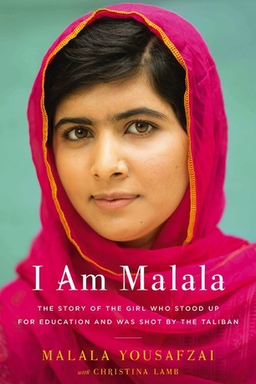
I Am Malala cover

I Am Malala

by Malala Yousafzai

I Am Malala chronicles Malala Yousafzai''s extraordinary journey from a rural Pakistani village to global recognition as a Nobel Laureate. Her courageous stand against the Taliban for girls'' education inspires readers with a story of resilience, hope, and the profound impact of advocacy in changing the world.

The Courage to Speak: One Girl’s Voice Against Fear

Have you ever wondered what it takes to speak the truth when the entire world tells you to stay silent? In I Am Malala, Malala Yousafzai, with journalist Christina Lamb, answers that question through the journey of a young girl from Pakistan’s Swat Valley who stood up for her right to education—and nearly paid the ultimate price. Her story invites you to explore the tension between fear and courage, oppression and freedom, ignorance and enlightenment.

Malala argues that the struggle for education, especially for girls, is not simply a regional issue—it is a global moral imperative. Education, she contends, is the most effective weapon against extremism and one that every child, regardless of gender or geography, deserves. Her memoir is both deeply personal and sharply political, using her own life to expose how the Taliban’s rise in Pakistan was both a product of and a response to widespread inequality, poor governance, and misplaced priorities in a young nation’s identity.

A Childhood in a Valley of Beauty and Conflict

Malala was born in 1997 in Mingora, Swat Valley—a region often called the “Switzerland of the East” for its breathtaking beauty. But behind that landscape of waterfalls and orchards was a population struggling with poverty, tribal hierarchies, and political neglect. Her parents, especially her father, Ziauddin Yousafzai, defied centuries of Pashtun custom by celebrating her birth rather than mourning the arrival of yet another girl. Her father, an educator and activist, would become her greatest mentor, teaching her that words have the power to change the world.

In the early chapters, we see how her family’s small private school symbolized hope in a society where girls’ education was viewed with suspicion. Ziauddin’s belief that “Malala will be free as a bird” set the stage for her defiance of norms that told her to stay quiet, hidden, or obedient. It’s a universal reflection: every generation faces its own Taliban—forces that seek to control through fear—and every act of learning becomes a revolutionary gesture.

Faith, Family, and Fear

Malala’s narrative constantly interweaves her strong Muslim faith with her rejection of the Taliban’s distorted version of Islam. She reminds readers that the Quran encourages both men and women to seek knowledge and that real Islam celebrates learning, compassion, and justice. This combination of faith and inquiry made her an unlikely but unstoppable activist. Her interactions with friends, her love of school competitions, and her rivalry with classmates remind you that her story is not about politics alone—it’s about a normal girl who wanted to learn chemistry and English without fear of being attacked.

Her mother, Toor Pekai, grounds the story in everyday piety and hospitality, illustrating how women hold families and communities together even in patriarchal cultures. Family becomes an anchor amid instability, and this theme parallels stories in other human rights memoirs such as The Diary of Anne Frank or Long Walk to Freedom, where personal bonds give resilience to public bravery.

The Rise of Darkness and the Price of Courage

Malala’s idyllic valley darkened with the rise of Maulana Fazlullah, known as “Radio Mullah,” whose nightly broadcasts blended religious zeal with populist anger. Through mass communication and fear, the Taliban replaced reasoned debate with intimidation, shutting down girls’ schools and executing those who resisted. By contrasting classroom activities—learning poetry or painting—with the gunfire and curfews outside, Malala exposes what it feels like when education itself becomes a crime.

Her defiance culminated in tragedy on October 9, 2012, when a masked gunman boarded her school bus and shot her for “promoting Western values.” But her near-death experience transformed her case into a global movement. As she recovered in Birmingham, England, her fight turned from personal survival to universal advocacy. “They thought the bullet would silence me,” she writes, “but they failed. Out of that silence came thousands of voices.”

Why Her Story Matters to You

At its heart, I Am Malala is about what happens when education becomes not just a privilege but an act of resistance. Her story challenges you to ask: What would you risk to defend knowledge, truth, or equality? In a world where freedom of expression can still cost lives—from journalists in Russia to activists in Iran—Malala’s courage is both an inspiration and a mirror showing the dangers of silence. Her memoir invites you to see education not as schooling alone but as the freedom to think, question, and create a just society.

Key Message

Education is not just about reading and writing—it’s about dignity, power, and the courage to claim one’s voice. Malala’s story reminds us that when one girl stands up, millions rise behind her.


Roots of Rebellion: A Family and Its Valley

Before Malala became a global symbol, she was a girl of the Swat Valley, shaped by the beauty of mountains and the limitations of poverty. Her childhood is as much a story of her father’s ideals as her own awakening. Understanding those roots helps you see why resistance came as naturally to her as breathing.

A Family That Defied Tradition

Malala’s father, Ziauddin, was born with a stammer yet became one of Pakistan’s most passionate speakers for education. Coming from a modest background, he founded the Khushal School to challenge feudal hierarchies and patriarchal taboos. In Pashtun culture, sons were prized and daughters often hidden, but he drew a line from his own name to Malala’s on the family tree, symbolically giving her equal status. His unwavering belief—that words could outgun weapons—became Malala’s moral DNA.

Her mother, Toor Pekai, embodied the quiet strength of countless women whose stories go unheard. Though she left school early, she supported her husband’s radical idea of running a coeducational school and teaching girls. Their marriage broke many cultural patterns and modeled the value of partnership over patriarchy.

Swat: Paradise and Paradox

Swat’s history—once a peaceful Buddhist kingdom and later part of Pakistan—mirrors the tension between enlightenment and orthodoxy. Historical ruins of the Buddha coexisted with mosques that later echoed with radical sermons. Malala’s childhood world was filled with both poetry and politics: picnicking among waterfalls and hearing stories of the Pashtun warrior poet Khushal Khan Khattak, who fought for honor yet valued knowledge. This dual heritage of verse and valor defined what it meant to be Pashtun: to defend one’s dignity but also to show hospitality and justice.

By portraying her valley not as a backward tribal area but as a cultured land scarred by neglect, Malala corrects stereotypes often seen in Western media. (In contrast, Greg Mortenson’s Three Cups of Tea presents education in the same region through an outsider’s philanthropic lens, while Malala humanizes it from within.)

Childhood Dreams and Early Activism

Malala’s childhood combined modest joys—drawing, school competitions, and watching Bollywood films—with political awareness nurtured at dinner discussions. She saw her father’s struggles with corrupt officials and learned early how power operates. When a local cleric, the Mufti Ghulamullah, tried to close their school declaring it “haram,” she witnessed firsthand how ignorance dresses itself as piety. Rather than yield, her father debated faith using scripture, affirming that Islam honors education for both genders.

You sense here how the seed of defiance took root: rebellion against injustice begins in ordinary households that choose dignity over fear. As Malala herself later said, “Why should I wait for someone else? Why don’t I raise my voice?”

Lesson

Change often starts not in parliaments or palaces, but in families that teach courage, compassion, and conviction—long before the world begins to listen.


When Faith Meets Fear: The Taliban’s Shadow

To understand Malala’s courage, you first need to witness the fear she and her community endured. The rise of the Taliban in Swat wasn’t a sudden invasion from outside—it was the result of despair, religious manipulation, and a vacuum of justice. Malala’s account offers an intimate look at how extremism grows like a dark cloud from seeds of neglect.

Radio Mullah’s Propaganda

Maulana Fazlullah’s mastery of radio transformed faith into fear. From his nightly broadcast, the so‑called “Radio Mullah” told listeners to burn their TVs, stop educating girls, and surrender to “purity.” Like George Orwell’s Big Brother in 1984, his voice invaded homes and imagination alike. In a region where many were illiterate, the spoken word carried godlike power. Step by step, entertainment turned into sermons; sermons turned into decrees; decrees turned into executions.

Malala writes of neighbors who once laughed together now reporting each other for minor infractions. Fear reshaped daily life: women stopped going to markets, music disappeared, and even laughter felt dangerous. Her father’s school received letters calling it an “infidel institution.” At the same time, Fazlullah won popularity by providing swift—but brutal—justice where the government had failed to deliver any. That’s the paradox: when people lose faith in lawful systems, they often embrace lawlessness disguised as order.

Violence and Silence

One of Malala’s most haunting recollections is of Banr Bazaar dancer Shabana, murdered publicly as “punishment” for immorality. Her death marked the turning point when silence became complicity. Malala observed how neighbors whispered approval out of fear, repeating that “she deserved it.” Terror breeds moral numbness—it teaches people to justify cruelty for survival.

The Taliban’s war on art and knowledge was, in essence, a war on imagination. Statues of the ancient Buddha were dynamited, as if destroying history could erase all memory of tolerance. Malala connects these acts to a wider pattern: whether in the book burnings of Nazi Germany or the cultural erasures by ISIS decades later, authoritarian power thrives on the destruction of stories.

A Voice Over the Airwaves

When the Taliban banned girls’ education in 2009, the BBC offered a lifeline: anonymous blogging. Under the pseudonym “Gul Makai,” Malala began writing her diary, describing the daily dread of walking to school with her books hidden under her shawl. Her words reached the world, proving that a voice from a remote valley could echo globally. But those same words made her a target.

Insight

Fear spreads quickly when justice disappears. Yet so does hope—if even one person dares to speak.


The Day the World Stopped: Malala’s Shooting

October 9, 2012, changed global perceptions forever. Malala’s attempted assassination turned her from a local activist into a symbol of resistance. But beyond headlines, this scene reveals profound lessons about fragility, faith, and forgiveness.

A Morning Like Any Other

The day began with exams, friendly teasing, and rickshaws clogging Mingora’s narrow lanes. Malala describes her familiar five-minute school bus ride, the smell of diesel mixed with the sound of girls laughing—a normal day masking extraordinary danger. Then came the gunman’s shouted question: “Who is Malala?” Silence. A pointed finger. Three bullets. One would pass through her head, defying all odds to miss her brain.

At that instant, a fifteen-year-old girl’s love of books threatened an ideology’s entire foundation. The Taliban saw her not as a child but as a revolutionary, because education erodes obedience. (Historian Yuval Noah Harari later echoed this idea in Sapiens: that ideas, not armies, rule civilizations.)

Faith and Medical Miracles

Her survival was no less astonishing than the attack. Pakistani doctors performed emergency surgery, removing part of her skull to relieve swelling, while the army arranged evacuation to Britain. She drifted between life and death for days. When she woke in Birmingham and asked, “Who will pay for this? My father has no money,” her confusion reflected not fear but humility. Even in crisis, her concern was for her family’s dignity.

The global reaction—from President Obama’s condemnation to global school strikes—proved that her message had transcended geography. Yet at home, responses were divided: admiration mixed with conspiracy, nationalism with jealousy. This duality mirrors Pakistan’s identity crisis itself—torn between progress and paranoia.

Forgiveness Over Fury

What sets Malala apart is not merely her endurance but her refusal to hate. Speaking later at the UN, she said, “I don’t even hate the Talib who shot me. I want education for the sons and daughters of the Taliban.” Her forgiveness is not passive virtue; it is political resistance. In a world addicted to vengeance, it’s a reminder that empathy destabilizes violence more profoundly than any weapon could.

Reflection

When violence tries to silence you, responding with compassion isn't weakness; it's the most radical act of strength.


A New Life, A Global Mission

Survival brought Malala into an entirely new world. Birmingham, England—rainy, safe, and anonymous—was the opposite of her valley. But her recovery also signaled the rebirth of her activism. In this phase, she transforms from student to stateswoman, learning that fame is not freedom but responsibility.

Healing the Body and the Voice

For months, Malala endured reconstructive surgeries and speech therapy. She named her teddy bear “Lilly,” found joy in simple things like “cheesy Wotsits,” and devoured books like The Wizard of Oz. As she regained her smile, she began again to speak about education—first privately to nurses, then publicly to world leaders. Her recovery room became a microcosm of global empathy: gifts from children, shawls from Benazir Bhutto’s family, and letters from Beyoncé and Angelina Jolie.

From Patient to Advocate

With maturity far beyond her years, she used her newfound fame to found the Malala Fund, supporting education projects in Nigeria, Syria, and Pakistan. Her UN speech on her sixteenth birthday redefined her image: no longer “the girl who was shot,” but “the girl who fought for education.” She declared, “One child, one teacher, one book, one pen can change the world.” The speech connected her struggle to global movements—from racial justice to gender equality—through the common language of learning.

Living in exile also forced her to assess privilege and guilt. Birmingham offered safety, but she missed her mountains, her mother’s tea, and her friends in Mingora. Her story shows that activism has costs: displacement, misunderstanding, and loneliness. Yet she found purpose in believing her suffering wasn’t wasted—it was transformed into advocacy.

Courage as a Collective Inheritance

Malala’s later reflections remind you that bravery is contagious. Her story inspired young girls from Kenya to Colombia to demand schools. Her recognition—from the UN to the Nobel Peace Prize nomination—turns personal trauma into public empowerment. As with Anne Frank, who wrote despite Nazi persecution, and Greta Thunberg, who speaks despite political scorn, Malala proves that youth movements can change the arc of history.

Takeaway

Education is not only about classrooms—it’s about equipping generations to challenge injustice with knowledge, empathy, and a fearless voice.

Dig Deeper

Get personalized prompts to apply these lessons to your life and deepen your understanding.

Go Deeper

Get the Full Experience

Download Insight Books for AI-powered reflections, quizzes, and more.