
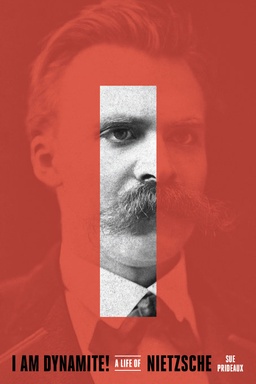
I Am Dynamite! cover

I Am Dynamite!

by Sue Prideaux

Dive into the explosive life of Friedrich Nietzsche, the philosopher who transformed Western thought. Despite his groundbreaking ideas, Nietzsche faced personal and professional struggles, descending into madness before his concepts gained recognition. This compelling biography unveils the complexities of his life and lasting impact on philosophy.

Nietzsche’s Journey from Discipline to Dionysus

How does a disciplined philologist become the philosopher of the will to power, the prophet who declares God dead? This is the central arc of Nietzsche’s life and thought as traced through these pages. Nietzsche begins within the rigorous classical world of Pforta and Humboldtian education, passes through the emotional and aesthetic laboratories of Tribschen and Bayreuth under Wagner’s spell, and ends in the solitary lightning of Sils‑Maria and Turin. Along the way, health turns into method, friendship becomes philosophy, and breakdown yields myth. The book’s story is at once philosophical evolution, cultural diagnosis, and psychological odyssey.

Early Formation: Pforta and Discipline

At Schulpforta, Nietzsche’s education under Prussian discipline forged the tools of classical philology. Humboldt’s ideas of Bildung (self‑cultivation) and Wissenschaft (rigorous study) shaped him into a scholar who could dissect Greek tragedy with the precision of a surgeon. Yet the same structure that taught him method taught him rebellion. He absorbed Greek ideals deeply but also saw how academic philology could suffocate life—an ambivalence that would mark his later style and urge toward freer thinking.

Encounter with Wagner: Art as Revelation

Meeting Wagner in Leipzig and spending summers at Tribschen transformed Nietzsche’s devotion to form into a passion for art’s metaphysical intensity. Wagner’s home was a living Gesamtkunstwerk—music, décor, myth, and personality fusing into an aesthetic religion. For young Nietzsche, this was proof that art could redeem culture. His Birth of Tragedy crystallized those revelations into theory: the fusion of Apollonian form and Dionysian ecstasy as the pulse of life. But dependence on Wagner’s charisma also planted the seed for eventual revolt when Bayreuth turned those ecstatic ideals into a national spectacle.

Bayreuth and the Cracks of Disillusionment

The Bayreuth festival promised a new Greek age and delivered disorderly ticket sales, populist nationalism, and theatrical excess. Nietzsche, once Wagner’s disciple, now saw art corrupted by power. The crowds came for fashion, not tragedy. Wagner’s Parsifal—a Christian drama of pity—offended Nietzsche’s newly forming creed of life‑affirmation. The disenchanted admirer became the critic, culminating in Human, All Too Human, where he broke with metaphysics and turned toward Enlightenment skepticism, Voltairean wit, and psychological analysis of faith and morality.

Illness, Form, and the Aphoristic Turn

Illness reshaped Nietzsche’s style as pain dictated brevity. Unable to read for long or bear bright light, he wrote in aphorisms—flashes of thought capturing entire systems in a sentence. 'Poison Cottage' became both prison and forge. What disability removed in scholarly endurance, it restored in density and rhythm. The constraint became freedom; aphorism replaced argument. The fragments soon felt prophetic, forming the seeds of works that would redefine philosophical writing itself.

Beyond Wagner: From Rationalism to Prophecy

Liberated from Wagner, Nietzsche declared the death of God in The Gay Science—a modern parable about moral emptiness after faith. This was not atheism’s triumph but a warning: the moral scaffolds remain though their foundations are gone. From that diagnosis came his next step—creating value anew. At Sils‑Maria he conceived two key notions: the eternal recurrence as the test of affirmation and the figure of Zarathustra as the bearer of post‑Christian wisdom. Philosophy turned poetic; the thinker became prophet.

Zarathustra and the Affirmation of Life

In Thus Spoke Zarathustra, Nietzsche merged poetry, myth, and psychology. Zarathustra descends from his mountain to teach not dogma but transformation: that the Übermensch is one who says 'yes' to life, willing even its eternal repetition. Each parable—the tightrope walker, the dancing star, the animals—conveys moral metamorphosis through imagery rather than logic. This mode reflects Nietzsche’s attempt to write a 'fifth gospel' for a godless age: scripture without theology, ethics without resentment.

Love, Solitude, and the Triadic Experiment

The triangle with Lou Salomé and Paul Rée dramatized Nietzsche’s yearning for intellectual companionship and exposed the fragility of his idealism. He envisioned a 'holy trinity' of free spirits replacing marriage’s conventions. What began as an experiment in philosophical intimacy collapsed into jealousy, gossip, and personal crisis. Yet the emotional burn deepened his understanding of Eros, solitude, and creative suffering—motifs that course through Zarathustra and later aphorisms.

Genealogy and the Psychology of Morals

In On the Genealogy of Morality, Nietzsche reinvented moral philosophy as archaeology of power. He traced how the strong once called their acts 'good' and how the weak rebranded submission as virtue. His term ressentiment named the emotional economy behind this reversal: envy transmuted into righteousness. By exposing Christianity and modern morality as historical outcomes rather than eternal truths, Nietzsche demanded that culture recognize the will to power operating beneath sanctity.

Collapse and Aftermath

The final act—Nietzsche’s collapse in Turin—shifts the narrative from intellectual to tragic. His mind broke under chronic illness and isolation. The famous episode with the beaten horse symbolized the convergence of compassion and agony central to his philosophy. After 1889, silence replaced speech. His sister Elisabeth curated his image, transforming him into ideology. The archive she built turned a thinker of freedom into a banner for movements he despised, forcing future readers to recover Nietzsche from Nietzsche’s myth.

Through discipline and rebellion, illness and ecstasy, Nietzsche turned philosophy into a personal art of transformation. What begins at Pforta’s Latin desk ends at Sils‑Maria’s rock. The lesson for you is not worship but imitation: to pursue thought as creation, to test your values as he did his, and to affirm life even when its light sears your eyes.


Discipline, Bildung, and the Greek Ideal

Nietzsche’s foundations lie in a culture that worshiped the Greeks as the model of human flourishing. At Pforta, he internalized Humboldt’s doctrine that education (Bildung) should form character, not just transmit facts. Daily routines began before dawn; lessons carved intellectual muscle. You can see how this regimen gave him stamina and precision that later turned against the very system that created him. His training in textual analysis under Ritschl and others made possible the elegant cruelty of his future polemics.

From Greek Grammar to Cultural Critique

Pforta’s classical curriculum did more than drill Latin verbs—it provided Nietzsche a lens on culture. The Greeks taught him that art and life are inseparable; every ritual expresses metaphysical insight. When he later diagnosed Europe as philistine, he was comparing it to Athens. This philological saturation also prepared the Apollonian–Dionysian categories: rational Apollonian control contrasted with ecstatic Dionysian dissolution. From classroom to tragedy, Nietzsche learned to read culture as text.

The Paradox of Bildung

Humboldt’s humanism aimed at unity of knowledge and personality, yet produced professional specialists. Nietzsche absorbed its rigor but soon rebelled against its compartmentalization. He saw that when learning ceases to serve life, it degenerates into pedantry. This insight, formed in adolescence, propels all his later educational polemics—culminating in his lectures On the Future of Our Educational Institutions. The same school that molded him also furnished the tools to dismantle it.

(Note: This paradox mirrors Nietzsche’s larger project—using inherited structures of reason to expose reason’s own limits.)


The Wagner Effect and its Undoing

Richard Wagner’s magnetism offered young Nietzsche a living demonstration that art could be religion. At Tribschen, art became life itself: candlelit performances, perfumes, mythic staging. Nietzsche believed he had witnessed the rebirth of tragedy. Wagner’s praises of Schopenhauer bound metaphysics to music, persuading Nietzsche that beauty could transcend reasoning. The emotional energy of that discipleship pulses through The Birth of Tragedy where Apollo and Dionysus symbolize the eternal rhythm between order and rapture.

From Vision to Disillusion

As Wagner’s ambitions turned institutional at Bayreuth, Nietzsche saw myth becoming machinery. Rehearsal chaos, financial vanity, and Wagner’s nationalism alienated the philosopher who once sought salvation through art. His essay Richard Wagner in Bayreuth masks grief with tribute but already cools in tone. The final break came with Parsifal—a Christian sermon Nietzsche deemed life‑denying. The mentor became symbol of regression; Nietzsche answered with fierce autonomy and the Enlightenment heat of Human, All Too Human.

Key Transition

The rupture with Wagner mirrors Nietzsche’s transition from romantic metaphysics to radical secular humanism. Friendship catalyzes philosophy: love turns critique inward and produces new form.

(Parenthetical note: Many thinkers—Freud, Jung, even Heidegger—will replay this pattern of early devotion to a master followed by critical emancipation.)


Illness as Method and the Aphoristic Voice

Chronic pain forced Nietzsche to invent a new form of thinking. Eye disease, migraines, and digestive torment rendered sustained study impossible, yet his will to write intensified. Confined to dim rooms he dubbed 'Poison Cottage,' he condensed pages into parcels of lightning. The aphorism—brief, charged, self‑sufficient—became both survival tactic and philosophy of form. Each note had to contain the entire pulse of conviction before pain returned.

Constraint as Liberation

Physical limitation made him abandon exhaustive argument for suggestive force. He began dictating to friends like Köselitz and experimenting with typewriters such as the Malling‑Hansen ball. The aphoristic style fit his conviction that truth must be danced rather than demonstrated. Brevity became intensity; illness turned into eloquence. The rhythm of attack and relief shaped collections such as Beyond Good and Evil and The Gay Science.

The Body Thinks

Nietzsche often wrote that philosophy must learn to listen to the body. His own suffering enacted that dictum. Each spasm taught him that thought is corporeal: exhaustion filters ideas. In the microbursts of pain, concepts become crystalline. The aphorism speaks the language of nerves. You can feel in its snap the pressure of health lost but meaning recovered.

Transformative Lesson

Nietzsche’s brevity is not stylistic whim—it is philosophical necessity. By turning illness into method, he makes fragility a source of strength, modeling how limits can anchor creativity.


From Enlightenment to the Death of God

With Human, All Too Human Nietzsche exchanged metaphysics for analysis. He becomes a surgeon of beliefs, roasting romantic illusions in rational fire. Voltaire replaces Schopenhauer; wit replaces awe. He calls his audience 'free spirits'—those unafraid to question the genealogy of their morals. Yet Enlightenment reason alone still frightens him: science that replaces theology with new dogma. His aphorisms dissect not to destroy but to clear ground for health.

God’s Death and Modern Nihilism

The parable of the madman in The Gay Science is Nietzsche’s alarm bell. The crowd has killed God but does not grasp the act. Without divine foundation, moral systems flicker as relics. You are left in a twilight where values haunt like ghosts. Nietzsche insists this moment demands creators—individuals bold enough to forge new meaning without metaphysical sanction. He calls this the greatest of dangers and opportunities.

Implication for the Reader

If you reject old gods, you must become your own legislator. The absence of heaven is not void but frontier.

(Note: Nietzsche’s 'death of God' anticipates existentialism’s later question—how to live authentically in a disenchanted world.)


Eternal Recurrence and the Mountain Revelation

At Sils‑Maria, solitude matured into revelation. The thin air, storms, and reflection on the lake distilled Nietzsche’s thought into a single imaginative explosion: eternal recurrence. The idea arrives as a demon’s whisper—what if you had to live this life again, endlessly? Could you affirm it? The thought is less cosmology than litmus test for joy. Accepting recurrence means saying yes to existence without remainder.

Birth of Zarathustra

From this alpine crucible rose Zarathustra, Nietzsche’s invented prophet. He fuses Eastern sage and Greco‑modern self‑creator. Composed across Rapallo and Sils, the book reads like song more than system—filled with riddles and imagery. Through Zarathustra, Nietzsche dramatizes the step beyond nihilism: creation of values by embracing one’s finitude as eternal.

Suffering and Affirmation

Illness and insight arrive together. Each attack sharpens conviction that pain is part of vitality. Thus the 'yes‑sayer' emerges: the one who can regard the world’s horror as necessary to its beauty. For Nietzsche, philosophy becomes physiological courage—saying yes even to return eternal storms.

Symbolic Value

Sils‑Maria is more than geography: it is mental altitude, showing that creation requires seclusion, extremity, and risk. The mountain replaces the temple; the thinker becomes his own priest.


Love, Loneliness, and the Lou Salomé Catalyst

Lou Salomé enters Nietzsche’s story as muse and mirror. Alongside Paul Rée, she embodied the intellectual independence Nietzsche longed to see in others. Their plan for a 'holy trinity' of free spirits—living, writing, and thinking together outside convention—was an audacious social experiment. But emotion and expectation quickly warped philosophy into drama. Lou denied Nietzsche’s marriage proposal, sparking humiliation and estrangement that echoed through his later depictions of love and gender.

Intellectual Passion and Wound

What Nietzsche sought from Lou was not possession but resonance—a companion for his life‑philosophy. When the experiment disintegrated amid gossip and his sister Elisabeth’s interference, Nietzsche’s solitude hardened into vocation. Letters vacillated between adoration and fury, reflecting the conflict between Apollonian clarity and Dionysian excess within his own psyche. In losing Lou, he gained Zarathustra’s solitary voice.

Lasting Impact

This interpersonal catastrophe renewed Nietzsche’s meditation on love as creative tension and on loneliness as the price of independence. He realized that genuine philosophy cannot rely on disciples—it must invent its audience anew.

(Parenthetical note: Lou Salomé’s later influence on Freud and Rilke shows how Nietzsche’s emotional life radiated culturally far beyond his works.)


Morality, Power, and the Genealogical Lens

By the late 1880s Nietzsche undertook a grand post‑religious project: to expose moral values as historical outcomes. On the Genealogy of Morality functions like an excavation. He distinguishes 'master' morality—rooted in strength and affirmation—from 'slave' morality, born of weakness and envy. Over centuries, the latter triumphed, redefining virtue as humility and turning power inward as guilt. Nietzsche names this reversal ressentiment, the spiritual revenge of impotence.

Psychology of Values

Rather than judging right and wrong, Nietzsche asks how judging itself arises. Morality, he argues, is a symptom—an interpretation that serves life or resists it. The genealogical method combines psychology and history: uncovering the bodily instincts and social pressures that produced conscience, punishment, and forgiveness. Each moral thrill conceals instincts redirected by culture’s priestly class.

Affirmative Countermove

Nietzsche’s remedy is not cynicism but transvaluation—consciously creating new values that express strength rather than resentment. The ideal type is the reader who transforms inward struggle into productive energy, who replaces blame with creation. Thus will to power is ethical creativity, not domination.

Practical Application

Use Nietzsche’s genealogy as tool: when confronted with a moral claim, ask who benefits from it and what instincts it masks. Doing so continues his unfinished archaeology of values.


Collapse, Myth, and the Archive

On January 3, 1889, Nietzsche’s long tension between strength and fragility snapped in Turin. Witnesses described him embracing a beaten carriage horse before falling into psychosis. The collapse ended his philosophical production but began his legend. Diagnosed by Binswanger and Wille as paralytic dementia (likely tertiary syphilis), his decline illustrates how nineteenth‑century medicine merged pity and spectacle. Overbeck rescued him briefly; his mother nursed him; ultimately his sister Elisabeth seized custody.

The Afterlife of a Philosopher

Elisabeth Förster‑Nietzsche relocated both patient and papers to Weimar, transforming domestic care into public cult. She edited fragments into The Will to Power, reorganizing notes to suit nationalist ideology and her late husband’s anti‑Semitic politics. Villa Silberblick became a shrine attracting intellectuals and demagogues alike—Kessler, Spengler, even Hitler. Nietzsche’s thought, once a plea for spiritual self‑creation, became raw material for authoritarian myth.

Cautionary Message

Every archive is an interpretation. The Nietzsche Archive shows how control of editing and mythologizing can invert a philosopher’s intent. To read Nietzsche today is to excavate him not only from his time but from his own afterlife.

(Note: Later philological restorations by scholars such as Colli and Montinari would finally disentangle author from myth.)

Dig Deeper

Get personalized prompts to apply these lessons to your life and deepen your understanding.

Go Deeper

Get the Full Experience

Download Insight Books for AI-powered reflections, quizzes, and more.